✓ Live — 20 Articles
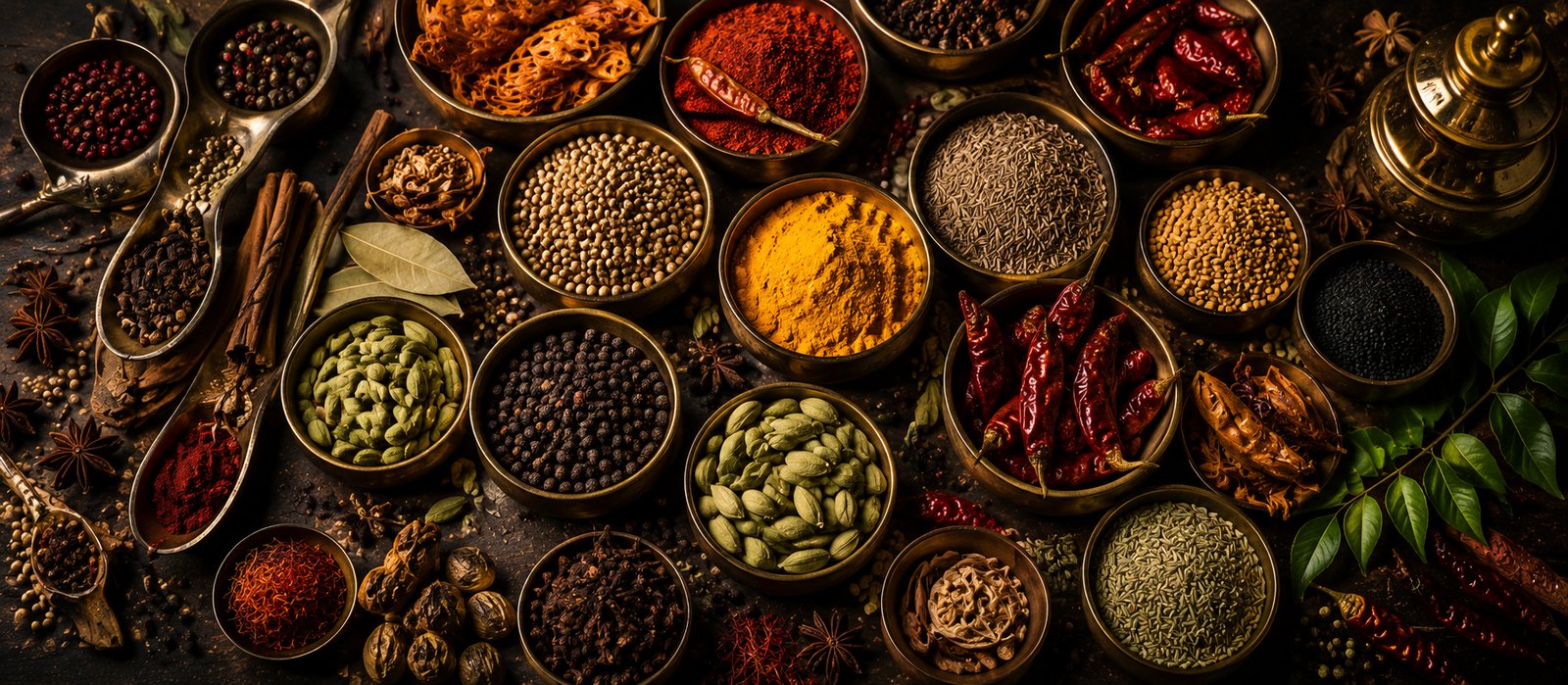
Spices — Whole
Every major whole spice in Indian cooking — cooking science, correct technique, storage, and what it contributes.
Spices
Cumin — Jeera
The backbone of Indian cooking — tadka, ground, and roasted forms
Spices
Coriander Seeds
The gentle workhorse — whole in tadka, ground in masala
Spices
Black Pepper
India's original heat — different from chilli, irreplaceable in South India
Spices
Mustard Seeds
The pop that starts South Indian cooking
Spices
Fenugreek Seeds
The bitter-sweet spice — methi dana in tadka and blends
Spices
Fennel Seeds
Sweet warmth — digestive and essential in Kashmiri garam masala
Spices
Nigella Seeds — Kalonji
The black seed in naan, Bengali tadka, and pickles
Spices
Ajwain — Carom Seeds
The digestive spice with thymol — bread and dal applications
Spices
Green Cardamom
The queen of spices — why it works in both sweet and savoury
Spices
Black Cardamom
The smoky, camphor-like spice of North Indian cooking
Spices
Cloves — Laung
The most potent aromatic — eugenol science
Spices
Cinnamon and Cassia
Bark, quill, and the difference that matters
Spices
Mace and Nutmeg
Two spices from one fruit — different applications
Spices
Star Anise
The licorice note in biryani and Chettinad cooking
Spices
Indian Bay Leaf — Tej Patta
Why Indian bay leaf is different from Mediterranean bay
Spices
Stone Flower — Dagad Phool
The lichen spice that defines Chettinad and Kolhapuri cooking
Spices
Saffron — Kesar
The world's most expensive spice — colour, aroma, and authentication
Spices
Long Pepper — Pippali
The ancient predecessor of black pepper
Spices
Asafoetida — Hing
The smell that becomes savour — the Jain cook's allium substitute
Spices
Curry Leaves — Kadi Patta
The irreplaceable South Indian aromatic — why dried is useless
✓ Live — 8 Articles
Spices — Ground
Turmeric, chilli varieties, amchur, dry ginger, white pepper, and black salt.
Ground Spices
Turmeric — Haldi
Colour, the staining science, and the curcumin evidence
Ground Spices
Kashmiri Chilli
Maximum colour, minimum heat — the biryani and butter chicken spice
Ground Spices
Guntur Chilli
India's hottest — why Andhra food is the spiciest
Ground Spices
Byadgi Chilli
Karnataka's colour spice with moderate heat
Ground Spices
Amchur — Dry Mango Powder
The dry acid solution for stuffings and spice blends
Ground Spices
Dry Ginger — Sonth
Different from fresh ginger — Kashmiri and Ayurvedic applications
Ground Spices
White Pepper
More heat, less aroma than black — specific applications
Ground Spices
Black Salt — Kala Namak
The sulphurous salt of chaat and digestive preparations
✓ Live — 11 Articles
Spice Blends
Garam masala, panch phoron, sambar powder, chaat masala, and 7 more — the logic of Indian spice blending.
Spice Blends
Garam Masala
Why it's a finishing spice and why commercial blends fall short
Spice Blends
Panch Phoron
Bengal's five-spice system — always whole, never ground
Spice Blends
Goda Masala
Maharashtra's fragrant blend with stone flower
Spice Blends
Kala Masala
Vidarbha's dark, intensely flavoured Maharashtrian blend
Spice Blends
Sambar Powder
The foundation of South Indian cooking
Spice Blends
Rasam Powder
Pepper and tomato — the thin soup science
Spice Blends
Biryani Masala
Layered aromatic architecture for the sealed-vessel technique
Spice Blends
Chaat Masala
The science of street food flavour — amchur and black salt
Spice Blends
Pav Bhaji Masala
Mumbai's street food spice blend decoded
Spice Blends
Tandoori Masala
The red marinade — Kashmiri chilli and yogurt science
Spice Blends
Kitchen King Masala
The all-purpose blend and why to make your own instead
✓ Live — 12 Articles
Lentils & Legumes
All 12 common Indian dals — cooking science, ICMR nutrition, and the truth about which dal is actually 'healthiest'.
Lentils
Toor Dal
Most consumed. Silky texture science. Regional forms.
Lentils
Moong Dal
Most digestible. Four forms. Why prescribed for illness.
Lentils
Urad Dal
Makes dosa crispy and dal makhani rich.
Lentils
Chana Dal
Highest protein and fibre. Very low GI.
Lentils
Masoor Dal
15 min, no soaking. High iron.
Lentils
Kabuli Chana
Less protein than desi chana. Why chole is dark.
Lentils
Kala Chana
49% more protein than kabuli.
Lentils
Rajma
American bean. Safety science. Overnight improvement.
Lentils
Moth Beans — Matki
Misal base. Very high iron.
Lentils
Val Dal
Exceptional calcium (249mg).
Lentils
Chawli
Highest folate of all common Indian legumes.
Lentils
Whole Masoor
More fibre than split. Holds shape.
✓ Live — 18 Articles
Grains — Flours and Millets
Atta, maida, besan, sooji, rice flour, and 10 millets — ICMR nutrition and cooking science.
Grains
Atta — Whole Wheat
Roti puffing science, gluten behaviour
Grains
Maida — Refined Wheat
When maida is correct — naan, bhatura, samosa
Grains
Besan — Chickpea Flour
Highest protein. Pakora crispiness. Kadhi science.
Grains
Sooji / Rava — Semolina
Upma and halwa science
Grains
Rice Flour
Starch gelatinisation without gluten
Grains
Jowar Flour
Bhakri technique — hot water and hand-patting
Grains
Bajra Flour
8mg iron. Assertive flavour. Rajasthan's bread flour.
Grains
Ragi Flour
344mg calcium. The honest claim.
Grains
Jowar — Sorghum
Comparable to atta nutritionally. Deccan plateau grain.
Grains
Bajra — Pearl Millet
8mg iron. Arid India survival grain.
Grains
Ragi — Finger Millet
344mg calcium. Mudde and fermented ambali.
Grains
Foxtail Millet
Near-atta protein. Most accessible millet.
Grains
Little Millet
9.3mg iron — highest of all millets.
Grains
Kodo Millet
High fibre. Needs soaking to reduce bitterness.
Grains
Barnyard Millet
15.2mg iron — 3× more than atta.
Grains
Proso Millet
Mildest flavour. Good protein.
Grains
Amaranth — Rajgira
Complete protein. Highest calcium. Genuine exception.
Grains
Millets vs Rice and Wheat
The honest comparison.
✓ Live — 6 Articles
Oils & Fats
Ghee, mustard oil, coconut oil, groundnut oil, sesame oil, vanaspati — smoke points, cooking science, and when to use each.
Oils
Ghee
India's oldest fat. 250°C smoke point. Finishing aroma.
Oils
Mustard Oil
Must be smoked. Antimicrobial in pickle. Bengali fat.
Oils
Coconut Oil
Virgin vs refined. Kerala's essential fat.
Oils
Groundnut Oil
India's most-used. Neutral, versatile, high smoke point.
Oils
Sesame Oil
Two completely different oils — never use dark for cooking.
Oils
Vanaspati
What it is, historical harm, current regulatory status.
✓ Live — 3 Articles
Souring Agents
Tamarind, kokum, and amchur — the three primary acid sources of Indian cooking.
Souring Agents
Tamarind
Heat-stable sourness. South India's essential acid.
Souring Agents
Kokum
Western coast's unique acid. Irreplaceable in sol kadhi.
Souring Agents
Amchur
Dry sourness — the no-liquid acid solution.
✓ Live — 3 Articles
Dairy
Paneer, dahi, and khoya — the three dairy pillars of Indian cooking.
Dairy
Paneer
Why it doesn't melt. How to cook without toughening.
Dairy
Dahi — Yogurt
Why it curdles, how to prevent it, every application.
Dairy
Khoya — Mawa
Reduced milk and the science of Indian sweets.
✓ Live — 4 Articles
Fresh Aromatics
Ginger, garlic, coriander, and mint — the finishing aromatics.
Fresh Aromatics
Fresh Ginger
Raw vs cooked science. Gingerol to shogaol.
Fresh Aromatics
Fresh Garlic
Why it must be cooked through. Stage-by-stage chemistry.
Fresh Aromatics
Fresh Coriander
Finishing herb only. The soap-taste genetics.
Fresh Aromatics
Fresh Mint
Menthol cooling science. When mint vs coriander.