What Does Sambar Powder Taste Like?
Sambar Powder in Every Indian Language
| Language | Name | Pronunciation |
|---|---|---|
| English | Sambar Powder | SUM-bar |
| Hindi | सांभर मसाला | SUM-bar Mah-sah-lah |
| Tamil | சாம்பார் பொடி — Sambar Podi | SUM-bar POH-dee |
| Telugu | సాంబార్ పొడి — Sambar Podi | SUM-bar POH-dee |
| Malayalam | സാമ്പാർ പൊടി — Sambar Podi | SUM-bar POH-dee |
| Kannada | ಸಾಂಬಾರ್ ಪುಡಿ — Sambar Pudi | SUM-bar POO-dee |
| Bengali | সাম্বার মশলা | SUM-bar Moh-sha-lah |
| Gujarati | સાંભળ મસાલો | SUM-bar Mah-sah-lo |
| Marathi | सांभर मसाला | SUM-bar Mah-sah-lah |
What Is Sambar Powder?
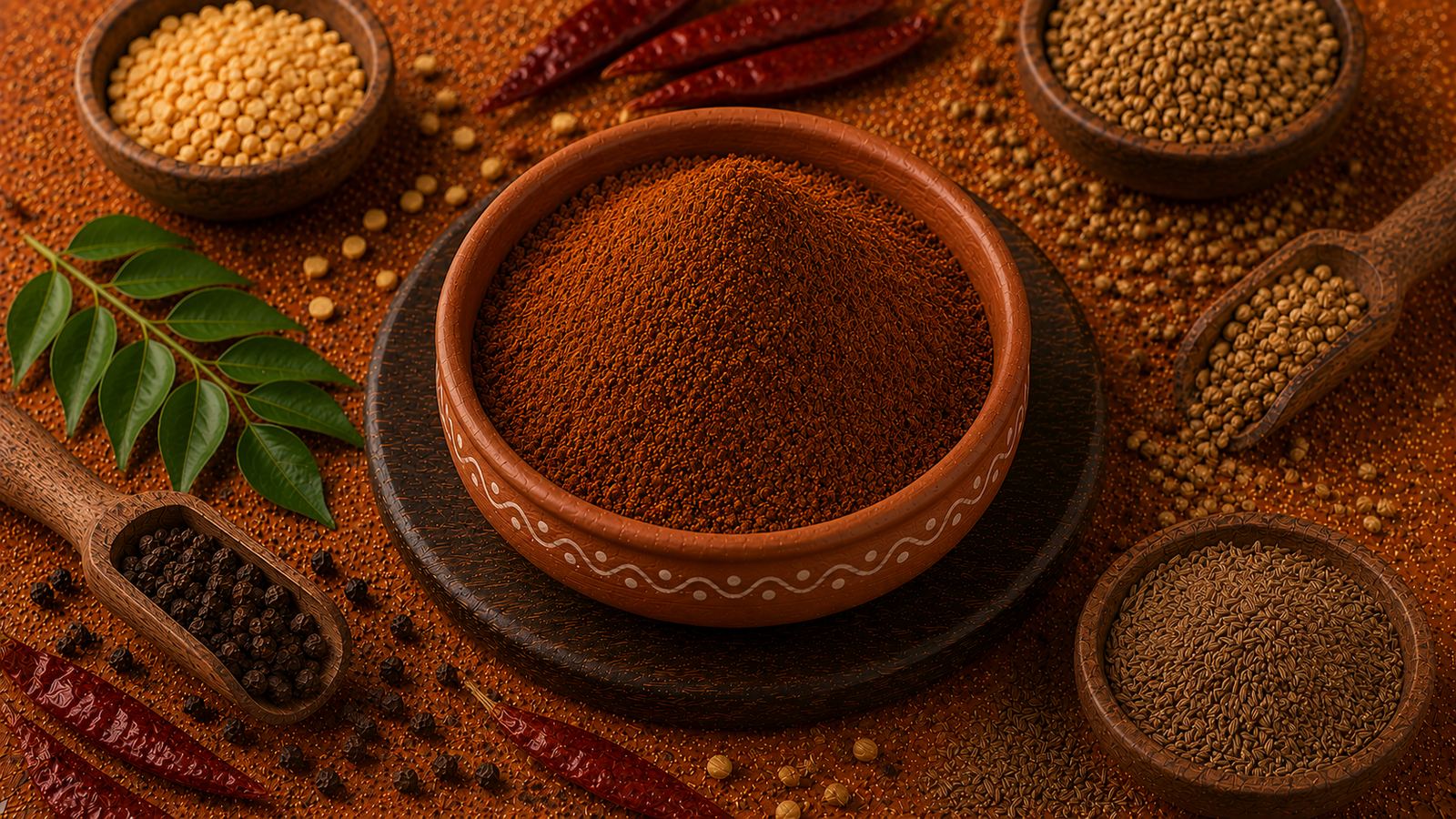
Sambar powder is the ground spice blend used exclusively in sambar — the ubiquitous South Indian lentil-vegetable stew served with idli, dosa, and rice across Tamil Nadu, Karnataka, Kerala, and Andhra Pradesh. It is one of the most ingredient-intensive spice blends in Indian cooking, typically containing 15–20 components, including roasted chana dal and urad dal — lentils included not as nutritional components but as flavour and texture agents.
Sambar powder's composition is deeply personal in South Indian households — recipes are passed down through generations, and the specific balance of coriander to chilli, the degree of roasting, the inclusion or exclusion of curry leaves or coconut, varies meaningfully between families, regions, and states.
- Sambar — consumed daily across South India — cannot be authentic without sambar powder; generic garam masala produces a completely different dish
- The inclusion of roasted lentils in the blend adds body and a characteristic toasted, nutty depth absent from North Indian masalas
- The tamarind in sambar requires a spice blend calibrated for high-acid environments — sambar powder's composition is designed for this
- Without sambar powder, South Indian cooking loses its foundational flavour identity — this single blend underpins millions of daily meals
- The diversity of regional sambar powder recipes (Tamil, Kerala, Andhra, Karnataka) reflects the depth of South Indian spice culture
Sambar Powder Through History
Sambar as a dish likely originated in Tamil Nadu — historical accounts vary, with some attributing its invention to the kitchen of Maratha ruler Shivaji and others to ancient Brahmin cooking traditions. The spice blend that defines it evolved over centuries as part of a sophisticated vegetarian cooking tradition that uses lentils and tamarind as structural elements.
The commercialisation of sambar powder (most famously by the Tamil Nadu government's co-operative brand and by companies like MTR and Aachi) in the 20th century standardised what had been entirely a household preparation. MTR sambar powder, originating from Mavalli Tiffin Rooms in Bengaluru, became one of the first mass-market Indian spice blends of the post-independence era.
The Science of Sambar Powder
How to Store Sambar Powder
How to Buy Good Sambar Powder
How to Use Sambar Powder Correctly
- Add 1–2 tsp to the tamarind water stage of sambar cooking
- Cook the sambar powder in the tamarind water for 5–10 minutes before adding cooked dal
- Not a finishing spice — should be cooked into the preparation
- For quick sambar: dissolve sambar powder in tamarind water, add vegetables and cooked dal, simmer 15 minutes
- Quantity: 1.5–2 tsp per pot of sambar serving 4 people
What Sambar Powder Pairs Well With
Dishes That Use Sambar Powder
Where Sambar Powder Matters Most
| South Indian Cuisine | Essential |
| Tamil Cuisine | Essential |
| Keralan Cuisine | Essential |
| Karnataka Cuisine | Essential |
| Andhra Cuisine | Essential |
| Brahmin Vegetarian | Essential |
| Jain Cooking | Common |
Sambar Powder vs Rasam Powder vs Curry Powder
| Feature | Sambar Powder | Rasam Powder | Curry Powder |
|---|---|---|---|
| Purpose | Sambar — lentil-vegetable stew | Rasam — thin pepper broth | British colonial generic |
| Lentils in blend? | Yes — essential | Sometimes | No |
| Heat level | Medium | High pepper content | Variable |
| Tamarind compatible? | Yes — designed for it | Yes | Partly |
| Authentic? | Yes | Yes | No — British invention |