What Does Kala Chana Taste Like?
Kala Chana in Every Indian Language
| Language | Name | Pronunciation |
|---|---|---|
| English | Black Chickpea | KAH-lah CHAH-nah |
| Hindi | काला चना — Kala Chana | KAH-lah CHAH-nah |
| Bengali | কালা চনা | KAH-lah CHAH-nah |
| Tamil | கொண்டைக்கடலை — Kondakadalai | kon-dah-KAH-dah-lye |
| Telugu | కాళా శెనగలు — Kaala Senagalu | KAH-lah seh-NAH-gah-loo |
| Malayalam | കടല — Kadala | KAH-dah-lah |
| Kannada | ಕಾಳು ಕಡಲೆ — Kaalu Kadale | KAH-loo KAH-dah-leh |
| Gujarati | કાળા ચણા — Kala Chana | KAH-lah CHAH-nah |
| Marathi | काळे हरभरे — Kale Harbhare | KAH-leh HAR-bha-reh |
| Punjabi | ਕਾਲੇ ਛੋਲੇ — Kale Chole | KAH-leh CHO-leh |
| Urdu | کالے چنے | KAH-leh CHAH-neh |
| Sanskrit | कृष्ण चणक — Krishna Chanaka | KRISH-nah CHAH-nah-kah |
What Is Kala Chana?
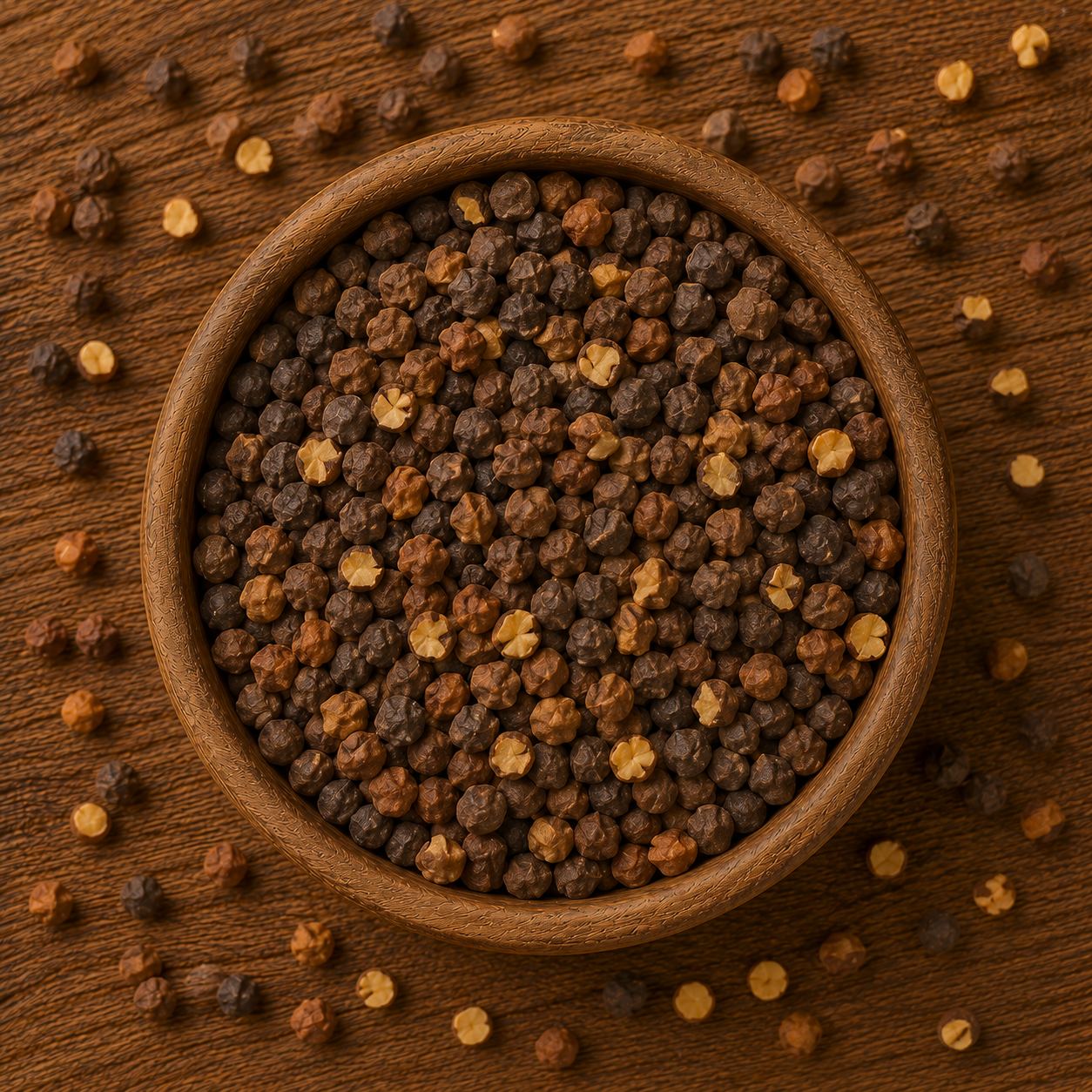
Kala chana — black chickpea — is the desi variety of Cicer arietinum, smaller and darker than the white kabuli chickpea. It is the traditional Indian chickpea, cultivated for thousands of years and consumed as a whole legume in curries, festival preparations, and as sprouted health food.
Kala chana holds enormous cultural significance — it is the primary prasad (food offering) distributed during Navratri and Kanjak/Ashtami ceremonies across North India. Its nutritional density makes it a crucial protein source in North Indian vegetarian diet.
- Navratri Ashtami prasad across North India is always kala chana — one of the most religiously significant foods in Hindu practice
- The desi variety is significantly more nutritious than kabuli — more protein, iron, fibre, lower GI
- Sprouted kala chana is a nutritional tradition for protein and iron
- Without kala chana, North Indian vegetarian cooking loses an important festival and everyday protein source
Kala Chana Through History
Chickpea cultivation dates to at least 3000 BCE — desi variety seeds found at Harappan sites. The desi variety is the ancient form, adapted to dry poor Indian soils. Kabuli (white) variety was introduced later, likely through Central Asian trade routes in the medieval period.
The Science of Kala Chana
How to Store Kala Chana
How to Buy Good Kala Chana
How to Use Kala Chana Correctly
- Soak overnight (8–12 hours) — essential
- Pressure cook: 20–25 minutes after soaking
- Cook until tender — not mushy
- Festival prasad: boil until fully soft, season simply
- For sprouts: soak 8 hours, sprout 24–36 hours
What Kala Chana Pairs Well With
Dishes That Use Kala Chana
Where Kala Chana Matters Most
| North Indian Cuisine | Essential |
| Punjabi Cuisine | Essential |
| Festival Food | Essential |
| Rajasthani Cuisine | Common |
| South Indian Cuisine | Common |
| Jain Cooking | Essential |
| Sattvic Cooking | Essential |
Kala Chana (Desi) vs Kabuli Chana
| Feature | Kala Chana (Desi) | Kabuli Chana (White) |
|---|---|---|
| Size | Small, wrinkled | Large, smooth |
| Colour | Dark brown-black | Cream-white |
| Nutritional density | Higher — more fibre, iron, polyphenols | Moderate |
| Glycemic index | Lower — ~28–35 | Higher — ~33–47 |
| Festival use? | Yes — Navratri primary | Less traditional |
| For hummus? | Less traditional | Yes — standard |