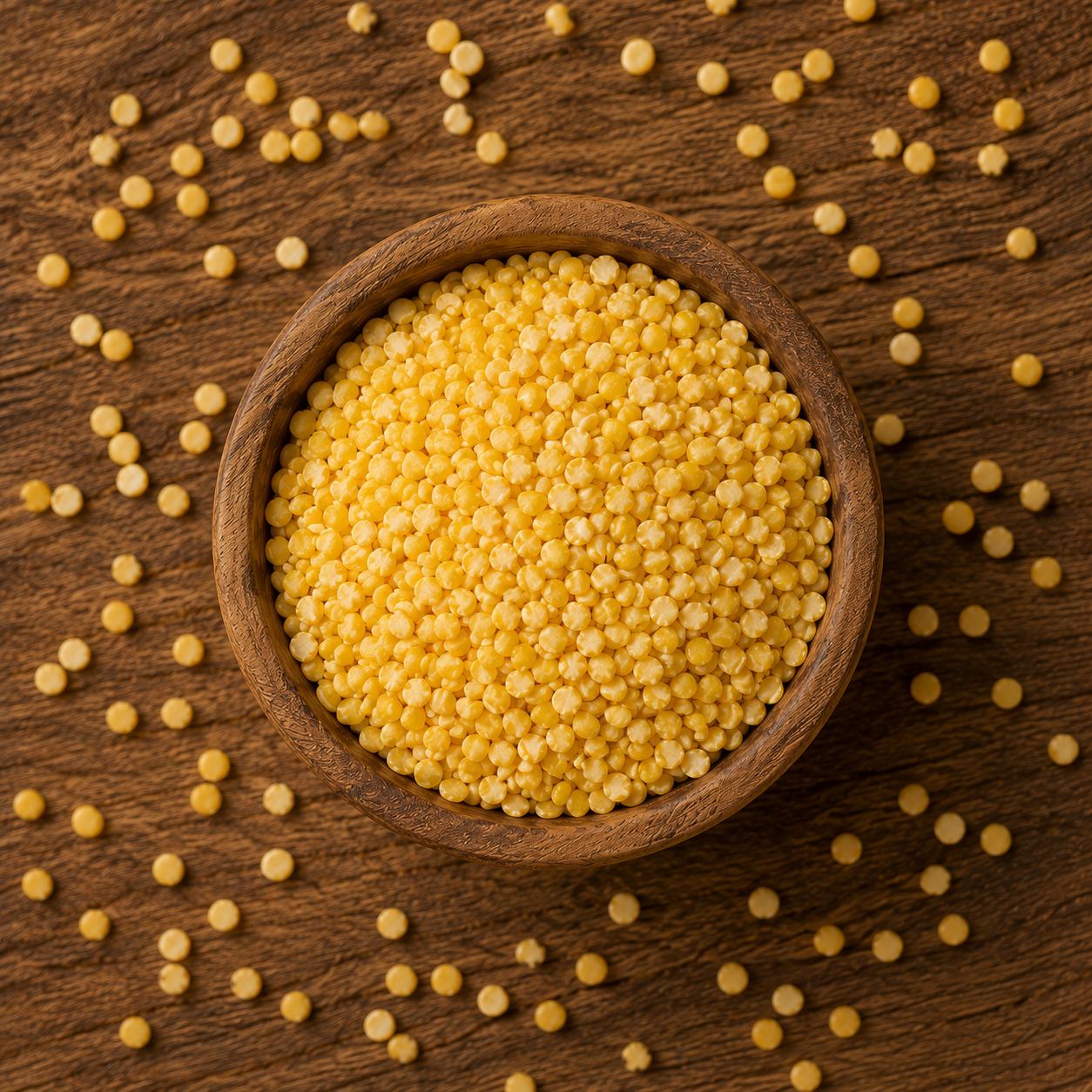
Ingredient identity
Ingredient DNA
Moong Dal — Split Green Gram
Vigna radiata · Family: Fabaceae · Genus: Vigna
Origin
South Asia — ancient
Category
Dal (split)
Form
Small yellow split lentils
Primary Use
Khichdi · Light dal · Dosa batter · Sprouts
Cooking Time
2–3 min (PC) / 20–25 min (boiled)
Protein
~24g per 100g dry
Digestibility
Highest of all Indian lentils
Taste profile
What Does Moong Dal Taste Like?
Flavour Profile — Moong Dal
Mildness★★★★☆
Earthiness★★☆☆☆
Sweetness★★☆☆☆
Creaminess★★★☆☆
Nuttiness★★☆☆☆
Aroma Strength★☆☆☆☆
Botanical classification
Kingdom
Plantae
Family
Fabaceae
Genus
Vigna
Species
Vigna radiata
Hindi Name
Moong Dal
Sanskrit Name
Mudga
English Name
Moong Dal
Arabic Name
Adas Akhdar
Names across India
Moong Dal in Every Indian Language
| Language | Name | Pronunciation |
|---|---|---|
| English | Split Green Gram | MOONG DAL |
| Hindi | मूंग दाल — Moong Dal | MOONG DAL |
| Bengali | মুগ ডাল — Mug Dal | MOOG DAL |
| Tamil | பாசி பருப்பு — Pasi Paruppu | PAH-see PAH-roo-poo |
| Telugu | పెసర పప్పు — Pesara Pappu | peh-SAH-rah PAP-poo |
| Malayalam | ചെറുപയർ — Cherupayar Parippu | cheh-roo-PAH-yar PAH-rip-poo |
| Kannada | ಹೆಸರು ಬೇಳೆ — Hesaru Bele | HEH-sah-roo BEH-leh |
| Gujarati | મગ ની દાળ — Mag Ni Dal | MAG nee DAL |
| Marathi | मूगडाळ — Mugdal | MOOG-dal |
| Punjabi | ਮੂੰਗ ਦਾਲ — Moong Dal | MOONG DAL |
| Urdu | مونگ دال — Moong Dal | MOONG DAL |
| Sanskrit | मुद्ग — Mudga | MOOG-ah |
Origin and identity
What Is Moong Dal?
Moong dal is the split, de-husked mung bean (Vigna radiata). Distinguished from other Indian lentils by its extraordinary digestibility — recommended in Ayurveda for the sick, elderly, and infants. Lowest in flatulence-causing oligosaccharides, highest in digestibility.
The yellow split form cooks in 2–3 minutes in a pressure cooker — the fastest of all Indian lentils. Combined with rice for khichdi, it is India's foundational comfort and recovery food.
What Indian Cooking Loses Without Moong Dal
- Khichdi — India's most fundamental comfort food — uses moong dal for its digestibility
- Moong dal dosa requires its specific soaking and grinding properties
- For young children, moong dal khichdi is typically the first protein source
- The speed of moong dal cooking (2–3 minutes) makes it the most practical everyday lentil
Historical significance
Moong Dal Through History
Historical Record
India's Most Ancient Cultivated Lentil
Mung beans have been cultivated in India for at least 4,500 years — seeds found at Harappan sites. Sanskrit texts identify mudga as one of the most beneficial Ayurvedic foods for its digestibility and tridosha balance.
Cooking science
The Science of Moong Dal
Cooking Science
Why Moong Dal Is More Digestible
Moong dal has approximately 40–50% lower levels of gas-producing oligosaccharides (raffinose, stachyose) than chickpeas or kidney beans. Soaking and sprouting further reduces oligosaccharide content through enzymatic breakdown. This is the scientific basis of the ancient Ayurvedic recommendation — moong dal genuinely is more digestible.
Storage science
How to Store Moong Dal
Storage Reference
Dried
12–24 months
Cooked
3–4 days
Note
Store in airtight container away from heat and light
Buying guide
How to Buy Good Moong Dal
Technique
How to Use Moong Dal Correctly
Using Moong Dal in the Kitchen
Technique, quantity, and what to avoid
- No soaking required for split yellow moong
- Pressure cook: 2–3 minutes
- Khichdi: 1:1 ratio with rice, cook with 5–6 parts water until very soft
- For dosa batter: soak 4 hours, grind with rice
- 1/2 cup dry per 2 servings
Pairings
What Moong Dal Pairs Well With
Best Pairings — Moong Dal
Famous dishes
Dishes That Use Moong Dal
Key Dishes Using Moong Dal
Khichdi
All India · Rice-lentil comfort food
Standard base lentil
Moong Dal Tadka
All India · Yellow lentil
Light everyday dal
Moong Dal Dosa
South India · Crepe
Batter ingredient
Moong Dal Halwa
North India · Sweet
Primary ingredient
Pongal
South India · Rice-lentil porridge
Base lentil
Moong Soup
All India · Medicinal soup
Primary ingredient
Regional use
Where Moong Dal Matters Most
Regional Importance
★★★★★
All India
Universal — khichdi and everyday dal
★★★★★
South India
Pongal and moong dosa
★★★★★
North India
Moong dal tadka and halwa
★★★★★
Gujarat
Sprouted preparations
★★★★★
Bengal
Bhaja moong (roasted) and dal
Where Moong Dal Fits in Indian Cooking
| All Indian Cuisines | Essential |
| Ayurvedic Cooking | Essential |
| Jain Cooking | Essential |
| Sattvic Cooking | Essential |
| Baby Food | Essential |
Comparison
Yellow Moong Dal vs Whole Green Mung vs Toor Dal
Yellow Moong Dal vs Whole Green Mung vs Toor Dal
| Feature | Yellow Moong Dal | Whole Green Mung | Toor Dal |
|---|---|---|---|
| Form | Split, skin removed | Whole seed, skin on | Split, skin removed |
| Colour | Yellow | Green | Yellow |
| Digestibility | Highest | High | Moderate |
| Cooking time (PC) | 2–3 min | 8–10 min | 4–5 min |
| For khichdi? | Standard | Can be used | Less traditional |
| For sambhar? | Not traditional | No | Yes — standard |
Nutrition
Nutrition and Key Compounds
Moong Dal — Honest Nutritional Picture
Culinary quantities — aromatic and flavour contribution, not macro nutrition
~24g protein, 59g carbohydrate, 16g fibre per 100g. Exceptionally high in folate, iron, B vitamins. High folate important in pregnancy.
Substitutions
Substitutes for Moong Dal
What Works and What Does Not
Good substitute
Toor dal
Slightly earthier, works in most preparations.
Good substitute
Masoor dal
Cooks similarly fast, slightly earthier.
No substitute
For moong dal halwa
The frying properties in ghee are unique to moong.
People Also Search
Related Articles
Chef's notes
Practical Insight
From the Kitchen
For restorative khichdi, cook moong and rice together in 1:1 ratio with 5–6 parts water until it reaches porridge consistency. Season with ghee, cumin, turmeric, asafoetida. This is exactly what Ayurveda prescribes for digestive recovery.