★★★★☆ South India
★★★☆☆ North India
What Does Black Pepper Taste Like?
Black Pepper in Every Indian Language
| Language | Name | Pronunciation |
|---|---|---|
| English | Black Pepper | BLAK PEP-er |
| Hindi | काली मिर्च — Kali Mirch | KAH-lee MIRCH |
| Bengali | গোলমরিচ — Golmorich | Gol-MOH-rich |
| Tamil | மிளகு — Milagu | MIH-lah-goo |
| Telugu | మిరియాలు — Miriyalu | MIH-ree-yah-loo |
| Malayalam | കുരുമുളക് — Kurumulaku | Koo-roo-moo-LAH-koo |
| Kannada | ಕಾಳು ಮೆಣಸು — Kaalu Menasu | KAH-loo MEH-nah-soo |
| Gujarati | કાળા મરી — Kala Mari | KAH-lah MAH-ree |
| Marathi | काळी मिरी — Kali Miri | KAH-lee MEE-ree |
| Punjabi | ਕਾਲੀ ਮਿਰਚ — Kali Mirch | KAH-lee MIRCH |
| Urdu | کالی مرچ — Kali Mirch | KAH-lee MIRCH |
| Sanskrit | मरीच — Marica | MAH-ree-chah |
What Is Black Pepper?
Black pepper — kali mirch — is India's original heat spice and one of the most economically important spices in world history. Native to the Western Ghats of Kerala, it funded ancient trade between India and Rome, drove the European Age of Exploration, and defined the flavour of Indian cooking for thousands of years before chilli arrived from the Americas in the 16th century.
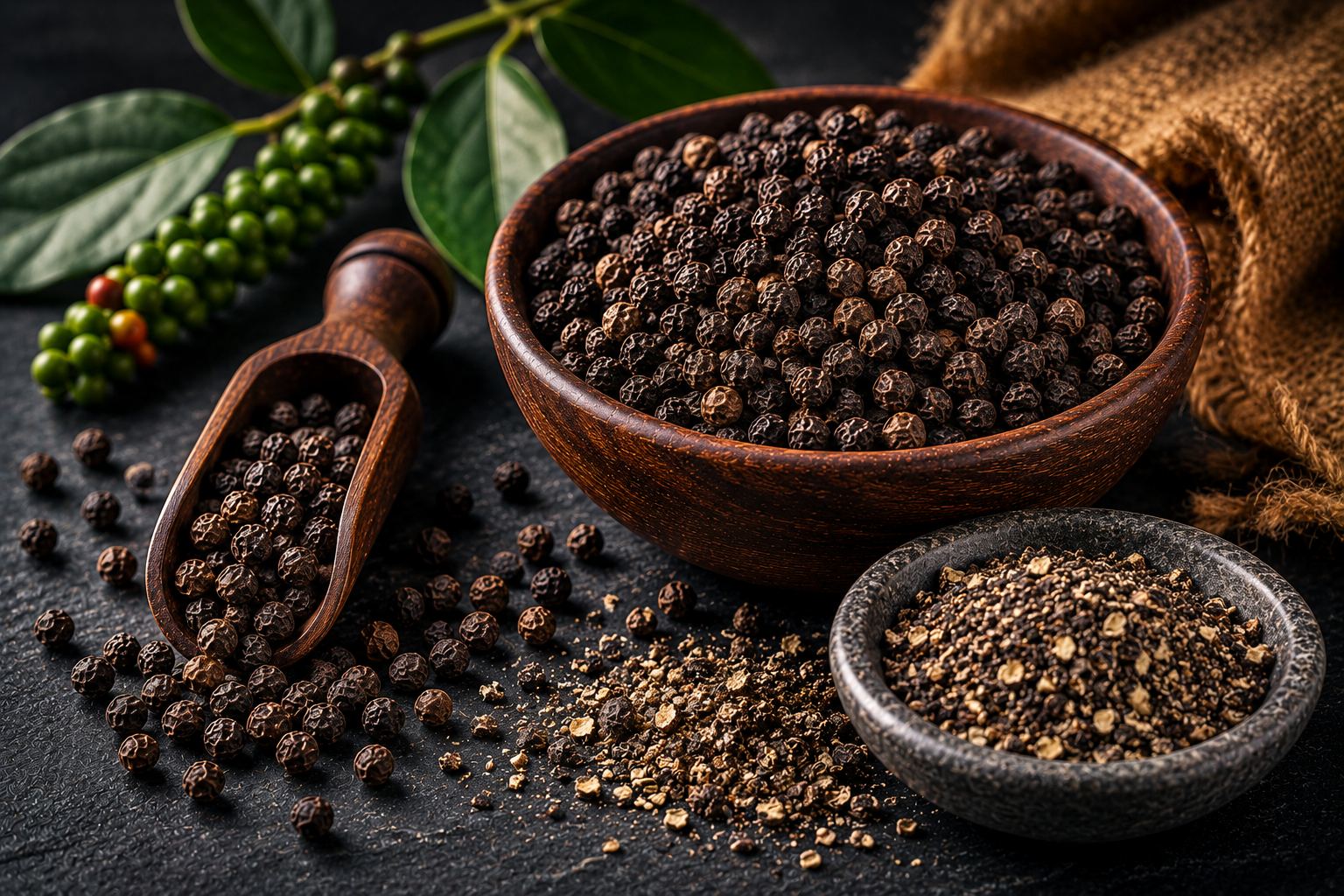
Black pepper comes from the berries of Piper nigrum, a climbing vine native to southern India. The berries are picked while still green and sun-dried until they turn black and wrinkled. White pepper comes from the same plant — the outer layer is removed before drying. Green peppercorns are the fresh, unripe berry. Each processing method produces a distinctly different flavour profile from the same plant.
- South Indian chettinad cooking is architecturally built on black pepper — it provides heat in dishes where chilli would be inappropriate
- Pepper rasam — a thin, peppery South Indian broth — exists because of black pepper's digestive properties and medicinal tradition
- Garam masala's background heat comes from black pepper, not chilli — distinguishing its warm complexity from raw chilli pungency
- Kerala's pepper vine cultivation is one of the oldest agricultural traditions in India — the spice is part of the cultural identity
- Before the Portuguese brought chilli to India in the 16th century, black pepper was the primary heat source in all Indian cooking
Black Pepper Through History
Black pepper's history is inseparable from the history of world trade. Roman merchants paid for Indian black pepper with gold — Alaric, the Visigoth king who sacked Rome in 410 CE, demanded 3,000 pounds of pepper as part of his ransom. Arab traders controlled the spice routes from Kerala to Europe for centuries, keeping the source secret.
The search for a direct sea route to India's pepper was the primary motivation for Portugal's Age of Exploration under Vasco da Gama, who reached Calicut (now Kozhikode) in Kerala in 1498. The spice that funded this voyage was pepper. The colonisation of much of Asia and Africa followed from this initial commercial motivation.
In Kerala, pepper cultivation is documented in Sangam poetry (300 BCE–300 CE) and in the historical records of the Roman Republic. The Western Ghats remain the primary source of Indian black pepper today.
The Science of Black Pepper
How to Store Black Pepper
How to Buy Good Black Pepper
How to Use Black Pepper Correctly
- Slow-cooked dishes: add whole peppercorns at the start — they soften and release heat slowly over an hour of cooking
- Ground: add freshly cracked pepper at the end of cooking or at the table — heat and aroma are strongest freshly ground
- Rasam: whole peppercorns crushed and simmered in the broth are central to traditional pepper rasam
- Marinades: cracked pepper in yogurt-based marinades distributes heat evenly into meat
- Quantity: 1/2 to 1 tsp freshly ground per dish for 4; 1 tbsp whole in slow-cooked dishes
What Black Pepper Pairs Well With
Dishes That Use Black Pepper
Where Black Pepper Matters Most
| South Indian Cuisine | Essential |
| Keralan Cuisine | Essential |
| Chettinad Cuisine | Essential |
| Mughlai Cuisine | Essential |
| Kashmiri Cuisine | Common |
| North Indian Cuisine | Common |
| Jain Cooking | Essential |
| Sattvic Cooking | Essential |
Black Pepper vs White Pepper vs Chilli
| Feature | Black Pepper | White Pepper | Red Chilli |
|---|---|---|---|
| Plant | Piper nigrum | Piper nigrum | Capsicum spp. |
| Origin | India (Kerala) | India (Kerala) | Americas (Portuguese import) |
| Heat compound | Piperine | Piperine | Capsaicin |
| Heat onset | Slow, building | Sharp, direct | Immediate, lingering |
| Aroma | Complex, earthy | Sharper, less complex | Fruity-sharp |
| Use in India | Ancient — 5000+ years | Specific applications | Post-16th century |
| Replaces chilli? | Historically yes | Partially | N/A |