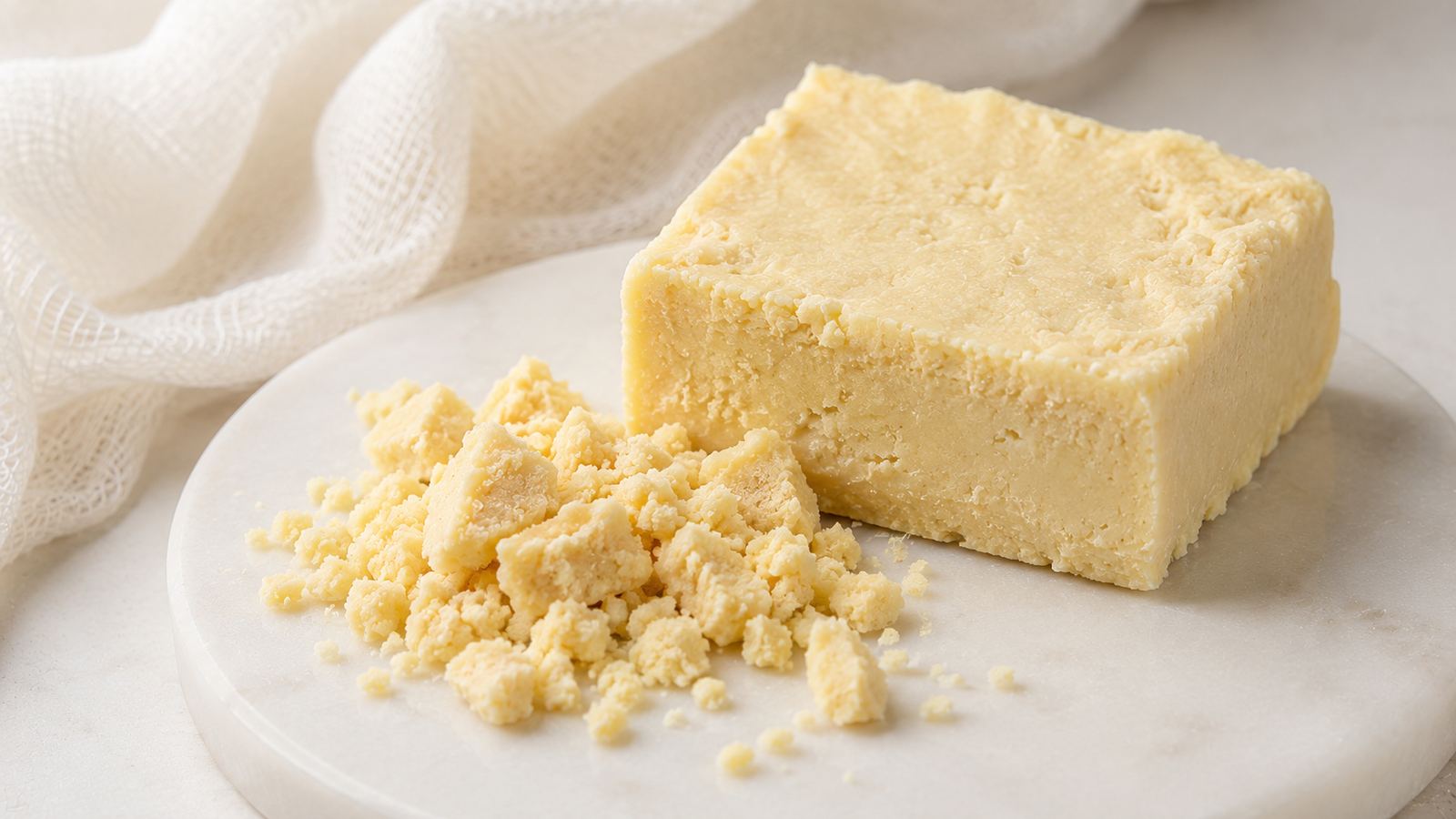
What Does Khoya Taste Like?
Khoya in Every Indian Language
| Language | Name | Pronunciation |
|---|---|---|
| English | Reduced Milk Solids / Khoya | KHOH-yah |
| Hindi | खोया / मावा — Khoya / Mawa | KHOH-yah |
| Bengali | ক্ষীর — Khir | KHEER |
| Tamil | கோவா — Kova | KOH-vah |
| Telugu | ఖోయా — Khoya | KHOH-yah |
| Malayalam | കോവ — Kova | KOH-vah |
| Kannada | ಖೋವ — Khova | KHOH-vah |
| Gujarati | માવો — Mavo | MAH-voh |
| Marathi | खवा — Khava | KHAH-vah |
| Punjabi | ਮਾਵਾ — Mawa | MAH-wah |
| Urdu | کھویا — Khoya | KHOH-yah |
| Sanskrit | क्षीरसार — Kshira Sara | KSHEE-rah SAH-rah |
What Is Khoya?
Khoya (also called mawa) is milk reduced to a thick paste or solid by prolonged heating — essentially the concentrated solids of whole milk with most moisture removed. It is made by continuously stirring whole milk over heat for several hours until it reduces to approximately 20–25% of its original volume.
Khoya is the foundation of traditional Indian mithai (sweets). Burfi (Indian fudge), gulab jamun, halwa, milk cake, and dozens of regional sweets are built on khoya. Understanding khoya is essential for understanding Indian sweet-making. Three distinct textures exist: chikna (soft, pasty), daania (medium-firm), and batti (hard, crumbly) — different sweets use different khoya types.
- Burfi — India's most widely eaten sweet — is fundamentally khoya with sugar, flavouring, and sometimes additions
- Gulab jamun dough is made primarily from khoya — without it, the dumplings have wrong texture
- The specific Maillard reactions during khoya making create complex caramelised milk notes that define traditional mithai's flavour
- Without khoya, traditional Indian sweet-making would collapse — there is no dairy substitute that replicates its properties
- Halwai (sweet shop) culture across India is built on khoya-making as a craft
Khoya Through History
Khoya-making is an ancient Indian dairy skill. The halwai (sweet-maker) tradition — producing khoya-based sweets for sale — is mentioned in medieval texts and has been a feature of Indian market towns for centuries. Different regions developed different khoya-based sweets, creating India's remarkable diversity of mithai: Rajasthani ghevar, Bengali sondesh (using chenna rather than khoya), North Indian burfi and halwa.
The Science of Khoya
How to Store Khoya
How to Buy Good Khoya
How to Use Khoya Correctly
- For burfi: mix khoya + sugar, cook on low heat until it pulls away from pan, set in greased tray
- For gulab jamun: crumble khoya, mix with small amount of flour, shape into balls, fry on low heat
- For halwa: add khoya to cooked halwa in last 10 minutes
- For stuffings: knead chikna khoya with sugar and cardamom for paratha or modak filling
- Quantity: most burfi uses 500g khoya per standard batch (serving 20–25)
What Khoya Pairs Well With
Dishes That Use Khoya
Where Khoya Matters Most
| North Indian Cuisine | Essential |
| All Indian Sweet-Making | Essential |
| Jain Cooking | Essential |
| Festival Cooking | Essential |
Khoya vs Paneer vs Condensed Milk
| Feature | Khoya (Mawa) | Paneer | Condensed Milk |
|---|---|---|---|
| Process | Reduced by long heating | Acid-set curd | Reduced + sweetened |
| Texture | Dense, paste/solid | Firm blocks | Liquid/syrup |
| Primary use | Sweets base | Savoury cooking | Sweets, beverages |
| Protein | ~18g/100g | ~18g/100g | ~8g/100g |
| Fat | ~20g/100g | ~20g/100g | ~9g/100g |
| Sugar added? | No | No | Yes |