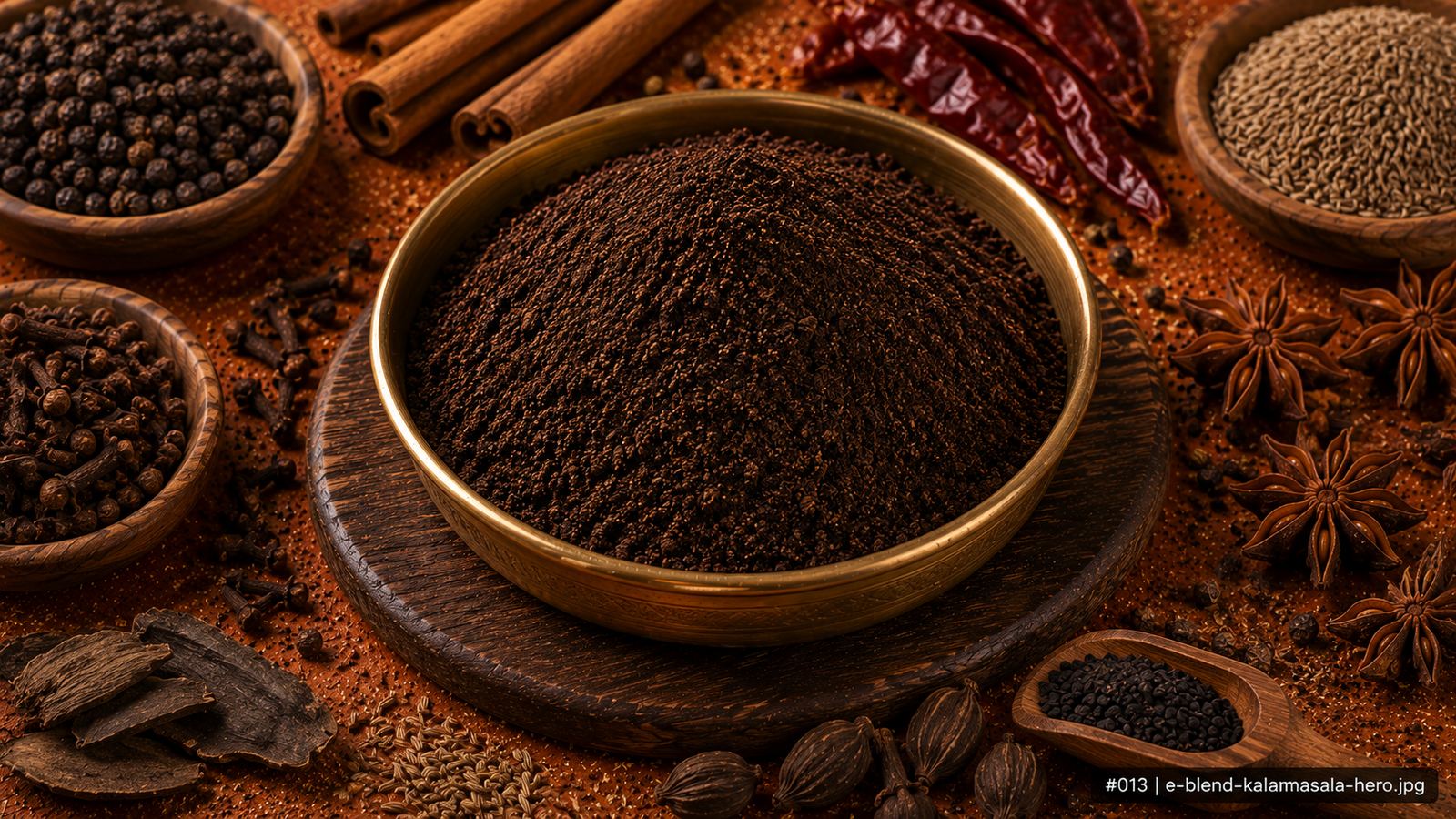
What Does Kala Masala Taste Like?
Kala Masala in Every Indian Language
| Language | Name | Pronunciation |
|---|---|---|
| English | Kala Masala / Black Masala | KAH-lah Mah-sah-lah |
| Hindi | काला मसाला | KAH-lah Mah-sah-lah |
| Marathi | काळा मसाला — Kala Masala | KAH-lah Mah-sah-lah |
| Tamil | கால மசாலா | KAH-lah Mah-sah-lah |
| Telugu | కాళా మసాలా | KAH-lah Mah-sah-lah |
| Malayalam | കാള മസാല | KAH-lah Mah-sah-lah |
| Kannada | ಕಾಳ ಮಸಾಲ | KAH-lah Mah-sah-lah |
| Bengali | কালা মশলা | KAH-lah Moh-sha-lah |
| Gujarati | કાળો મસાલો | KAH-loh Mah-sah-lo |
| Punjabi | ਕਾਲਾ ਮਸਾਲਾ | KAH-lah Mah-sah-lah |
| Urdu | کالا مسالہ | KAH-lah Mah-sah-lah |
What Is Kala Masala?
Kala masala — literally 'black masala' — is the Vidarbha region's defining spice blend, distinguished from Maharashtra's goda masala by one defining characteristic: each spice component is dry-roasted to a very dark, almost black stage before grinding. This extreme dark-roasting produces Maillard reaction products that give kala masala its characteristic smoky, bolder character.
The components are similar to goda masala — coriander, cumin, cloves, cinnamon, cardamom, stone flower, dried coconut, sesame seeds — but the extended roasting creates a fundamentally different flavour. Where goda masala is fragrant and complex, kala masala is smoky and bold. It is used primarily in meat preparations and hearty vegetable dishes from the Vidarbha region.
- Vidarbha cuisine's bold, smoky character is largely defined by kala masala's extreme dark-roasting approach
- Mutton preparations from the Nagpur region specifically call for kala masala — generic goda masala produces a lighter, different dish
- The Maillard reaction products in dark-roasted kala masala create bitter-smoky compounds that balance differently with rich meat than lighter masalas
- Understanding kala masala reveals how the same ingredients, roasted differently, can produce entirely different culinary results
- It represents one of India's most underappreciated regional spice traditions — rarely known outside Maharashtra
Kala Masala Through History
Vidarbha — the eastern region of Maharashtra bordering Madhya Pradesh — has a distinct culinary identity influenced by both Maharashtrian and central Indian cooking traditions. The dark-roasting tradition likely developed as a way to extract maximum flavour from locally available spices through extended heat exposure. The resulting smoky, bold masala suits the region's hearty, meat-forward cooking tradition.
The Science of Kala Masala
How to Store Kala Masala
How to Buy Good Kala Masala
How to Use Kala Masala Correctly
- Add 1.5–2 tsp per 500g protein during main masala stage
- Cook for 3–4 minutes in oil — dark masala needs this to develop fully
- For bharit (fire-roasted brinjal): add 1 tsp with fried onion and roasted eggplant
- Quantity: 1.5–2 tsp per dish for 4 people
- Works particularly well with robust ingredients — mutton, smoked aubergine, kidney beans
- Balance with tamarind or kokum for acidity to cut through the smoky richness
What Kala Masala Pairs Well With
Dishes That Use Kala Masala
Where Kala Masala Matters Most
| Maharashtrian Cuisine | Common |
| Vidarbha Cuisine | Essential |
| Restaurant Indian | Occasional |
| North Indian Cuisine | Rare |
| Jain Cooking | Rare — typically contains garlic |
Kala Masala vs Goda Masala vs Kolhapuri Masala
| Feature | Kala Masala | Goda Masala | Kolhapuri |
|---|---|---|---|
| Colour | Near-black | Dark brown | Deep red-brown |
| Roasting | Very dark — near burnt | Medium-dark | Medium-dark |
| Character | Smoky, bold, bitter | Fragrant, complex | Hot, coconut-rich |
| Region | Vidarbha | All Maharashtra | Western Maharashtra / Kolhapur |
| Primary use | Meat, bharit | Dal, usal, rice | Meat, rassa |
| Heat level | Medium | Low-medium | Very high |