What Does Goda Masala Taste Like?
Goda Masala in Every Indian Language
| Language | Name | Pronunciation |
|---|---|---|
| English | Goda Masala | GOH-dah Mah-sah-lah |
| Hindi | गोडा मसाला | GOH-dah Mah-sah-lah |
| Bengali | গোডা মশলা | GOH-dah Moh-sha-lah |
| Tamil | கோடா மசாலா | GOH-dah Mah-sah-lah |
| Telugu | గోడా మసాలా | GOH-dah Mah-sah-lah |
| Malayalam | ഗോഡ മസാല | GOH-dah Mah-sah-lah |
| Kannada | ಗೋಡಾ ಮಸಾಲ | GOH-dah Mah-sah-lah |
| Gujarati | ગોડા મસાલો | GOH-dah Mah-sah-lo |
| Marathi | गोडा मसाला | GOH-dah Mah-sah-lah — the home spice blend |
What Is Goda Masala?
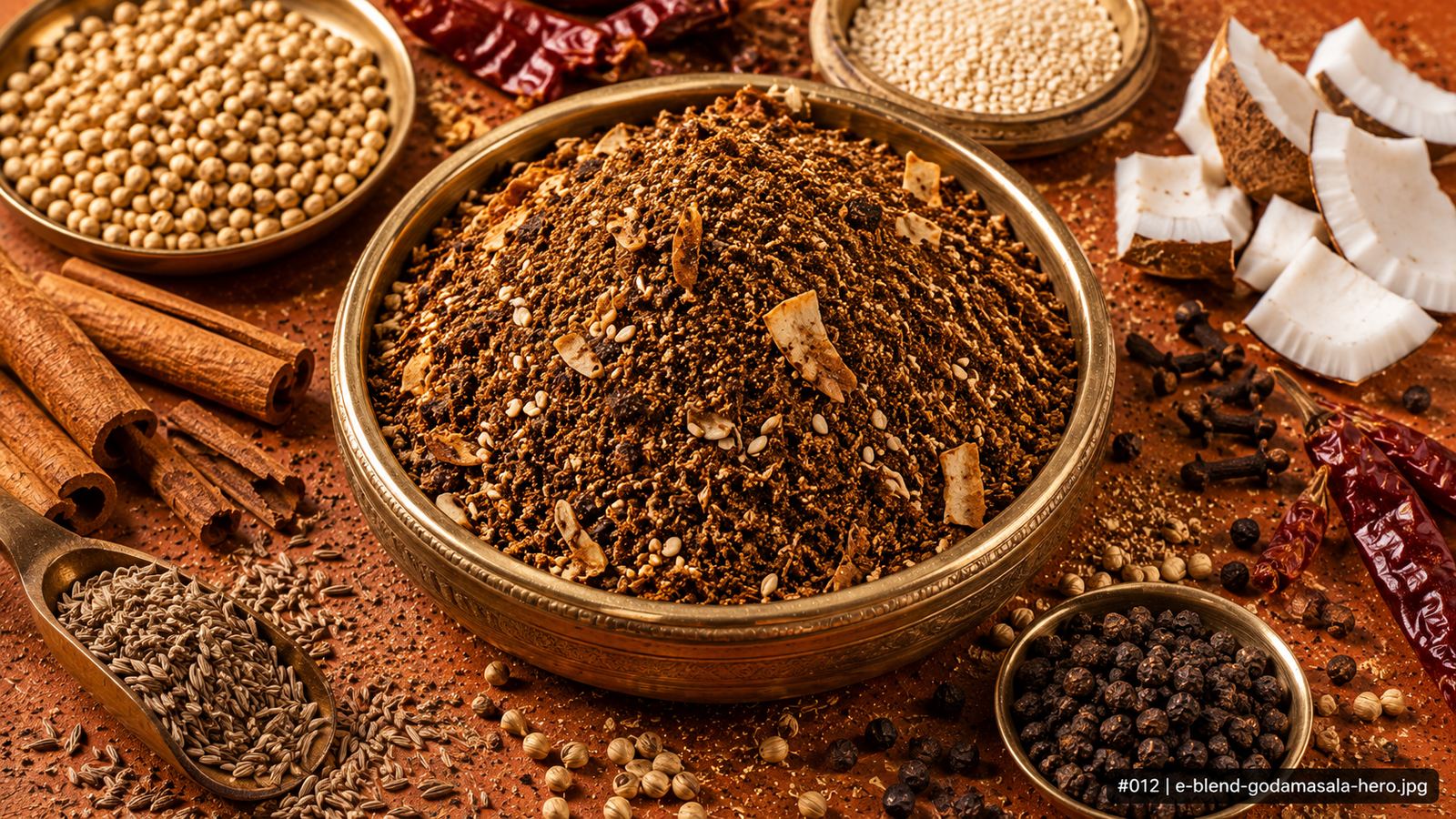
Goda masala is Maharashtra's defining ground spice blend — the Maharashtrian equivalent of what garam masala is to North India. The name means 'fragrant masala' in Marathi (goda can mean sweet or fragrant depending on context). It is significantly more complex than garam masala, typically containing 15–30 individual spice components including two that appear in virtually no other Indian masala: dried coconut (kopra) and stone flower (dagad phool).
Goda masala is darker than garam masala — the coconut and some spices are dry-roasted until quite dark, giving it a near-black appearance and a distinctly different character. It is used during cooking rather than purely as a finishing spice, and its darker, more complex profile is suited to the robust Maharashtrian vegetable and pulse preparations it accompanies.
- Maharashtrian dal (amti) made with goda masala tastes categorically different from dal made with garam masala — the coconut-stone flower combination is distinctive
- Matki usal (moth bean curry) and other Maharashtrian usal preparations are defined by goda masala's complex dark profile
- Vangi bhath (eggplant rice) cannot be authentic without goda masala — it is the defining seasoning
- The stone flower (dagad phool) component is the ingredient that no other masala contains — its earthy, mossy depth is irreplaceable
- Goda masala represents one of India's most sophisticated and underappreciated regional spice systems — as complex as any masala in the country
Goda Masala Through History
Goda masala is a Maharashtrian household tradition — historically, each family would have its own version, made at home by dry-roasting and grinding the components together. The blend varies between Brahmin and non-Brahmin households, between Konkan and Vidarbha regions, and between urban and rural traditions. The inclusion of dried coconut reflects the Konkan coastal influence on Maharashtrian cooking, where coconut is a foundational ingredient.
The Science of Goda Masala
How to Store Goda Masala
How to Buy Good Goda Masala
How to Use Goda Masala Correctly
- Add 1–2 tsp during cooking — not purely as a finishing spice
- Cook briefly in oil with onion-tomato base before adding vegetables or dal
- For vangi bhath: add to the oil with rice and onions
- Quantity: 1–2 tsp per dish for 4 people
- For dal (amti): add at the start with the tempering, not just at the end
- Can be combined with a small amount of garam masala for additional aromatic top note
What Goda Masala Pairs Well With
Dishes That Use Goda Masala
Where Goda Masala Matters Most
| Maharashtrian Cuisine | Essential |
| Coastal Maharashtrian | Essential |
| Konkan Cuisine | Common |
| Goan Cuisine | Occasional |
| North Indian Cuisine | Rare |
| Jain Cooking | Common |
Goda Masala vs Garam Masala vs Kala Masala
| Feature | Goda Masala | Garam Masala | Kala Masala (Kolhapuri) |
|---|---|---|---|
| Region | Maharashtra | All India | Kolhapur, Maharashtra |
| Colour | Dark brown-black | Medium brown | Very dark — almost black |
| Unique ingredient | Dried coconut + stone flower | None specific | Very dark-roasted spices |
| When added | During cooking | End of cooking | During cooking |
| Heat level | Moderate | Moderate | High — more chilli |