★★★★★ North India
★★★★☆ South India
What Does Cumin Taste Like?
Cumin in Every Indian Language
| Language | Name | Pronunciation |
|---|---|---|
| English | Cumin | KYOO-min |
| Hindi | जीरा — Jeera | JEE-rah |
| Bengali | জিরা — Jira | JEE-rah |
| Tamil | சீரகம் — Seeragam | SEE-rah-gum |
| Telugu | జీలకర్ర — Jeelakarra | JEE-lah-kah-rah |
| Malayalam | ജീരകം — Jeerakam | JEE-rah-kum |
| Kannada | ಜೀರಿಗೆ — Jeerige | JEE-ree-geh |
| Gujarati | જીરૂ — Jeeru | JEE-roo |
| Marathi | जिरे — Jire | JEE-reh |
| Punjabi | ਜ਼ੀਰਾ — Zeera | ZEE-rah |
| Urdu | زیرہ — Zeera | ZEE-rah |
| Sanskrit | जीरक — Jiraka | JEE-rah-kah |
What Is Cumin?
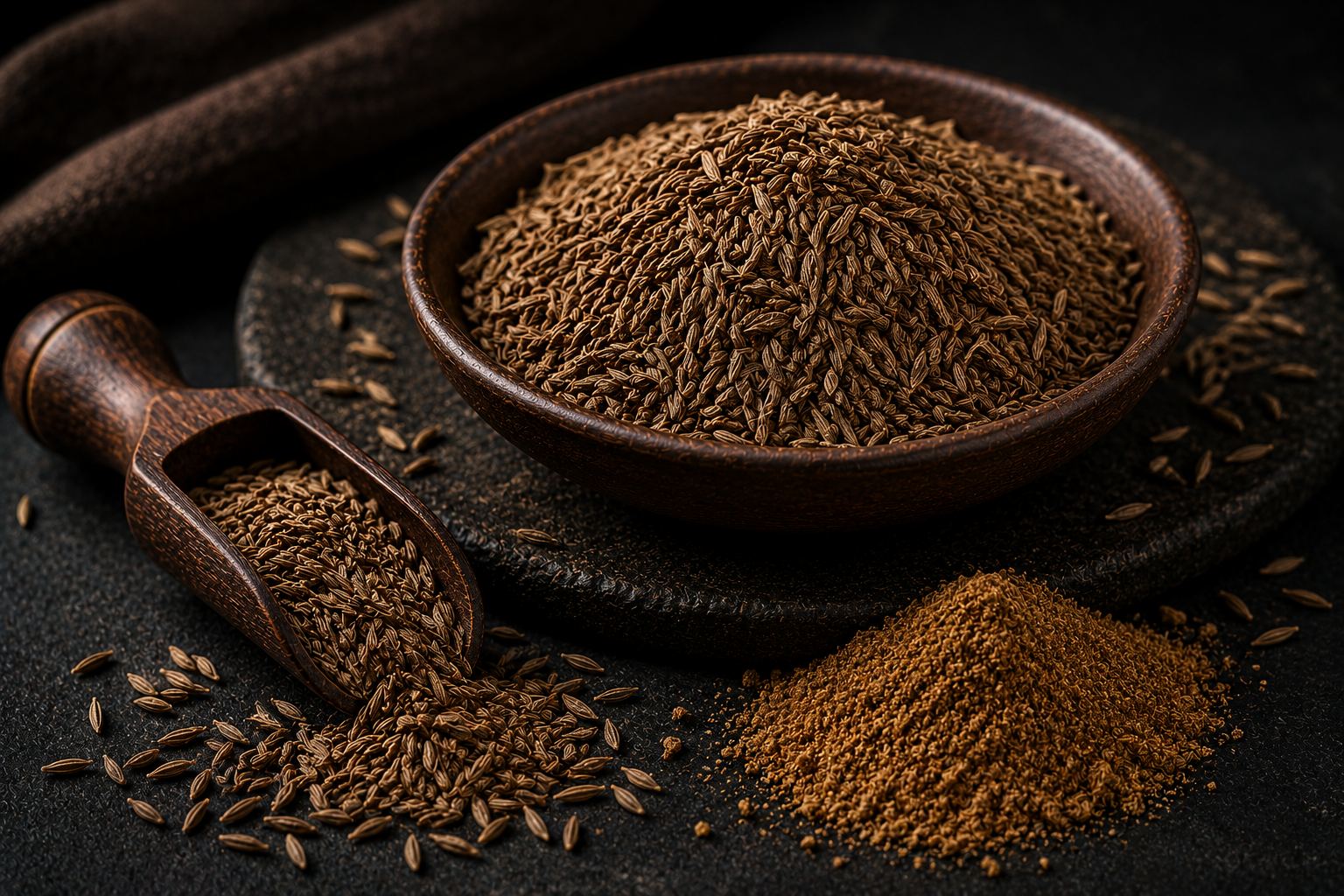
Cumin — jeera — is the backbone of Indian cooking. The small, ridged, pale brown seeds of Cuminum cyminum are the most widely used whole spice in the Indian kitchen, appearing in virtually every regional cuisine from Kashmir to Kerala. In whole form it is used in tadka; ground, it becomes one of the most important powder spices in Indian cooking.
Cumin's flavour is earthy, warm, and slightly bitter — with a distinctive nuttiness that deepens when dry-roasted or added to hot oil. The ground form (jeera powder) has a slightly softer, more complex character than whole seeds. Both forms are essential, and the two are not interchangeable — they behave differently in cooking and produce different aromatic results.
- Dal tadka without jeera produces a flat, one-dimensional result — cumin's earthy character is the foundation
- Jeera rice — one of India's most universally eaten rice preparations — is built entirely on cumin in hot ghee
- Ground jeera is one of the four base spices (with coriander, turmeric, and chilli) forming the foundation of most North Indian curries
- Chaat masala, garam masala, and virtually every Indian spice blend includes cumin as a structural component
- No other spice covers the full spectrum of Indian cooking — whole and ground, tadka and blend, savoury and digestive — the way cumin does
Cumin Through History
Cumin has been cultivated in India for at least 5,000 years and appears in the earliest Vedic texts as both a culinary ingredient and an Ayurvedic medicine. Ancient Sanskrit texts list jiraka as a digestive spice — a classification that persists in Indian home cooking today, where jeera water (jal jeera) is given for digestive relief.
Cumin was one of the spices traded along the ancient routes connecting India to Egypt, Rome, and the Arab world. Roman cookbooks (most famously Apicius) list cumin extensively — it arrived via Indian Ocean trade. The word 'cumin' itself derives from the Sanskrit jiraka through Arabic kammun and Latin cuminum, tracing the spice's journey westward through trade.
British colonial accounts of Indian cooking invariably mention jeera as one of the first spices they encountered — its distinctive earthy aroma marking Indian cooking as unmistakably different from European cuisine.
The Science of Cumin
How to Store Cumin
How to Buy Good Cumin
How to Use Cumin Correctly
- Tadka: add whole seeds to hot oil or ghee (180°C) — should sizzle immediately and turn one shade darker in 20 seconds
- Ground: add during the masala-building stage with other powder spices, not at the very start
- Dry-roast whole in a dry pan 2–3 minutes until fragrant, cool, then grind for chaat, raita, and finishing
- Quantity: 1/2 to 1 tsp whole per dish for 4; 1/2 tsp ground in curry base
- Jeera rice: fry 1 tsp whole cumin in ghee until it crackles, then add soaked basmati
What Cumin Pairs Well With
Dishes That Use Cumin
Where Cumin Matters Most
| North Indian Cuisine | Essential |
| South Indian Cuisine | Common |
| Bengali Cuisine | Essential |
| Gujarati Cuisine | Essential |
| Rajasthani Cuisine | Essential |
| Mughlai Cuisine | Essential |
| Jain Cooking | Essential |
| Sattvic Cooking | Essential |
Cumin vs Caraway vs Shahi Jeera
| Feature | Cumin (Jeera) | Caraway | Shahi Jeera |
|---|---|---|---|
| Botanical name | Cuminum cyminum | Carum carvi | Bunium persicum |
| Flavour | Earthy, warm | Anise-rye note | Intense smoky cumin |
| Indian use | Extensively | Rarely | Mughlai cooking |
| Tadka use? | Yes — primary | No | Yes — biryani |
| Ground form? | Essential | Occasionally | Rare |
| Shape | Ridged, pale brown | Curved, darker | Thin, black-edged |