★★★★★ South India
★★★★☆ Punjab
What Does Fenugreek Seeds Taste Like?
Fenugreek Seeds in Every Indian Language
| Language | Name | Pronunciation |
|---|---|---|
| English | Fenugreek Seeds | FEN-yoo-greek |
| Hindi | मेथी दाना — Methi Dana | MEH-thee DAH-nah |
| Bengali | মেথি — Methi | MEH-thee |
| Tamil | வெந்தயம் — Vendhayam | VEN-dha-yum |
| Telugu | మెంతులు — Menthulu | MEN-too-loo |
| Malayalam | ഉലുവ — Uluva | oo-LOO-vah |
| Kannada | ಮೆಂತ್ಯ — Menthya | MEN-tyah |
| Gujarati | મેથી — Methi | MEH-thee |
| Marathi | मेथी — Methi | MEH-thee |
| Punjabi | ਮੇਥੀ — Methi | MEH-thee |
| Urdu | میتھی — Methi | MEH-thee |
| Sanskrit | मेथिका — Methika | meh-THEE-kah |
What Is Fenugreek Seeds?
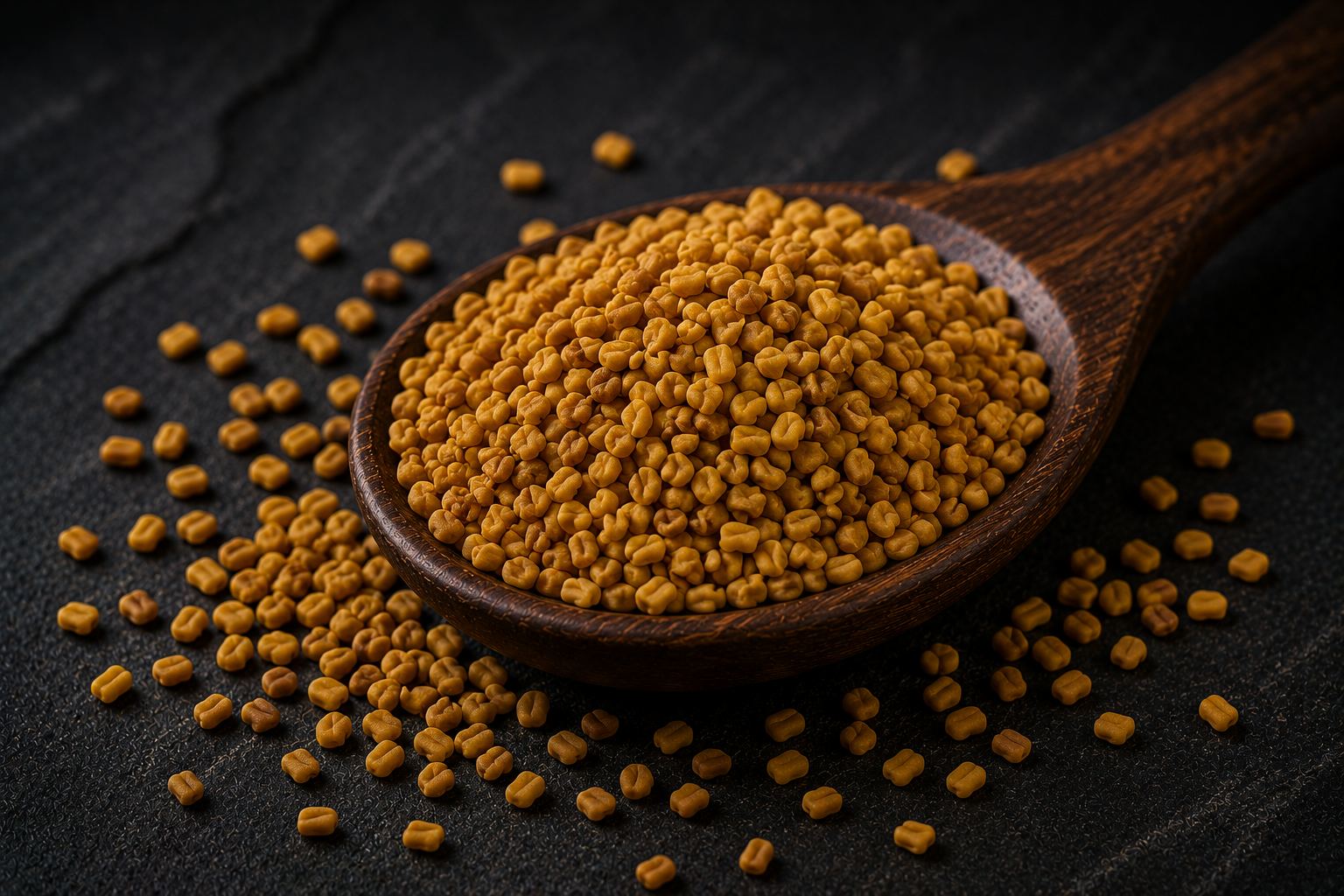
Fenugreek seeds — methi dana — are the hard, amber-coloured seeds of Trigonella foenum-graecum. They are among the most medicinally valued spices in India, appearing in Ayurvedic texts dating back 3,000 years, and among the most culinarily challenging — intensely bitter in their raw state, requiring careful use in small quantities to avoid overpowering a dish.
Fenugreek occupies a unique dual role in Indian cooking: as a spice (the seeds) and as a vegetable (the fresh and dried leaves, called methi or kasuri methi). The seeds and leaves are from the same plant but have different flavour profiles and completely different culinary applications. This guide covers the seeds only.
- Panch phoron — Bengal's five-spice blend — cannot exist without fenugreek's bitter counterpoint to fennel's sweetness
- Idli and dosa batter fermentation is partially driven by fenugreek seeds — they aid fermentation and contribute to the characteristic slight sourness
- South Indian sambhar powder and most curry masala blends include fenugreek as a bitterness and body ingredient
- Without a small amount of fenugreek, many Indian spice blends taste flat and one-dimensional — the bitter note creates contrast
- The maple-like sotolone compound in fenugreek is what makes Indian restaurant cooking smell distinctive to visitors
Fenugreek Seeds Through History
Fenugreek is one of the oldest cultivated plants on Earth — seeds have been found in Egyptian sites dating to 4000 BCE and in Neolithic settlements across the Middle East. In India, the Charaka Samhita (one of Ayurveda's foundational texts) references methi extensively for diabetes, digestive issues, and lactation support — all uses that persist in Indian home medicine today.
Fenugreek was a significant commodity in ancient Arab and Indian Ocean trade — its medicinal reputation made it valuable across cultures. Arab traders called it hulba, and it appears in medieval cookbooks from Persia to Morocco. In India, its culinary and medicinal uses became so intertwined that separating them is difficult — families that cook with fenugreek often simultaneously value its health properties.
The Science of Fenugreek Seeds
How to Store Fenugreek Seeds
How to Buy Good Fenugreek Seeds
How to Use Fenugreek Seeds Correctly
- Tadka: add 1/4 tsp whole to hot oil — let them turn one shade darker (not dark brown — will become very bitter)
- Soak overnight to reduce bitterness for certain dishes and for idli batter
- For panch phoron: equal parts with cumin, nigella, fennel, and mustard
- Quantity: very small — 1/4 tsp whole per dish for 4 is usually sufficient
- For pickles: add to oil-based achars whole — they soften and provide bitterness balance
- Never dry-roast beyond light golden — over-roasting creates an acrid, unpleasant bitterness
What Fenugreek Seeds Pairs Well With
Dishes That Use Fenugreek Seeds
Where Fenugreek Seeds Matters Most
| South Indian Cuisine | Essential |
| Bengali Cuisine | Essential |
| Punjabi Cuisine | Common |
| Rajasthani Cuisine | Common |
| North Indian Cuisine | Common |
| Jain Cooking | Common |
| Sattvic Cooking | Occasional |
Fenugreek Seeds vs Fenugreek Leaves vs Kasuri Methi
| Feature | Fenugreek Seeds | Fresh Methi Leaves | Kasuri Methi (Dried) |
|---|---|---|---|
| Flavour | Bitter, maple-like | Bitter, green | Concentrated bitter, aromatic |
| Use | Tadka, blends, batter | Vegetables, breads | Finishing spice |
| Intensity | High — small quantities | Medium | High — small quantities |
| Replaces other? | No | No | No — all three different |
| Added when? | Start of cooking | During cooking | End of cooking |