★★★★★ Kerala (grown)
★★★★★ Mughlai tradition
What Does Green Cardamom Taste Like?
Green Cardamom in Every Indian Language
| Language | Name | Pronunciation |
|---|---|---|
| English | Green Cardamom | KAR-dah-mum |
| Hindi | इलायची — Elaichi | eh-LYE-chee |
| Bengali | এলাচ — Elach | eh-LACH |
| Tamil | ஏலக்காய் — Elakkai | eh-LAHK-kye |
| Telugu | ఏలకులు — Elakulu | eh-LAH-koo-loo |
| Malayalam | ഏലം — Elam / ഏലത്തരി — Elattari | eh-LAHM |
| Kannada | ಏಲಕ್ಕಿ — Elakki | eh-LAHK-kee |
| Gujarati | એલચી — Elchi | EHL-chee |
| Marathi | वेलदोडा — Veldoda | VEL-doh-dah |
| Punjabi | ਇਲਾਇਚੀ — Ilaichi | ih-LYE-chee |
| Urdu | الائچی — Ilaichi | ih-LYE-chee |
| Sanskrit | एला — Ela | EH-lah |
What Is Green Cardamom?
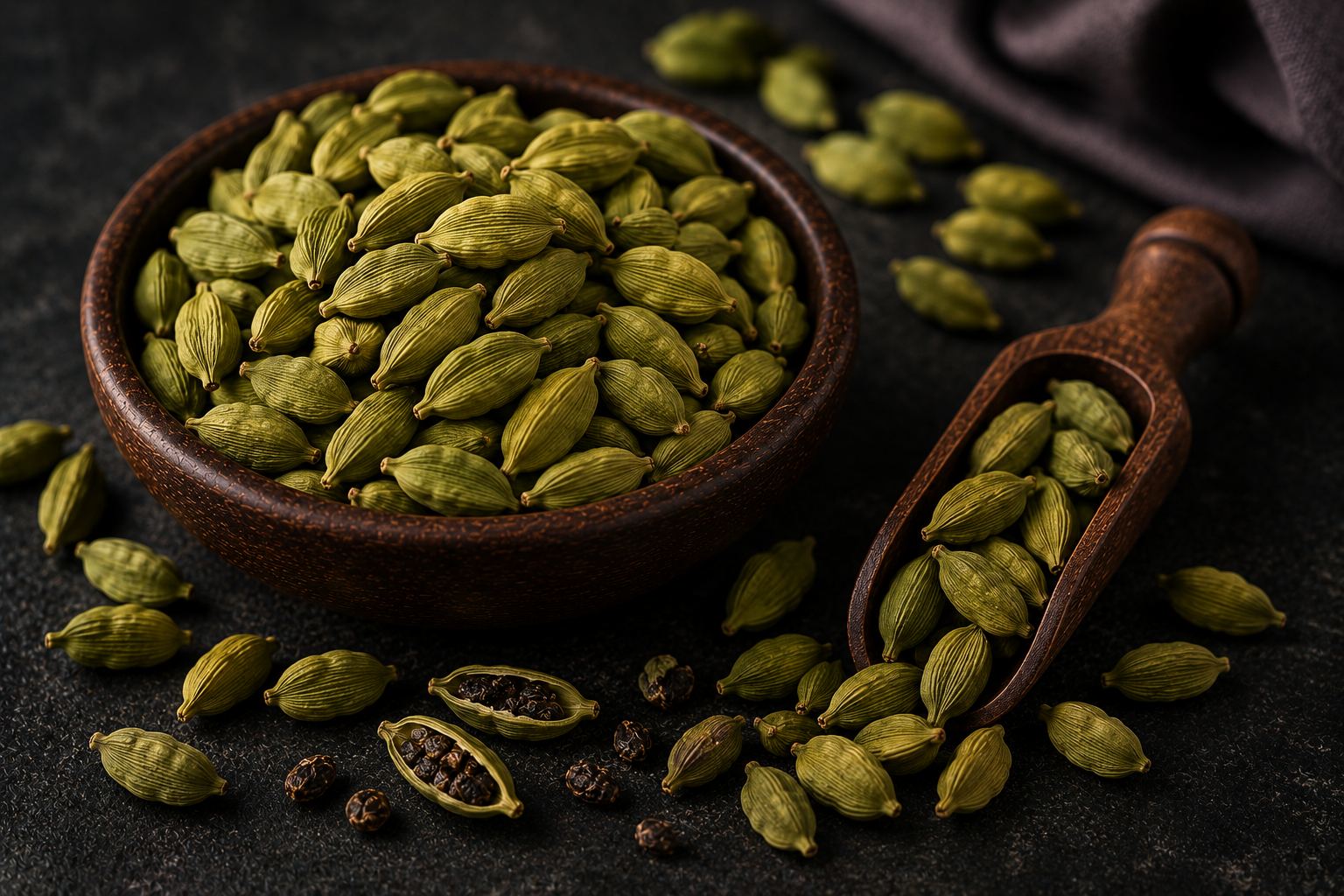
Green cardamom — elaichi — is the dried seed pod of Elettaria cardamomum, a plant native to the forests of Kerala's Western Ghats. It is called the Queen of Spices for its extraordinary versatility: unlike virtually every other spice in the Indian kitchen, green cardamom works with equal success in sweet dishes (kheer, ladoo, halwa) and savoury dishes (biryani, korma, garam masala) and beverages (chai, lassi). This dual character is botanical — the floral, complex aroma of 1,8-cineole works as a bridge between sweet and savoury applications.
Cardamom pods contain seeds which are the actual flavour source — the green pod is a protective wrapper. The most common mistake is using old, bleached, or pre-ground cardamom where the aromatic compounds have escaped. Freshly ground cardamom seeds from green pods is dramatically more aromatic than any pre-ground version.
- Chai without cardamom is technically possible but culturally incomplete — elaichi chai is the defining daily beverage of India
- Biryani's aromatic complexity depends significantly on whole cardamom pods in the cooking oil at the start
- Garam masala's floral top note comes from cardamom — without it, the blend tastes sharp and flat
- Kheer, halwa, and most milk-based Indian desserts derive their characteristic perfumed quality from cardamom
- The unique ability to bridge sweet and savoury makes cardamom the most culinarily versatile spice in Indian cooking
Green Cardamom Through History
Green cardamom is native to the forests of Kerala — specifically the Idukki and Wayanad districts of the Western Ghats. It has been cultivated and traded from Kerala for at least 3,000 years, appearing in ancient Sanskrit texts, Ayurvedic formularies, and in the records of Arab and Greek traders.
Arab merchants called it hail and it became one of the most valuable commodities in medieval spice trade — more expensive per gram than gold in certain periods. Cardamom travelled from Kerala through Arab trade to Persia, Turkey, and Scandinavia — where it became embedded in Nordic baking traditions (cardamom buns in Sweden and Norway are a direct inheritance from Arab-Indian trade routes).
The Mughal court used green cardamom extensively in both cooking and in attars (perfumes) — reflecting its dual role as a flavour and a fragrance. Much of what defines Mughlai cuisine's aromatic complexity traces to cardamom.
The Science of Green Cardamom
How to Store Green Cardamom
How to Buy Good Green Cardamom
How to Use Green Cardamom Correctly
- Whole pods in biryani/korma: add to hot ghee at the start — pods will slightly puff in 20 seconds
- For chai: lightly crush 2–3 pods per cup and simmer with tea
- For desserts: crack pods, grind seeds fine with pestle, add just before serving
- For garam masala: crack pods, separate seeds, dry-roast seeds lightly, grind
- Quantity: 2–3 whole pods per dish for 4; 1/4 tsp ground per dessert/chai
- Never add pre-ground cardamom at start of cooking — all aroma is lost
What Green Cardamom Pairs Well With
Dishes That Use Green Cardamom
Where Green Cardamom Matters Most
| North Indian Cuisine | Essential |
| South Indian Cuisine | Essential |
| Bengali Cuisine | Essential |
| Mughlai Cuisine | Essential |
| Gujarati Cuisine | Essential |
| Jain Cooking | Essential |
| Sattvic Cooking | Essential |
Green Cardamom vs Black Cardamom vs White Cardamom
| Feature | Green Cardamom | Black Cardamom | White Cardamom |
|---|---|---|---|
| Botanical name | Elettaria cardamomum | Amomum subulatum | Elettaria cardamomum (bleached) |
| Flavour | Floral, sweet, complex | Smoky, camphor, woody | Mild, floral — less complex |
| Use | Sweet + savoury | Savoury only | Sweet applications |
| In biryani? | Yes — essential | Yes — specific regions | Sometimes |
| In chai? | Essential | No | Occasionally |
| Price | High | Medium | Highest per unit |