★★★★☆ North India
★★☆☆☆ South India
What Does Mace Taste Like?
Mace in Every Indian Language
| Language | Name | Pronunciation |
|---|---|---|
| English | Mace | MAYSS |
| Hindi | जावित्री — Javitri | jah-VIT-ree |
| Bengali | জয়িত্রী — Joitri | joy-EE-tree |
| Tamil | ஜாதிப்பத்திரி — Jatipathri | jah-tee-PAH-tree |
| Telugu | జాపత்రి — Japathri | jah-PAH-tree |
| Malayalam | ജാതിപ്പത്രി — Jathipathri | jah-thee-PAH-tree |
| Kannada | ಜಾಯಿಪತ್ರೆ — Jayipatre | jah-yee-PAH-treh |
| Gujarati | જાવંત્રી — Javantri | jah-VAN-tree |
| Marathi | जायपत्री — Jaypatri | jay-PAH-tree |
| Punjabi | ਜਾਵਿਤਰੀ — Javitri | jah-VIT-ree |
| Urdu | جاوتری — Javitri | jah-VIT-ree |
| Sanskrit | जातीपत्र — Jatiphala Patram | jah-tee-PAH-lah PAH-trum |
What Is Mace?
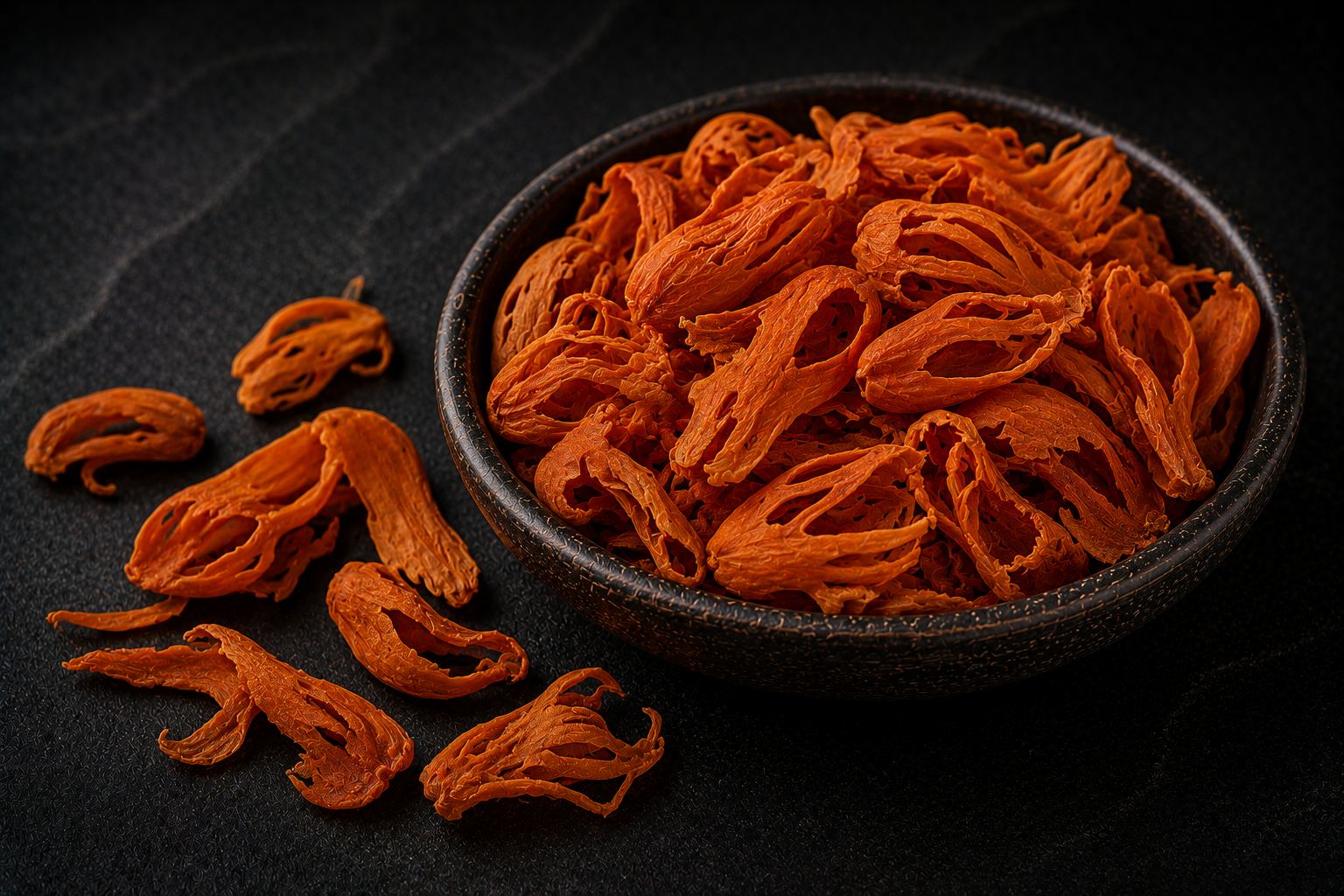
Mace and nutmeg come from the same fruit of Myristica fragrans. The fruit resembles a peach — the outer flesh (used to make pickles in Kerala and Indonesia), the hard shell (discarded), the nutmeg kernel inside (the seed), and the red lace-like aril that wraps around the shell (mace). When dried, the aril turns from vivid red to orange-yellow and becomes what we know as mace blades.
Mace has a flavour similar to nutmeg but more delicate, floral, and slightly sweeter — it is the more refined of the two spices. In Indian cooking, mace is primarily associated with Mughlai cuisine — kormas, biryanis, and milk-based preparations — where its gentle, complex warmth enhances without dominating. It is rarely used in South Indian cooking and is not a standard everyday spice for most home cooks.
- Shahi korma — the royal creamy curry of Mughal court cooking — uses mace as one of its defining spices
- Mughlai biryani in its most refined versions uses mace alongside saffron for aromatic complexity
- Kheer and Mughlai sheer khurma desserts use mace for a warm, floral note
- Without mace, Mughlai cooking loses an aromatic layer — the distinction between korma and other curries is partly dependent on mace and nutmeg
- The rarity and expense of mace historically made it a marker of luxury cooking — its presence in a dish signalled special occasion preparation
Mace Through History
Mace and nutmeg are both native to the Banda Islands in Indonesia's Maluku archipelago — a set of tiny volcanic islands that were the only source of nutmeg and mace in the world until the 19th century. This geographic monopoly made Banda the most strategically valuable piece of land in the medieval world.
The Dutch VOC (East India Company) massacred most of the Banda Islands' population in 1621 to seize control of the nutmeg and mace monopoly — one of history's most violent examples of spice-trade imperialism. In India, mace arrived via Arab traders and became embedded in Mughal court cooking. The Mughal emperor Akbar's royal kitchen records reference mace extensively in biryani and korma preparations.
The Science of Mace
How to Store Mace
How to Buy Good Mace
How to Use Mace Correctly
- Biryani: add 1 blade to the ghee with other whole spices at the start
- Korma: add 1 blade during the sauce base — remove before serving
- Ground: use a tiny pinch (1/8 tsp) in garam masala or kheer
- For milk desserts: simmer 1 blade in milk for 10 minutes, remove before serving
- Quantity: 1–2 blades maximum per dish for 4 people — very concentrated
- Can be ground to powder and added to garam masala in a tiny proportion
What Mace Pairs Well With
Dishes That Use Mace
Where Mace Matters Most
| Mughlai Cuisine | Essential |
| North Indian Cuisine | Common |
| Hyderabadi Cuisine | Common |
| Kashmiri Cuisine | Common |
| Bengali Cuisine | Occasional |
| South Indian Cuisine | Rare |
| Jain Cooking | Rare |
Mace vs Nutmeg
| Feature | Mace (Javitri) | Nutmeg (Jaiphal) |
|---|---|---|
| Part of plant | Aril (lace-like wrapper) | Seed kernel |
| Flavour | More delicate, floral, sweet | Richer, heavier, slightly bitter |
| Form | Blade / ground | Whole / ground |
| Indian use | Mughlai cooking, milk desserts | Garam masala, desserts, biryani |
| Intensity | Moderate — 1 blade sufficient | Moderate — use sparingly |
| Price | Higher — more labour | Lower than mace |
| Best in | Cream/milk applications | Ground spice blends |