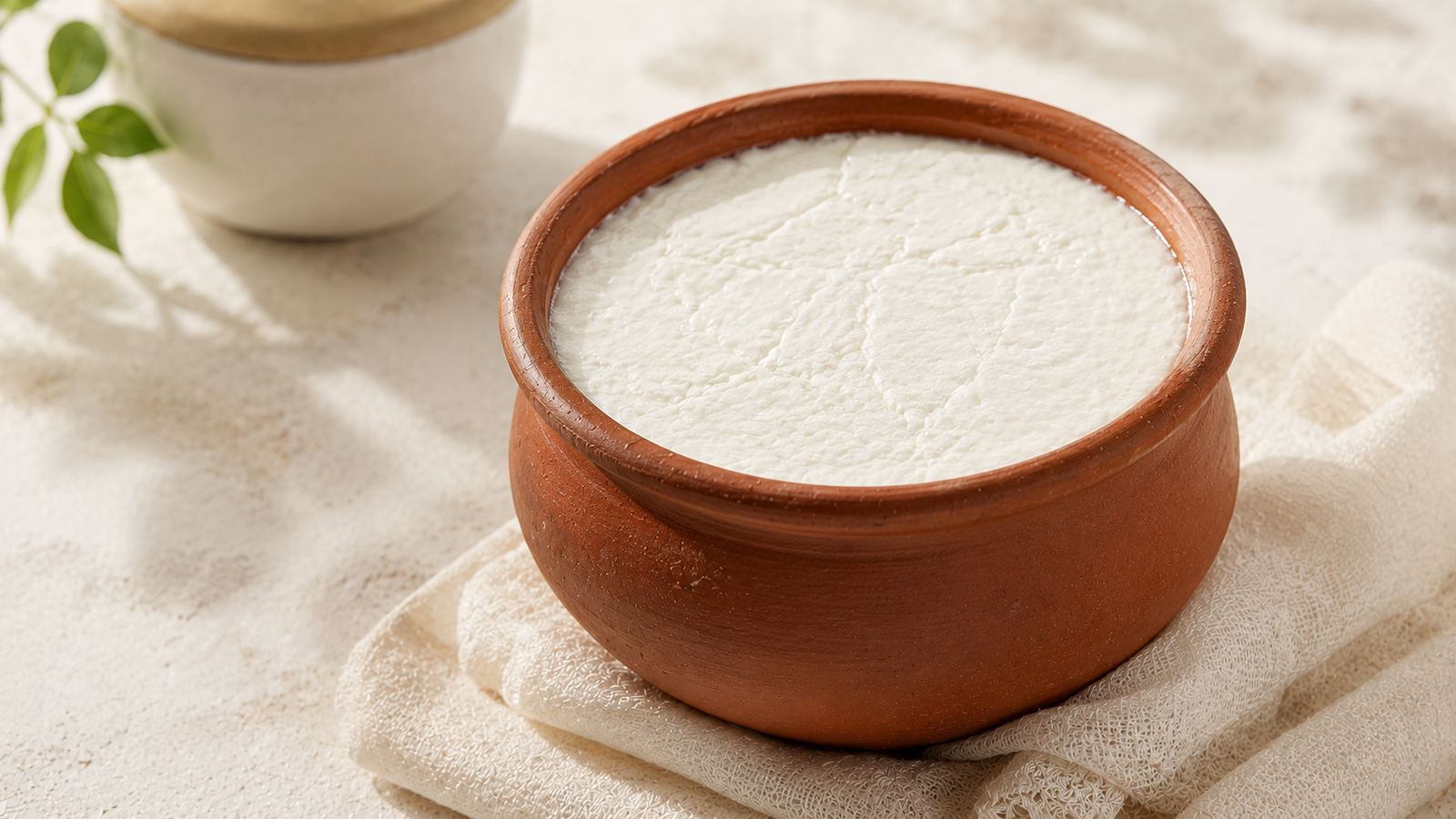
What Does Dahi Taste Like?
Dahi in Every Indian Language
| Language | Name | Pronunciation |
|---|---|---|
| English | Yogurt / Curd | DAH-hee |
| Hindi | दही — Dahi | DAH-hee |
| Bengali | দই — Doi | DOY |
| Tamil | தயிர் — Thayir | THYE-eer |
| Telugu | పెరుగు — Perugu | peh-ROO-goo |
| Malayalam | തൈര് — Thairu | THYE-roo |
| Kannada | ಮೊಸರು — Mosaru | MOH-sah-roo |
| Gujarati | દહીં — Dahi | DAH-hee |
| Marathi | दही — Dahi | DAH-hee |
| Punjabi | ਦਹੀਂ — Dahi | DAH-hee |
| Urdu | دہی — Dahi | DAH-hee |
| Sanskrit | दधि — Dadhi | DAH-dhee |
What Is Dahi?
Dahi is Indian yogurt — milk fermented with Lactobacillus cultures to produce a mild, slightly sour set curd. It is one of the foundational dairy ingredients of Indian cooking, present in virtually every regional cuisine in different applications. Indian dahi is thinner and milder than Greek yogurt, which affects how it behaves in cooking — they cannot always be substituted for each other.
Dahi's dual role — as a food and as a cooking ingredient — distinguishes it from most dairy products. It is consumed directly (with rice, as raita, in lassi), used as a marinade base (tandoori, tikka), incorporated into curries (kadhi), and used in the dum process of biryani.
- Raita — the cooling yogurt accompaniment — is the essential complement to spicy preparations in Indian serving
- Tandoori and tikka marinades use dahi as the protein-protective coating that enables high-temperature cooking without burning
- Kadhi — the yogurt-besan curry of North India and Gujarat — is a specific preparation that only works with Indian curd
- Biryani dum cooking uses dahi-sealed vessels — the steam generated from the yogurt layer cooks the top layer
- Lassi (both sweet and salted) and chaas (buttermilk) are among India's most consumed beverages
Dahi Through History
Fermented milk (dahi) has been made in India for at least 5,000 years. Sanskrit texts from the Vedic period reference dadhi extensively — both as food and in religious ritual. The tradition of eating dahi-chawal (yogurt with rice) as a restorative, cooling meal is mentioned in ancient texts. The Ayurvedic tradition classifies dahi as both nutritive and medicinal, particularly for gut health.
The Science of Dahi
How to Store Dahi
How to Buy Good Dahi
How to Use Dahi Correctly
- Whisk smooth before adding to hot preparations — never add cold lumpy dahi directly
- For kadhi: whisk dahi + besan together cold before adding to hot water
- For marinades: use full-fat dahi for best coating adhesion
- For raita: season cold dahi with salt, cumin, coriander
- For lassi: blend dahi with water (2:1), add sugar or salt
What Dahi Pairs Well With
Dishes That Use Dahi
Where Dahi Matters Most
| All Indian Cuisines | Essential |
| Jain Cooking | Essential |
| Sattvic Cooking | Essential |
Indian Dahi vs Greek Yogurt vs Sour Cream
| Feature | Indian Dahi | Greek Yogurt | Sour Cream |
|---|---|---|---|
| Consistency | Medium-thin | Thick, strained | Thick |
| Fat | Full or low-fat | Typically low-fat | High fat |
| Sourness | Mild | More sour | Sour |
| For kadhi? | Yes — standard | Too thick — use with dilution | No |
| For marinade? | Yes — ideal | Can work | Not ideal |
| For raita? | Yes — ideal | Works, thicker | No |