★★★★★ Punjab
★★★★☆ Bihar/Rajasthan
★☆☆☆☆ South India
What Does Mustard Oil Taste Like?
Mustard Oil in Every Indian Language
| Language | Name | Pronunciation |
|---|---|---|
| English | Mustard Oil | MUS-tard OYL |
| Hindi | सरसों का तेल — Sarson Ka Tel | SAR-son KAH TEL |
| Bengali | সর্ষের তেল — Sorsher Tel | SOR-sher TEL |
| Tamil | கடுகு எண்ணெய் — Kadugu Ennai | KAH-doo-goo EN-eye |
| Telugu | ఆవ నూనె — Aava Noone | AH-vah NOO-neh |
| Malayalam | കടുക് എണ്ണ — Kaduku Enna | KAH-doo-koo EN-ah |
| Kannada | ಸಾಸಿವೆ ಎಣ್ಣೆ — Saasive Enne | SAH-see-veh EN-eh |
| Gujarati | રાઈ નું તેલ — Rai Nu Tel | RYE noo TEL |
| Marathi | मोहरीचे तेल — Mohricha Tel | MOH-ree-cheh TEL |
| Punjabi | ਸਰ੍ਹੋਂ ਦਾ ਤੇਲ — Sarhon Da Tel | SAR-hohn DAH TEL |
| Urdu | سرسوں کا تیل — Sarson Ka Tel | SAR-son KAH TEL |
| Sanskrit | सिद्धार्थक तैल — Siddharthaka Taila | sid-DHAR-tah-kah TYE-lah |
What Is Mustard Oil?
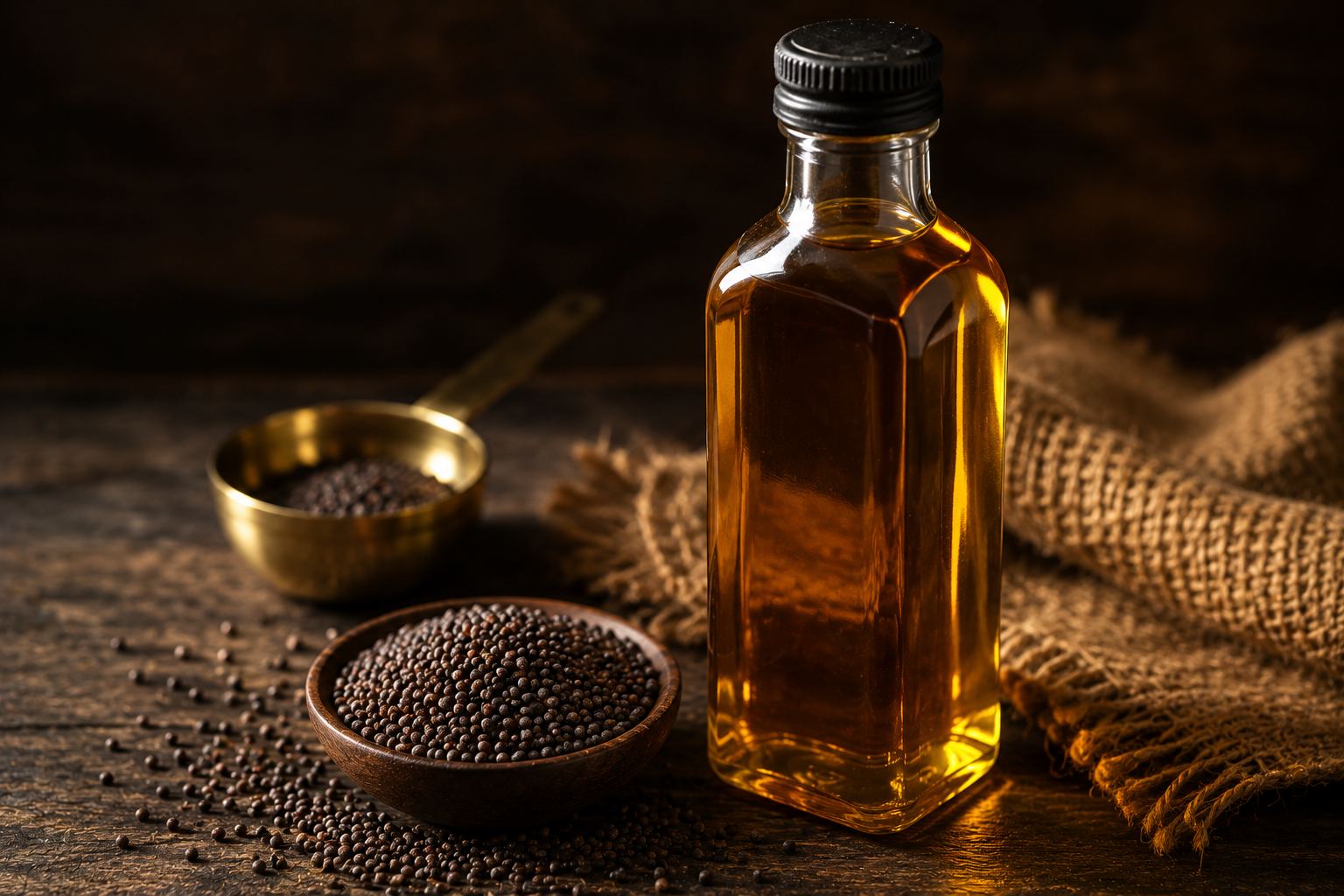
Mustard oil is pressed from the seeds of Brassica juncea (brown mustard) or Brassica nigra (black mustard). It is the defining cooking fat of Bengal and Punjab — in these regions it is not just a cooking medium but a cultural identity. Bengali cooking in mustard oil tastes unmistakably Bengali; Punjabi sarson ka saag cooked in mustard oil is a different dish from the same preparation made in refined oil.
Raw mustard oil has a sharp, pungent smell and flavour from allyl isothiocyanate. This must be driven off by heating the oil to its smoke point (around 250°C) before adding ingredients — this process, called 'burning the oil,' is essential in Bengali and Punjabi cooking. Once the sharp raw note dissipates and the oil lightens in colour, it is ready to use.
- Bengali fish curry (Shorshe Maach) is architecturally impossible without mustard oil — refined oil produces a categorically different dish
- Sarson Ka Saag in Punjab is cooked in mustard oil — the fat is integral to the dish's flavour, not merely a cooking medium
- Mustard oil pickles (achar) across North India use raw mustard oil as the preservative medium — its antimicrobial properties prevent spoilage
- Kachchi ghani (cold-pressed) mustard oil retains more aromatic compounds and is considered significantly superior to hot-pressed versions
- The pungency of mustard oil that Bengalis and Punjabis value as flavour is what makes it taste 'wrong' to those unaccustomed to it — it is a genuine regional flavour preference
Mustard Oil Through History
Mustard cultivation in India dates to the Indus Valley Civilisation (circa 3000 BCE), and mustard oil has been pressed from these seeds throughout that history. It was the primary cooking fat of the eastern and northern plains long before refined vegetable oils arrived in the 20th century.
The British colonial food system introduced refined vegetable oils as 'modern' and 'scientific,' marginalising traditional fats including mustard oil and ghee. Post-independence India saw a revival of traditional fats, but mustard oil's status in states that use it never actually diminished — Bengali and Punjabi home cooks continued using it throughout.
The European and American markets restrict mustard oil for food use due to erucic acid content — it is sold as 'for external use only' in the UK and USA, despite being one of India's primary traditional cooking fats. This regulatory asymmetry reflects different safety assessment approaches rather than demonstrated harm at culinary levels.
The Science of Mustard Oil
How to Store Mustard Oil
How to Buy Good Mustard Oil
How to Use Mustard Oil Correctly
- Heat to smoke point before using (240°C — 1–2 minutes on high heat)
- Wait for oil to lighten in colour and smoke to stop before adding ingredients
- For fish marinating: use raw (unheated) mustard oil — the pungency is intentional in marinades
- For pickles: use raw mustard oil — the allyl isothiocyanate acts as a preservative
- Quantity: use as the primary cooking fat — 2–3 tbsp per dish for 4 people
What Mustard Oil Pairs Well With
Dishes That Use Mustard Oil
Where Mustard Oil Matters Most
| Bengali Cuisine | Essential |
| Punjabi Cuisine | Essential |
| Bihari Cuisine | Essential |
| Rajasthani Cuisine | Common |
| North Indian Cuisine | Common |
| Odishan Cuisine | Common |
| South Indian Cuisine | Rare |
Mustard Oil vs Coconut Oil vs Groundnut Oil vs Ghee
| Feature | Mustard Oil | Coconut Oil | Groundnut Oil | Ghee |
|---|---|---|---|---|
| Smoke point | 250°C | 177°C | 230°C | 250°C |
| Raw pungency? | Yes — must burn off | No | No | No |
| Regional association | Bengal, Punjab | Kerala, South India | Gujarat, Maharashtra | All India |
| Flavour | Pungent, earthy | Coconut | Mild, nutty | Nutty, buttery |
| For fish? | Yes — essential in Bengal | Yes — Kerala | Occasionally | Yes |