★★★★★ Maharashtra (goda masala)
★★★☆☆ Bengal garam masala
What Does Stone Flower Taste Like?
Stone Flower in Every Indian Language
| Language | Name | Pronunciation |
|---|---|---|
| English | Stone Flower / Rock Flower | STONE FLOW-er |
| Hindi | दगड फूल — Dagad Phool | DAH-gad phool |
| Bengali | পাথর ফুল — Pathor Phool | PAH-thor phool |
| Tamil | கற்பாசி — Kalpasi | KAL-pah-see |
| Telugu | రాతి పువ్వు — Rati Puvvu | RAH-tee POO-voo |
| Malayalam | കൽക്കടൽ — Kalkadal | KAL-kah-dal |
| Kannada | ಕಲ್ಲು ಹೂವು — Kallu Hoovu | KAL-loo HOO-voo |
| Gujarati | દગડ ફૂલ — Dagad Phool | DAH-gad phool |
| Marathi | दगड फूल — Dagad Phool | DAH-gad phool — essential in goda masala |
| Punjabi | ਪੱਥਰ ਫੁੱਲ — Patthar Phull | PAH-thar phull |
| Urdu | داگد پھول — Dagad Phool | DAH-gad phool |
| Sanskrit | शैलेयम् — Shaileyam | SHY-leh-yum |
What Is Stone Flower?
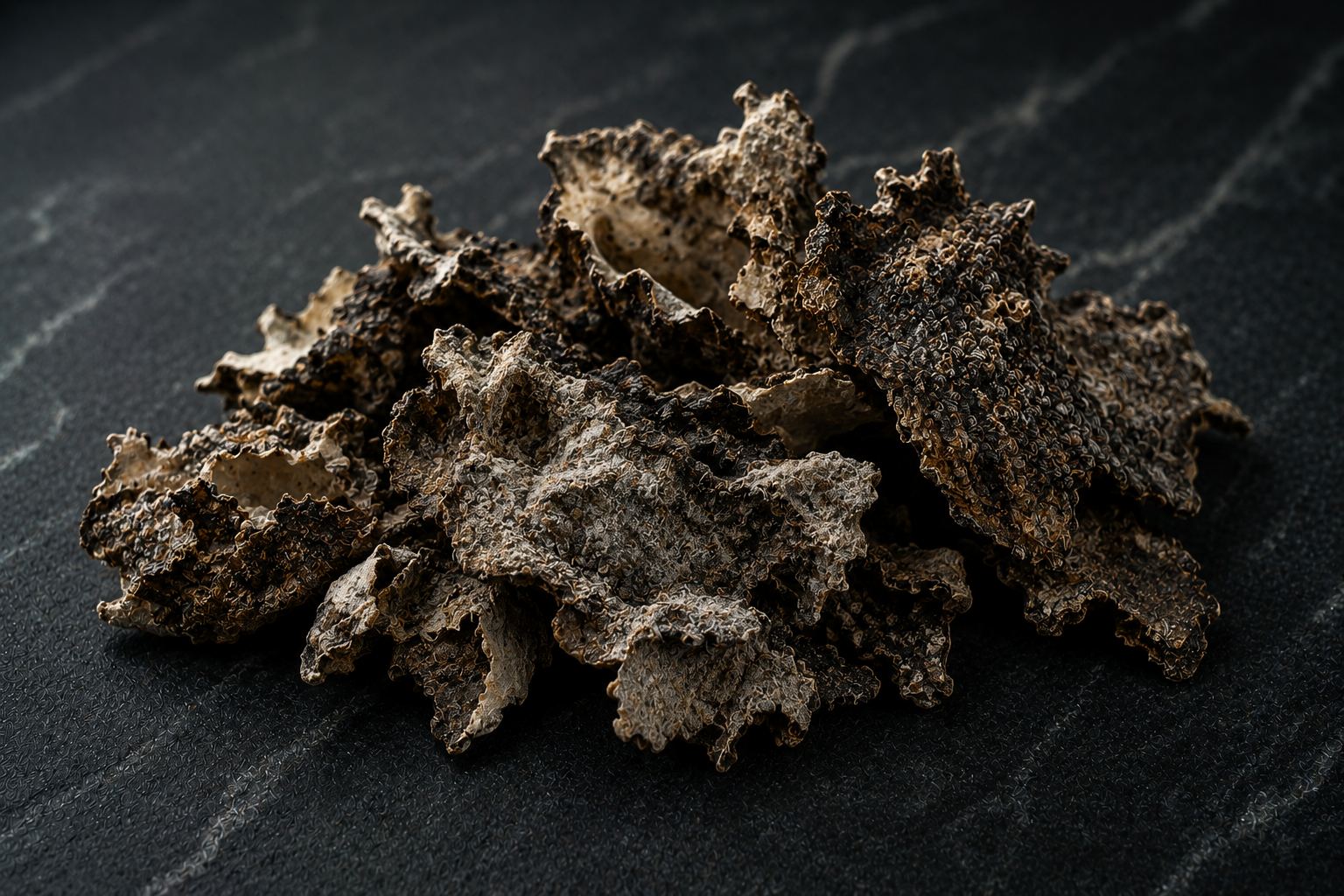
Stone flower — dagad phool — is not a flower at all. It is a lichen — the symbiotic organism formed by algae and fungi growing together, typically on rocks and tree bark in the Deccan Plateau and South India. In appearance it looks like flat, grey-brown dry patches or curly pieces. In Indian cooking, it is one of the most unusual and regionally specific ingredients — unknown to most North Indian home cooks but essential in Chettinad, Maharashtrian goda masala, and certain Bengali garam masala recipes.
The flavour contribution of stone flower is subtle — earthy, woody, slightly mossy — more a deepening and complexifying agent than a dominant note. It is often compared to a more delicate version of dried mushroom's umami contribution. In the spice blends where it appears, removing it produces a noticeably flatter result, even though identifying stone flower as a specific flavour in the finished dish is difficult.
- Chettinad cuisine's depth and complexity is partly attributed to stone flower in the master spice blend — it is one of the ingredients that makes chettinad cooking difficult to replicate
- Maharashtrian goda masala would be structurally incomplete without dagad phool — it contributes an earthy base note that other spices do not provide
- Bengali garam masala variations that include stone flower have a distinctly different, more complex character than those without
- The umami-adjacent quality of stone flower in slow-cooked preparations deepens the overall flavour in ways that are difficult to isolate but noticeable in absence
- As one of the most geographically specific Indian spice ingredients, stone flower is a genuine marker of regional culinary identity
Stone Flower Through History
Stone flower's use in Indian cooking likely developed through observation of its contribution to slow-cooked preparations — a cook or tradition would have discovered that adding these lichen pieces to long-cooked meat and spice preparations deepened the flavour in a particular way. The tradition is most developed in Chettinad (Tamil Nadu) and Maharashtra — two cuisines known for their complex, layered spice traditions.
The spice does not appear in ancient Sanskrit texts in the culinary context in the same way as other spices — suggesting its incorporation into Indian cooking may be relatively recent or was specific enough to not have reached the texts of the period. Its use remains highly regional today.
The Science of Stone Flower
How to Store Stone Flower
How to Buy Good Stone Flower
How to Use Stone Flower Correctly
- Add whole pieces to hot oil at the start of slow-cooked preparations — like biryani or Chettinad curry
- 1–2 small pieces per dish for 4 people
- For goda masala: include a few pieces in the spice blend
- For Chettinad preparations: dry-roast briefly before grinding into the masala
- Remove before serving — the pieces are not meant to be eaten
- Rinse briefly before use if very dusty
What Stone Flower Pairs Well With
Dishes That Use Stone Flower
Where Stone Flower Matters Most
| Chettinad Cuisine | Essential |
| Maharashtrian Cuisine | Essential |
| Bengali Cuisine | Occasional |
| Hyderabadi Cuisine | Occasional |
| North Indian Cuisine | Rare |
| South Indian Cuisine | Common |
Stone Flower vs Dried Mushroom vs Kokum (Umami/Depth Agents)
| Feature | Stone Flower | Dried Mushroom | Kokum |
|---|---|---|---|
| Type | Lichen | Fungus | Fruit skin |
| Flavour | Earthy, mossy, complex | Umami, meaty | Sour, fruity |
| Indian use | Regional — Chettinad, Maharashtra | Occasional | South India, Goa |
| Depth effect | Subtle, complex | Strong umami | Sour depth |
| Used whole? | Yes — in slow cooks | Yes | Yes |
| Remove before serving? | Yes | Usually | Yes |