Ingredient identity
Ingredient DNA
Urad Dal — Black Gram
Vigna mungo · Family: Fabaceae · Genus: Vigna
Origin
South Asia
Category
Dal (multiple forms)
Forms
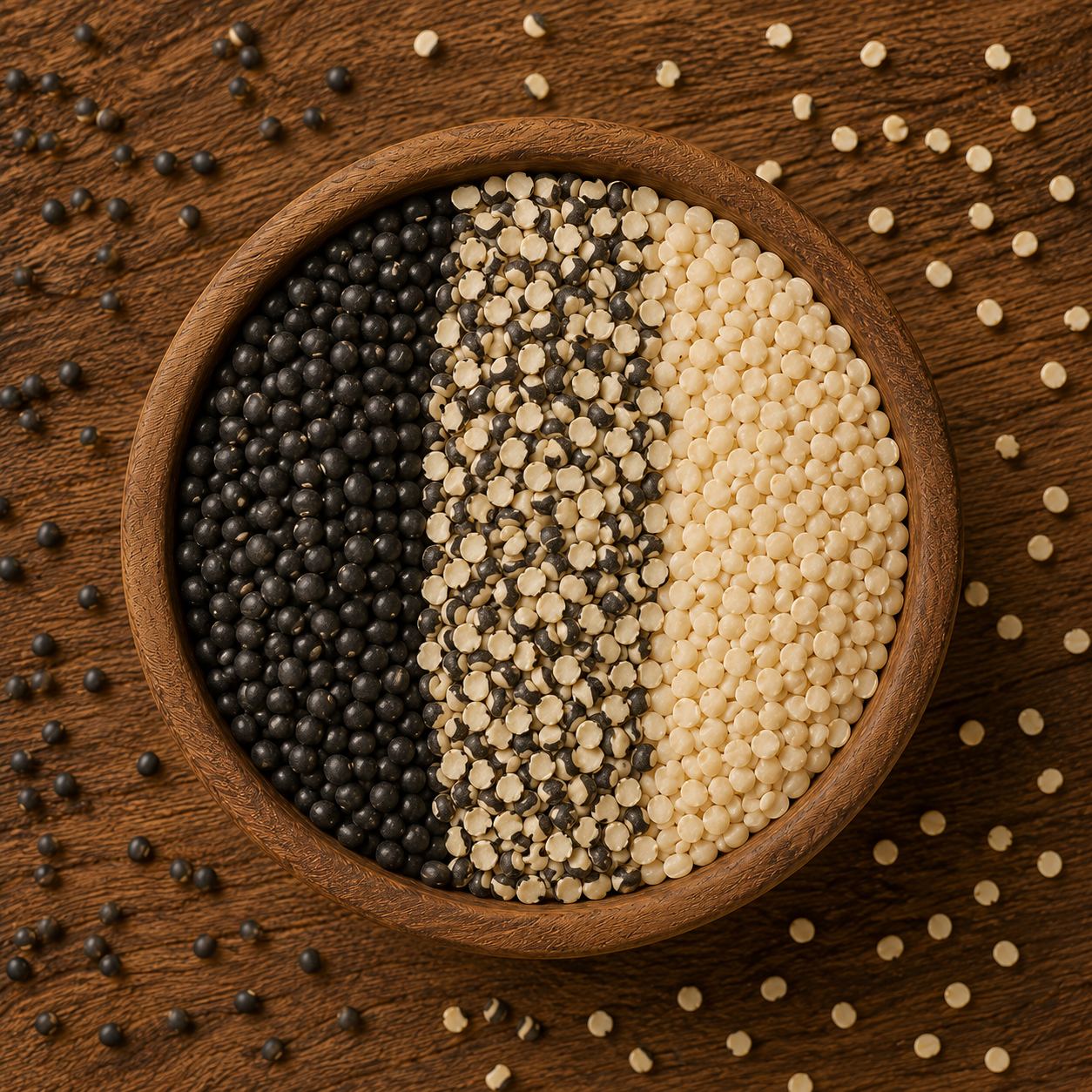
Whole black · Split skin-on · Split skinless (white)
Primary Uses
White: idli/dosa · Whole black: dal makhani · Split: tadka
Unique Property
High mucilage — creates idli batter's binding network
Protein
~25g per 100g dry
Taste profile
What Does Urad Dal Taste Like?
Flavour Profile — Urad Dal
Earthiness★★★☆☆
Creaminess★★★★☆
Nuttiness★★☆☆☆
Richness★★★★☆
Mildness★★★☆☆
Aroma Strength★★☆☆☆
Botanical classification
Kingdom
Plantae
Family
Fabaceae
Genus
Vigna
Species
Vigna mungo
Hindi Name
Urad Dal / Kaali Dal
Sanskrit Name
Masha
English Name
Urad Dal
Arabic Name
Adas Aswad
Names across India
Urad Dal in Every Indian Language
| Language | Name | Pronunciation |
|---|---|---|
| English | Black Gram / Urad | OO-rad |
| Hindi | उड़द दाल — Urad Dal | OO-rad DAL |
| Bengali | কলাই ডাল — Kalai Dal | KAH-lye DAL |
| Tamil | உளுந்து — Ulundu | oo-LOON-doo |
| Telugu | మినుములు — Minumulu | mee-NOO-moo-loo |
| Malayalam | ഉഴുന്ന് — Uzhunnu | oo-ZHOON-noo |
| Kannada | ಉದ್ದಿನ ಬೇಳೆ — Uddina Bele | OOD-dee-nah BEH-leh |
| Gujarati | અડદ ની દાળ — Adad Ni Dal | AH-dad nee DAL |
| Marathi | उडदाची डाळ — Udadhachi Dal | oo-DAD-ah-chee DAL |
| Punjabi | ਮਾਂਹ ਦੀ ਦਾਲ — Maah Di Dal | MAA DAL |
| Urdu | ماش دال — Mash Dal | MASH DAL |
| Sanskrit | माष — Masha | MAH-shah |
Origin and identity
What Is Urad Dal?
Urad dal (Vigna mungo) comes in three distinct forms: whole black urad (for dal makhani), split skin-on (for some dals), and split skinless white urad (for idli, dosa, vada). Each is used differently.
White urad dal has a unique high mucilage content essential for idli-dosa batter — it creates the fermentation substrate and binding network that allows idli to hold its shape when steamed. Without it, idli batter cannot rise or set.
What Indian Cooking Loses Without Urad Dal
- Idli and dosa — South India's most consumed foods — are impossible without white urad dal
- Dal makhani uses whole black urad cooked overnight — the extended cooking releases natural creaminess
- White urad fried in tadka (tiny golden-brown pieces) is a fundamental South Indian cooking technique
- Papad (poppadom) is made from urad dal flour
- Vada requires urad dal's sticky batter for its characteristic texture
Historical significance
Urad Dal Through History
Historical Record
South India's Foundation Lentil
Urad has been cultivated in India for at least 3,500 years. Sangam poetry of ancient Tamil Nadu references ulundu. Its role in idli-dosa preparation represents one of the oldest continuous food cultures in the world. Dal makhani's popularity was spread from the 1950s by restaurants like Moti Mahal in Delhi.
Cooking science
The Science of Urad Dal
Cooking Science
Fermentation — Why Urad Makes Idli Rise
Idli batter fermentation depends on Leuconostoc mesenteroides (bacteria) and Saccharomyces cerevisiae (yeast), naturally present on rice and urad. The mucilage provides a fermentable substrate and the gel network that traps CO2. Without urad's specific mucilage, fermentation produces CO2 but no structure to hold it — idli would be flat and dense.
Storage science
How to Store Urad Dal
Storage Reference
Whole black / split
18–24 months
Cooked
3–4 days
Idli batter (fermented)
2–3 days refrigerated
Buying guide
How to Buy Good Urad Dal
Technique
How to Use Urad Dal Correctly
Using Urad Dal in the Kitchen
Technique, quantity, and what to avoid
- Dal makhani: soak overnight, pressure cook 20–30 min, slow cook 4–8 hours with butter
- Idli batter: soak white urad 4–6 hours, grind smooth, ferment 8–12 hours
- Tadka: add split white urad to hot oil until golden before mustard seeds
- Vada: grind to thick fluffy batter, deep fry
- 1/4 cup white urad + 3/4 cup rice for idli (makes ~12–14 idli)
Pairings
What Urad Dal Pairs Well With
Best Pairings — Urad Dal
Famous dishes
Dishes That Use Urad Dal
Key Dishes Using Urad Dal
Dal Makhani
Punjab · Overnight black lentil
Whole black urad — primary
Idli
South India · Steamed rice cake
White urad — essential
Dosa
South India · Rice-lentil crepe
White urad — essential
Vada
South India · Savoury doughnut
White urad
Papad
All India · Lentil wafer
Urad flour
Medu Vada
South India · Fried doughnut
White urad
Regional use
Where Urad Dal Matters Most
Regional Importance
★★★★★
South India
Idli, dosa, vada foundation
★★★★★
Punjab
Dal makhani
★★★★★
All India
Papad, tadka everywhere
★★★★★
North India
Dal makhani and mash ki dal
Where Urad Dal Fits in Indian Cooking
| South Indian Cuisine | Essential |
| Punjabi Cuisine | Essential |
| All Indian Cuisines | Essential |
| Jain Cooking | Common |
| Sattvic Cooking | Common |
Comparison
Whole Black Urad vs White Split Urad
Whole Black Urad vs White Split Urad
| Feature | Whole Black Urad | White Split Urad |
|---|---|---|
| Colour | Dark brown-black | Pale cream-white |
| Skin on? | Yes | No |
| Primary use | Dal makhani · Slow cook | Idli batter · Tadka · Vada |
| Cooking time | Very long — overnight ideal | Quick — 2–3 min PC |
| Texture cooked | Rich, creamy, earthy | Sticky-smooth |
Nutrition
Nutrition and Key Compounds
Urad Dal — Honest Nutritional Picture
Culinary quantities — aromatic and flavour contribution, not macro nutrition
~25g protein per 100g dry — highest of all common Indian lentils. Exceptionally high calcium, iron, B vitamins.
Substitutions
Substitutes for Urad Dal
What Works and What Does Not
No substitute
For idli-dosa batter
Urad's mucilage is unique — no other lentil provides the fermentation substrate and binding.
No substitute
For dal makhani
Overnight cooking of whole black urad produces a natural creaminess no other lentil replicates.
Partial
Black-eyed peas (general dal)
Different flavour but acceptable.
People Also Search
Related Articles
Chef's notes
Practical Insight
From the Kitchen
For dal makhani, overnight cooking is non-negotiable. Pressure-cooked versions are faster but categorically different. Extended cooking slowly dissolves urad's starch, creating natural creaminess. Add butter and cream only in the last 30 minutes.