★★★★★ Kerala (grown)
★★★★★ Mughlai tradition
What Does Cloves Taste Like?
Cloves in Every Indian Language
| Language | Name | Pronunciation |
|---|---|---|
| English | Cloves | KLOHVZ |
| Hindi | लौंग — Laung | LOWN-g |
| Bengali | লবঙ্গ — Labongo | LAH-bong-go |
| Tamil | கிராம்பு — Kirambu | kih-RAHM-boo |
| Telugu | లవంగం — Lavangam | lah-VAHN-gum |
| Malayalam | ഗ്രാമ്പൂ — Grambu | GRUM-boo |
| Kannada | ಲವಂಗ — Lavanga | lah-VAHN-gah |
| Gujarati | લવિંગ — Laving | LAH-ving |
| Marathi | लवंग — Lavang | LAH-vung |
| Punjabi | ਲੌਂਗ — Laung | LOWN-g |
| Urdu | لونگ — Laung | LOWN-g |
| Sanskrit | लवंग — Lavanga | lah-VAHN-gah |
What Is Cloves?
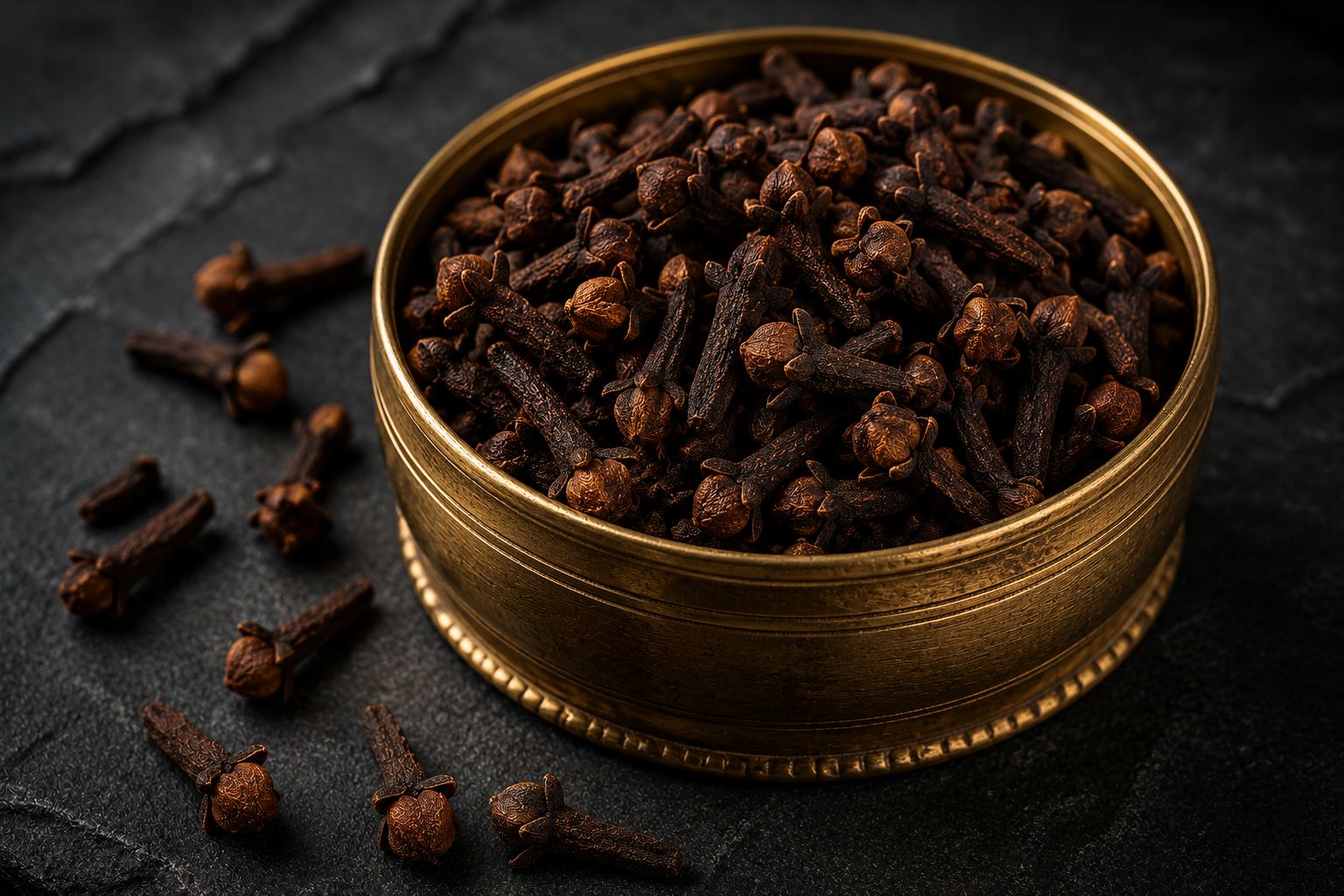
Cloves — laung — are the dried flower buds of Syzygium aromaticum, an evergreen tree originally from the Maluku Islands of Indonesia. They are among the most intensely aromatic substances in the entire spice world — a single clove contains enough eugenol to numb the tongue if bitten into, explaining their ancient use in dentistry for toothache relief.
In Indian cooking, cloves must be used with significant restraint — even half a clove too many will dominate an entire dish. They are essential in garam masala, biryani, and rice pilafs, where their role is to provide a warm, sweet-sharp aromatic backbone. They are always used whole in slow-cooked preparations and either whole or ground in spice blends.
- Garam masala's warm, aromatic backbone comes significantly from cloves — without them the blend tastes flat and incomplete
- Biryani rice cooked with whole cloves has a distinctive perfumed quality that cannot be replicated by other spices
- Kashmiri Wazwan and North Indian nihari use cloves as structural whole spices that hold their character across hours of cooking
- The numbing eugenol in cloves contributes to the overall warmth perception in slow-cooked meat dishes — distinct from chilli heat
- Chai in many North Indian and Kashmiri traditions includes a clove — a tradition that traces to Ayurvedic use of cloves for throat health
Cloves Through History
Cloves are native to the Maluku Islands (the original Spice Islands) of Indonesia — a fact that drove the European spice trade of the 15th and 16th centuries. However, cloves arrived in India via ancient Arab trade routes long before European involvement, and appear in Sanskrit medical texts as lavanga.
The Ayurvedic tradition valued cloves as a warming, antimicrobial, and digestive spice — uses now understood through cloves' high eugenol content, which has documented antimicrobial properties. Arab traders brought cloves to India and the Arab world from Indonesia, making them one of the most extensively traded spices in pre-colonial history.
In Kerala, cloves began to be cultivated as local production rather than imported, establishing the state as a producer of several previously imported spices. Mughal cuisine adopted cloves as a structural element of the elaborate spice blends required for court cooking.
The Science of Cloves
How to Store Cloves
How to Buy Good Cloves
How to Use Cloves Correctly
- Biryani: add 3–4 whole cloves to hot ghee at the start — they release quickly
- Garam masala: cloves form one of the primary components by aroma weight
- Rice pilaf: add 2 cloves per cup of rice to the cooking water
- Chai: add 1 clove per cup (maximum) — it dominates very easily
- Quantity: maximum 3–4 whole cloves per dish for 4 people — very concentrated
- Remove whole cloves before serving — biting into a whole clove is unpleasant
What Cloves Pairs Well With
Dishes That Use Cloves
Where Cloves Matters Most
| North Indian Cuisine | Essential |
| Mughlai Cuisine | Essential |
| Kashmiri Cuisine | Essential |
| South Indian Cuisine | Common |
| Bengali Cuisine | Essential |
| Jain Cooking | Common |
| Sattvic Cooking | Common |
Cloves vs Star Anise vs Cinnamon (Warm Spice Trio)
| Feature | Cloves | Star Anise | Cinnamon |
|---|---|---|---|
| Key compound | Eugenol (70–90%) | Anethole (80–90%) | Cinnamaldehyde (65–80%) |
| Flavour | Intensely warm, numbing | Sweet anise, warm | Sweet, warm, woody |
| Use rate | Very small — 3–4 pieces | Small — 1–2 pods | Moderate — 1 stick |
| Indian biryani? | Essential | Optional in some versions | Essential |
| In chai? | Yes — 1 only | Rarely | Yes |
| Overpowering risk | Very high | Medium | Medium |