Ingredient identity
Ingredient DNA
Masoor Dal — Red Lentil
Lens culinaris · Family: Fabaceae · Genus: Lens
Origin
Middle East — ancient
Category
Dal (split)
Form
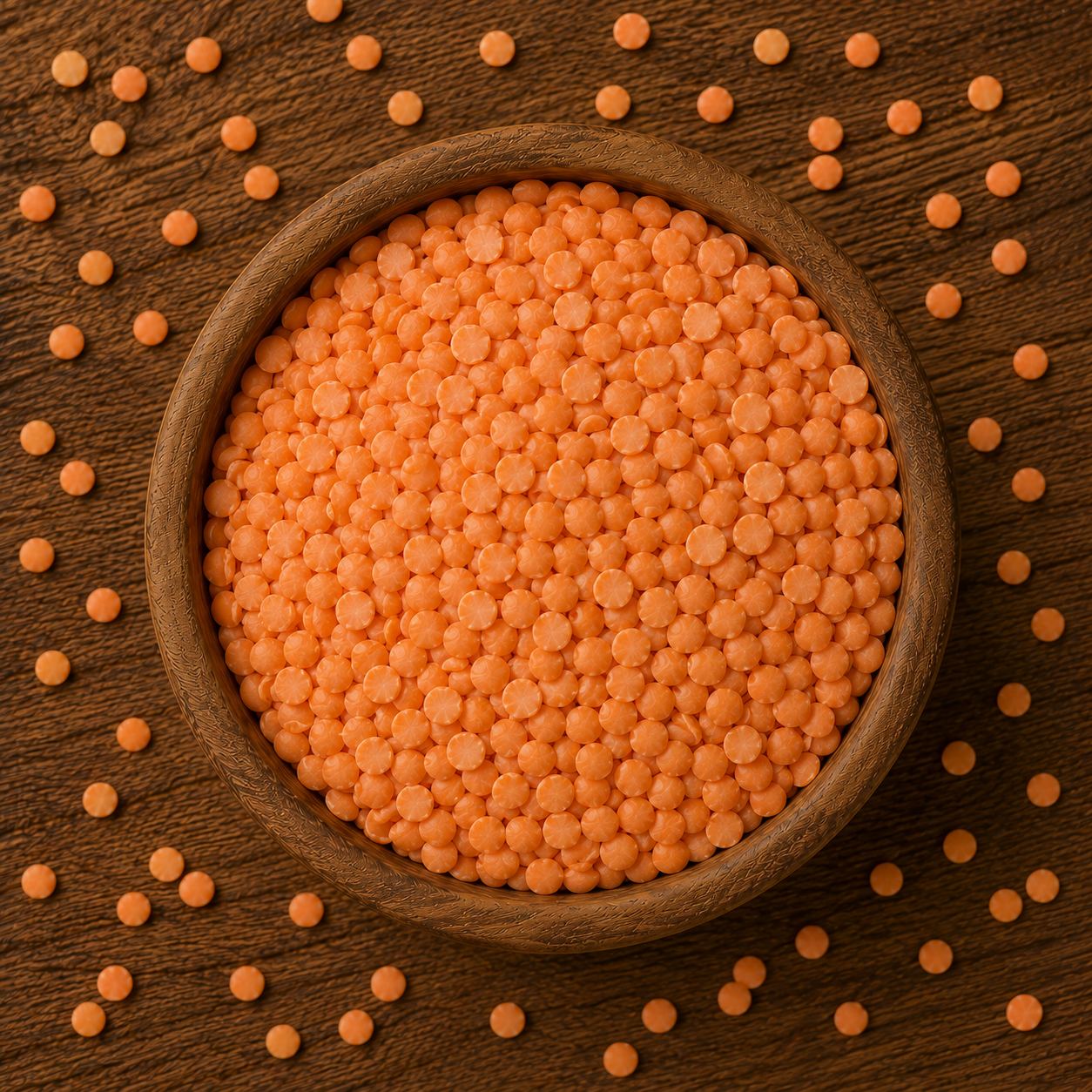
Small flat salmon-pink split lentils
Primary Use
Quick everyday dal · Bengali preparation · Soups
Cooking Time
15 min (no soaking) / 2 min (PC)
Protein
~26g per 100g dry
Taste profile
What Does Masoor Dal Taste Like?
Flavour Profile — Masoor Dal
Earthiness★★☆☆☆
Nuttiness★★☆☆☆
Creaminess★★★★☆
Mildness★★★☆☆
Sweetness★☆☆☆☆
Aroma Strength★☆☆☆☆
Botanical classification
Kingdom
Plantae
Family
Fabaceae
Genus
Lens
Species
Lens culinaris
Hindi Name
Masoor Dal / Lal Masoor
Sanskrit Name
Masura
English Name
Masoor Dal
Arabic Name
Adas Ahmar
Names across India
Masoor Dal in Every Indian Language
| Language | Name | Pronunciation |
|---|---|---|
| English | Red Lentil | MAH-soor DAL |
| Hindi | मसूर दाल — Masoor Dal | MAH-soor DAL |
| Bengali | মসুর ডাল — Masur Dal | MAH-soor DAL |
| Tamil | மைசூர் பருப்பு — Mysoor Paruppu | my-SOOR PAH-roo-poo |
| Telugu | మసూర్ పప్పు — Masoor Pappu | MAH-soor PAP-poo |
| Malayalam | മസൂര് — Masur Parippu | MAH-soor PAH-rip-poo |
| Kannada | ಮಸೂರ ಬೇಳೆ — Masoora Bele | MAH-soo-rah BEH-leh |
| Gujarati | મસૂર ની દાળ — Masur Ni Dal | MAH-soor nee DAL |
| Marathi | मसूर डाळ — Masur Dal | MAH-soor DAL |
| Punjabi | ਮਸਰ ਦਾਲ — Masar Dal | MAH-sar DAL |
| Urdu | مسور دال — Masoor Dal | MAH-soor DAL |
| Sanskrit | मसूर — Masura | MAH-soo-rah |
Origin and identity
What Is Masoor Dal?
Masoor dal is the split, skinless form of Lens culinaris — the common lentil. Small, flat, salmon-pink. Fastest cooking of all Indian lentils: no soaking required, stove-cooked in 15–20 minutes, pressure-cooked in 2 minutes.
Its mild, slightly earthy flavour makes it the most accessible everyday dal. Particularly popular in North India and Bengal, where Bengali masoor dal — cooked with tomatoes and simple cumin-ginger tadka — is a beloved everyday preparation.
What Indian Cooking Loses Without Masoor Dal
- No soaking, 15-minute cooking — most practical for quick weekday meals
- Bengali masoor dal with tomatoes showcases the dal's own mild earthiness
- For new cooks, masoor's forgiving behaviour makes it the ideal starting lentil
- Outside India, masoor dal is the most recognisable Indian lentil — 'red lentil dal' in Western cooking is almost always masoor
Historical significance
Masoor Dal Through History
Historical Record
One of the World's Oldest Cultivated Crops
Lentils (Lens culinaris) are among the world's oldest food crops — cultivation evidence from Fertile Crescent dating to 8500 BCE. In India, masoor has a long history though less central than toor or urad to the most ancient South Asian traditions.
Cooking science
The Science of Masoor Dal
Cooking Science
Why Masoor Cooks So Fast
Masoor's thin, flat profile and lack of outer skin allows water to penetrate starch granules rapidly. The small surface area-to-volume ratio allows uniform heat penetration. The starch gelatinises throughout almost simultaneously — unlike toor or chana where outer layers gelatinise before the centre. This is why masoor cooks from dry in 15 minutes while others require 30–45.
Storage science
How to Store Masoor Dal
Storage Reference
Dried
18–24 months
Cooked
3–4 days
Note
Store in airtight container away from heat and light
Buying guide
How to Buy Good Masoor Dal
Technique
How to Use Masoor Dal Correctly
Using Masoor Dal in the Kitchen
Technique, quantity, and what to avoid
- No soaking — rinse and cook directly
- Boil: 15–20 minutes with 3 parts water
- Pressure cook: 2 minutes
- Bengali style: add tomatoes during cooking, finish with cumin-ginger tadka
- 1/2 cup dry per 2 servings
Pairings
What Masoor Dal Pairs Well With
Best Pairings — Masoor Dal
Famous dishes
Dishes That Use Masoor Dal
Key Dishes Using Masoor Dal
Masoor Dal Tadka
North India · Red lentil dal
Primary lentil
Bengali Masoor Dal
Bengal · Simple tomato preparation
Primary lentil
Masoor Soup
All India · Lentil soup
Primary
Daal (British-Indian)
UK · Indian cuisine
Most common lentil used
Regional use
Where Masoor Dal Matters Most
Regional Importance
★★★★★
North India
Quick everyday dal
★★★★★
Bengal
Masoor with tomato — beloved
★★★★☆
All India
Fast and versatile
Where Masoor Dal Fits in Indian Cooking
| North Indian Cuisine | Essential |
| Bengali Cuisine | Essential |
| All Indian Cuisines | Common |
| Jain Cooking | Essential |
| Sattvic Cooking | Essential |
Comparison
Masoor Dal vs Toor Dal vs Moong Dal
Masoor Dal vs Toor Dal vs Moong Dal
| Feature | Masoor Dal | Toor Dal | Moong Dal |
|---|---|---|---|
| Cooking time | Fastest — 15 min | Medium — 30–45 min | Fast — 20–25 min |
| Soaking needed? | No | Optional | No |
| For sambhar? | Not traditional | Yes | Not traditional |
| Texture | Creamy, smooth | Creamy | Very smooth |
| Protein/100g | ~26g (highest) | ~22g | ~24g |
Nutrition
Nutrition and Key Compounds
Masoor Dal — Honest Nutritional Picture
Culinary quantities — aromatic and flavour contribution, not macro nutrition
~26g protein — highest of common split Indian lentils. 60g carbohydrate, 11g fibre. High in folate, iron, manganese.
Substitutions
Substitutes for Masoor Dal
What Works and What Does Not
Good substitute
Moong dal
Similar texture and speed.
Good substitute
Toor dal (with soaking)
Different flavour, works in most preparations.
People Also Search
Related Articles
Chef's notes
Practical Insight
From the Kitchen
Masoor dal is the best starting lentil for new cooks — no soaking, forgiving, quick. Bengali preparation (masoor + tomatoes, cumin-ginger tadka, ghee drizzle) is one of the simplest and most satisfying dals in the entire repertoire.