Indian Food Atlas · Level 1
The Cultural Shaper
Why Religion Changed Indian Food
Six religious traditions, six dietary systems, one subcontinent — how faith shaped what a billion people eat, cook, and consider sacred.
Six religious traditions, six dietary systems, one subcontinent — how faith shaped what a billion people eat, cook, and consider sacred.
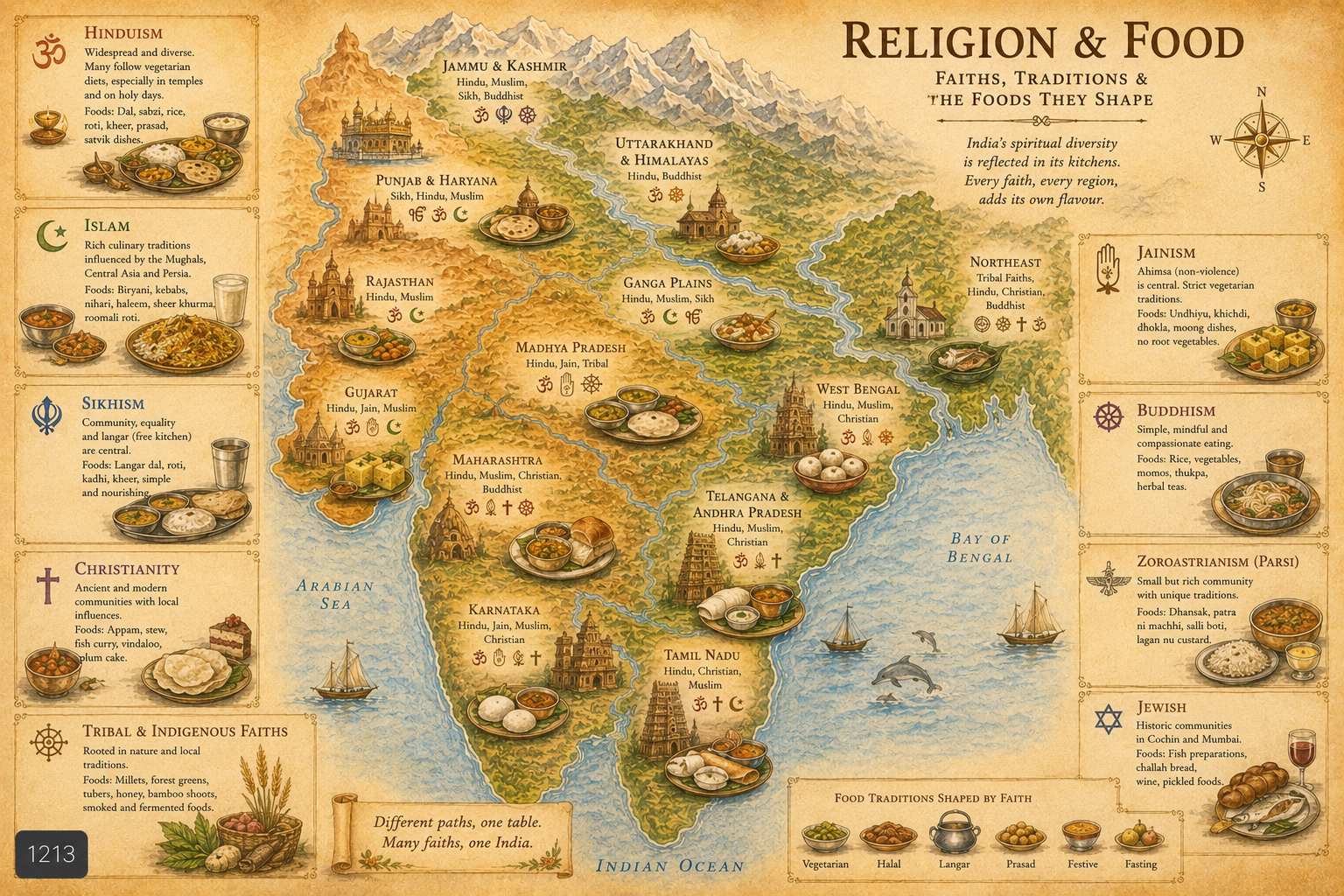
Of all the forces that shaped Indian regional food — climate, geography, trade routes, colonialism — religion is the most pervasive and the most specific. Climate determines what can be grown; religion determines what can be eaten. In India, where six major religious traditions have coexisted for millennia, each with specific dietary laws, prohibitions, and food-related practices, the result is the world's most religiously diverse food landscape. Understanding what each tradition permits, prohibits, and prescribes explains more about regional Indian food variation than any other single factor.
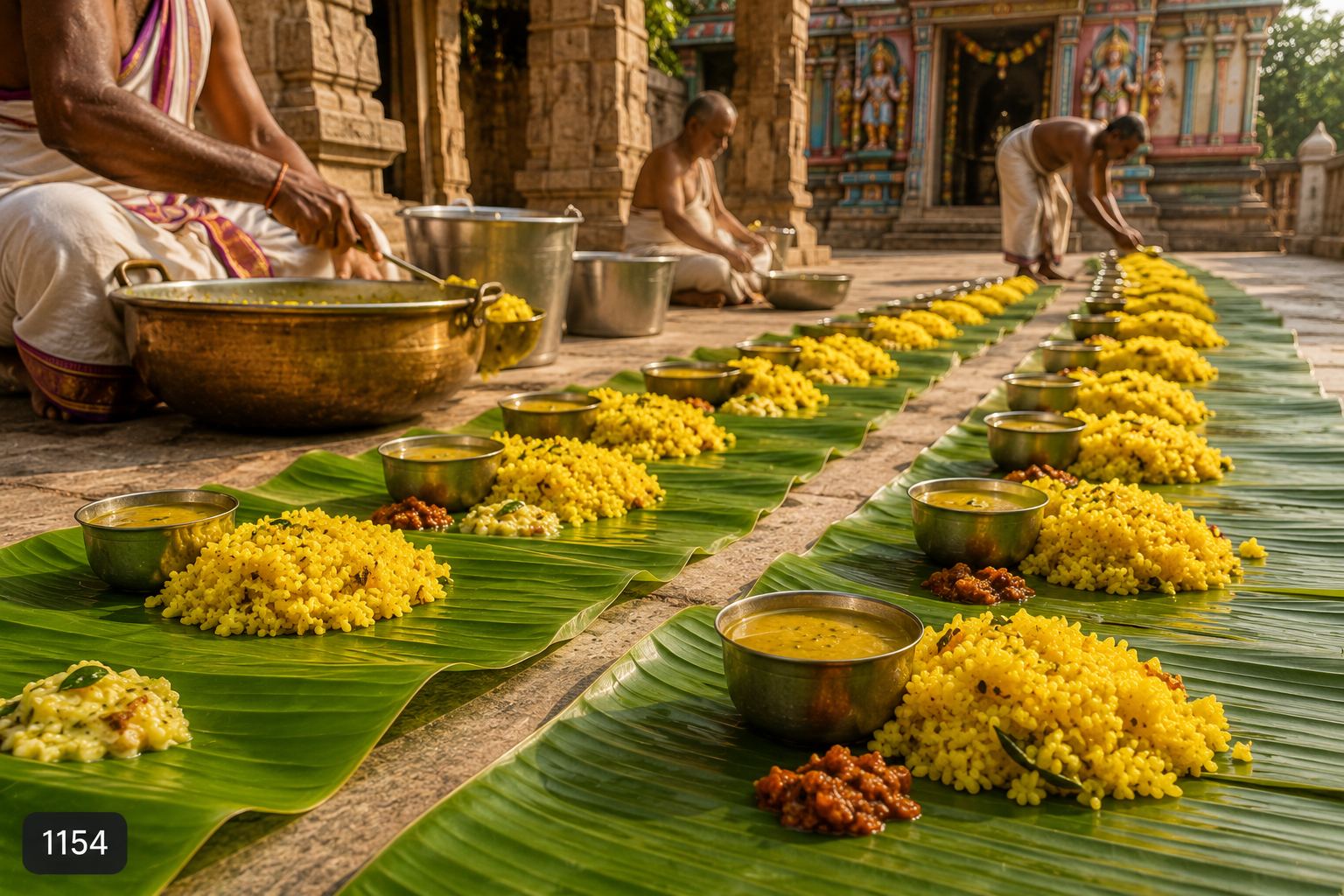
Hinduism has no single dietary code. What a Hindu may or may not eat varies by sect, region, caste, family tradition, and personal practice — producing more internal food diversity than any other religious tradition. This is both its complexity and its culinary contribution: it accommodated regional food cultures rather than overriding them.
| Community | Typical Practice | Culinary Contribution |
|---|---|---|
| Brahmin (South Indian Iyer/Iyengar) | Strictly vegetarian, no onion or garlic (Iyengar); no meat, fish, or egg | Tamil Nadu's most refined vegetarian tradition — sambhar, rasam, kootu, payasam — centuries of vegetarian cooking within strict constraint |
| Brahmin (Kashmiri Pandit) | Vegetarian but eat fish; use asafoetida (hing) instead of onion/garlic | Unique tradition — vegetarian framework but fish-eating; produces distinctly flavoured Kashmiri vegetarian cooking using hing as the aromatic base |
| Vaishnava (across India) | Vegetarian; many avoid onion and garlic (considered tamasic) | Drove the Gujarati and Rajasthani pure vegetarian traditions; the sattvic cooking philosophy that avoids stimulating foods |
| Nair, Mudaliar, Vellalar (South India) | Fish and meat-eating; beef avoided; pork variable | South Indian non-vegetarian tradition — fish curries, chicken preparations, the non-vegetarian complement to Brahmin cooking |
| Rajput (Rajasthan) | Meat-eating including game; no beef; elaborate hunting tradition | Laal maas, safed maas, royal Rajasthani game preparations — the Rajput warrior food tradition |
Beef is prohibited in most Hindu practice — not by a single ancient law but by the gradual elevation of the cow to sacred status over centuries of agricultural dependence. The cow was the most valuable agricultural animal: it provided milk, butter, ghee, and dung (fuel and fertiliser) while alive; beef only at death. Protecting the living cow was economically rational in a subsistence agriculture economy. This economic logic became religious prohibition; the prohibition became cultural identity; the identity is now constitutionally protected in most Indian states. The food consequence: India is the world's largest producer and consumer of milk — and the world's largest population with a beef prohibition — both consequences of the same historical logic.
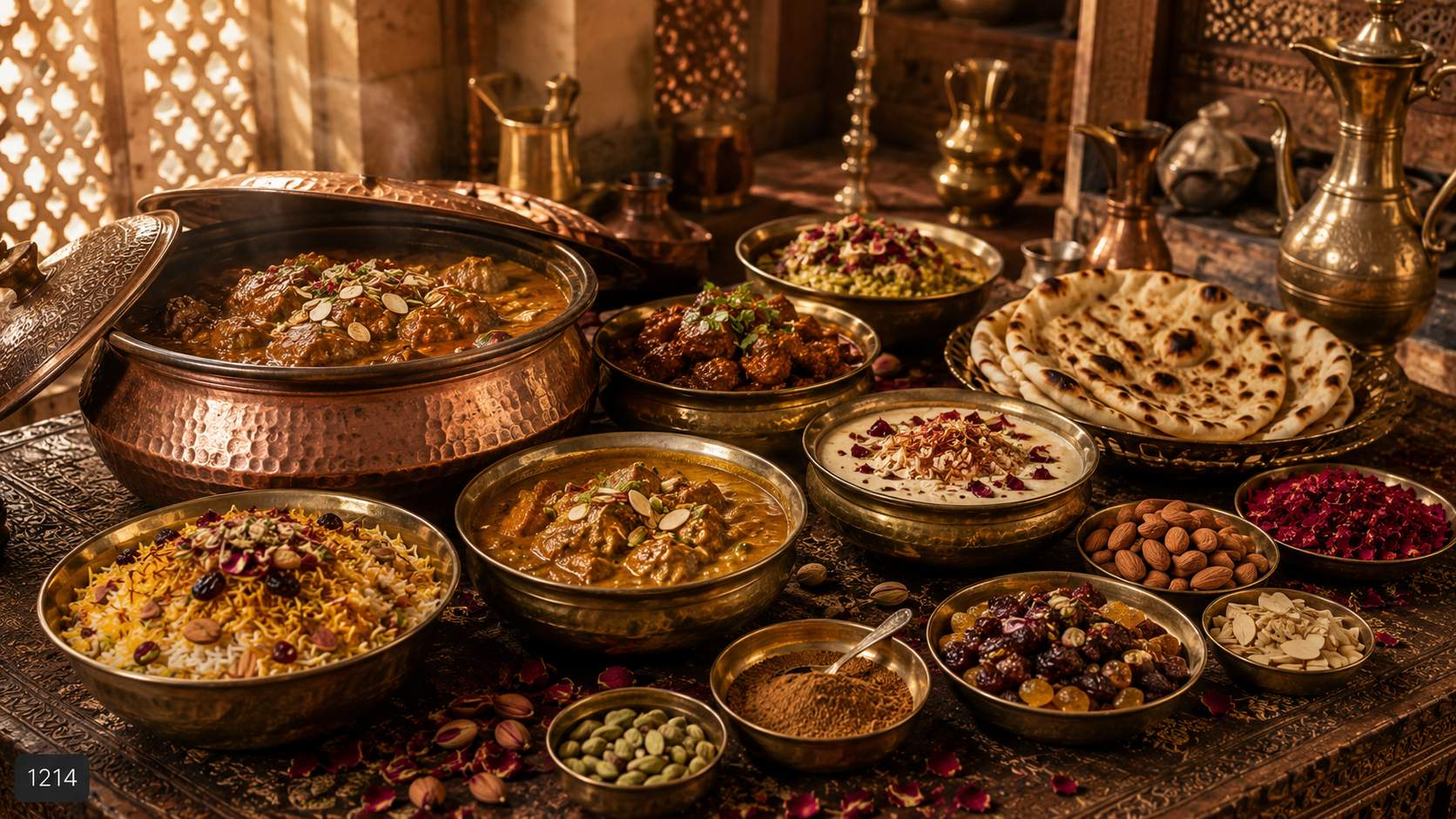
Islam arrived on India's west coast via Arab traders in the 7th century CE — centuries before the Mughal Empire that most people associate with Islamic influence on Indian food. Two distinct traditions emerged: the refined Mughal court cooking of the north, and the Arab-influenced coastal cooking of the Malabar Muslims (Moplah community). Together they created the most internationally influential strand of Indian food.
The Mughal court at Delhi and Agra (1526–1857) was the single most culturally influential institution in North Indian food history. Persian-speaking, Central Asian in origin, and Muslim in practice, the Mughals brought dum cooking (slow-cooking in sealed vessels), layered rice preparations (biryani), ground nut-and-dried-fruit enriched sauces, and the kebab tradition that now defines North Indian restaurant cooking globally. The menu of the average North Indian restaurant anywhere in the world is substantially Mughal court cooking, filtered through several centuries and democratised.
Jainism's central principle is ahimsa (non-violence) — extended to include not only animals but plants with multiple lives (root vegetables, where harvesting kills the plant and potentially disturbs underground organisms). The result is the most rigorous dietary philosophy in the world, and paradoxically, one of the most creative and refined.
| Category | Status | Reason |
|---|---|---|
| Meat, fish, egg | ❌ Prohibited | Involves killing animals — direct violence |
| Root vegetables (onion, garlic, potato, carrot, radish, beet) | ❌ Prohibited | Harvesting kills the entire plant; root contains infinite lives; disturbs underground organisms |
| Eating after sunset | ❌ Prohibited | Insects drawn to light may be inadvertently consumed; insects die in cooking fires after dark |
| Multi-seeded fruits (figs, brinjal/aubergine — in strict practice) | ⚠️ Avoided by many | Multiple seeds = multiple potential lives destroyed |
| Above-ground vegetables, lentils, dairy, grains | ✅ Permitted | Harvesting does not kill the plant; no underground disturbance |
Jain cooking is often described as "restrictive." It is more accurately described as extraordinarily creative within its constraints. Without onion or garlic as flavour bases — the foundation of most Indian cooking — Jain cooks developed hing (asafoetida), dried ginger, cumin, and careful layering of permitted spices to achieve depth of flavour. Without root vegetables, they elevated above-ground vegetables, lentils, and dairy to the centre of the plate. The constraint produced innovation. Gujarati Jain cooking, in particular, is among India's most technically sophisticated vegetarian traditions — not despite its restrictions but because of them.
The Sikh concept of langar — the free community kitchen attached to every gurdwara — is one of the most extraordinary food institutions in the world, and the single most powerful example of religion directly shaping a food culture's values rather than just its ingredients.
Indian Christianity is not colonial Christianity. The Syrian Christian (Nasrani) community of Kerala claims conversion by St Thomas the Apostle in 52 CE — making them one of the world's oldest continuously practicing Christian communities, predating most European Christianity. Their food traditions developed over two millennia within Kerala's food culture, producing a cuisine entirely distinct from what most people associate with Christian influence on Indian food.
Buddhism's dietary influence in India is concentrated in two areas: the Northeast states (Nagaland, Manipur, Mizoram, Meghalaya, Arunachal Pradesh, Sikkim) where Theravada and Tibetan Buddhist traditions intersect with tribal food cultures, and the Ambedkarite Buddhist communities of Maharashtra who converted from Dalit backgrounds following B.R. Ambedkar's conversion in 1956.
Unlike Jainism, Buddhism has no universal dietary prohibition on meat. The Buddha himself ate meat when it was offered. Different Buddhist traditions have different practices: Chinese and Vietnamese Buddhism tends toward strict vegetarianism; Tibetan Buddhism permits meat (historically necessary in cold high-altitude climates with limited vegetable agriculture); Theravada Buddhism allows eating meat when the animal was not killed specifically for the monk. In India's Northeast, where Buddhist practice coexists with tribal hunting and foraging traditions, Buddhist communities often eat meat. The idea of Buddhism as automatically vegetarian is a simplification that does not reflect Indian Buddhist practice.
| Tradition | Beef | Pork | Fish | Vegetarian by Default | Defining Food Contribution |
|---|---|---|---|---|---|
| Hinduism | ❌ Most avoid | ⚠️ Variable | ✅ Most eat | ⚠️ Variable — Brahmin yes, most no | Sattvic cooking, temple food, the vegetarian mainstream of India |
| Islam | ✅ Mainstream | ❌ Prohibited | ✅ Permitted | No — meat-centred | Mughal court cuisine, biryani, kebab, Hyderabadi and Lucknawi traditions |
| Jainism | ❌ Prohibited | ❌ Prohibited | ❌ Prohibited | Yes — the strictest vegetarianism | Above-ground vegetarian cooking, hing-based flavouring, Gujarat's pure vegetarian cuisine |
| Sikhism | ⚠️ Most avoid | ⚠️ Most avoid | ✅ Most eat | ⚠️ Langar is vegetarian; personal practice varies | Langar food culture, Punjabi food generosity, the community kitchen tradition |
| Christianity (Syrian) | ✅ Mainstream | ✅ Mainstream | ✅ Central | No | Kerala beef and duck tradition, appam with stew, fish molee |
| Buddhism | ⚠️ Variable | ⚠️ Variable | ✅ Most eat | ⚠️ Variable by tradition | Northeast tribal-Buddhist food fusion, fermented food traditions |
The most interesting food spaces in India are often where multiple religious food traditions coexist and negotiate. Kerala is the clearest example: Hindu sadya, Syrian Christian beef roast, and Moplah Muslim biryani coexist within the same small state, each maintaining its identity while sharing ingredients (coconut, curry leaves, mustard seeds, black pepper) and cooking techniques. The shared table is not compromise — it is diversity operating in parallel.
India is widely perceived internationally as a vegetarian country. The reality: approximately 70–80% of Indians eat meat, fish, or eggs. The vegetarian perception comes from two sources: the global visibility of Gujarati and Punjabi restaurant culture (both communities have strong vegetarian traditions), and the outsized influence of Brahmin and Jain vegetarian philosophy on Indian food writing. The great meat-cooking traditions of India — Mughal biryani, Hyderabadi haleem, Kerala fish curry, Chettinad chicken, Bengali fish — are mainstream Indian food practice, not exceptions. The misconception has persisted because the loudest voices in Indian food culture have historically been from vegetarian communities.