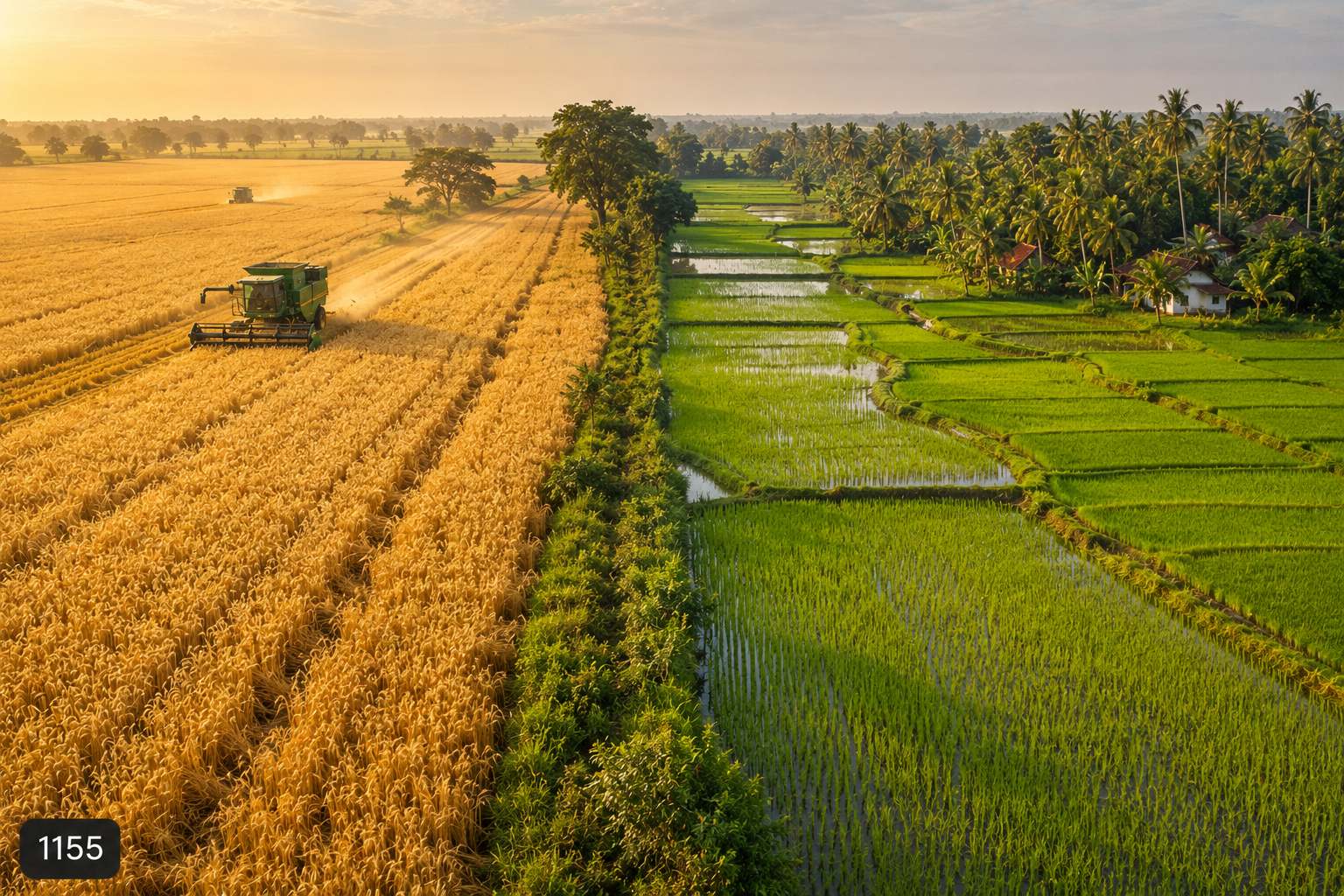
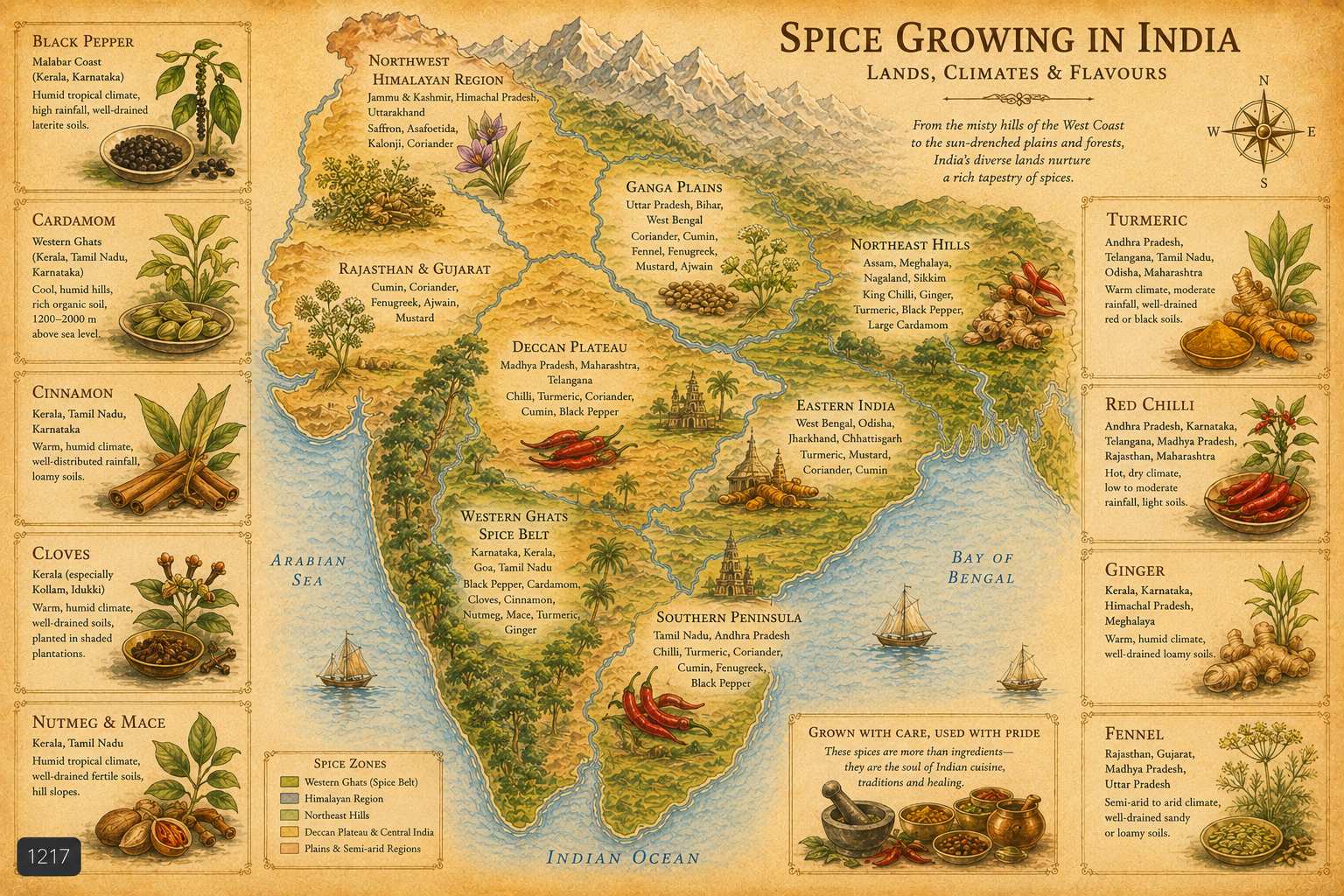
If you drew one line across India that explained the most food differences, it would be a rainfall line — separating rice country from wheat country. Everything else follows from that.
⏱ 14 min read🗓 Updated June 2026★ Level 1 Atlas
The fundamental divide
The line that splits India's food in two
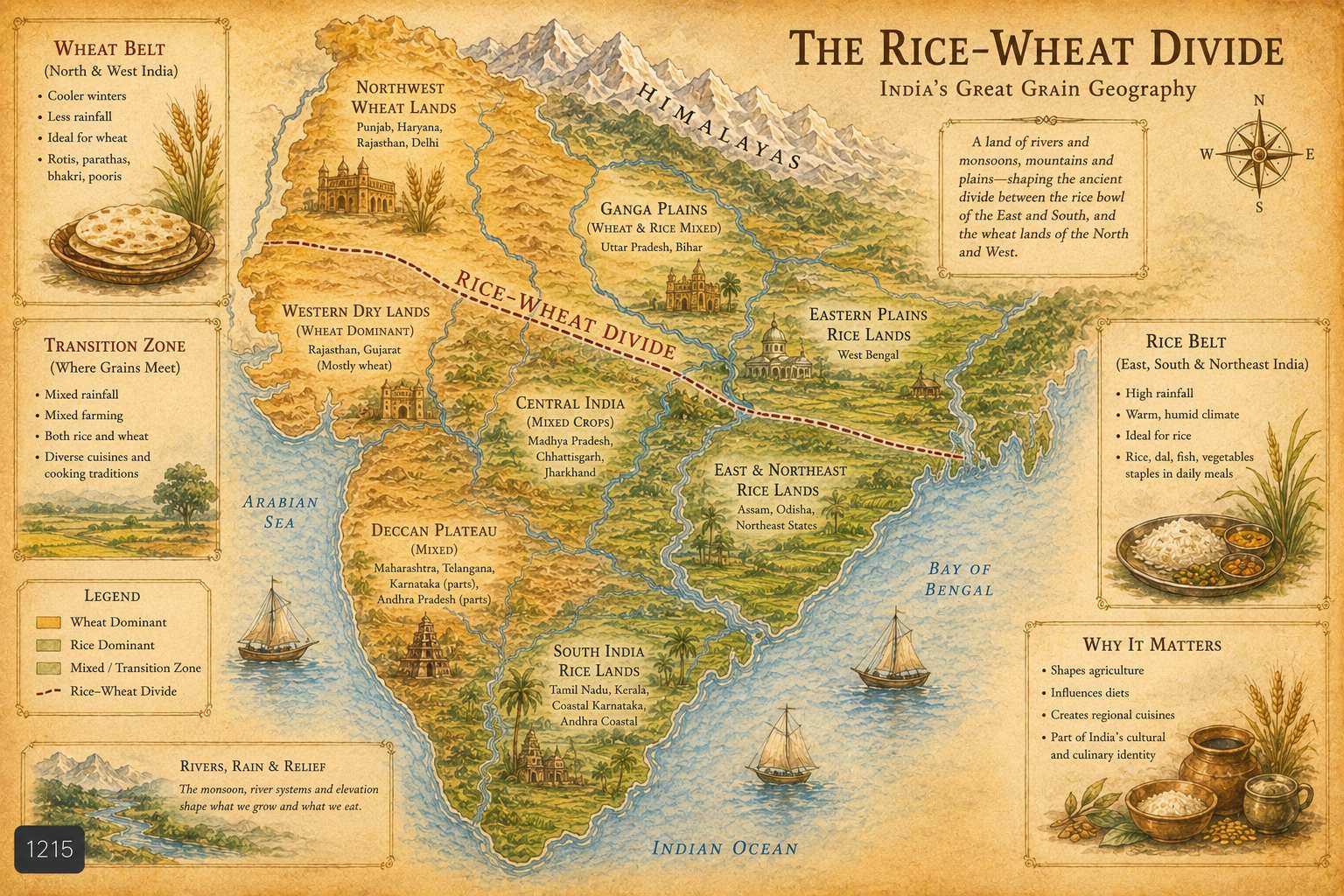
If you drew a single line across India that explained the most food differences, it would not be a cultural or religious line — it would be a climate and rainfall line that separates rice-growing country from wheat-growing country. This divide runs roughly diagonally across the subcontinent, from Gujarat in the west to West Bengal in the east, and everything about the meal on either side of it is different: the staple grain, the cooking fat, the spice base, the vegetable selection, the acid source, and even the structure of the plate. Understanding this divide is the single most useful piece of food geography for understanding Indian cuisine.
Two crops, two rainfall requirements, one food geography divide
Rice (Oryza sativa) requires standing water for 3–6 months of its growing cycle — it needs 1,000–2,000mm of annual rainfall or equivalent irrigation. It prefers warm temperatures (22–32°C) and high humidity. The regions of India that receive high seasonal monsoon rainfall — the coastal belt and river deltas — developed rice agriculture naturally.
Wheat (Triticum aestivum) needs only 450–650mm of annual rainfall and prefers cooler growing temperatures (15–20°C) during grain development. It cannot survive waterlogging. The drier, cooler Indo-Gangetic plain — irrigated by the five Punjab rivers — is ideal wheat territory.
Millets (jowar, bajra, ragi) need even less water than wheat — 250–500mm — making them the crops of the semi-arid Deccan and Thar zones that neither rice nor wheat can serve reliably.
This agricultural reality, established over 8,000+ years of cultivation, became the dietary foundation that every other food difference was built upon.
The rice-wheat-millet divide mapped across India. The monsoon line — where annual rainfall drops below 1,000mm — is the agricultural boundary that became the most important food geography line in the country.
🍚
The rice belt
Where rice is the centre of the plate
The rice belt encompasses the entire coastal and southern periphery of India — Kerala, Tamil Nadu, coastal Karnataka, coastal Andhra Pradesh, Odisha, West Bengal, and the Northeast. In these regions, rice is not simply a carbohydrate accompaniment — it is the structural centre of the meal. Everything else is designed to work with it.
Sambhar, rasam, kootu, poriyal are all designed to be mixed into rice — the meal is the rice with accompaniments, not accompaniments with rice on the side
Kerala
Red rosematta rice, white rice, rice flour for appam and puttu
Sadya — up to 28 preparations on a banana leaf, all served alongside rice as the centre
Fish curry and rice — the combination is structural: the fish curry is watery enough to be mixed into rice and eaten together
Odisha
Pakhala — fermented rice soaked in water, eaten cold
Unique rice preparation — fermented overnight, eaten with accompaniments as a cooling summer meal
Northeast
Sticky rice, black rice, red rice — enormous variety
Rice is often eaten with hands, formed into balls, or wrapped in leaves — different physical relationship with the grain than mainland rice culture
Why Rice Demands Liquid Accompaniments
In a rice-based meal, accompaniments must be liquid or semi-liquid — because liquid clings to rice and creates a unified mouthful, while solid accompaniments fall off. This is why sambhar is thin, rasam is even thinner, fish curry is watery, and dal in South India is more liquid than dal in the North. The physical properties of rice determine the consistency of everything served alongside it. This is not a stylistic choice — it is a mechanical requirement of the grain. Change the grain to wheat and the same logic produces thick dals, chunky sabzis, and solid chutneys — because bread needs something it can scoop.
🫓
The wheat belt
Where bread is the centre of the plate
The wheat belt encompasses the Indo-Gangetic plain — Punjab, Haryana, UP, Rajasthan, parts of Madhya Pradesh and Gujarat. In these regions, wheat bread (roti, paratha, naan, puri, kulcha) is the structural centre of the meal. Rice, where eaten, is a secondary preparation — a comfort food or festival dish rather than the daily staple.
Transition zone — rice eaten but bread dominates; thepla is portable (dries without spoiling) reflecting the merchant travel tradition
🌾
The forgotten third grain
The millet belt — India's oldest food tradition
Between the rice belt and the wheat belt lies a millet zone that predates both — the semi-arid Deccan plateau and Thar desert where jowar (sorghum), bajra (pearl millet), and ragi (finger millet) have been grown for at least 4,000 years. Millets are the oldest cultivated grains on the subcontinent, and the most nutritionally complete. They were displaced from prestige by rice and wheat but never abandoned by communities who still grow them.
Why Millets Survived
Drought-resistant, nutritious, ancient — the grain the Deccan never abandoned
Jowar (sorghum) and bajra (pearl millet) require only 250–500mm of rainfall and survive in poor soils. In the semi-arid Deccan (interior Maharashtra, Karnataka, Andhra, Telangana) and the Thar borderlands, these are not alternative grains — they are the only grains that grow reliably. Ragi (finger millet) grows in the Nilgiris and Eastern Ghats hill zones. The millet bhakri of Maharashtra and Karnataka, the bajra rotla of Rajasthan and Gujarat, and the ragi mudde of Karnataka are not heritage foods — they are the daily staple of millions of people for whom rice and wheat are the alternatives, not the defaults. Millets are also significantly more nutritious than either rice or wheat — higher protein, higher fibre, richer mineral content — which is why they are now being rediscovered as "superfoods" by the same urban culture that previously dismissed them as "poor people's food."
🔀
Where the divide blurs
Transition zones — where both traditions meet and negotiate
The rice-wheat divide is not a sharp line but a transition zone where both grain cultures coexist, compete, and create hybrid traditions. These transition zones are often the most culinarily interesting parts of India.
Transition Zone
Character
Result
Gujarat
Wheat-primary but rice eaten; Gujarati thali uniquely includes both rice and bread simultaneously
The only Indian thali that serves rice and bread at the same meal as equals — a deliberate both/and rather than either/or
Maharashtra
Coastal Maharashtra is rice-dominant; interior Deccan is millet/wheat; Mumbai synthesises all three
A state with three grain identities in three ecological zones — the food changes completely as you travel east from the coast
Karnataka
North Karnataka is more wheat/millet (jowar bhakri dominant); South Karnataka is more rice-dominant (Udupi, Coorg)
Internal north-south divide within a single state mirrors the national divide at smaller scale
Andhra/Telangana border
Eastern coastal districts are rice-dominant; western districts transition to millet
The rainfall gradient is directly visible in the grain transition — a living map of the climate-food principle
The transition zones where rice and wheat cultures meet — Gujarat's both/and thali tradition, Maharashtra's three-zone grain identity, and Karnataka's internal north-south divide.
🍽
The meal difference
Same ingredients — completely different meals
The grain divide produces downstream differences in every element of the meal. Take the same inputs — lentils, vegetables, dairy, spice — and the choice of base grain changes everything around it.
Meal Element
Rice Culture (South/East)
Wheat Culture (North/West)
Base grain
Rice — structural centre, all accompaniments designed for it
Bread — structural centre, accompaniments designed to be scooped
Dal consistency
Thin and liquid — to mix into rice
Thick and substantial — to scoop with bread
Vegetable preparation
Semi-dry (poriyal, kootu) or wet (sambhar) — works with rice
Semi-solid sabzi — holds together for scooping
Acid element
Tamarind or sour curd — mixed into rice directly
Pickle (achar) — eaten alongside bread, not mixed
Fat use
Cooking fat in dishes, ghee as garnish on rice
Fat cooked into bread (paratha), ghee applied to hot roti
Sweet timing
Early in meal (South Indian), or throughout (payasam mixed with rice)
After the meal — mithai and dessert as conclusion
Portion logic
Rice in centre, small katori bowls of accompaniments around it
Bread in hand, accompaniments in central bowls for communal sharing
✨
Where both traditions shine
The dishes that transcend the divide
Some Indian dishes have crossed the grain divide and become genuinely pan-Indian. Biryani — layered spiced rice — is eaten across wheat-belt North India because it is festive, not everyday. Khichdi — rice and lentils cooked together — is the comfort food of both zones. Puri-bhaji appears at festivals everywhere. These crossover dishes are the ones that most often travel internationally, because they appeal regardless of which grain tradition the diner comes from.
The Biryani Exception
Biryani is a rice dish — but it conquered the wheat belt. Hyderabadi biryani in a predominantly Telugu-speaking region. Lucknawi biryani in the heart of wheat-belt UP. Kolkata biryani in Bengal. Biryani crossed the divide because it is festive, not everyday. Even in wheat-belt regions, rice is acceptable — preferred, even — for celebrations. The daily bread culture accommodates rice for special occasions. Biryani exploited this gap and became India's most cross-regional dish — eaten from Kashmir to Kanyakumari, from Gujarat to Bengal.
The rice-wheat divide is the most important food geography line in India — a roughly diagonal line across the subcontinent separating the high-rainfall coastal and delta regions (where rice grows abundantly) from the drier interior plains (where wheat grows). Everything about the meal differs on each side: the base grain, the consistency of accompaniments, the structure of the plate, the cooking fat, and even the timing of sweets.
Why does South India eat rice and North India eat wheat?
Climate and rainfall determine the base grain. Rice requires 1,000–2,000mm of annual rainfall and warm temperatures — conditions the coastal South and river deltas provide. Wheat needs only 450–650mm and cooler temperatures — conditions the Indo-Gangetic plain provides. These agricultural realities, established over 8,000 years, became the dietary foundations that every other food difference was built upon.
What are Indian millets and why are they important?
Jowar (sorghum), bajra (pearl millet), and ragi (finger millet) grow in the semi-arid Deccan and Thar zones — India's oldest cultivated grains, requiring only 250–500mm of rainfall. They remain the daily staple for millions in Maharashtra, Karnataka, Rajasthan, and Gujarat. Millets are more nutritious than rice or wheat — higher protein, higher fibre, richer minerals — and are being rediscovered as superfoods by urban India.
Is there a part of India that eats both rice and wheat equally?
Gujarat is the most notable transition zone — the Gujarati thali uniquely includes both rice and bread simultaneously, unlike any other regional Indian thali tradition. Maharashtra also has a three-zone grain identity: rice on the Konkan coast, millet in the Deccan interior, and wheat in cities. Karnataka has an internal north-south divide mirroring the national divide.