India produces 70% of the world's spices — and the cuisines that use any spice most heavily are almost always where that spice grows. The spice map is the food map.
⏱ 14 min read🗓 Updated June 2026★ Level 1 Atlas
The geographical argument
Spice geography is food geography
Indian spice use is not uniform — regional cuisines use different spices in different proportions, and the cuisines that most heavily use any given spice are almost always located where that spice is grown. This is not coincidence. Spices were expensive to transport in the pre-railway era. Regions grew what the climate permitted and cooked with what was locally abundant. The spice map of India is therefore also the agricultural map of India — understanding which region grows which spice explains a large portion of why regional Indian cuisines taste the way they do. India produces approximately 70% of the world's spices, and the growing regions are highly specific.
Kashmiri — appears in everyday cooking because it is grown locally; prohibitively expensive elsewhere
Turmeric
Tamil Nadu, Karnataka, Andhra Pradesh, Odisha
Tropical — high rainfall, rich loamy soil
All-India for colour and medicine, but most elaborate use in Tamil Nadu where multiple varieties grow
Coriander seed
Rajasthan (Kota), MP, Gujarat
Semi-arid, specific harvest-season rainfall
Rajasthani, Gujarati, all-India — but most important structurally in regions of production
Cloves
Kerala, Karnataka (introduced from Maluku Islands, now naturalised)
Tropical, high humidity, coastal
Kerala, biryani traditions — grown locally since Arab trade introduced the plant
Mustard seed
West Bengal, Rajasthan, UP, MP
Cool winters, moderate rainfall
Bengali cooking (also as oil) — the plant and the fat tradition are inseparable from Bengali delta agriculture
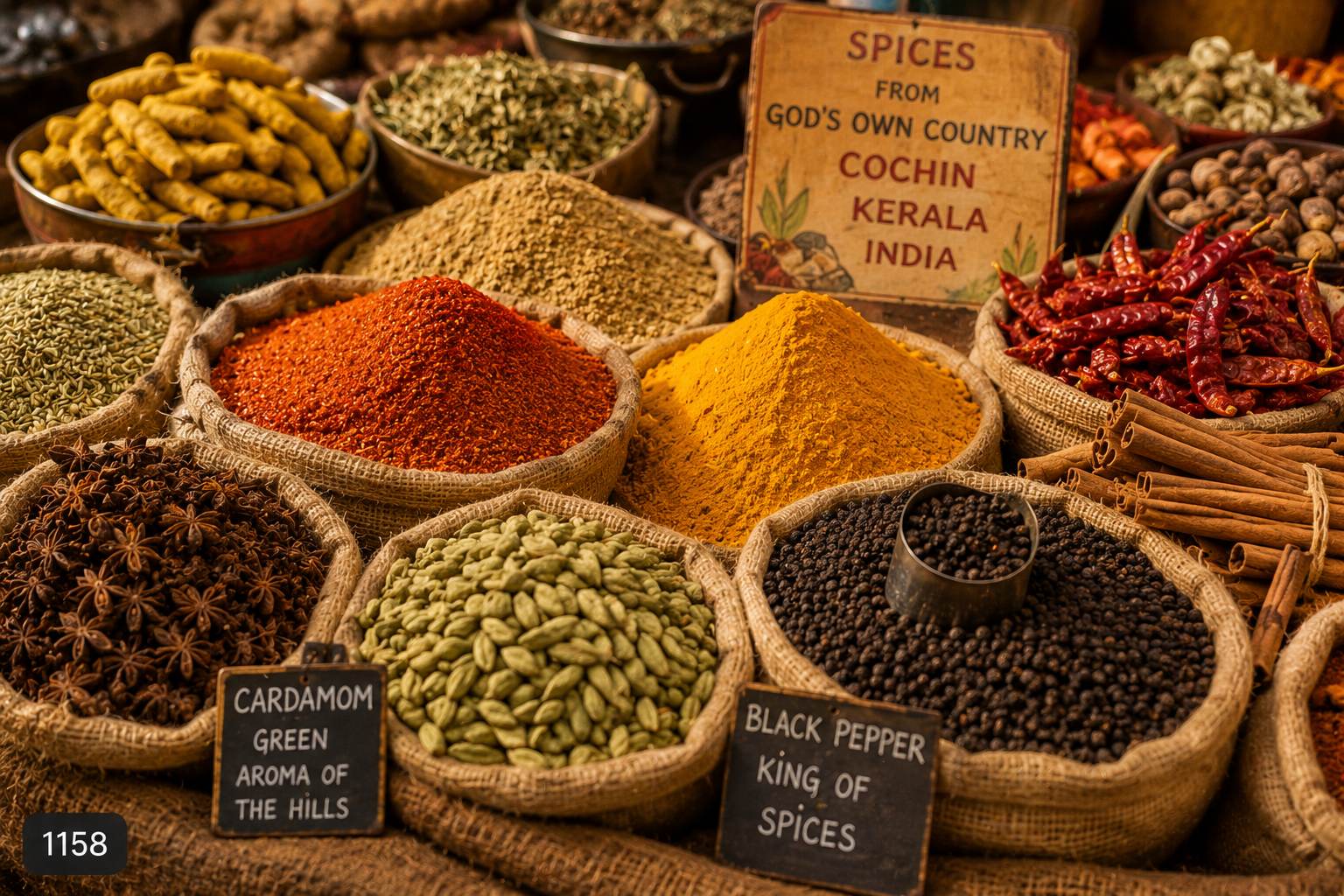
The spice growing map of India — black pepper and cardamom in the Western Ghats, chilli in Andhra and Karnataka, cumin and fenugreek in Rajasthan and Gujarat, saffron uniquely in Kashmir.
🌶
The heat geography
Why some regions are hotter than others — the chilli geography
The Guntur district of Andhra Pradesh grows more chilli than any other region in India — including varieties (Guntur Sannam, Teja) among the world's hottest. Andhra Pradesh's cuisine is the spiciest in India. This is not coincidence: the region that grows the most chilli, grows the hottest varieties, and has grown it longest uses it most intensively. The same logic applies to Rajasthan's dried Mathania chilli, Karnataka's Byadgi chilli (used for colour and flavour rather than heat), and Chettinad's use of multiple dried chilli varieties simultaneously.
The Chilli Heat Scale by Region
From Andhra's incendiary heat to Kashmir's gentle warmth
Most intense heat: Andhra Pradesh, Telangana — Guntur chilli used in quantities that produce what locals describe as a full-body experience. Very hot: Chettinad (Tamil Nadu) — multiple dried chilli varieties plus fresh, in a complex spiced gravy. Kolhapuri (Maharashtra) — kala masala with high dried chilli proportion. Hot: Rajasthan — Mathania dried red chilli, bold but not incendiary. Moderate: North Indian mainstream, Bengali, Gujarati. Mild aromatic: Kashmir — warming spices (cardamom, cinnamon, cloves) provide warmth; chilli is secondary. Kashmiri Pandit cooking in particular uses minimal chilli.
🌸
Beyond heat
Aromatic spices — the flavour architecture of each region
Heat is only one dimension of spice use. The aromatic spices — cumin, coriander, cardamom, fennel, cloves, cinnamon — create the flavour identity of each regional cuisine. These are the spices that, when you smell them together, immediately signal where the dish comes from.
Tamil Nadu identity
Mustard + Curry Leaf + Dried Red Chilli
Every Tamil Nadu tadka begins with mustard seeds popping in sesame or coconut oil, followed by curry leaves and dried red chilli. These three elements together produce an unmistakably Tamil Nadu base note before any other spice is added.
Rajasthani identity
Cumin + Coriander + Dried Red Chilli (Mathania)
The Rajasthani spice base — cumin and coriander seeds tempered in ghee, with the specific Mathania dried chilli — produces a deep, earthy, desert-adapted flavour profile found nowhere else.
Bengali identity
Panch Phoron in Mustard Oil
Bengali panch phoron (five-spice: mustard, fenugreek, cumin, nigella, fennel) tempered in mustard oil produces a pungent, complex base note that signals Bengali cooking immediately. Nothing else smells like this.
Kashmiri identity
Fennel + Dry Ginger + Black Cardamom
The Kashmiri spice vocabulary — fennel seed (saunf), dry ginger (saunth), and large black cardamom (badi elaichi) — produces an aromatic, warming profile that is gentle in heat but profound in fragrance. The rogan josh and yakhni traditions are built on this.
Chettinad identity
Kalpasi + Marathi Mokku + Star Anise
Chettinad uses spices unavailable anywhere else in India — kalpasi (stone flower, Parmotrema perlatum), marathi mokku (dried flower pods), and a complex masala of 20+ ingredients. The uniqueness of these spices is what makes Chettinad food impossible to fully replicate outside its source region.
Gujarati identity
Goda Masala + Cumin + Sesame
Gujarat's goda masala — a sweet spice blend including stone flower and roasted coconut — produces the mildly sweet aromatic base that characterises Gujarati cooking. The sweetness in savoury dishes is not sugar — it is the spice blend.
🍋
The acid agents
Souring agents — the regional acid that defines flavour
Every regional Indian cuisine has a primary souring agent that provides acidity. Like cooking fats, souring agents are agricultural products — whatever the climate grows in the right conditions becomes the acid of choice. The sourness is not interchangeable: tamarind, kokum, kodampuli, dry mango, and yoghurt each produce a completely different acid character.
Souring Agent
Where Grown / Used
Flavour Character
Best Known Use
Tamarind
Tamil Nadu, Karnataka, Andhra — grows wild in South India
Deep, fruity, complex — sweet-sour with a slight earthiness
Sambhar, rasam, tamarind rice, chutneys — the defining acid of South Indian cooking
Kokum
Western Ghats coastline — Maharashtra, Goa, coastal Karnataka
Delicate, fruity, slightly floral sourness — lighter than tamarind
Solkadhi (coconut-kokum drink), Malvani and Goan fish curries
Kodampuli (Gamboge)
Kerala specifically — the Malabar coast and backwaters
Sharp, distinctive, complex — produces a dark colour and specific souring unlike tamarind
Kerala fish curry — cannot be substituted without changing the fundamental character of the dish
Dry mango (amchur)
North India — from summer mango harvest, dried and powdered
Tangy, fruity, sharp — the souring agent of the North Indian kitchen
Chaat, North Indian sabzi, marinades — the acid in the absence of tamarind
Yoghurt (dahi)
All India — but dominant as souring agent in North and West
Mild, creamy sour — provides acid while adding richness
Kadhi (yoghurt curry), marinades, raita, Rajasthani gatte ki sabzi
🔧
Regional masala traditions
The spice blends that define each cuisine
Every regional Indian cuisine has a signature spice blend — a combination so specific to its region that using it immediately identifies the dish's origin. These blends are not random — they are the accumulated wisdom of generations of cooks working with locally available spices.
Blend
Region
Key Ingredients
Character
Goda masala
Maharashtra
Stone flower, coconut (roasted), sesame, coriander, cumin, bay leaf, cloves
Mildly sweet, aromatic, complex — the signature Maharashtrian blend
Kala masala
Kolhapur, Maharashtra
Coconut (blackened), sesame, dried red chilli, coriander, cumin — roasted very dark
Deep, smoky, intense — the darkest and most powerful masala in Maharashtra
Panch phoron
Bengal, Odisha
Mustard, fenugreek, cumin, nigella, fennel — in equal proportions
Pungent, complex, uniquely Bengali — used as a whole-spice tempering, never ground
Warm, slightly bitter, deeply aromatic — every household's version is slightly different
Chettinad masala
Chettinad, Tamil Nadu
20+ ingredients including kalpasi, marathi mokku, star anise, dried red chilli
The most complex masala in Indian cooking — impossible to replicate without the specific spices
Kashmiri spice base
Kashmir
Fennel, dry ginger, black cardamom, cinnamon, cloves, mawal (cockscomb flowers)
Fragrant, warming, gentle heat — the wazwan tradition built on this base
⛵
The historical dimension
The spice trade that changed world history
India's spice geography did not just shape Indian cuisine — it shaped world history. The black pepper of Kerala's Western Ghats was the primary driver of Arab, Venetian, Portuguese, Dutch, and British trading enterprises across four centuries. Understanding the spice map of India is understanding why Europe sent ships around Africa.
The Spice Trade in Numbers
Why India's spices were worth more than gold
At peak demand (15th century CE), black pepper was worth its weight in silver on European markets. Kerala's Malabar coast produced most of the world's black pepper, cardamom, and cinnamon. Arab traders controlled the overland route from India to Venice; the Venetians controlled the European end. The Portuguese sent Vasco da Gama around Africa in 1498 specifically to break this Arab-Venetian monopoly on Indian spice trade. The chilli that now defines Indian cuisine arrived as a byproduct of this quest — the Portuguese brought it from the Americas in exchange for the spice access they sought. The spice trade created the global economy; the global economy brought chilli to India; chilli transformed Indian cooking. The entire arc begins with Kerala's Western Ghats.
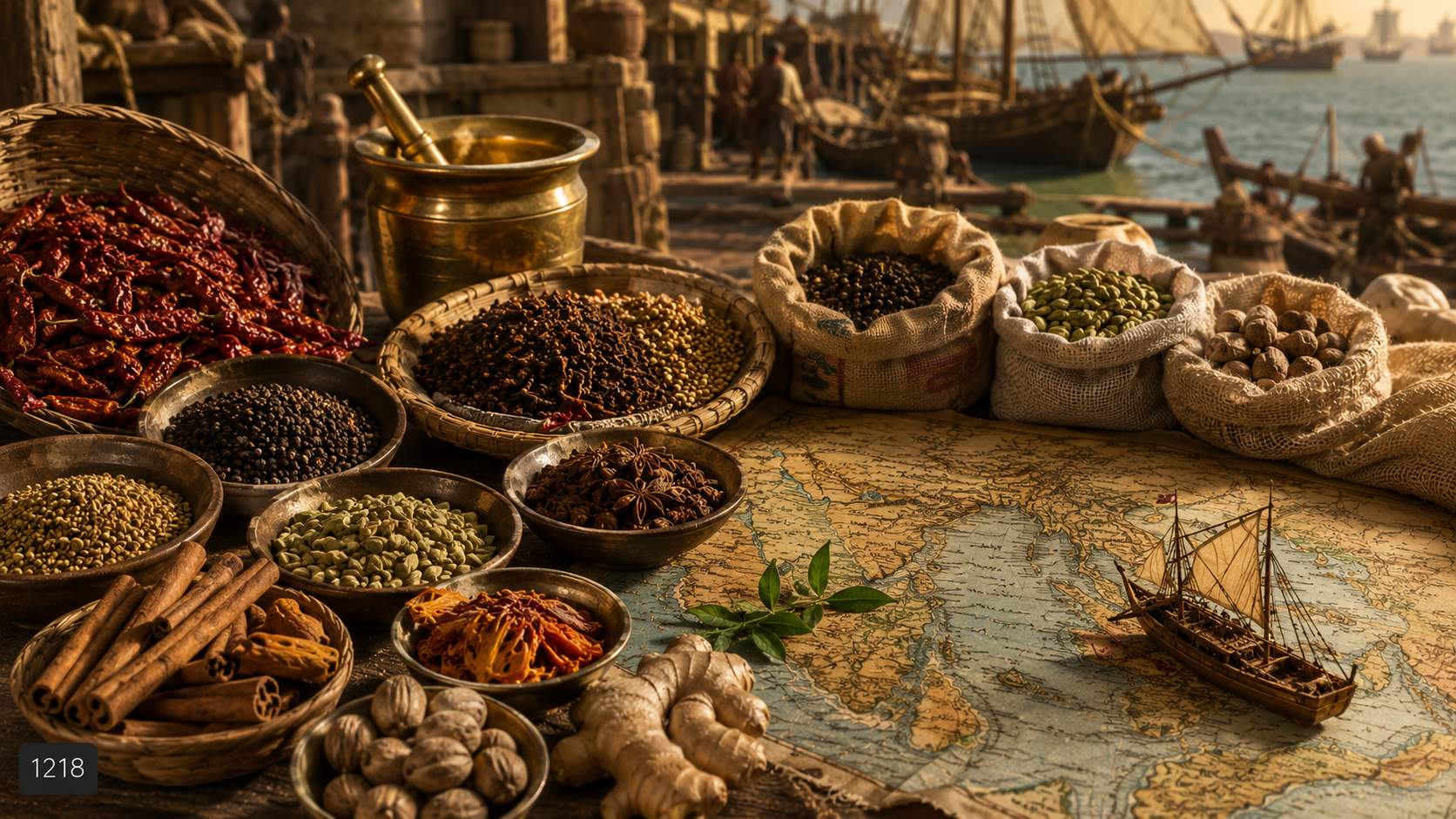
The spice trade routes from India — Arab dhows carrying Kerala pepper to Persia and Arabia, Venetian ships carrying it to Europe, Portuguese vessels rounding Africa to break the Arab monopoly. The spice geography of India drove world history for 500 years.
Guntur district of Andhra Pradesh grows more chilli than any other region in India, including varieties among the world's hottest (Guntur Sannam, Teja). The region that grows the most chilli, grows the hottest varieties, and has grown it longest uses it most intensively. Andhra Pradesh's cuisine reflects its agricultural surplus directly.
Why does saffron appear in everyday Kashmiri cooking?
Kashmir is the only place in India where Crocus sativus (saffron) grows — specifically on the well-drained alkaline slopes around Pampore, near Srinagar. Because saffron is locally grown rather than imported, it is affordable enough for everyday use. The same saffron costs 10–20 times more in other Indian states and is used only for special occasions.
What is panch phoron?
Panch phoron is Bengal's signature five-spice blend — mustard seed, fenugreek seed, cumin seed, nigella seed (kalonji), and fennel seed in equal proportions. Unlike most spice blends, it is never ground — it is used as whole seeds tempered in mustard oil, where each spice pops and releases flavour separately. The combination produces an unmistakably Bengali base note.
What makes Chettinad spices unique?
Chettinad cuisine uses spices unavailable anywhere else in India — kalpasi (stone flower, Parmotrema perlatum), marathi mokku (dried flower pods), and a masala of 20+ ingredients. The Nagarathar merchant community brought some of these spices from their Southeast Asian trading operations. The uniqueness of these spices makes Chettinad food impossible to fully replicate outside its source region.
Why did the Portuguese come to India?
The Portuguese sent Vasco da Gama around Africa in 1498 specifically to break the Arab-Venetian monopoly on India's spice trade — particularly Kerala's black pepper, cardamom, and cinnamon, which were worth near their weight in silver on European markets. The chilli that now defines Indian cuisine arrived as a byproduct: the Portuguese brought it from the Americas in exchange for spice trade access they sought on the Malabar coast.