100 million people, 705 tribes, food traditions that predate every dynasty and empire in Indian history. The least documented and most diverse dimension of Indian food culture.
⏱ 16 min read🗓 Updated June 2026★ Level 1 Atlas
The hidden dimension
India's least documented culinary tradition
India has 705 officially recognised Scheduled Tribes with a combined population of over 100 million people — approximately 8% of India's total. These communities have food traditions that are in many cases completely distinct from the mainstream Indian regional cuisines that fill food books and restaurant menus. Tribal food is not a variation of Hindu vegetarian cooking or Islamic meat cooking — it is a completely separate culinary world shaped by forest environments, specific agricultural practices, hunting and foraging traditions, and fermentation methods developed in relative isolation from mainstream Indian food culture. It is the least documented and least celebrated dimension of Indian food diversity — and some of it is disappearing as communities integrate with mainstream society.
705 tribes, 100 million people, food traditions mostly undocumented
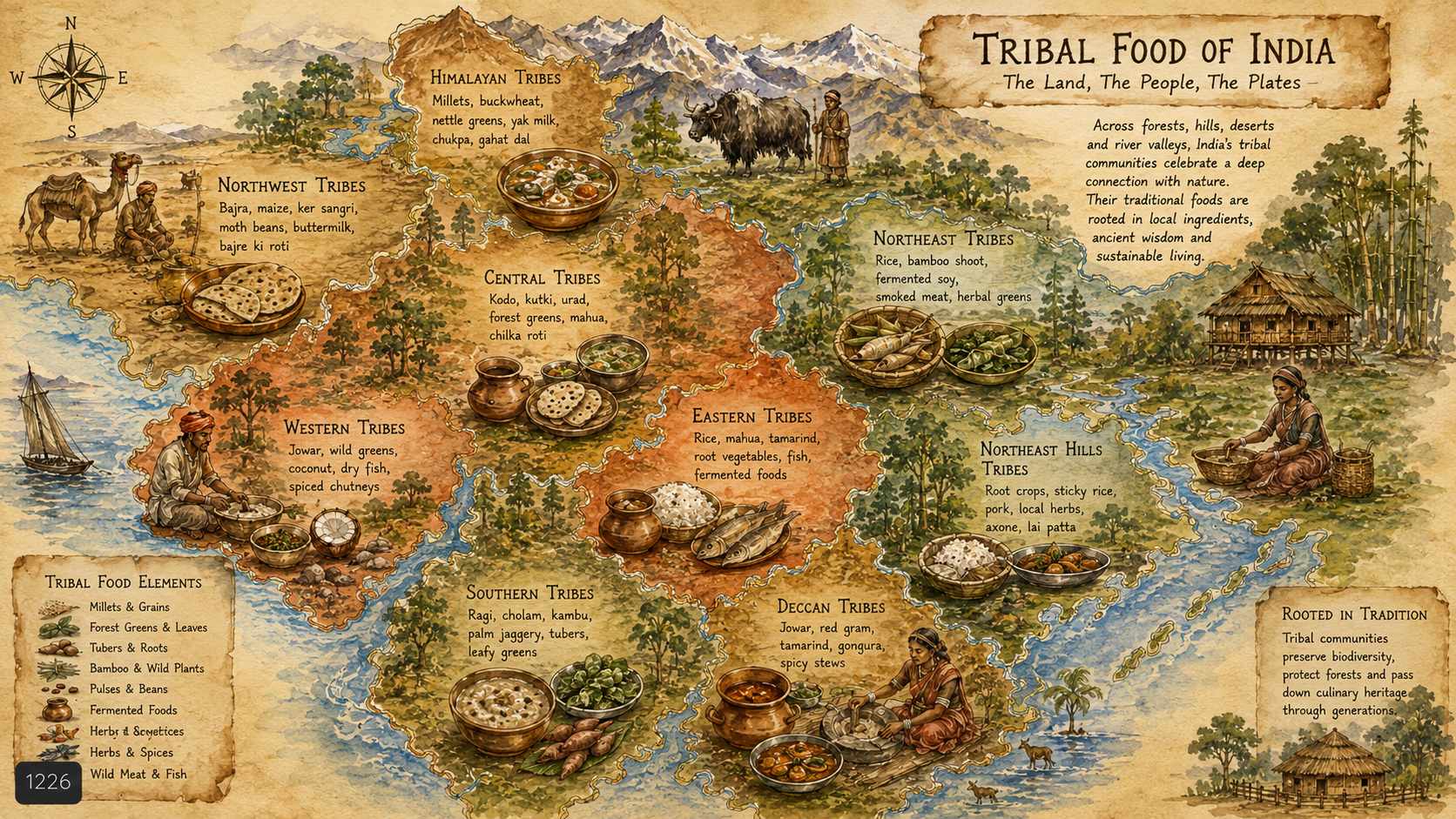
India's tribal food traditions span five major geographical zones: the Northeast (8 states, the richest tribal food diversity in India), Central India (Jharkhand, Chhattisgarh, Odisha tribal belt — Santhal, Munda, Gond, Bhil communities), the Western Ghats (Adivasi communities of the Nilgiris, Wayanad, and Palakkad), the Andaman and Nicobar Islands (including uncontacted communities), and scattered communities in Rajasthan, Gujarat, and Himachal Pradesh. Each zone has food practices completely distinct from each other and from mainstream Indian cooking. A Naga smoked pork preparation and a Gond mahua flower dish are as different from each other as French and Japanese cuisine — and both are as different from a Punjabi dal as anything on earth.
India's major tribal food regions — the Northeast's fermented-smoked tradition, Central India's forest-based food culture, the Western Ghats' Adivasi cooking, and the marine-based food cultures of the Andaman Islands.
🌿
Region 1 — The richest tribal food zone
Northeast India — fermented, smoked, and completely different
The eight states of Northeast India — Nagaland, Manipur, Mizoram, Meghalaya, Arunachal Pradesh, Assam (hill tribes), Tripura, and Sikkim — contain the richest concentration of tribal food diversity in India. The food traditions here are more closely related to Southeast Asian food cultures than to anything in mainland India — a consequence of geography, ethnicity, and centuries of relative separation from the Gangetic plain.
Nagaland — The Smoked and Fermented Tradition
Axone, smoked pork, and the world's most intense fermented ingredients
Axone (akhuni) — fermented soybean paste, the defining flavour ingredient of Nagaland. Produced by fermenting boiled soybeans wrapped in banana leaves for several days. The resulting paste has an intense, pungent, complex flavour that functions similarly to Korean doenjang or Japanese miso — a fermented protein base that flavours everything.
Smoked meats — pork, beef, and wild game smoked over wood fires for preservation and flavour. The smoking tradition is central to Naga food culture — a preservation method developed for a jungle environment without refrigeration.
Bamboo shoot preparations — fresh, fermented, and dried bamboo shoots appear in virtually every Naga dish. Fermented bamboo (soibum) has a sour, complex character unlike anything in mainstream Indian cooking.
Bhut jolokia (ghost pepper) — grown in Nagaland and Assam, this is one of the world's hottest chilli varieties, used fresh in Naga cooking in quantities that mainland Indian cuisines would consider extreme.
Manipur — The Kangshoi and Singju Tradition
River plants, lotus stems, and Meitei food culture
Kangshoi — a thin vegetable stew made with seasonal greens, fish, and minimal spicing. The Meitei community's everyday meal — simple, clean, dependent on fresh local ingredients rather than spice complexity.
Singju — a fresh salad of local herbs, vegetables, and fermented fish (ngari), with green chilli. Completely unlike anything in mainland Indian cooking — a fresh, fermented, herbaceous preparation.
Ngari — fermented dried fish, a pungent flavour ingredient used across Manipuri cooking as the Meitei community's primary umami source. The fermentation is months-long; the result is extraordinarily intense.
Lotus stem preparations — Loktak lake provides lotus stems as a distinctive local ingredient appearing in Manipuri cooking in ways not found anywhere else in India.
Meghalaya — The Khasi and Garo Traditions
Jadoh, tungtap, and the matrilineal food culture
Jadoh — rice cooked with pork blood and organs, the defining Khasi preparation. A complete meal in one pot, ceremonially important and culturally central to the Khasi community.
Tungtap — fermented dried fish chutney, the Khasi condiment that accompanies most meals. Pungent, complex, irreplaceable in Khasi cooking.
Dohkhlieh — minced pork salad with onions and ginger — a fresh preparation that shows the Khasi preference for clean flavours alongside intense fermented elements.
Meghalaya's matrilineal social structure (property passes through the female line) has some food culture implications — the kitchen is a female-controlled space with specific knowledge transmission traditions that differ from patrilineal mainland Indian cooking cultures.
🌲
Region 2 — The forest food tradition
Central India — Gond, Santhal, Bhil, and the forest pantry
Central India's tribal belt — spanning Jharkhand, Chhattisgarh, Odisha's interior, eastern Maharashtra, and parts of MP — contains some of India's oldest continuous tribal cultures. The Santhal, Munda, Ho, Gond, and Bhil communities have food traditions built on forest ecology: wild plant gathering, shifting cultivation (jhum), specific tuber and root preparations, and the central importance of mahua.
Mahua — The Central Indian Tribal Ingredient
Madhuca longifolia — the tree that feeds, intoxicates, and sustains
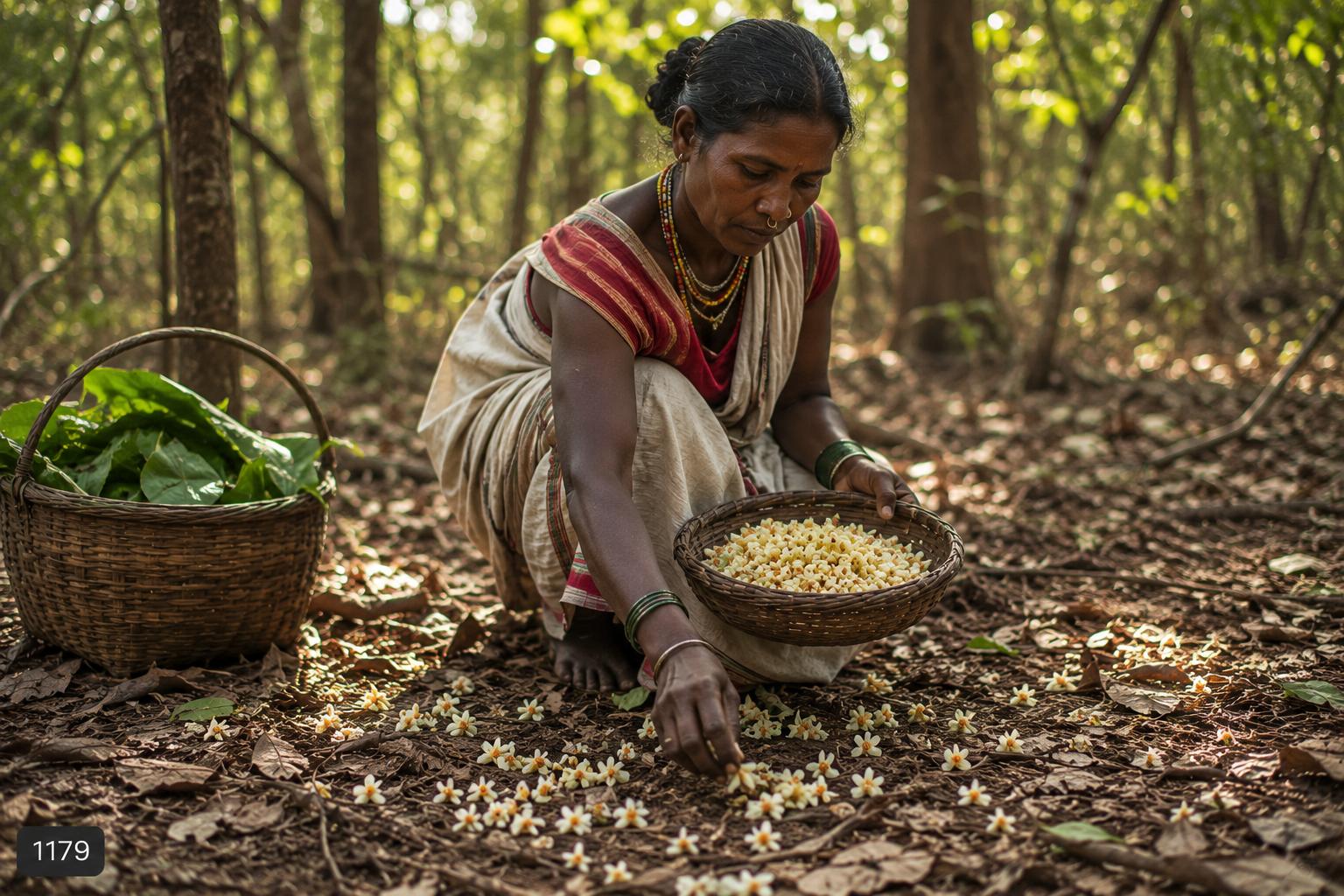
Mahua (Madhuca longifolia) is the most important single ingredient in Central Indian tribal food culture. Every part of the tree is used:
Mahua flowers — eaten fresh, dried and stored, or fermented into mahua liquor (the traditional alcoholic beverage of most Central Indian tribal communities, and of enormous cultural significance).
Mahua seeds — pressed for oil used in cooking and as a substitute for ghee.
Mahua flour — ground from dried flowers, used in specific preparations including a fermented bread that requires no other ingredient.
The Indian government's periodic attempts to regulate or prohibit mahua liquor production have been among the most contested policy interventions in tribal communities — the tree and its liquor are inseparable from cultural identity, seasonal ritual, and daily nutrition.
Beyond mahua, Central Indian tribal cuisine uses red ant chutney (chaprah) — ground red ants with salt and chilli, providing sourness and protein; mushrooms and forest tubers not available in mainstream markets; dried and smoked meats of wild game; and specific millet preparations including ragi (finger millet) preparations distinct from the Deccan millet tradition.
🏔
Region 3 — The highland forest tradition
Western Ghats — Adivasi food of the Nilgiris and Wayanad
Bamboo rice, wild honey, and highland ecology food
The Nilgiris plateau (the meeting point of Kerala, Tamil Nadu, and Karnataka) hosts several Adivasi communities with food traditions built on highland forest ecology.
Bamboo rice (mulayari) — the grain produced by bamboo plants when they flower (which occurs once every 40–120 years, when the entire bamboo forest flowers and dies simultaneously). Bamboo rice has a distinctive nutty flavour and is harvested communally during the rare flowering event. It cannot be cultivated — only harvested from wild bamboo.
Wild honey — the Irula community are skilled honey gatherers, harvesting from wild honeybee colonies in cliff faces and forest trees. The wild honey varieties of the Nilgiris have distinct flavour profiles from cultivated honey that chefs are now seeking out.
Wild tubers — the forest floor of the Ghats produces specific tubers (different species from the cultivated yam and cassava of mainstream Indian markets) that Adivasi communities have eaten for generations but that rarely appear in any food literature.
🍃
Region 4 — The tribal belt of eastern India
Odisha's tribal cuisine — pakhala, mahua, and forest food
Kondh, Saura, Bonda — Odisha Interior Tribes
Fermented rice, forest vegetables, and the most isolated food cultures in mainland India
Odisha's interior districts (Koraput, Kalahandi, Malkangiri, Kandhamal) contain some of the most geographically isolated tribal communities in mainland India. Their food cultures reflect this isolation — minimal outside influence, food systems built almost entirely on local forest ecology.
Pakhala — fermented rice soaked in water, eaten cold with accompaniments. This is mainstream in coastal Odisha but originates in tribal food practice; the tribal versions use specific wild vegetables and fermented fish not found in the coastal version.
Mandia (ragi/finger millet) — a staple grain across Odisha's tribal communities, prepared as a thick porridge (ambil) or flatbread. The red colour and earthy flavour of ragi is characteristic.
Forest vegetables — drumstick leaves, colocasia (taro), specific wild greens harvested from the forest floor that do not appear in any mainstream Indian vegetable market.
Sal leaf preparations — sal (Shorea robusta) leaves are used as plates, containers, and cooking vessels in Odisha tribal cooking — an entirely natural packaging system that gives food a distinctive earthy note.
🏝
Region 5 — The most isolated food culture in India
Andaman Islands — marine food cultures at the edge of the world
Great Andamanese, Onge, Jarawa, Sentinelese
Hunter-gatherer marine food cultures — some entirely uncontacted
The indigenous communities of the Andaman Islands represent food cultures more ancient and more isolated than anything else in India. The Sentinelese — the world's last uncontacted people — have a food culture that has had no outside influence for approximately 60,000 years (since the ancestors of the current community arrived on the island from Africa).
For the communities with some documented contact (Great Andamanese, Onge, Jarawa in limited observation):
Marine-based food culture — fish, dugong, turtle, and molluscs are the primary protein sources. Fishing techniques using specific bow designs are highly developed.
Forest food — pigs, monitor lizards, honey, and specific Andaman forest fruits supplement the marine diet.
No spice tradition — unlike mainland Indian cooking built on spice complexity, Andaman indigenous cooking uses minimal flavouring. The food reflects ingredients rather than transformation.
These communities face existential pressure from contact with mainland India, disease, and habitat loss. Their food cultures — the most ancient in the country — may not survive the 21st century.
🧺
What tribal food uses that mainstream food does not
Ingredients from outside the mainstream
Ingredient
Community / Region
Use
Mainstream Equivalent
Axone (fermented soybean)
Naga, Northeast
Flavour base for stews and curries — umami depth
No direct equivalent in mainstream Indian cooking
Mahua flower
Gond, Santhal, Bhil — Central India
Fresh and dried food; fermented into liquor; pressed for oil
No equivalent — a uniquely tribal ingredient
Red ant chutney (chaprah)
Chhattisgarh tribes
Souring agent and protein source — ground with chilli and salt
Approximate sourness from tamarind; no protein equivalent
Bamboo rice
Nilgiris Adivasi, Kerala
A grain harvested from flowering bamboo — nutty, distinctive
No cultivated equivalent — only wild-harvested
Ngari (fermented fish)
Manipur (Meitei community)
Umami flavour base used across all Manipuri preparations
Closest to fish sauce but drier and more intense
Bamboo shoot (fermented)
Northeast — all communities
Vegetable ingredient with complex sour-fermented character
No direct equivalent — fresh bamboo shoot approximates but lacks fermented complexity
Bhut jolokia (ghost pepper)
Nagaland, Assam
Fresh or dried heat — one of the world's hottest chillies
Guntur chilli approximates heat level but not flavour profile
🧫
The fermentation expertise
Why tribal food cultures are fermentation masters
Fermentation is more central to tribal food cultures than to almost any mainstream Indian cuisine. The reasons are practical: fermentation preserves food without refrigeration, increases nutritional value (particularly B vitamins and protein digestibility), and produces complex flavours from simple ingredients. In forest environments with no market access and seasonal food availability, fermentation is the critical food technology.
What Tribal Fermentation Has That Mainstream India Lacks
Mainstream Indian fermentation is well-documented — idli-dosa batter, yoghurt, pickles, kanji. But tribal fermentation traditions go significantly further: soybean fermentation (axone) produces a miso-like paste; bamboo shoot fermentation (soibum) produces a sour, complex vegetable ingredient; fish fermentation (ngari, tungtap) produces an umami-dense condiment; mahua fermentation produces a grain alcohol of complex flavour. These traditions represent sophisticated food technology developed over thousands of years of forest living — and they are being lost as communities shift to mainstream food markets. The global fermentation renaissance (kimchi, miso, kombucha) values exactly what tribal Indian food traditions developed independently and earlier.
⚠️
Why this matters
Disappearing food cultures — what India stands to lose
Tribal food cultures in India face three simultaneous pressures: forest degradation reduces access to wild ingredients that cannot be cultivated; integration with mainstream markets introduces processed foods that displace traditional preparations; and the younger generation, seeking economic mobility, often leaves tribal areas and food traditions behind. The result is that food cultures representing thousands of years of accumulated knowledge about specific ecosystems, fermentation techniques, and nutritional systems are disappearing faster than they are being documented.
The Documentation Gap
India has extensive food literature about Mughal court cuisine, Brahmin vegetarian traditions, and regional restaurant cooking. It has almost no systematic documentation of tribal food cultures. The communities with the longest food history and the most distinct culinary traditions are the least represented in Indian food writing. This is not an accident — it reflects the historical marginalisation of tribal communities in Indian public life broadly. The few researchers and chefs who have begun seriously engaging with tribal food (particularly in the Northeast) are working against a significant documentation deficit. The food that disappears undocumented is gone permanently — unlike most cultural losses, fermentation traditions and forest ingredient knowledge cannot be reconstructed from historical texts that were never written.
Tribal food refers to the food traditions of India's 705 officially recognised Scheduled Tribes — approximately 100 million people whose culinary practices are built on forest ecology, shifting cultivation, hunting, foraging, and fermentation traditions developed largely independently of mainstream Indian food culture. These traditions vary enormously by region and are in many cases more closely related to Southeast Asian food cultures than to anything in the Indian mainstream.
What is axone?
Axone (also spelled akhuni) is fermented soybean paste — the defining flavour ingredient of Nagaland. Produced by fermenting boiled soybeans in banana leaves for several days, it functions similarly to Korean doenjang or Japanese miso — providing an intense, complex, fermented protein base. It has a pungent smell that surprises first-time tasters but produces extraordinarily deep flavour in cooking.
What is mahua?
Mahua (Madhuca longifolia) is a tree native to Central India whose flowers, seeds, and bark are all used by tribal communities. The flowers are eaten fresh or dried, and fermented into mahua liquor — the traditional alcoholic beverage of most Central Indian tribal communities and of enormous cultural significance. The seeds are pressed for cooking oil. Mahua is considered a sacred tree by many tribal communities and is central to seasonal ritual, nutrition, and identity.
Is Northeast Indian food part of Indian food?
Yes — but it is very different from mainland Indian food. Northeast food traditions are shaped by food cultures more closely related to Myanmar, China, and Southeast Asia than to the Gangetic plain. Fermented ingredients (axone, ngari, soibum), smoked meats, bamboo shoot preparations, and rice varieties grown nowhere else in India create food cultures that surprise visitors expecting anything resembling mainstream 'Indian' cuisine.
Why are tribal food traditions disappearing?
Three simultaneous pressures: forest degradation reduces access to wild ingredients that cannot be cultivated; integration with mainstream markets introduces processed foods displacing traditional preparations; and younger generations seeking economic mobility often leave tribal areas and food knowledge behind. The fermentation traditions, wild ingredient knowledge, and preparation methods being lost represent thousands of years of accumulated food technology that cannot be reconstructed once gone.