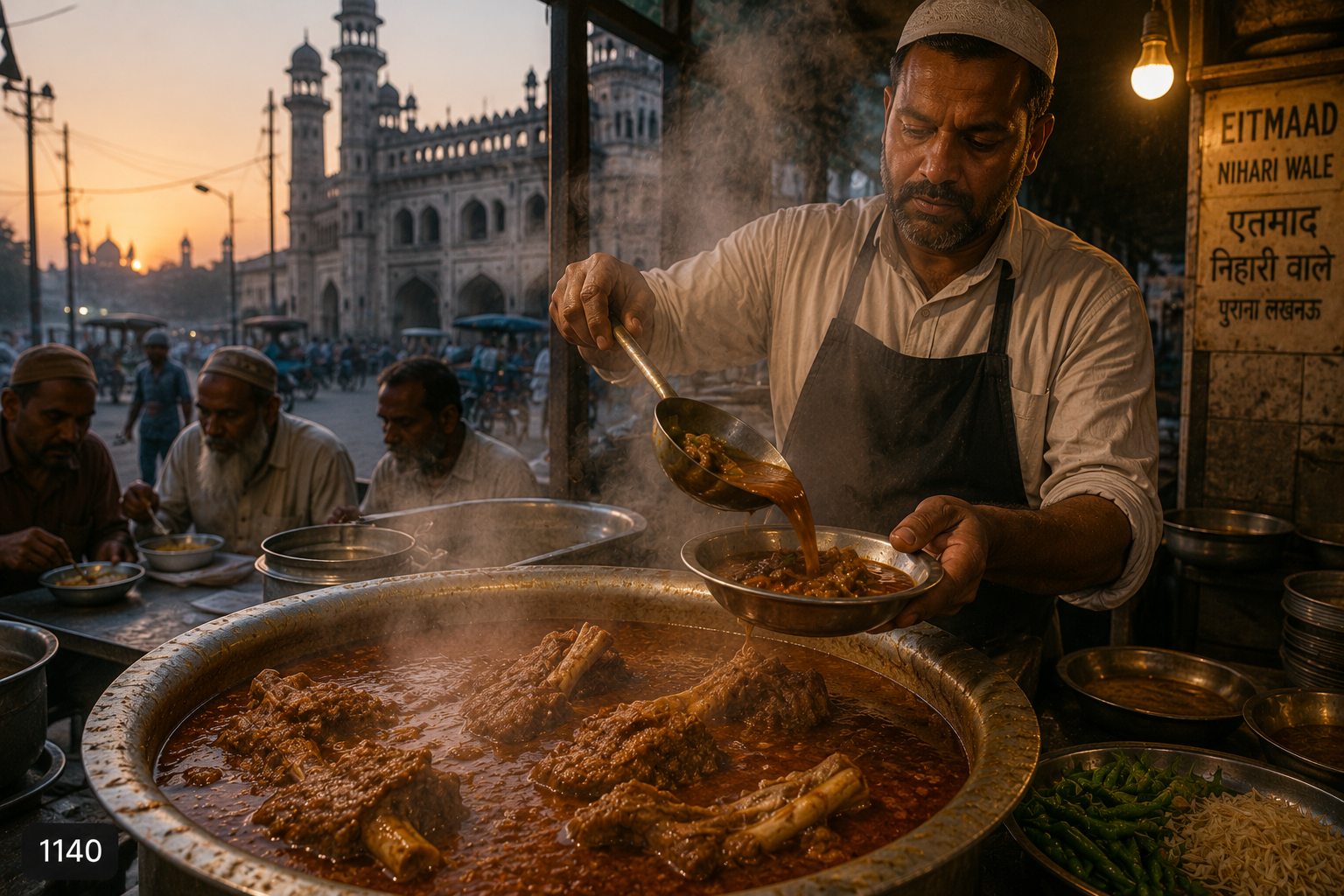
Muslim Food in India — The Nawabi Legacy and the Coastal Trader
India's Muslim food culture is not one tradition but many — Awadhi court cooking, Hyderabadi Nizami biryani, Malabar Arab-influenced cuisine, and the Mughal synthesis that produced the tandoor and dum traditions that now define 'Indian food' globally.
⏱ 13 min read🗓 Updated June 2026★ Food Story
The Core Framework
What makes Indian Muslim food distinct
India has the world's second largest Muslim population — over 200 million people — distributed across every state, every social class, and every food ecology. There is no single Indian Muslim cuisine. There is the Awadhi court tradition of Lucknow (dum cooking, galouti kebab, pakki biryani), the Hyderabadi Nizami tradition (kachchi biryani, haleem, the specific Hyderabadi masala vocabulary), the Malabar Muslim (Mappila) tradition of Kerala (Kaima rice biryani, fish curry in Arab-influenced spicing), and the street-level Muslim food of every Indian city's mohalla (neighbourhood). These are as different from each other as any four regional Indian cuisines.
Halal as Food Quality Standard
The halal requirement — meat slaughtered according to Islamic practice, with blood drained — is often discussed primarily as a religious restriction. But among Muslim cooks and food historians, the halal method is also considered a quality standard: the rapid blood-draining produces meat with a different colour, texture, and taste from non-halal slaughter. The distinctive character of Muslim meat preparations — the specific colour and texture of nihari, the character of seekh kebab — is partly a result of the halal method's specific effect on the meat's biochemistry, not just the spicing applied.
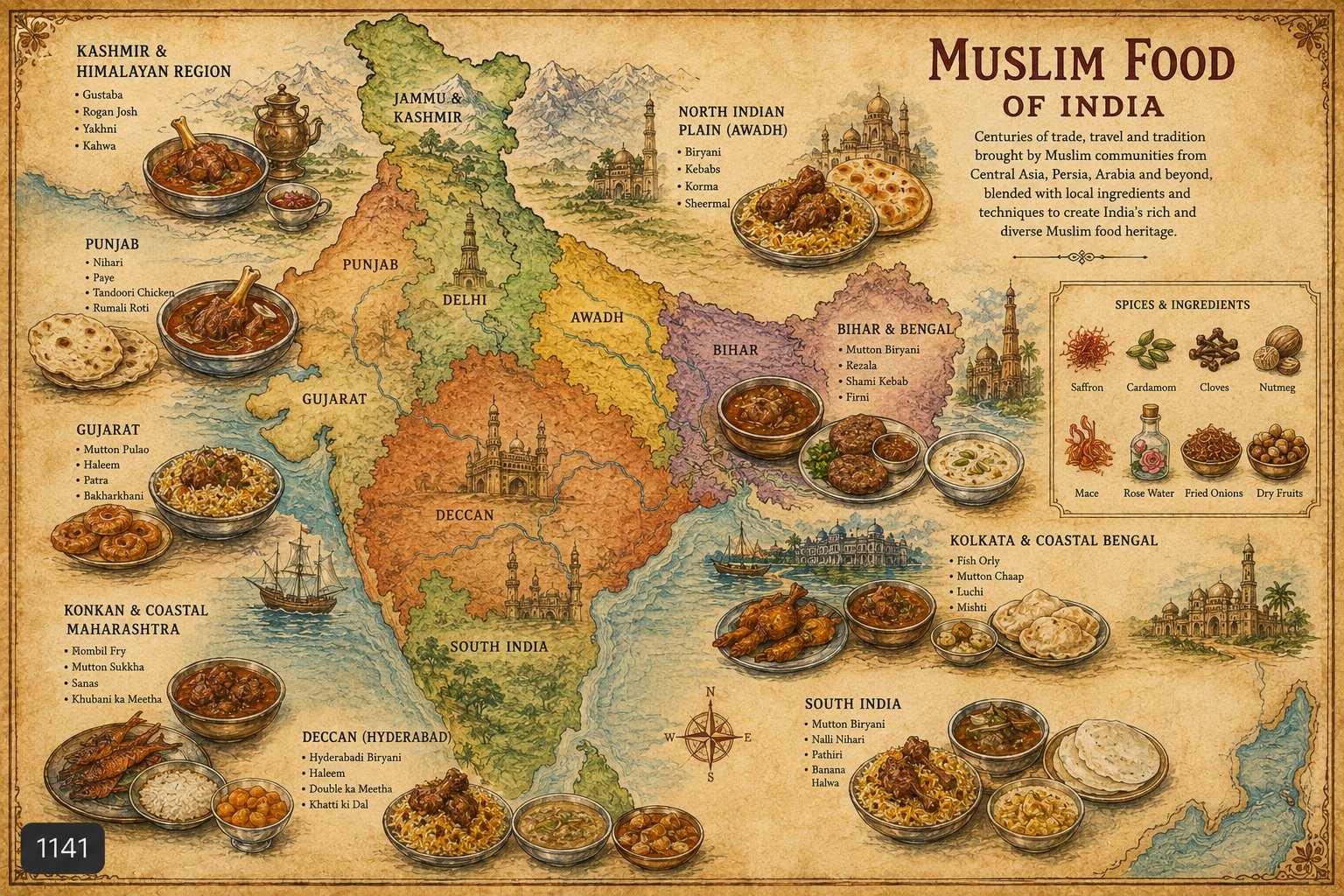
From Awadhi court cooking to Malabar Arab-influenced biryani — the geographic diversity of Indian Muslim food.
The Mughal court's culinary contribution to India cannot be overstated. The dum technique (sealed slow-cooking), the tandoor's systematic use for bread and meat, the biryani tradition, the kebab vocabulary — all entered mainstream Indian cooking through Muslim court culture and are now considered simply 'Indian'. The greatest irony of Indian food history is that many of the preparations most associated with 'Indian food' globally — butter chicken, biryani, naan, tandoori chicken — entered India through Muslim court and trade culture and became the Indian food that the world knows.
The Mughal court (16th-18th century) introduced or systematised the dum technique (sealed slow-cooking in a clay vessel), the biryani tradition, the kebab vocabulary (seekh, shammi, galouti), the tandoor's systematic use for bread and meat, and the refined spice compositions that define North Indian restaurant food globally. Many preparations most associated with 'Indian food' internationally entered through Mughal court culture.
Is all Indian Muslim food the same?
No. India's 200+ million Muslims have developed distinct food traditions across regions: the Awadhi court tradition (dum cooking, galouti kebab), Hyderabadi Nizami tradition (kachchi biryani, haleem), Malabar/Mappila tradition (Kaima rice biryani, Arab-influenced fish curry), and the street-level Muslim food of every Indian city. These are as different from each other as any four regional Indian cuisines.