Dinner can be similar across India. Lunch is variable. But breakfast is almost entirely region-specific — the meal most tied to local agriculture, history, and family tradition. Twelve cities, twelve completely different mornings.
⏱ 14 min read🗓 Updated June 2026★ Level 1 Atlas
Why breakfast matters most
Breakfast — India's most regionally distinct meal
Dinner in India can be similar across regions — dal, sabzi, roti or rice, pickle. Lunch is more variable but still follows recognisable patterns. But breakfast in India is almost entirely region-specific — what people eat in the morning is the meal least influenced by national trends, restaurant culture, or outside exposure. It is the meal most closely tied to local agricultural history, available ingredients, and family tradition. Mapping Indian breakfasts reveals the regional food identity of India more accurately than any other single meal — because breakfast is what people eat at home, not what they order in restaurants.
Rice and urad dal are the base agricultural surplus; tropical climate makes overnight fermentation reliable; breakfast is the primary meal of the day for many communities
North India
Wheat-based — aloo paratha, puri-sabzi, chole-bhature, poori, bread-butter in urban areas
Wheat is the agricultural base; cold winters require calorie-dense breakfast; the tandoor culture produces bread quickly for working households
West India
Highly regional — poha in MP and Maharashtra, thepla in Gujarat, misal pav in Pune, batata vada in Mumbai
The transition zone between rice and wheat cultures produces the most varied breakfast traditions — each sub-region has its own distinct morning meal
East India
Luchi-aloor dom in Bengal, chura-dahi in Bihar, sattu in Bihar/UP, pakhala in Odisha
Rice and wheat both present; strong morning meal traditions tied to agricultural and religious calendars; sattu (roasted grain flour) reflects the agricultural surplus of the Gangetic plain
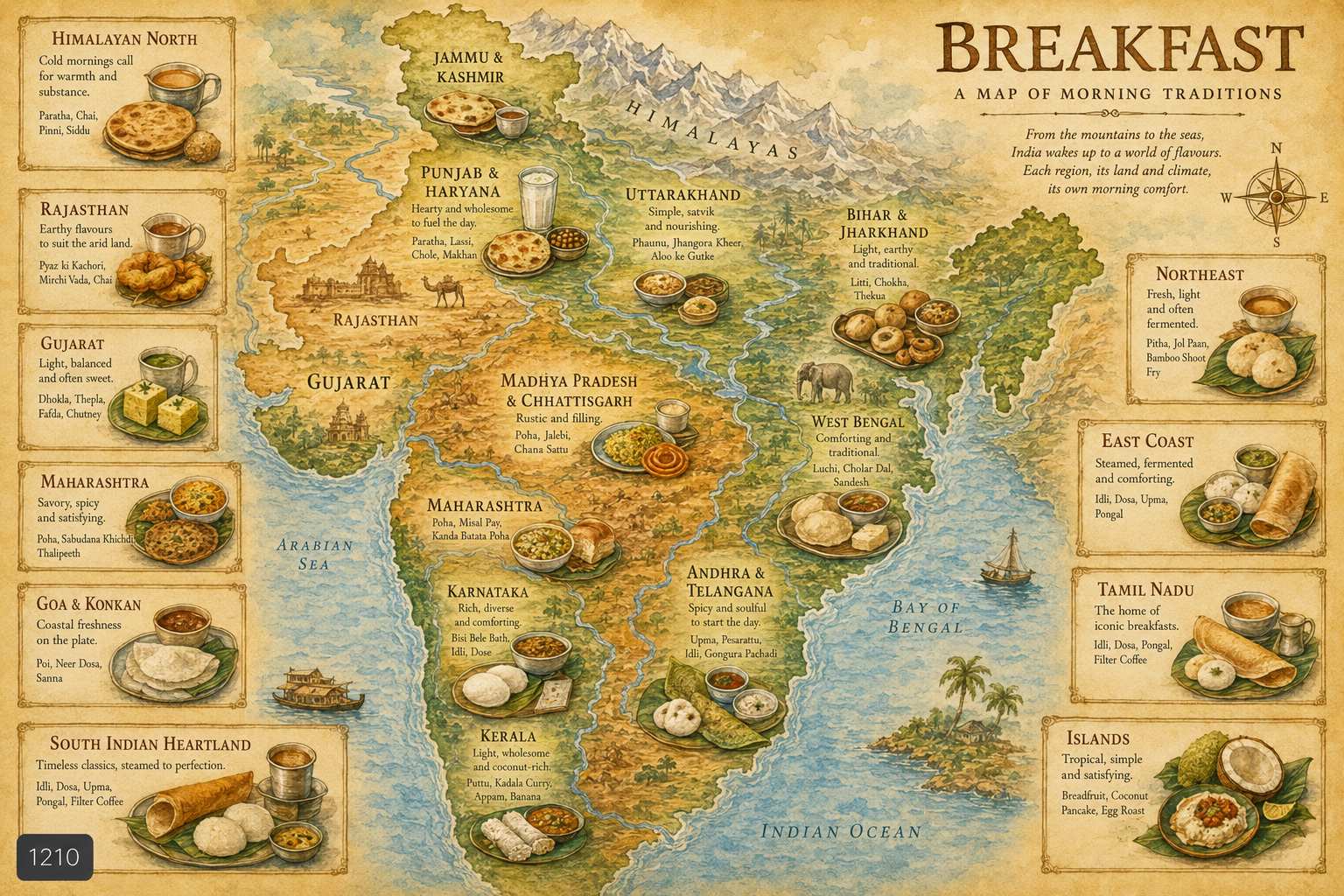
India's breakfast map — idli-dosa in the south, paratha in the north, poha and misal in the west, luchi in Bengal. The morning meal is the meal most closely tied to local agricultural history and least influenced by national trends.
🌅
Zone 1
South Indian breakfasts — fermentation is the technique
The South Indian breakfast tradition is built on a single food technology: lactic acid fermentation of a rice-and-urad-dal batter. This one technique produces a family of entirely different breakfast preparations depending on how the batter is cooked. The fermentation makes the preparation light, digestible, and nutritionally richer than the raw ingredients.
Tamil Nadu / Kerala
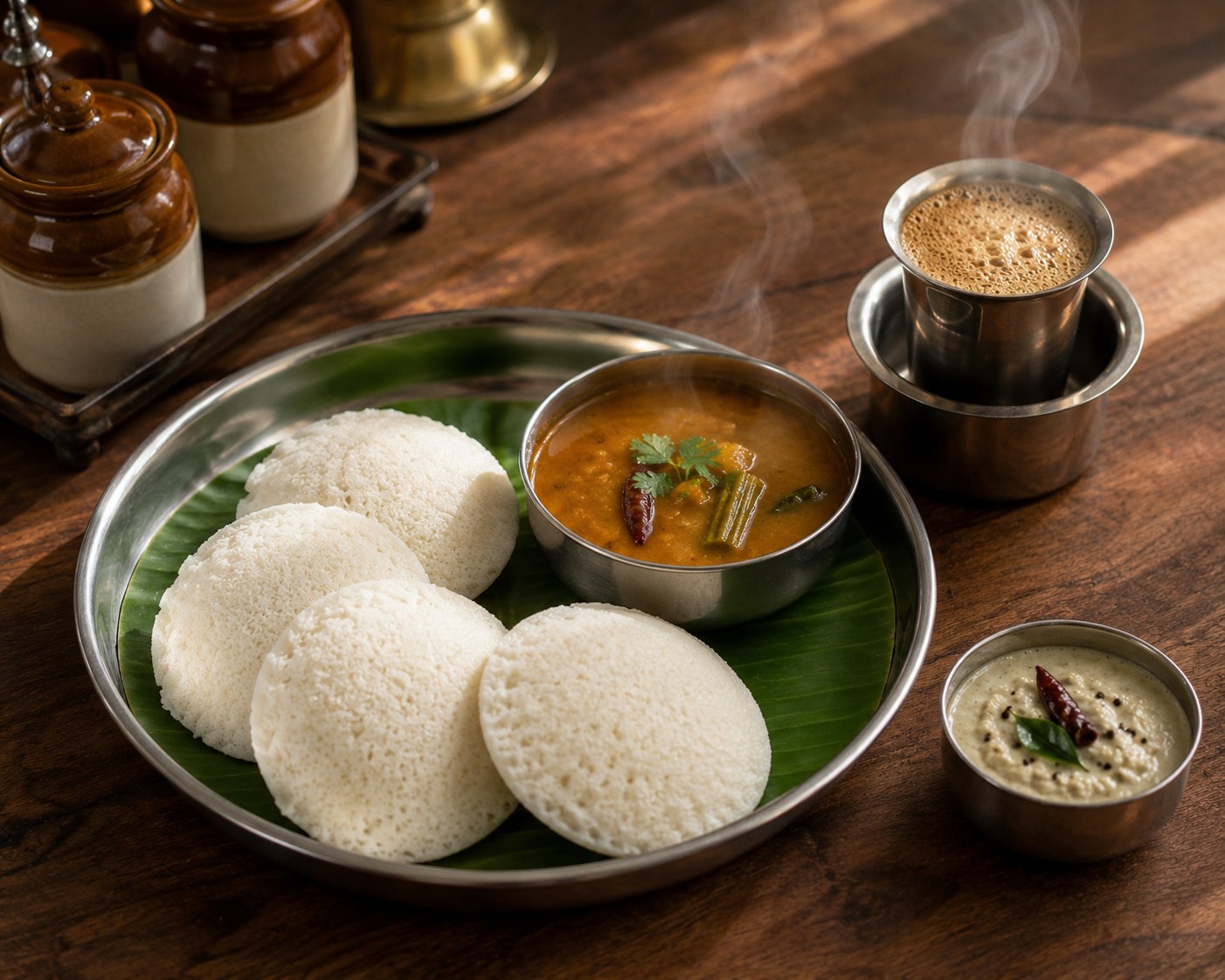
Idli
Steamed in moulds — white, soft, round. The fermented batter produces lightness through carbon dioxide created by bacterial activity. Eaten with sambhar and multiple chutneys. The world's most consumed South Indian breakfast.
Tamil Nadu / Karnataka
Dosa
Same batter, spread thin on a hot griddle. The Maillard reaction (browning) at the edges creates crispness; the centre stays soft. Masala dosa adds spiced potato filling — an entirely different eating experience from the same base.
Tamil Nadu (Brahmin)
Pongal
Rice and moong dal cooked together with black pepper and ghee — the Tamil Brahmin breakfast and festival food simultaneously. Simpler than idli-dosa; older. The pepper provides heat without chilli.
Kerala
Puttu
Steamed rice flour cylinders with coconut — cooked in a puttu kutti (dedicated cylindrical steamer). Eaten with kadala (black chickpea curry) or banana and sugar. A completely different texture from anything in the idli-dosa family despite using similar ingredients.
Kerala
Appam with Stew
Lacy fermented rice pancake — crispy edges, soft spongy centre — with coconut milk vegetable stew. The lacy edge is created by the same carbon dioxide that makes idli light; here it produces a different geometry.
Andhra / Tamil Nadu
Upma
Semolina (rava) cooked with vegetables and tempering — a non-fermented South Indian breakfast that uses wheat but in a completely different form from any North Indian wheat preparation. Quick, simple, comforting.
☀️
Zone 2
North Indian breakfasts — wheat, dairy, and calorie density
The North Indian breakfast is built around wheat bread and dairy — reflecting the agricultural surplus of the Indo-Gangetic plain. Cold winters created the caloric demand; dairy abundance and wheat surplus provided the supply. The Punjabi breakfast tradition is the most internationally recognised — and the most generous.
The Definitive Punjabi Morning
Aloo paratha with white butter, pickle, and thick lassi
The aloo paratha breakfast is one of the great breakfast traditions in the world — a whole-wheat flatbread stuffed with spiced mashed potato, fried in ghee on a tawa until golden, served with:
Makhan (white butter) — freshly churned, applied in a quantity that seems excessive until you taste it. Achaar (pickle) — mango or mixed vegetable, providing acid contrast. Thick lassi — yoghurt drink so thick it is eaten with a spoon, sometimes in a clay pot.
This breakfast provides enough calories for a morning of agricultural or physical labour. It was designed for that purpose. The fact that it is now eaten by office workers and international visitors who don't have fields to work in does not diminish its logic — it simply means it is extraordinarily satisfying.
Preparation
Region
Key Technique
Aloo paratha
Punjab, Haryana, Delhi
Potato stuffed into whole-wheat dough, rolled flat, cooked on tawa in ghee — the technical challenge is keeping the filling inside during rolling
Puri-bhaji
UP, Bihar, Delhi, all North India
Deep-fried puffy wheat bread with spiced potato — puri's puffing requires the steam created by water in the dough expanding on contact with hot oil
Chole bhature
Amritsar, Delhi — Punjabi origin
Fermented (yeast-leavened) deep-fried bread with spiced chickpea — the bhature uses a fermented dough for a distinctly different texture from puri
Sattu paratha
Bihar, eastern UP
Roasted gram flour (sattu) stuffed paratha — the sattu provides protein in a region where morning protein sources are limited
🌄
Zone 3
East Indian breakfasts — luchi, chura, and the morning rice culture
West Bengal
Luchi-Aloor Dom
Luchi — deep-fried puffy white flour bread — with spiced potato (aloor dom). The white flour distinguishes luchi from puri (whole wheat). Bengalis consider luchi a superior preparation precisely because of this refinement. Festival and weekend breakfast.
Bihar / UP
Sattu with Water or Lassi
Roasted gram flour (sattu) mixed with water, salt, and pickle — the quick-energy breakfast of the Bihari agricultural community. Extremely high protein, no cooking required. One of India's most underrated nutritional foods.
Bihar
Chura-Dahi
Flattened rice (chura/poha) soaked in yoghurt with sugar or jaggery — a no-cook breakfast that requires only soaking. The flattened rice absorbs the yoghurt quickly; the result is cool, filling, and gently sweet.
Odisha
Pakhala Bhata
Fermented rice soaked in water overnight, eaten cold with accompaniments (fried vegetables, pickles, dried fish). The summer breakfast of coastal Odisha — cooling, probiotic, and requiring no morning cooking.
🌇
Zone 4
West Indian breakfasts — the most diverse zone
West India — Gujarat, Maharashtra, MP — produces the most internally diverse breakfast map in India. No single breakfast tradition dominates; sub-regional identities are fierce and specific. Poha in Indore is not the same as poha in Pune; thepla in Ahmedabad is quite different from what is called thepla in Mumbai.
Poha — The Contested Central Indian Breakfast
Indore's claim vs Maharashtra's claim vs Gujarat's claim
Poha (flattened rice) is made across all three states but each claims it differently:
Indore poha — served with jalebi (fried sweet) alongside, garnished with sev and nylon sev, onion, fresh coriander, and lemon. The sweet-savoury combination of poha and jalebi eaten simultaneously is unique to Indore.
Pune/Maharashtra poha — with peanuts, mustard seeds, curry leaves, green chilli, sugar, and lemon. Simpler than Indore's version; more savory-forward.
Gujarati poha — often slightly sweeter, with more sugar in the tempering and a different spice profile reflecting the Gujarati preference for sweet notes in savoury food.
The same flattened rice, soaked and tempered, produces three distinct breakfast identities depending on the spice and garnish traditions of each region.
Preparation
City/Region
Defining Characteristic
Thepla
Gujarat (especially Ahmedabad)
Spiced whole-wheat flatbread with methi (fenugreek leaves) or other greens — the Gujarati portable breakfast, designed to last 2–3 days without refrigeration for travel
Misal pav
Pune / Maharashtra
Sprouted moth bean curry in spiced gravy with farsan toppings and pav bread — intensely spiced, substantial, a complete morning meal
Vada pav
Mumbai
Potato fritter in bread roll — the democratic street breakfast of Mumbai, eaten by every income level from construction workers to investment bankers
Dhokla
Gujarat
Steamed fermented chickpea flour cake — light, tangy, nutritious. The fermentation produces a spongy texture and slightly sour character; technically among the most nutritious breakfasts in the Atlas
🏙
City by city
The breakfast identity of twelve Indian cities
City
Signature Breakfast
Why This City Eats This
Chennai
Idli with sambhar and three chutneys
Tamil Nadu's fermented rice-dal tradition at its most refined — Chennai's tiffin culture elevated idli-dosa to an art form
Mumbai
Vada pav or poha or misal pav
Industrial city with working-class fast-food tradition; Portuguese pav bread meets Indian spice; democratic price point
Delhi
Aloo paratha or chole bhature or puri-sabzi
Capital city synthesising North Indian wheat traditions; the post-Partition Punjabi influence dominates morning food culture
Kolkata
Luchi-aloor dom or kochuri-aloo
Bengali preference for refined white flour; weekend and festival morning culture; the luchi is Bengal's luxury bread
Ahmedabad
Fafda-jalebi or thepla with curd
Gujarati sweet-savoury combination culture; fafda (chickpea flour stick) and jalebi eaten together is a specifically Gujarati morning pairing
Pune
Misal pav
Pune's most distinctively local food — spiced sprouted bean curry with pav is uniquely Puneri; different from Mumbai misal in spice level and garnish
Hyderabad
Khichdi or dosa or Irani chai with osmania biscuit
Transition city between South Indian dosa culture and North Indian wheat culture; Irani café culture (from Iranian settlers) adds a specific Hyderabadi morning tradition
Indore
Poha-jalebi
Indore's specific claim — poha served simultaneously with jalebi, the sweet-savoury combination eaten together, not sequentially
Amritsar
Amritsari kulcha with chole and lassi
Punjab's pilgrimage city has the most elaborate morning meal tradition — kulcha (stuffed tandoor bread) with spiced chickpeas and thick lassi
Bengaluru
Masala dosa with filter coffee
Karnataka's own dosa tradition — the Bengaluru masala dosa is slightly different from Chennai's; filter coffee is as essential as the food
Bhubaneswar
Pakhala or dahi-bara
Odisha's fermented rice breakfast culture; dahi-bara (lentil fritters in spiced yoghurt) is Odisha's own version of a North Indian preparation
Jaipur
Pyaaz kachori or dal-baati-churma
Rajasthan's own breakfast identity — the pyaaz kachori (crispy onion-stuffed pastry) of Jaipur's old city is a morning tradition of several centuries
🔬
The food science
Why breakfast preparations use specific techniques
Why Fermentation Dominates South Indian Breakfasts
The South Indian fermented batter (rice + urad dal, soaked and ground, fermented 8–16 hours) achieves three things simultaneously: it makes protein more bioavailable (fermentation breaks down phytic acid and makes amino acids easier to absorb); it creates carbon dioxide that produces lightness in idli and crispness in dosa; and it provides natural preservation, allowing the batter to keep for 2–3 days. The idli is nutritionally superior to the plain cooked rice it is made from — fermentation does this. This nutritional knowledge was embedded in breakfast tradition long before anyone understood its biochemistry.
Why Poha (Flattened Rice) Hydrates Instantly
Poha is parboiled, flattened rice — the parboiling precooks the starch and the flattening breaks the grain structure. When soaked in water, poha rehydrates in minutes rather than hours, because the cooking and flattening have already disrupted the starch chains that normally require sustained heat and water to break down. Poha is essentially a pre-cooked instant food produced by a centuries-old industrial process — the soaking and tempering of poha in minutes rather than cooking rice in 30 minutes is a deliberate time-saving technology, not an accident. The same principle underlies chura (Bihar's flattened rice), sakkar-bhat (Gujarat's sweetened poha), and beaten rice traditions across all of eastern and western India.
💡
The strategic insight
Why breakfast reveals regional identity more accurately than any other meal
Restaurants and food trends homogenise lunch and dinner. You can eat North Indian food in Chennai, Gujarati thali in Mumbai, or Bengali fish curry in Delhi because restaurants serve regional food nationally. But breakfast is what people eat at home before anyone is trying to impress anyone. It is the meal tied most directly to what the local market sells in the morning, what can be prepared quickly, what children eat without complaint, and what grandmothers have always made. It is the meal of habit, not performance.
This is why the breakfast map of India is the most reliable food geography map available. A traveller eating breakfast in twelve Indian cities will encounter twelve completely different food cultures — more different from each other than any twelve European city breakfasts. The morning meal has not been homogenised by restaurant culture, food television, or national food trends. It remains, in the most literal sense, a meal of place.
The Filter Coffee vs Chai Divide
India's most interesting breakfast beverage divide is not between regions but between the filter coffee culture of South India and the chai culture of North India. South India was drinking coffee before North India was drinking tea — the British plantation economy introduced tea as a mass beverage in the North in the early 20th century through aggressive marketing by tea boards. South India had developed an indigenous coffee culture from locally grown beans (Karnataka, Tamil Nadu, and Coorg are significant coffee producers) before tea marketing campaigns reached them. The result: South India remained coffee-drinking while North India became chai-drinking. The same country, the same British colonial period, but different agricultural baselines produced different beverage identities that persist today.
South Indians typically eat fermented rice-and-dal preparations — idli, dosa, uttapam, upma, pongal, puttu, or idiyappam — depending on state and community. The unifying technique is lactic acid fermentation of a batter made from rice and urad dal. The fermentation produces light, digestible, nutritionally superior preparations. Filter coffee accompanies the meal throughout South India.
What do North Indians eat for breakfast?
The North Indian breakfast is wheat-based and dairy-rich. Aloo paratha (spiced potato stuffed flatbread) with white butter and lassi is the definitive Punjabi morning. Puri-bhaji (fried bread with potato), chole bhature (fermented bread with chickpeas), and paratha with curd and pickle are common across Punjab, Haryana, UP, and Delhi. Chai accompanies the meal.
What is poha and where is it eaten?
Poha (also called chura or beaten rice) is parboiled, flattened rice that rehydrates in minutes when soaked in water. It is tempered with mustard seeds, curry leaves, onion, green chilli, lemon, and peanuts in Maharashtra and Madhya Pradesh; sweetened with jaggery in Gujarat; and eaten with yoghurt in Bihar. Indore's version — served simultaneously with jalebi (fried sweet) — is particularly famous.
Why is South India filter coffee and North India chai?
South India developed an indigenous coffee culture from locally grown beans (Karnataka, Tamil Nadu, Coorg) before the British introduced tea as a mass-market beverage in the 20th century. North India had no pre-existing coffee culture to compete with the British tea marketing campaigns that aggressively promoted chai in the early 1900s. Different agricultural baselines produced different beverage identities that persist today.
What is the most unique Indian city breakfast?
Indore's poha-jalebi combination — flattened rice tempered with spices served simultaneously alongside jalebi (fried sweet), eaten together — is arguably the most distinctive and surprising. Amritsar's kulcha-chole-lassi combination is among the most elaborate. Hyderabad's Irani chai with osmania biscuit is uniquely shaped by its Iranian settler community. Each city breakfast is a condensed version of that city's food identity.