A thali is not a plate with many dishes — it is a complete culinary system. Every element has a reason: nutritional, cultural, agricultural, and philosophical. Five thali traditions explained.
⏱ 16 min read🗓 Updated June 2026★ Level 1 Atlas
What the thali reveals
The thali is not a plate — it is a complete system
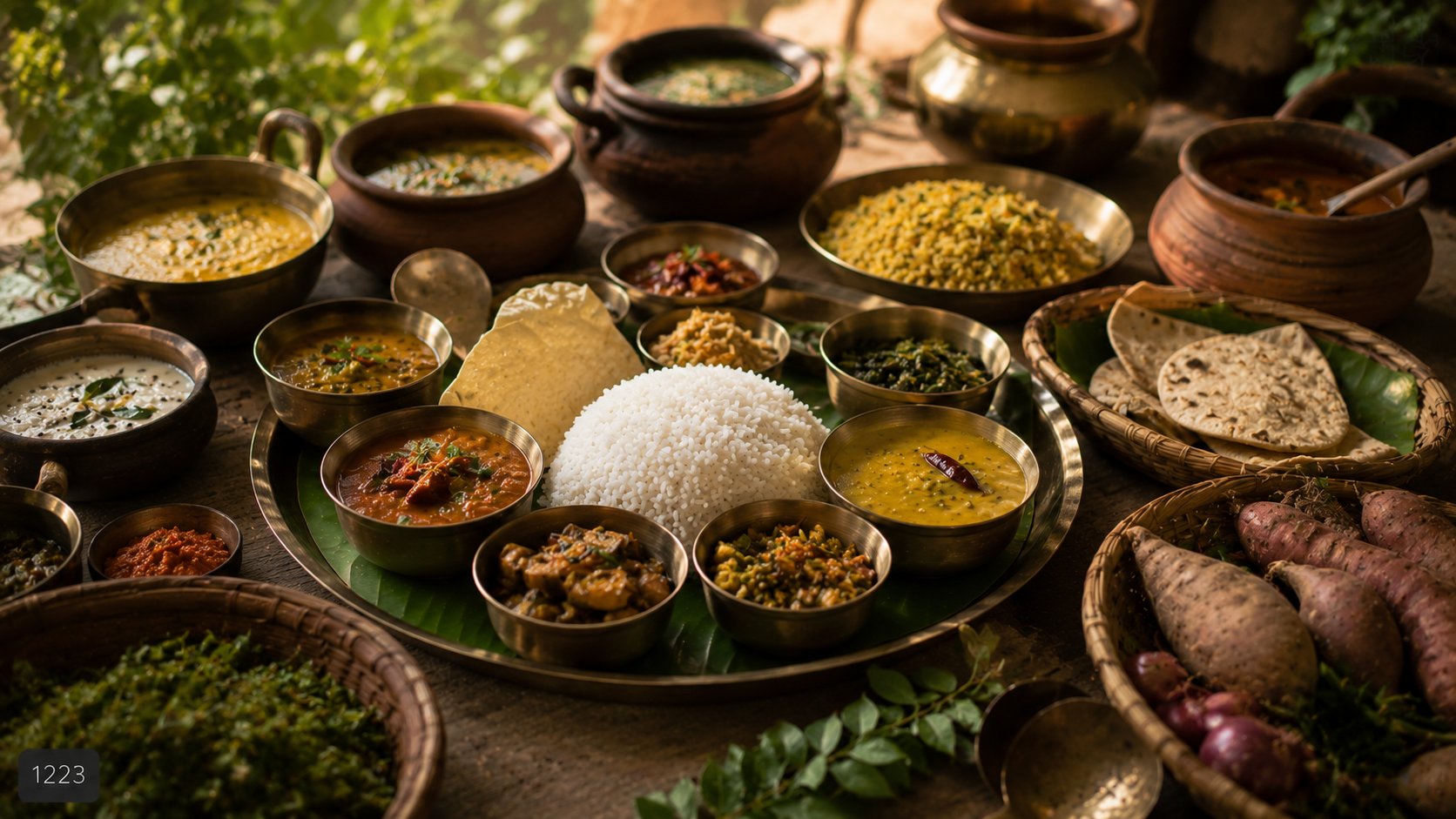
A thali is not simply a plate with many dishes — it is a complete culinary system that reflects a region's agricultural produce, nutritional philosophy, flavour balance principles, and cultural values. Every element in a traditional thali has a reason: the order in which dishes are served, the proportion of each component, whether sweets come first or last, and what the pickle and papad do structurally. Understanding the logic of each regional thali reveals more about Indian culinary philosophy than any single dish can. The thali is the most complete expression of a regional food culture available on a single plate.
Why every Indian thali follows the same structural logic
Despite enormous surface differences, every Indian thali — regardless of region — contains the same structural elements. This is not coincidence: it reflects a shared nutritional wisdom developed over thousands of years of Indian culinary philosophy.
Structural Element
Nutritional Role
South Indian Expression
North Indian Expression
Carbohydrate base
Energy foundation — the majority of calories
Rice (structural centre, everything mixed into it)
Wheat bread (roti, paratha, puri — eaten with accompaniments)
Thayir (curd) at end of meal — cooling and digestive
Raita, lassi, curd — cooling element throughout
Sweet
Closure, cultural completeness
Early in the meal or mixed with rice (South Indian); payasam last
Last — mithai or kheer as conclusion
Textural contrast
Sensory satisfaction
Pappadom — crispy, salty, structural contrast
Papad — same function; poppadums or farsan in Gujarat
Why the Thali Works Nutritionally
The traditional Indian thali is one of the most nutritionally balanced meal structures in the world. It contains complete protein (rice + lentils = complete amino acid profile), complex carbohydrates, multiple vegetable preparations for micronutrient diversity, fat for absorption of fat-soluble vitamins, acid for digestion, probiotics from fermented elements, and a sweet for psychological closure. This balance was not designed by nutritionists — it evolved through centuries of culinary practice guided by Ayurvedic philosophy. The fact that it works nutritionally is a consequence of its origins, not its intention.
🍌
Regional thali 1
The South Indian thali — rice as the structural centre
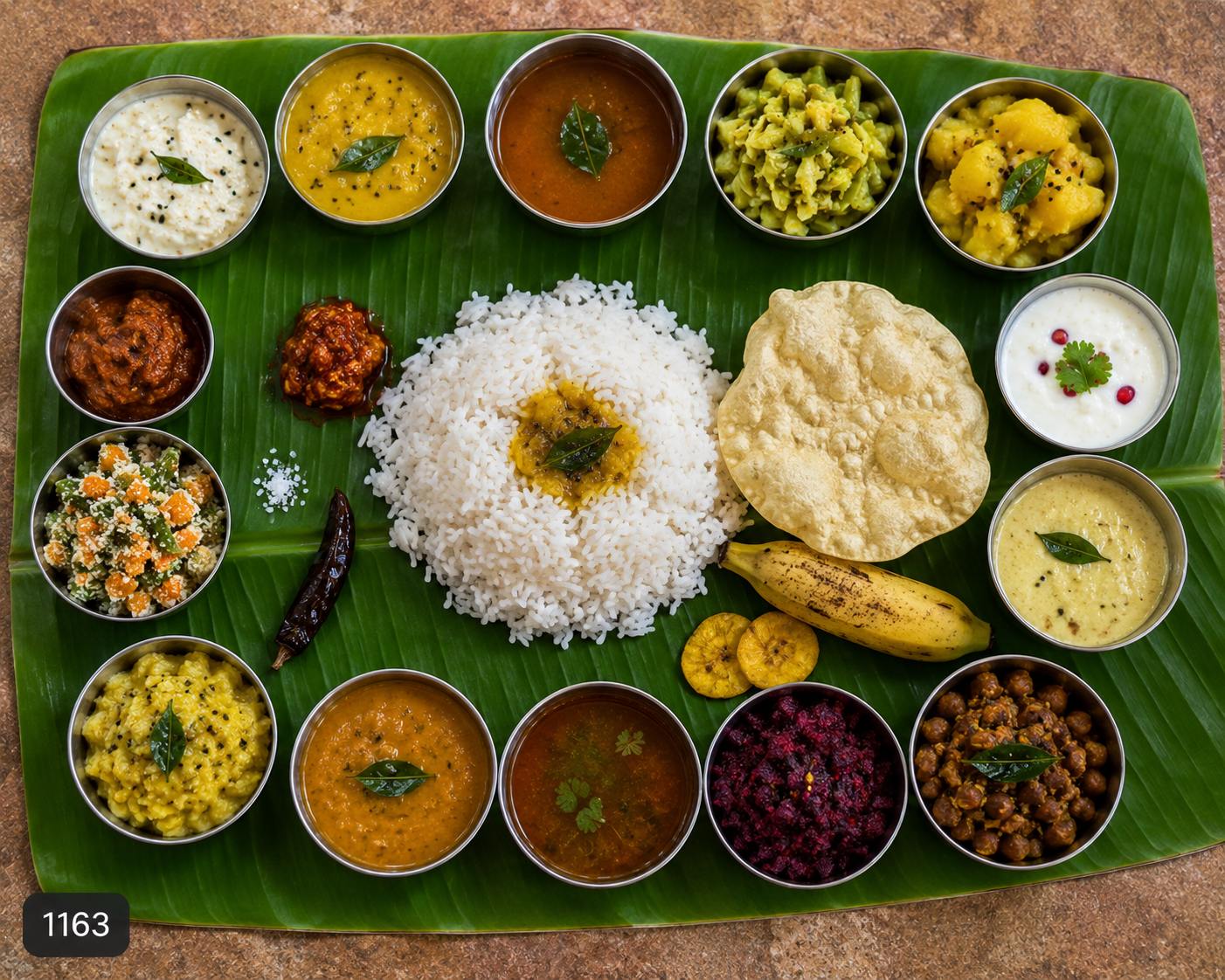
The South Indian thali (traditionally served on a banana leaf) is the most systematically structured of all Indian thalis. Each element has a specific position on the banana leaf and is served in a specific sequence that follows both flavour logic and Ayurvedic principles.
Sequence and Placement
The South Indian Banana Leaf — Position Has Meaning
Top-left: Salt, raw banana, or bitter vegetable — served first to stimulate digestion. Top-centre: Pickle (inji puli or mango) — acid element, served throughout. Top-right: Pappadom — textural contrast, eaten throughout. Centre-left: Payasam (sweet) — served early in the meal, before the main courses, following the Ayurvedic principle that sweet should stimulate appetite, not conclude a meal. Main body: Rice — served in quantity in the centre. Sambhar poured over first portion. Rasam poured over second. Curd mixed into final portion. Surrounding rice: Poriyal (dry vegetable), kootu (vegetable with lentil), aviyal (mixed vegetable in coconut), thoran (stir-fry) — each in a specific position around the rice.
The banana leaf is not a plate. It is a serving instruction.
The South Indian banana leaf thali — rice at the centre surrounded by sambhar, rasam, kootu, poriyal, aviyal, payasam, and pappadom. The sequence and position of each element follows ancient tradition.
🟡
Regional thali 2
The Gujarati thali — the only thali with rice and bread equally
The Sweet-Sour-Spicy Complete Meal
Gujarat — the transition zone thali that does both
The Gujarati thali is the only major Indian thali that includes both rice and bread simultaneously as equals — reflecting Gujarat's position in the transition zone between rice and wheat cultures. The meal includes rotli (thin wheat bread) and rice, both served with the same accompaniments.
Rotli (thin whole-wheat flatbread) — the bread element Rice — the grain element; served together, not sequentially Dal — sweeter and more liquid than North Indian dal; slightly tangy Kadhi — yoghurt and chickpea flour gravy, mildly sweet Shaak — seasonal vegetable preparation, often sweet-sour Undhiyu or seasonal vegetable — winter mixed vegetable preparation Gathiya or farsaan — fried chickpea flour snack as textural contrast Pickle and chutney — raw mango, chilli, or tamarind Shrikhand or basundi — sweet; or fresh fruit
The Gujarati thali expresses the six-taste philosophy (sweet, sour, salty, pungent, bitter, astringent) more explicitly than any other regional thali.
🐟
Regional thali 3
The Bengali meal — bitter first, sweet last, fish always
Sequence Over Structure
Bengal — a meal built on flavour sequence rather than simultaneous presentation
The Bengali meal is not typically served simultaneously — it follows a strict flavour sequence that is one of the most sophisticated meal structures in Indian cuisine.
Stage 1 — Shukto (bitter mixed vegetable): The meal always begins with bitterness — karela, raw banana, drumstick — believed to stimulate digestion and prepare the palate. This is the most distinctive element of Bengali meal structure. Stage 2 — Dal: A thin, fragrant dal — often chana dal with coconut and spices — follows the shukto. Stage 3 — Vegetables and fish: Multiple vegetable preparations (bhajas — fried, ghontos — mixed) alongside fish preparations in ascending richness. Stage 4 — Main fish course: The primary fish preparation — macher jhol (light curry) or for special occasions, the richer preparations like bhapa (steamed in banana leaf) or kalia. Stage 5 — Chutney and mishti: A sweet-sour chutney (tomato or raw mango), followed by mishti doi (sweetened yoghurt) or sandesh as the final course.
The sequence from bitter → savoury → fish → sweet is one of the most deliberate flavour journeys in Indian cuisine.
🏜
Regional thali 4
The Rajasthani thali — designed for desert conditions
The Desert Engineering Meal
Rajasthan — every element designed for survival, preserved, and rich in ghee
The Rajasthani thali is the most directly shaped by climate of any Indian thali — every element reflects the constraints and resources of the Thar Desert.
Baati (baked wheat balls): The centrepiece — baked in embers, not boiled. Uses no cooking water. Extremely long shelf life. Eaten by dipping in ghee and panchmel dal. Panchmel dal (five-lentil combination): Mixed lentils in a spiced gravy — the protein element, made from dried lentils that store indefinitely. Churma (crushed wheat with ghee and jaggery): The sweet element — crumbled baati mixed with ghee and jaggery. Sweet, dense, calorie-rich. Gatte ki sabzi (chickpea flour dumplings in yoghurt gravy): The vegetable course — cooked in yoghurt rather than water. No fresh vegetables required. Ker sangri (desert berry and bean): The preserved vegetable — sun-dried ingredients from the Thar, cooked with spices. Papad and pickle: Sun-dried lentil wafer; preserved mango or chilli pickle.
The Rajasthani thali is the only major Indian thali that uses essentially no water in its cooking and requires no fresh vegetables.
🌿
Regional thali 5
The Kerala Sadya — India's most elaborate meal structure
The Kerala sadya (feast) is the most structurally complex Indian meal tradition — up to 28 preparations served simultaneously on a single banana leaf for Onam, weddings, and major festivals. It is observed by all communities in Kerala regardless of religion.
Category
Dish
Function
Rice
Red rice (rosematta) or white rice
Structural centre — all other elements poured into or eaten alongside rice
Wet curries
Sambhar, rasam, pulissery (yoghurt curry)
Sequential: sambhar first, rasam second, pulissery third — mixed into successive portions of rice
Textural contrast; also eaten as a structural scoop
Sweet
Payasam (two or three varieties — ada pradhaman, palada)
The meal's closing element and its most anticipated
🌿
The philosophical foundation
Ayurvedic logic — why the thali is structured the way it is
The Indian thali's structure is not arbitrary — it reflects Ayurvedic dietary philosophy, which classifies foods by their effect on the body (heating or cooling), their taste (six tastes: sweet, sour, salty, pungent, bitter, astringent), and their digestibility. The traditional thali attempts to incorporate all six tastes and achieve balance between heating and cooling elements.
Why South Indian Thalis Serve Sweet Early
Western dining convention places sweet at the end — dessert is conclusion. South Indian thali tradition serves payasam (sweet) early, sometimes before the main meal begins. The Ayurvedic rationale: sweet stimulates digestive fire (agni) and prepares the stomach for heavier foods. Ending with curd (thayir sadam — curd rice) — cooling, mildly sour — settles the digestive system. The sequence is not about chronological taste preference — it is about digestive physiology. Whether the Ayurvedic theory is scientifically accurate is debated; that it produced a distinctive and internally logical meal structure is not.
📊
Comparison
Five thalis — one structure, five expressions
Thali
Base Grain
Defining Feature
Sweet Timing
Most Unique Element
South Indian
Rice (centre)
Served on banana leaf; sequential pouring of sambhar, rasam, curd into same rice
Early (payasam before main meal)
The banana leaf as serving instruction — position carries meaning
Gujarati
Both rice and rotli equally
Only thali with both grain traditions simultaneously; explicitly expresses all six Ayurvedic tastes
Integrated (shrikhand alongside savoury)
Sweetness in the dal, kadhi, and vegetables — savoury dishes with jaggery
Bengali meal
Rice
Strict bitter-to-sweet sequence; begins with shukto (bitter); ends with mishti doi
Last
Shukto — mandatory bitter opening course unique to Bengal
Rajasthani
Wheat (baati)
Only major thali that uses no water in cooking and requires no fresh vegetables
Integrated (churma alongside dal baati)
Baati baked not boiled; ghee in extraordinary quantity
Kerala Sadya
Rice
Up to 28 preparations simultaneously; the most elaborate meal structure in India
Last (payasam — the meal's most anticipated element)
The number and variety of simultaneous preparations — nothing else in Indian cooking approaches this
A thali is a complete Indian meal served on a single plate (traditionally steel or brass in the north, banana leaf in the south) with multiple small dishes simultaneously. It is not a sampler or tasting menu — it is the complete daily meal, with every element having a structural function: carbohydrate, protein, vegetable, acid, fat, dairy, and sweet in specific proportions.
Why does the South Indian thali serve sweet early?
South Indian Ayurvedic tradition holds that sweet stimulates digestive fire (agni) and prepares the stomach for heavier foods. Payasam is served before the main meal for this reason. The meal ends with curd rice (thayir sadam) — cooling and mildly sour — to settle digestion. The sequence reflects digestive physiology rather than taste preference.
What makes the Gujarati thali unique?
The Gujarati thali is the only major Indian thali that serves both rice and bread simultaneously as equals — reflecting Gujarat's position in the transition zone between rice and wheat cultures. It also explicitly expresses all six Ayurvedic tastes (sweet, sour, salty, pungent, bitter, astringent) in a single meal, including deliberate sweetness in savoury dishes like dal and kadhi.
How many dishes are in a Kerala sadya?
A full Kerala sadya for Onam or weddings has 24–28 preparations served simultaneously on a banana leaf. The count includes multiple pickles (3–5), multiple vegetable preparations, multiple curries, multiple payasam varieties, pappadom, and rice. The number and variety of simultaneous preparations makes the sadya the most structurally elaborate meal tradition in India.
Why does the Rajasthani thali use no fresh vegetables?
Because the Thar Desert produces very limited fresh vegetables year-round. The Rajasthani thali was engineered for desert conditions: baati (baked wheat, not boiled), gatte ki sabzi (chickpea flour dumplings in yoghurt, not water), ker sangri (sun-dried desert plants), and papad (sun-dried lentil wafer). Every element uses preserved or dried ingredients that survive desert heat without refrigeration.