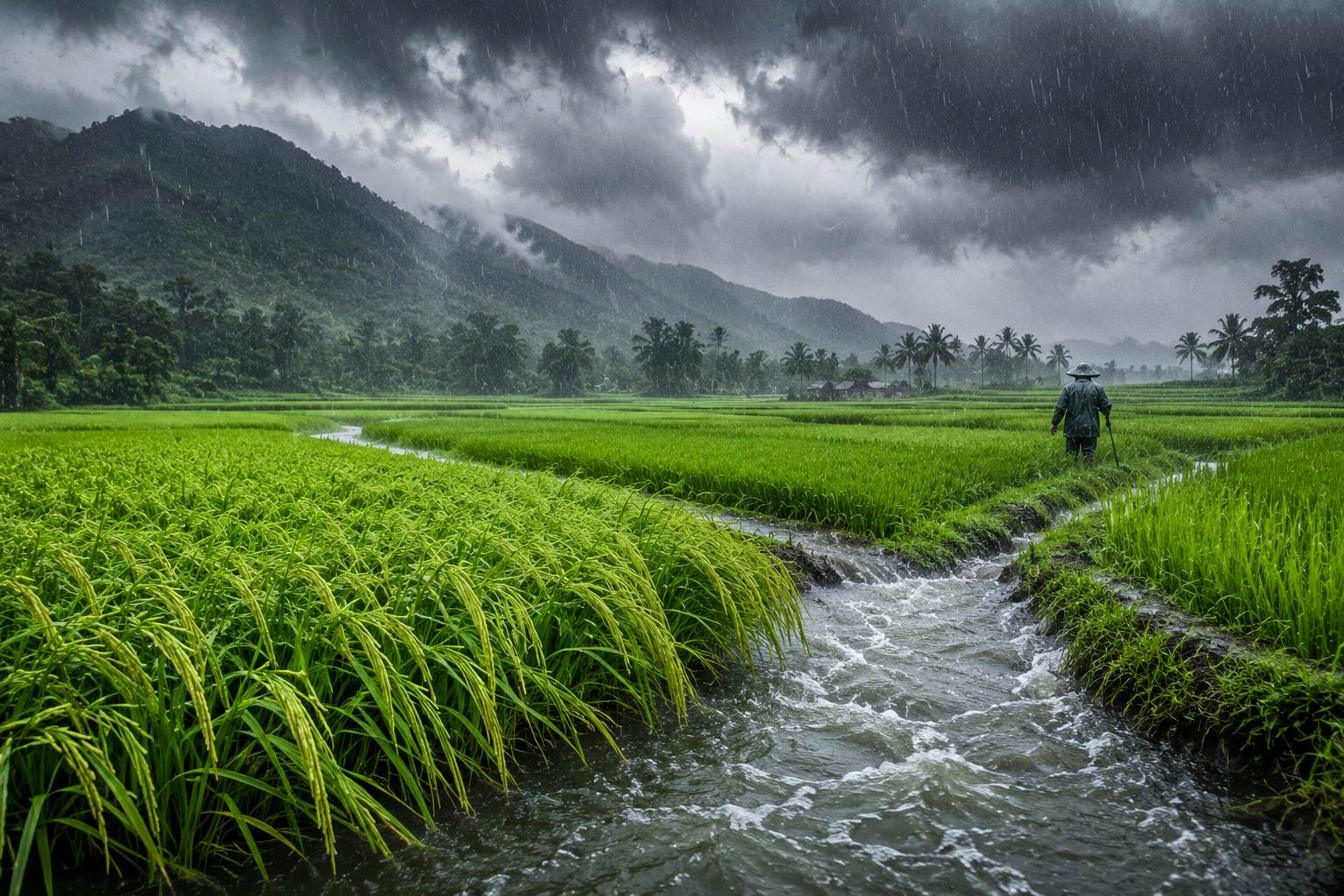
Before religion, before trade routes, before empires — climate determined what grew. And what grew determined what a billion people eat today.
⏱ 15 min read🗓 Updated June 2026★ Level 1
The foundational argument
Climate is the invisible hand behind every regional cuisine
Kerala's coconut abundance is not cultural preference — coconut palms thrive in Kerala's high-rainfall, warm coastal climate. Rajasthan's dried food tradition is not artistic choice — it is the engineering response to a desert with no refrigeration and no water to spare. Kashmir's warming spices are not arbitrary — they are the dietary response to a cold high-altitude climate where caloric density matters. Punjab's dairy richness is not mere indulgence — it expresses one of the world's most productive dairy systems, built on five rivers irrigating an exceptionally fertile plain. In every case, the food is a logical consequence of the place.
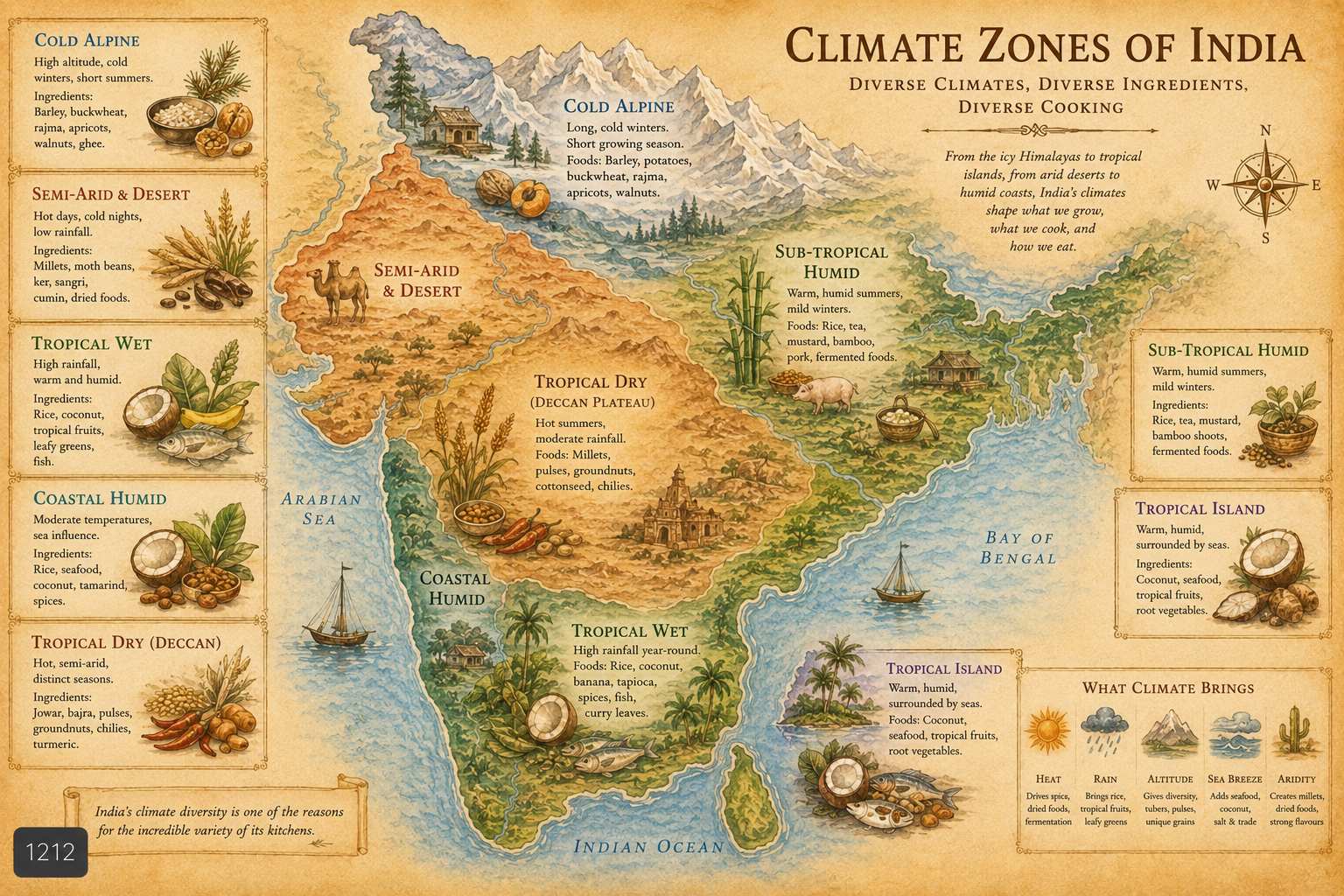
Climate determines what can grow (temperature, rainfall, soil), what must be preserved (heat and humidity vs. cold drive different strategies), what cooking fat is available (coconut in tropical zones, mustard in delta zones, ghee in dairy plains, groundnut oil in semi-arid interior), and what the body needs (calorie-dense warming food in cold climates; lighter fermented food in tropical climates). Religion, trade, and empire shaped what happened next — but climate set the starting conditions for every Indian regional cuisine.
India's five climate zones mapped against their food outputs. The monsoon line — where rainfall drops below 1,000mm — is the single most important boundary in Indian food geography.
What grows: Rice (multiple harvests), coconut palms, black pepper, cardamom, cloves, tropical fruits, year-round vegetables, freshwater and sea fish in abundance.
Food logic: Year-round warmth and humidity make fermentation reliable and effortless — lactic bacteria that convert rice-urad batter into idli and dosa are always active. Preservation is challenging (heat promotes spoilage), so this is a fresh-daily cooking culture. Coconut oil dominates because 80 million palms produce it continuously. Rice grows in such surplus that every meal is structurally built around it.
What visitors notice: Nothing is pre-made and reheated. Sourness — tamarind, kokum, kodampuli — is built into dishes because acid extends shelf life in tropical heat. Coconut appears in four simultaneous forms in a single meal: oil, milk, grated, and paste.
Why Fermentation Developed Here and Not in the North
Idli and dosa batter requires 8–16 hours fermentation. In Tamil Nadu and Kerala (28–35°C ambient), lactic bacteria are always active — fermentation happens reliably every night. In Punjab or Rajasthan, the same batter sits overnight without fermenting, or ferments inconsistently. Climate created the technique. The technique created the cuisine. This is why idli-dosa culture is a southern phenomenon — not because southerners are different people, but because the air temperature does the fermentation work for them.
What grows: Jowar (sorghum), bajra (pearl millet), toor dal, chana dal, groundnuts, cotton, onions. Too dry for reliable rice; not ideal for wheat.
Food logic: Millet is the base grain — jowar bhakri with spiced lentils and vegetables. Groundnut oil is the cooking fat because peanuts grow abundantly in semi-arid soil. Spicing is robust — bold spices preserve food in high temperatures without refrigeration. Andhra Pradesh's reputation as India's spiciest regional cuisine is a direct climate consequence: the Guntur chilli belt grows in this zone and has done so for 400 years.
What visitors notice: Bhakri (thick millet flatbread) is rougher, denser, and more nutritious than refined wheat roti. Legumes are central — the protein source when meat is expensive. Less rich than northern cooking; more direct and agricultural in character.
☀️
Climate Zone 3
Arid Desert — preservation, ghee, cooking without water
Rajasthan (Thar Desert) · Gujarat interior
Rainfall under 400mm · Up to 50°C summer · Near-freezing winter nights
What grows: Bajra (drought-resistant millet), moth beans, ker (desert berry), sangri (desert bean), date palms. Very limited fresh vegetables. Livestock — camels and goats — that survive the Thar.
Food logic: Water is too scarce and precious to use freely in cooking. This is the only major Indian cuisine explicitly built around cooking without water. Baati (wheat balls) are baked in embers, not boiled. Gatte (chickpea dumplings) cook in yoghurt, not water. Ghee — stable in desert heat, produced from drought-adapted cattle — replaces water as the primary cooking medium. Ker and sangri are sun-dried for year-round use because nothing fresh survives the summer heat. The cuisine's extraordinary richness is not indulgence — it is necessary caloric density for living in extreme conditions.
What visitors notice: Paradoxically, one of India's richest, most ghee-drenched cuisines comes from its driest region. Dal baati churma uses no water in any of its three components.
The Ghee Paradox — Richness from Scarcity
The richest use of cooking fat in India comes from the poorest agricultural zone. Rajasthan, with under 400mm annual rainfall, produces a cuisine that uses ghee more generously than any other Indian state. This seems counterintuitive until you understand the climate logic: ghee is stable at desert temperatures (unlike fresh dairy), available from goats and camels that survive the Thar, and serves as both cooking medium and caloric sustenance when fresh food is unavailable. The ghee is not wealth on display — it is the practical solution to a desert cooking problem that has been refined over centuries into an art form.
What grows: Winter wheat (in surplus), rice (second crop), mustard, sugarcane, dairy in large quantities from cattle and buffalo on rich pasture.
Food logic: The five rivers deposit alluvial soil of extraordinary fertility, producing wheat surpluses that feed India. Cold winters require high-calorie food — butter, ghee, cream, and whole milk are embedded in every meal because the climate demands caloric density and the agricultural system produces dairy in abundance. Wheat bread is the staple because wheat is what the land grows best. The tandoor — a clay oven producing intense dry heat — is perfectly suited to baking bread quickly in a region with cold nights and limited fuel.
What visitors notice: The sheer quantity of dairy. A paratha arrives with butter the size of a golf ball. Lassi is thick enough to eat with a spoon. Dal makhani was simmered overnight with cream. The climate requires this generosity.
🏔
Climate Zone 5
High Altitude — warming spices, calorie density, saffron
Altitude 1,600–5,000m · -20°C to 25°C seasonal range · 3–5 month growing season
What grows: Apples, walnuts, saffron (Kashmir valley only), rice (lower altitudes), root vegetables, buckwheat, barley. Short growing season; long winters require extensive food storage.
Food logic:Warming spices are a dietary necessity, not a flavour preference. Cardamom, cloves, cinnamon, dry ginger, and black pepper stimulate circulation and generate body heat — documented dietary adaptations in cold climates across all cultures globally. Caloric density matters — fat and protein are prioritised over fibre. Kashmir grows saffron (the only place in India where Crocus sativus thrives) on well-drained slopes — which is why saffron appears in everyday Kashmiri cooking, not just festivals. The wazwan (multi-course meat feast) is not excess — it is a tradition of calorie-rich eating to sustain the body through winter.
What visitors notice: The spice profile is warming and aromatic rather than hot. Saffron in everyday food. Meat is central in ways it is not in the plains. Dried fruits and nuts appear in savoury preparations — walnut chutney, dried apricot in korma — because the highland ecology produces them in surplus.
🌧️
The defining seasonal force
The Monsoon — how one season shapes an entire food culture
India receives most of its annual rainfall in three to four months. This single meteorological fact shapes the agricultural calendar, the food storage imperative, the festival calendar, and the cooking traditions of a billion people. The monsoon is not just weather — it is the organising principle of Indian agricultural life.
Monsoon Impact
Food Consequence
Where Most Visible
Hilsa migration
Hilsa fish migrate upstream into rivers during monsoon — July–September is Bengal's most celebrated culinary season
Bengal, Odisha, Bihar
Pre-monsoon mango season
Most intense mango culture in the world — hundreds of varieties, raw mango souring (amchur, aam panna), festival preparations
Maharashtra, UP, Andhra, Bengal
Post-monsoon new rice harvest
New rice harvest drives festival foods — pongal in Tamil Nadu, nabanna in Bengal, new rice rituals across all rice cultures
Tamil Nadu, Bengal, Kerala
Pre-monsoon preservation
Every household produces preserved foods before the rains — pickling, drying, fermenting — when fresh produce disappears
All India, especially coastal
Monsoon pakora culture
Hot fried spiced snacks eaten during monsoon rains — a specific cultural phenomenon; the same snacks eaten differently in dry season
North India, Maharashtra
Tamil Nadu two-monsoon advantage
Both southwest (June–Sept) and northeast (Oct–Dec) monsoons — double rice harvest, year-round agricultural abundance
Tamil Nadu specifically
🌊
Climate's delivery mechanism
River systems — how climate becomes cuisine
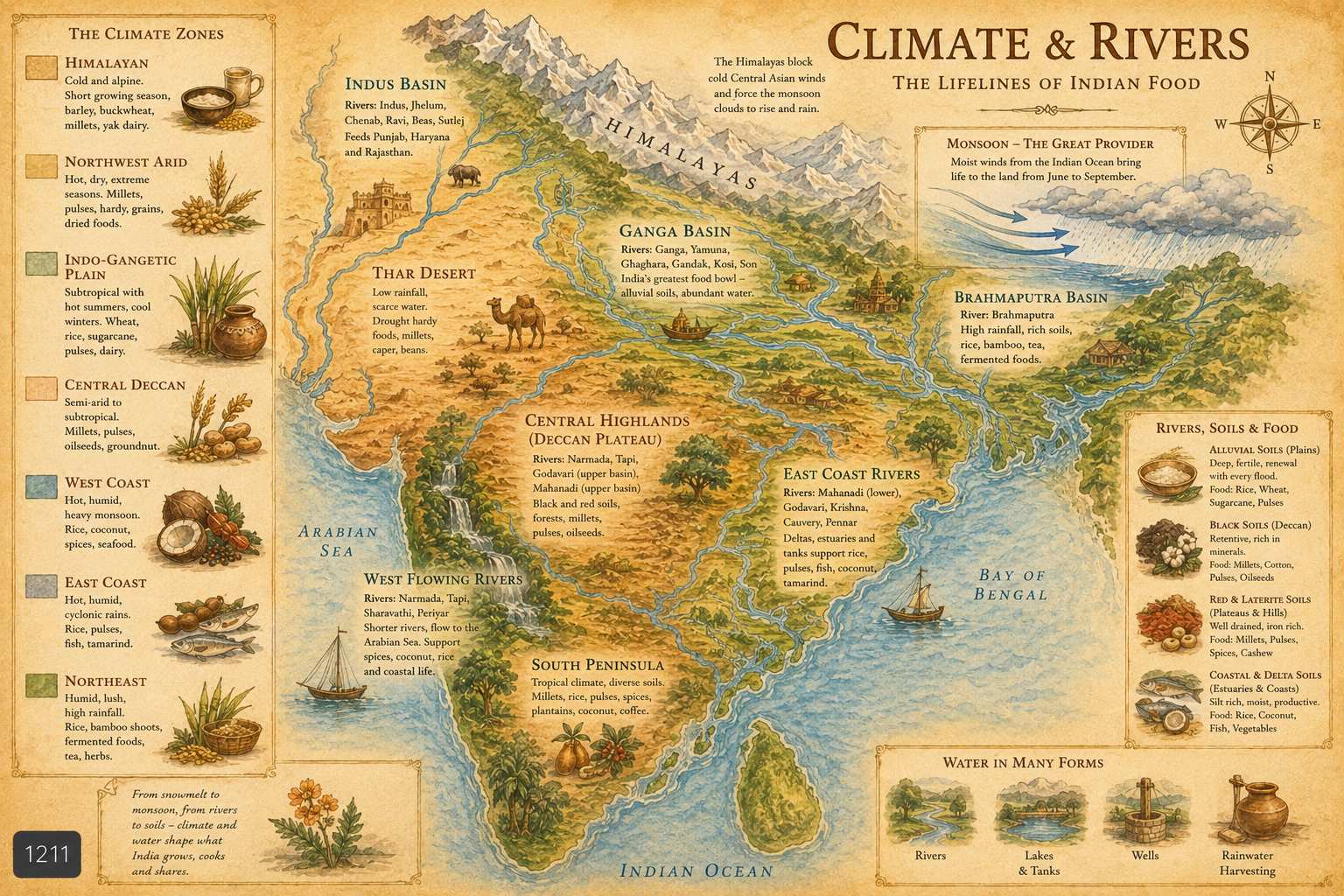
Climate determines what can grow; river systems determine where agricultural surplus actually concentrates. Every great Indian culinary tradition has a river at its heart.
River System
Food It Delivers
Culinary Consequence
Ganges-Brahmaputra delta
Alluvial fertility + 2,500km freshwater fish habitat + mustard-growing soil
Bengal's fish-rice-mustard oil culture — three elements from one river system defining one of the world's great cuisines
Punjab Five Rivers
Irrigated wheat and dairy surplus — India's most productive agricultural land
The bread-and-butter culture of Punjab that became the world's idea of "Indian food"
Cauvery River
Fertile delta rice farming — some of India's most productive paddy land
Tamil Nadu's rice surplus → rice in multiple forms at every meal, multiple varieties for different preparations
Kerala backwaters
900km interconnected canals and lagoons for inland fishing and paddy farming
Kerala's fish culture is not only coastal — backwaters supply freshwater fish (karimeen, koi) to the inland population
Jhelum / Kashmir valley
Fertile highland valley, lotus ponds, saffron fields on well-drained slopes
Lotus root (nadru) as a specific Kashmiri ingredient; saffron in everyday cooking because it grows locally
Brahmaputra floodplain
Highly fertile seasonally-flooded plains with exceptional rice diversity
Assam's black rice and sticky rice varieties, and the freshwater fish tradition of the Northeast
India's river systems mapped against their food outputs. Every great Indian culinary tradition has a river at its heart — providing water, fertile soil, and protein in the form of fish.
🔍
Five case studies
Five states, five climates, five inevitable cuisines
State
Climate Fact
Direct Food Consequence
Kerala
2,000–3,000mm rainfall, 27°C+, ~80 million coconut palms
Coconut oil is the default fat — not culturally chosen but agriculturally inevitable. Coconut in four simultaneous forms at every meal.
Rajasthan
Under 400mm rainfall, 50°C summer, no refrigeration possible
Sun-drying is free and effortless — ker, sangri, vegetables all dried. Ghee replaces water as cooking medium. Cuisine of engineered scarcity.
Bengal
2,500km of rivers permanently stocked with freshwater fish; mustard grown in delta soil
Fish is the cheapest available protein. Mustard oil is the local fat. Rice grows in alluvial surplus. Three delta outputs define the cuisine.
Kashmir
1,600m+ altitude, -10°C winters, Crocus sativus grows on valley slopes
Warming spices stimulate circulation in cold. Saffron in everyday food because it grows locally. Wazwan calorie density is dietary adaptation.
Punjab
Five-river irrigation produces exceptional wheat and dairy surplus; cold winters
Wheat bread as staple; dairy embedded in every meal for caloric density; tandoor for fast high-heat baking in cold conditions.
The Climate-Culture Lag
Climate necessity creates food practice. Practice becomes habit. Habit becomes culture. Culture becomes identity. Long after the original necessity has passed — after refrigerators, after global supply chains — the food tradition continues. Kerala still uses coconut oil even when groundnut oil is cheaper. Rajasthan still features ker and sangri even when fresh vegetables are available year-round. The food now exists as cultural identity, maintained long after the material conditions that created it have changed. Climate produced the cuisine; culture preserved it.
Kerala has approximately 80 million coconut palms. The state's tropical monsoon climate is ideal for coconut palms, which produce oil, milk, and flesh in year-round abundance. Before industrial vegetable oil production, coconut oil was the only widely available cooking fat. Geography produced the ingredient; abundance made it the default; culture preserved it long after the material necessity passed.
Why does Rajasthan use so many dried and preserved foods?
Rajasthan receives less than 400mm of annual rainfall, much of it covered by the Thar Desert. Without refrigeration, fresh food spoils in 50°C heat. Water is too scarce to use freely in cooking. The result: a cuisine built on dried ingredients, preservation techniques, and cooking methods that avoid water entirely — baati baked in embers rather than boiled, yoghurt gravies instead of water-based ones.
Why does Kashmir use warming spices?
Kashmir sits at 1,600–5,000m altitude with severe winters. Warming spices (cardamom, cloves, cinnamon, dry ginger) stimulate circulation and generate body heat — a dietary adaptation documented in cold climates globally. These spices also grow in or near the Kashmir valley. The wazwan tradition of multiple calorie-rich meat courses is direct dietary adaptation to high-altitude cold climate.
Why does Bengal eat so much fish?
Bengal is built on the Ganges-Brahmaputra delta. The 2,500km network of rivers and waterways keeps Bengal permanently stocked with freshwater fish. Fish is often the cheapest protein available. The mustard oil that defines Bengali cooking comes from mustard grown in the same delta soil. Climate delivered both the fish and the fat to cook it in simultaneously.
Is climate still relevant to Indian food, or has globalisation changed everything?
Climate remains relevant in two ways. Traditional food practices persist as cultural identity long after the original material necessity has passed. And new practices continue to be shaped by climate — the monsoon determines fishing seasons, harvest calendars drive festival foods, and local ingredient abundance (Nagpur oranges, Alphonso mangoes, Darjeeling tea) still defines regional food identity. Globalisation has added ingredients; it has not erased the climate foundation.