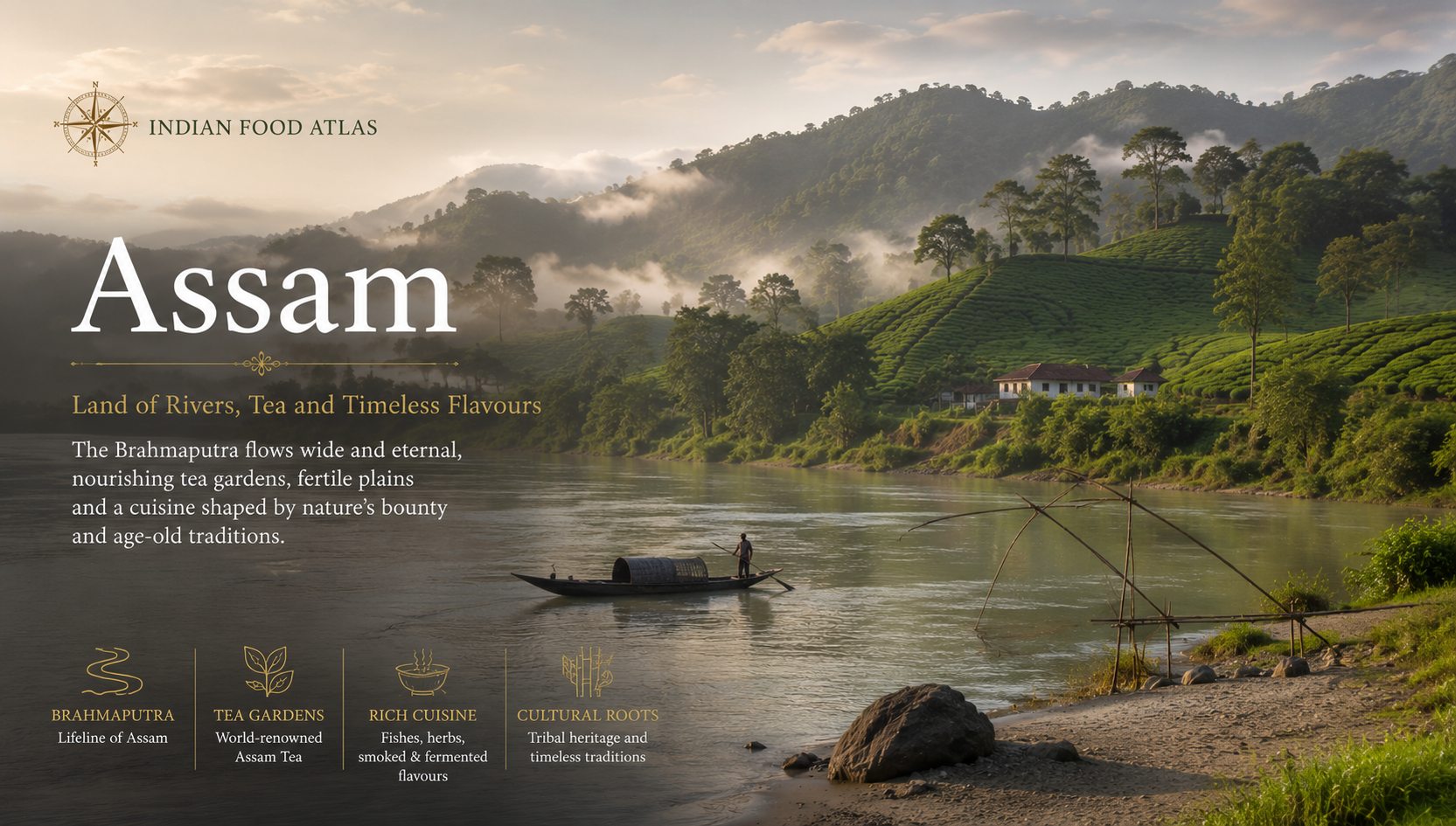
The mighty Brahmaputra flows through Assam, flooding and enriching the floodplain that produces specific fish, specific rice varieties, and the fermented bamboo, mustard leaf, and fish preparations that define Northeast India's most accessible regional food tradition.
⏱ 12 min read🗓 Updated June 2026★ State Food Guide
State Food Guide
Assam — The Brahmaputra's Kitchen
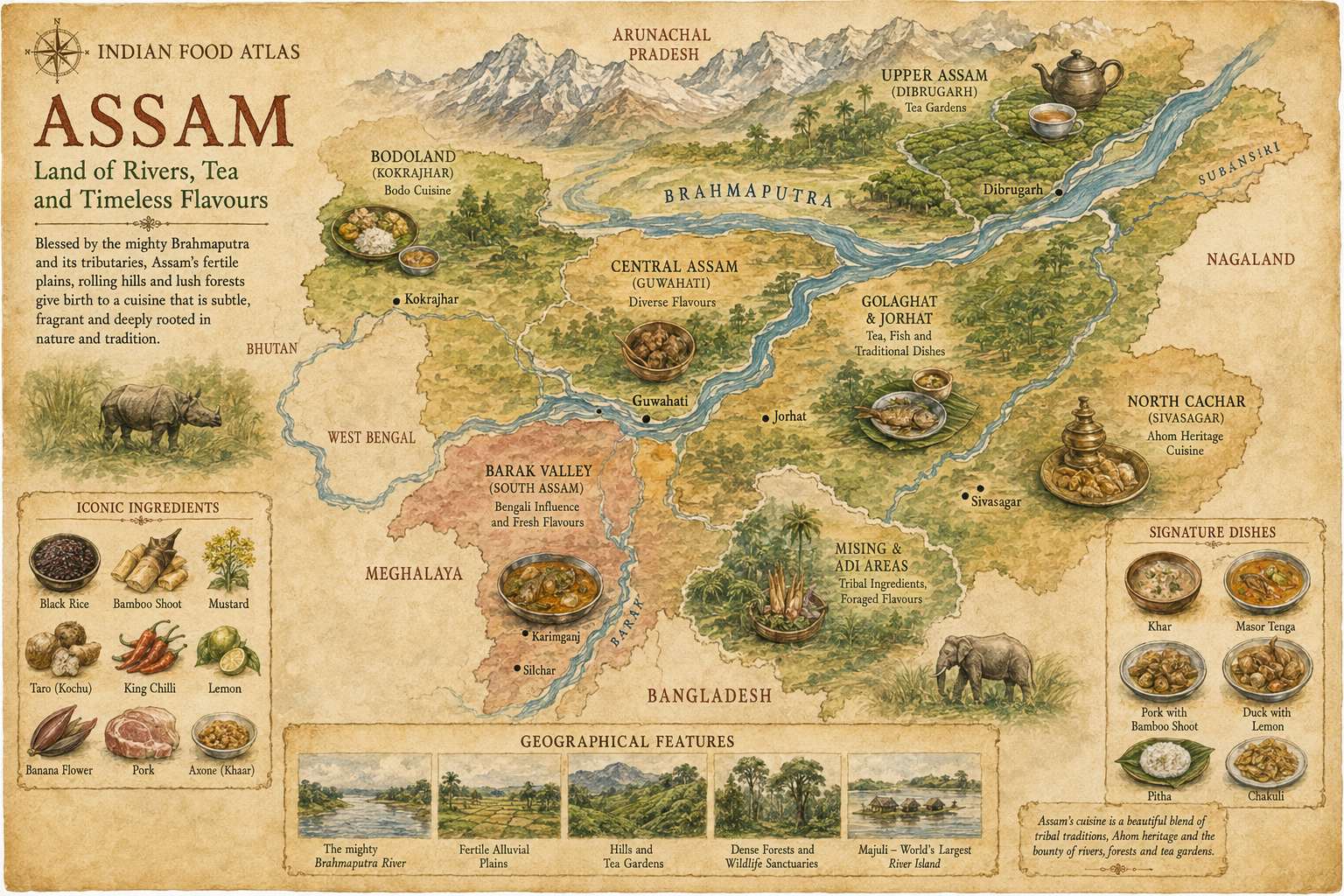
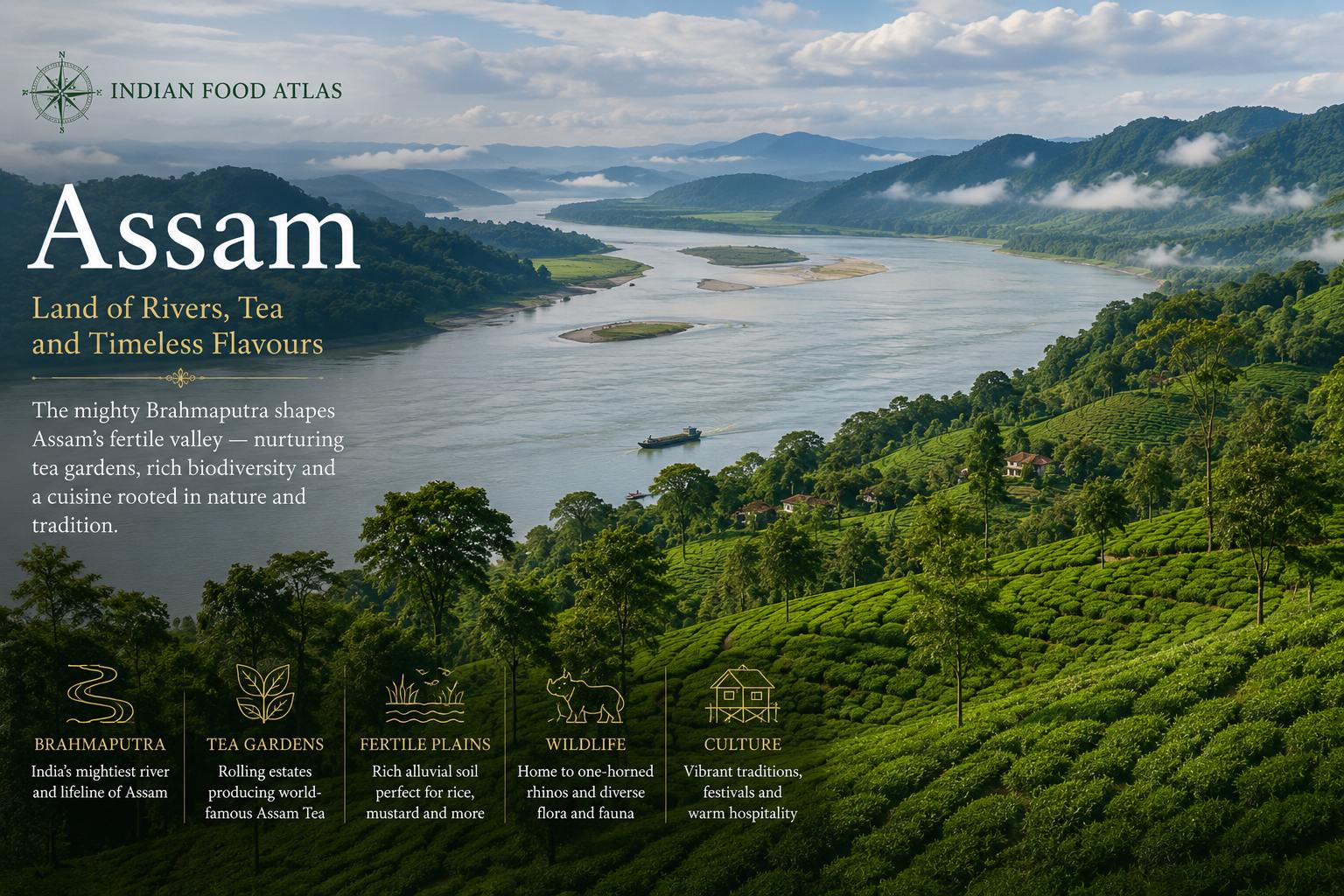
Assam's geography is the Brahmaputra river valley, flanked by the Eastern Himalayas to the north and the Meghalaya Plateau to the south. The river floods annually, enriching the floodplain with silt. The resulting ecosystem supports specific rice varieties (joha rice — the most fragrant in India), specific fish, and the bamboo forests that produce the seasonal shoots central to Assamese cooking.
One of the world's great rivers — shapes the entire ecology
Tea
World's largest tea-growing region
Fermented
Fermentation as the defining preservation technique
Bamboo
Young shoots as a seasonal staple
Smoked
Smoked fish and meat as the pantry tradition
The geographic regions and food zones of Assam Food Guide.
🗺
Geography & Climate
The land that made this food inevitable
The Brahmaputra is one of the world's great rivers — rising in Tibet, descending through Arunachal Pradesh, and broadening across Assam to create a valley up to 100km wide. The annual flooding deposits silt that makes Assam's agricultural land extraordinarily fertile. The specific fish of the Brahmaputra system — rohu, catla, hilsa, and the specific Assamese varieties — form the protein base of the daily meal. Rice is consumed three times daily from the specific joha and bora varieties that grow only in this specific ecology.
Fermentation is the defining technique of Assamese cooking — the preservation technology of a region with extreme humidity and temperature variation. Xkhari (fermented mustard leaf), Tungrymbai (fermented soybean, similar to the Northeast India tradition), smoked and dried fish (sidol), fermented bamboo shoot (khorisa) — these fermented ingredients appear in preparations throughout the year, providing the specific sour and umami depth that fresh ingredients alone do not achieve.
Assam produces more tea than any other region in the world. The tea gardens of the Brahmaputra valley (Dibrugarh, Jorhat, Golaghat) produce the specific Assam malty black tea — rich, bold, slightly bitter — that is the base for most English Breakfast tea globally and the vehicle for the chai culture of India. The tea, however, is an export culture — the local food tradition predates the colonial tea economy and exists independently of it.
Joha Rice — The World's Most Fragrant Rice
Joha rice (also called Jaha) is a short-grain aromatic rice variety grown only in Assam's Brahmaputra floodplain. The specific soil and water conditions of the Assamese floodplain produce a fragrance that is considered by rice specialists to rival Basmati in aromatic character — but with a completely different aroma profile. Where Basmati has a nutty, slightly floral fragrance, Joha has a sweet, almost pandan-like fragrance that intensifies when cooked. It has a Geographical Indication from Assam and is exported in small quantities. Most of the world has never encountered it.
The terrain and agricultural landscape that produces the defining ingredients.
🧬
Food DNA
The flavour architecture
Grains
Rice (joha, bora varieties) — joha is the most fragrant; bora is glutinous — specific to Assam ecology
Fish (Brahmaputra) — rohu, catla, hilsa — the river system's fish
Pork — specifically in hill-community cooking within Assam
Duck — in specific preparations — especially with ash gourd
Aromatics
Khorisa (fresh and fermented bamboo) — seasonal and preserved
Joha bhaat (fragrant rice) — the aromatic centrepiece
Mustard oil — the primary cooking fat
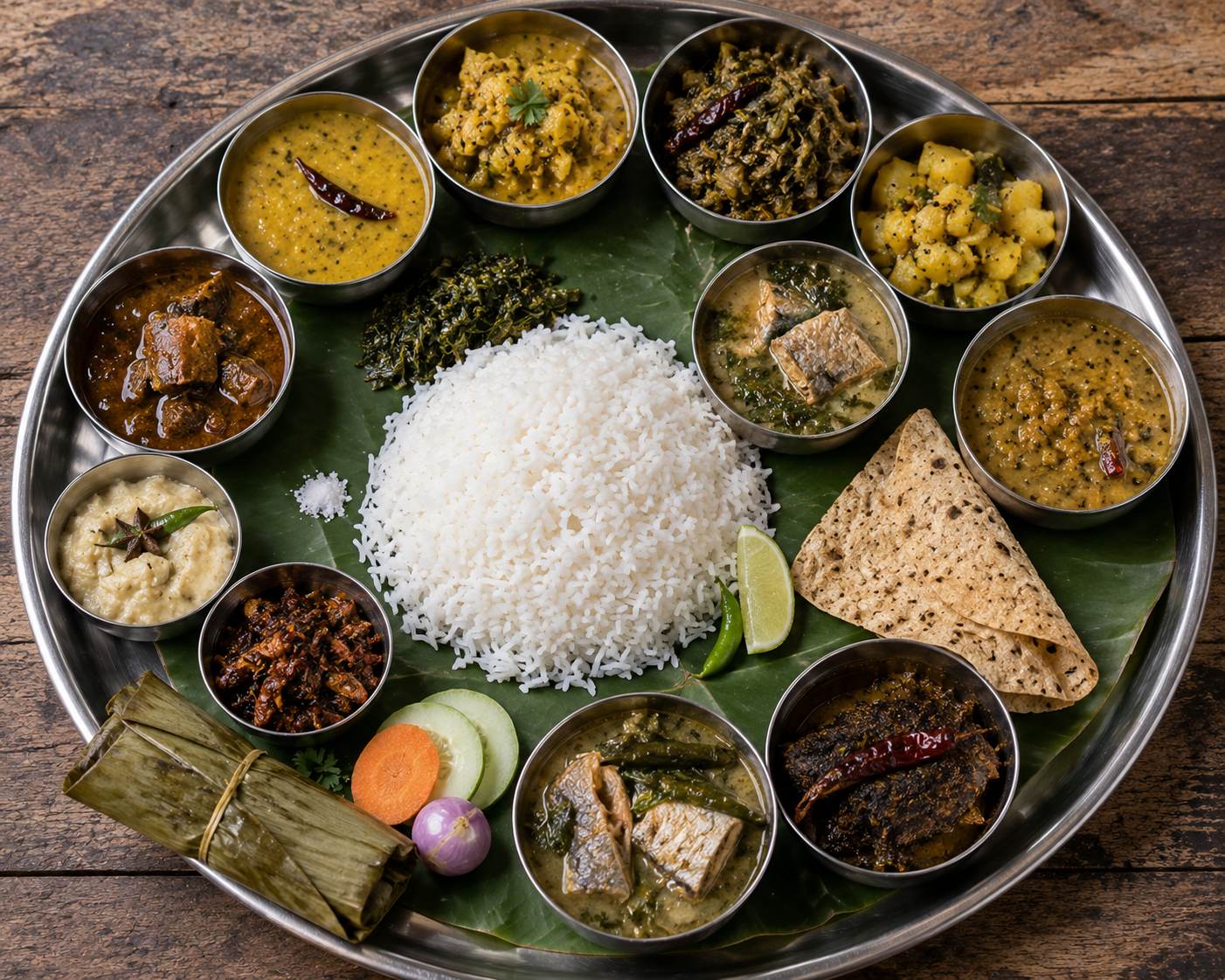
A complete thali representing the full flavour range.
🎉
Festival Foods
When the calendar drives the kitchen
Bihu (Rongali/Bohag)
The spring Bihu — pithas (rice cake preparations) of extraordinary variety. Til pitha (sesame), ghila pitha (fried rice cake), and many others are the Bihu food tradition.
Bihu (Kongali/Kati)
The autumn Bihu — more restrained, associated with the lean season. Simple rice preparations.
Bihu (Bhogali/Magh)
The winter harvest Bihu — meji (bonfire) and specific community feast foods.
Durga Puja
Fish preparations and community feasting — the Bengali influence on Assam's major festival.
Eid
Assamese Muslim community's specific food traditions — biryani with local ingredients.
🌍
Diaspora & Reach
How this cuisine spread beyond its borders
Assam's tea economy brought the state into global consciousness but its food culture remains the least internationally known of any large Indian state. The Northeast India diaspora in Delhi, Mumbai, and abroad has begun making Assamese food visible nationally through restaurants and social media.
Joha rice has recently attracted gourmet interest nationally and internationally as India's most fragrant indigenous rice variety. The fermented food tradition of Assam intersects with global fermentation trends, attracting food tourism.
Assamese food centres on rice (particularly joha, the most fragrant rice in India), fish from the Brahmaputra, and fermented ingredients (xkhari, khorisa, sidol) that provide sourness and umami. Mustard oil is the primary cooking fat. The cuisine is simpler than many North Indian traditions but has specific depth from the fermented ingredients.
What is joha rice?
Joha is an aromatic short-grain rice grown only in Assam's Brahmaputra floodplain. It has a fragrance described as sweet and pandan-like — different from Basmati's nutty floral character. It has a Geographical Indication from Assam and is considered among the world's most fragrant rice varieties.