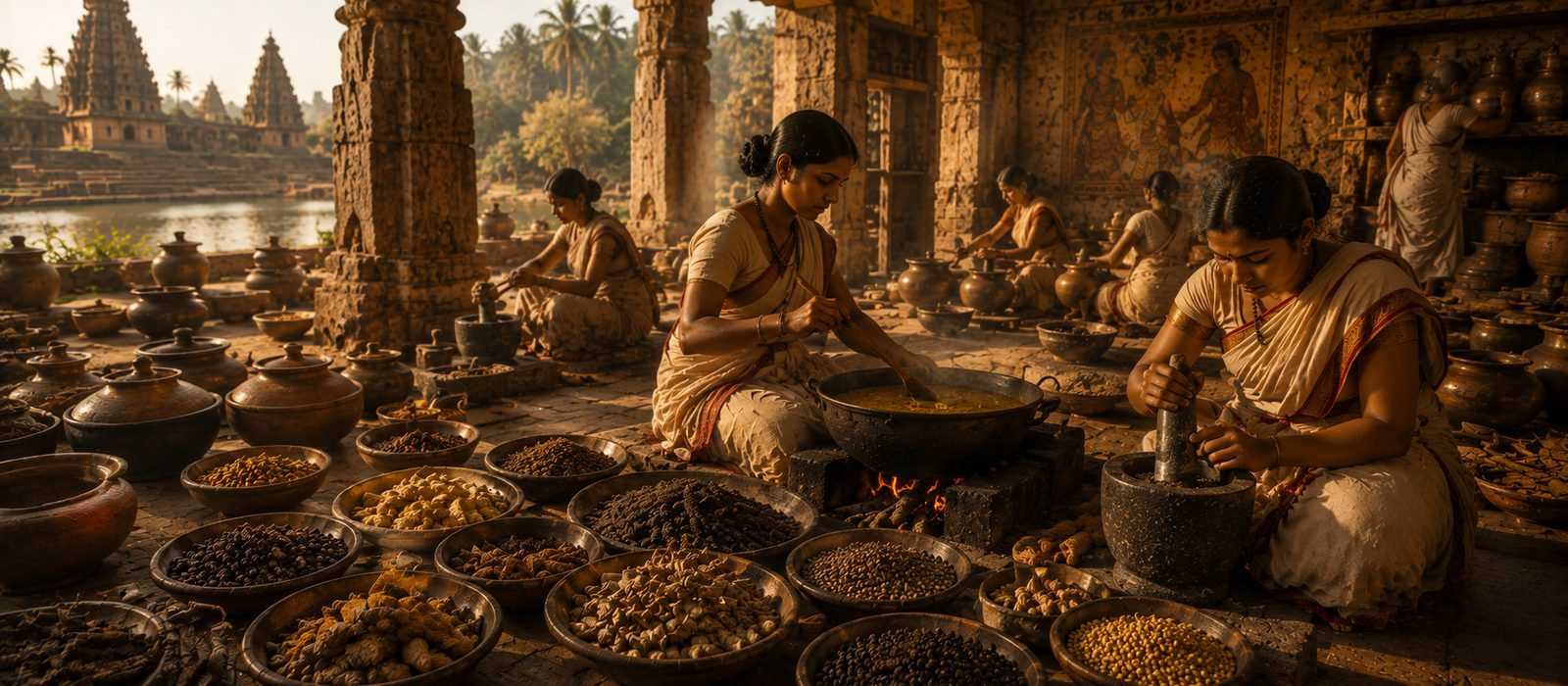
For most of Indian culinary history, there were no chillies. The heat that defines modern Indian food — the fire in curries, chutneys, and street food — arrived only five hundred years ago. What came before it, and how it came to be replaced, is one of the most important stories in world food history.
The World Before Chillies
Imagine a Roman merchant eating black pepper in Alexandria in the first century CE. Imagine a Persian trader crossing the Arabian Sea. Imagine a South Indian cook preparing pepper rasam in the tenth century. None of them had ever seen a chilli. For most of human history, chillies existed only in the Americas. The civilisations of India, China, Persia, Rome, Greece, Egypt, and Arabia all developed their cuisines entirely without them.
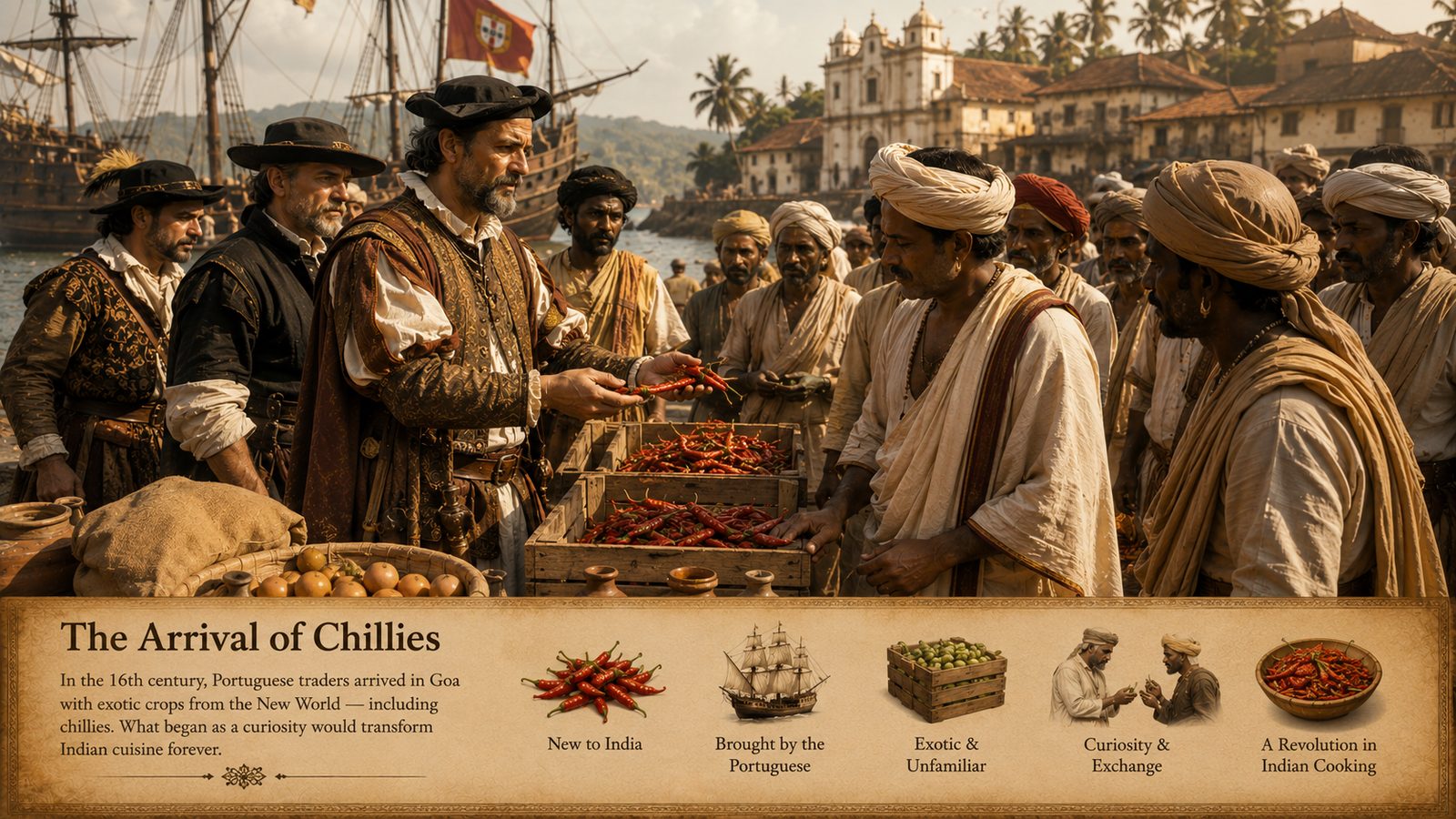
The ingredient now synonymous with spicy food was completely unknown across Afro-Eurasia until the voyages of the late fifteenth century connected the Old World and the New World for the first time. This event — the Columbian Exchange — transformed global food forever, and India was its greatest culinary beneficiary.
But before that transformation, India had already built one of the world's most sophisticated systems of heat — a system that had taken three thousand years to develop, and that the chilli would displace within a single century.
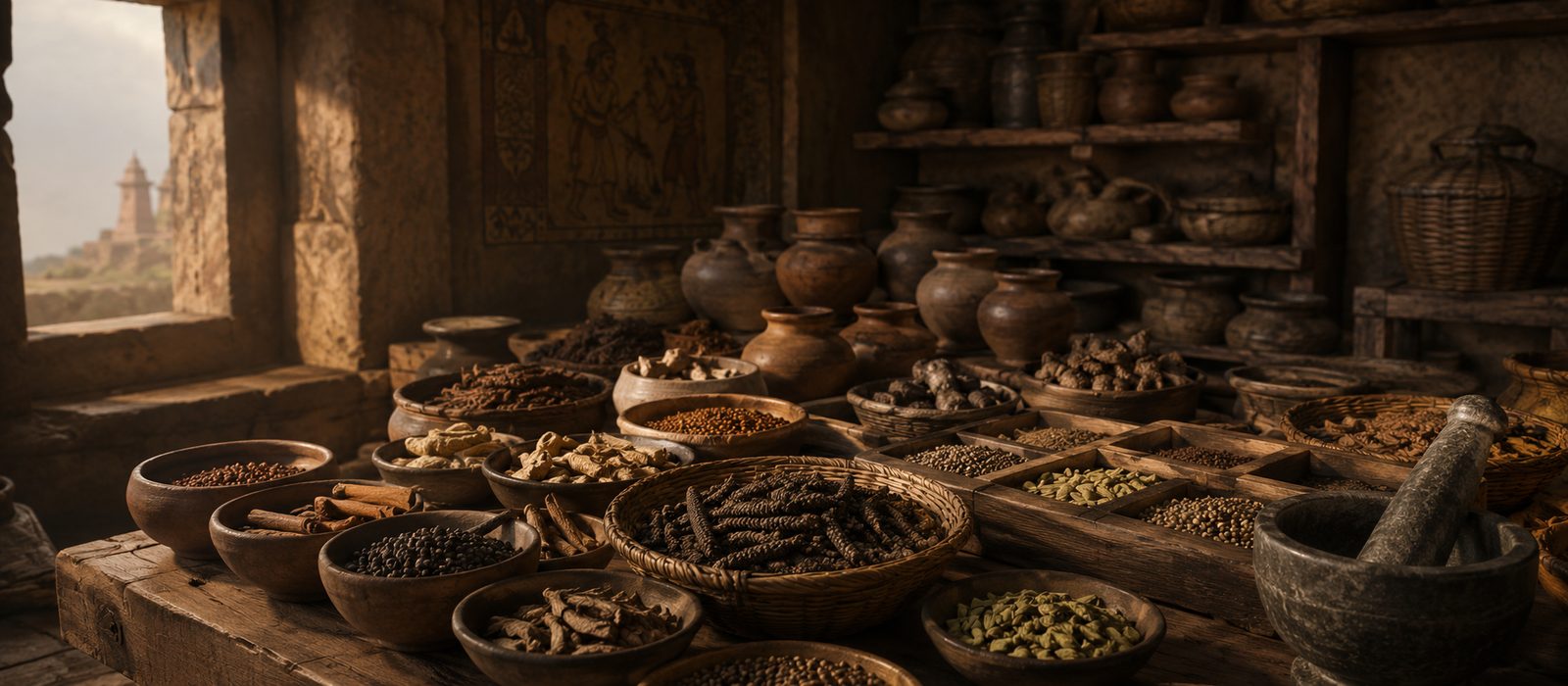
The ancient Indian spice box: black pepper, long pepper, ginger, mustard. No chillies — for five thousand years, these four ingredients provided all the heat Indian cooking needed.
What the Archaeology Tells Us
The evidence for India's pre-chilli heat system runs deep into antiquity. Black pepper cultivation on India's Malabar Coast is documented as early as 3000 BCE in historical records, though the precise archaeological evidence for this specific date continues to be refined by ongoing excavations. Long pepper — pippali in Sanskrit — appears in the Charaka Samhita, one of the foundational Ayurvedic texts compiled between 600 BCE and 200 CE, where it is referenced both as a flavouring and as medicine for respiratory and digestive conditions.
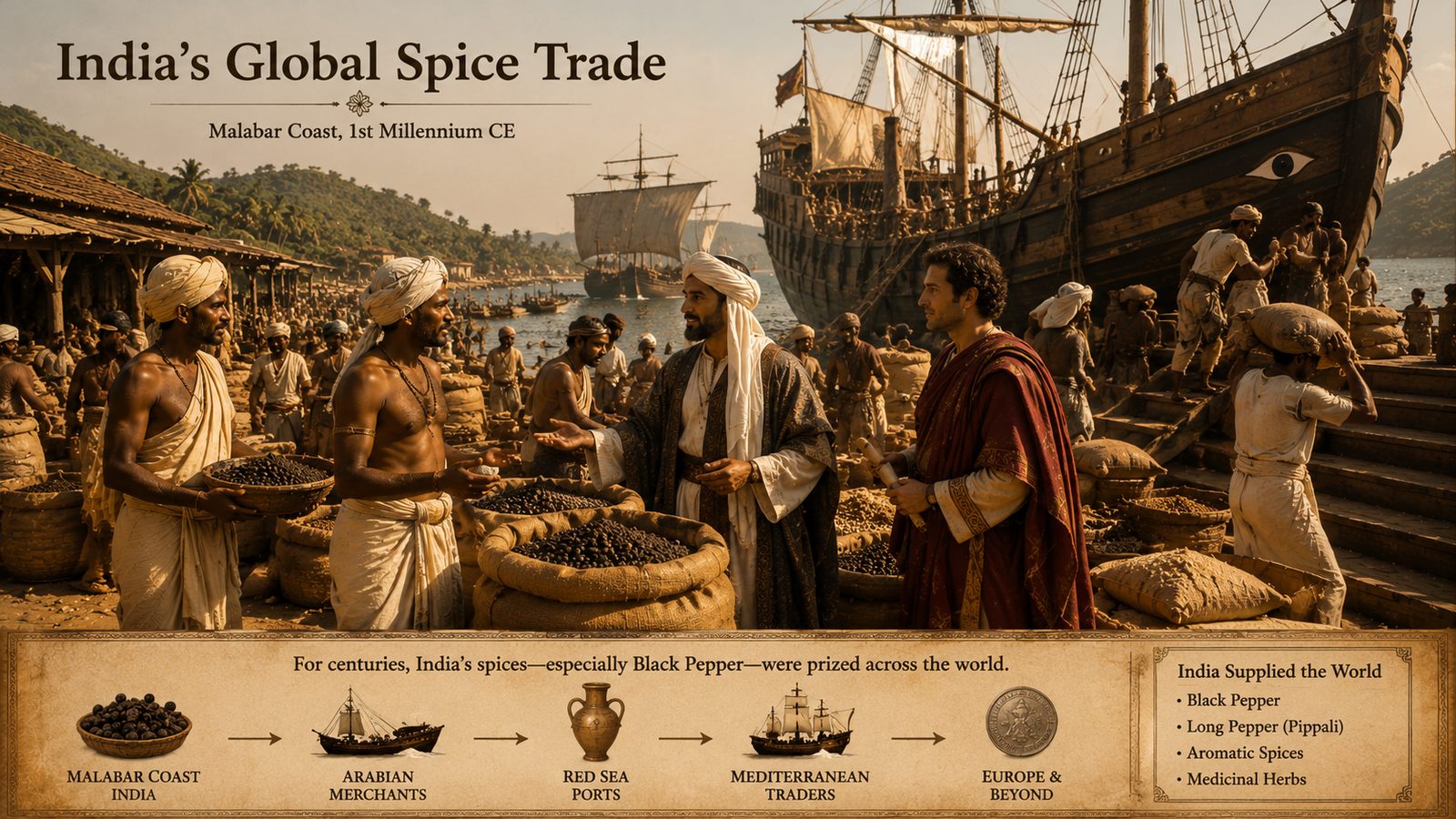
The Arthashastra, Kautilya's fourth-century BCE treatise on statecraft, lists black pepper as a regulated trade commodity — so important to the Mauryan economy that its distribution required state oversight. Roman records from the first century CE document pepper imports from India worth hundreds of thousands of denarii annually. Pliny the Elder complained that Rome was haemorrhaging gold to pay for Indian pepper.
Archaeological Evidence at a Glance
Indus Valley (c. 3000 BCE): Ginger and turmeric residues identified in cooking vessels at Indus Valley sites. Black pepper cultivation documented from this period though precise site attribution is subject to ongoing research.
Vedic Period (c. 1500–500 BCE): Long pepper and black pepper referenced in Sanskrit texts as both flavouring and medicine. Mustard cultivated widely.
Mauryan Empire (322–185 BCE): Arthashastra documents state regulation of pepper trade. Ginger recorded as a kitchen staple in imperial records.
Gupta Period (320–550 CE): Culinary manuscripts describe complex spice combinations. Roman trade records confirm massive Indian pepper exports.
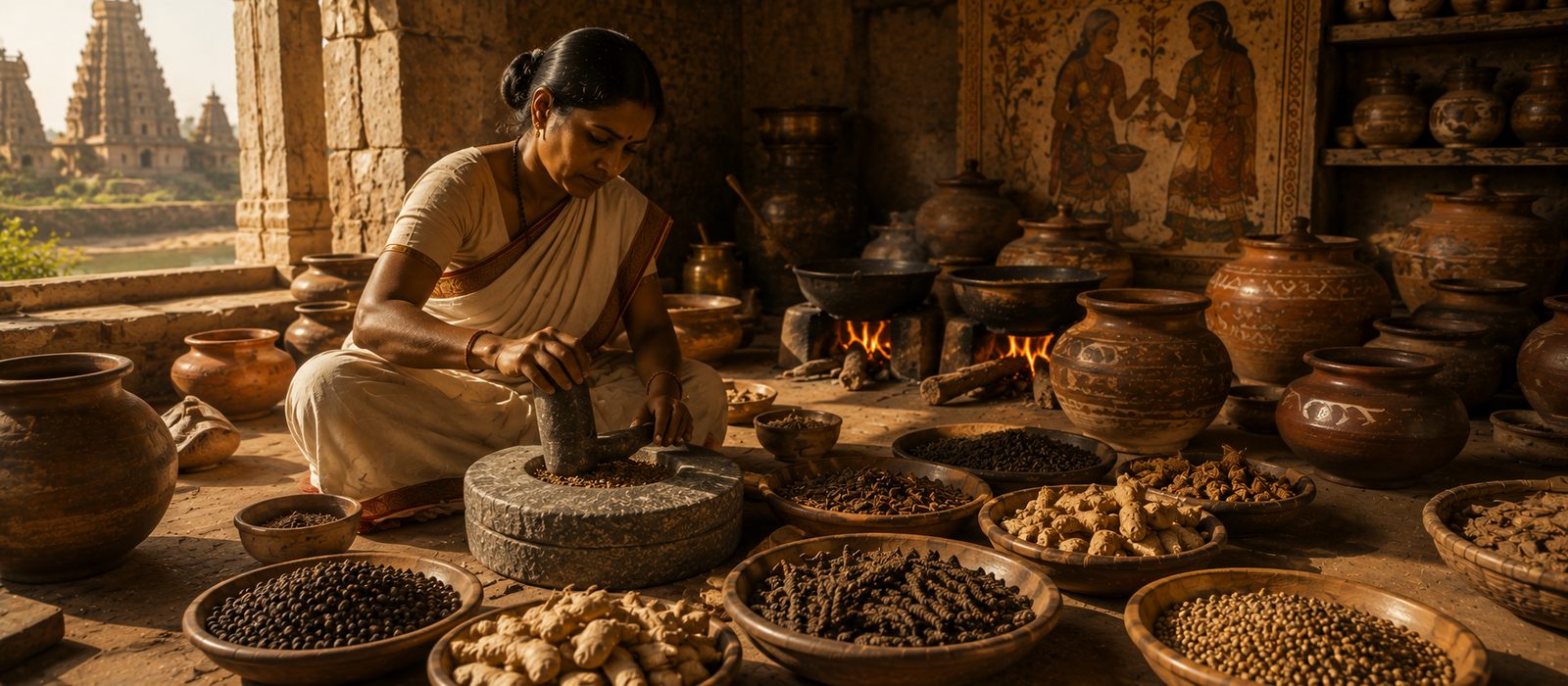
An ancient Indian kitchen, c. 500 CE. Heat came from pepper, ginger, and mustard. The techniques were sophisticated, the flavours complex — but the capsaicin burn of the chilli was entirely absent.
Timeline of Heat in Indian Cooking
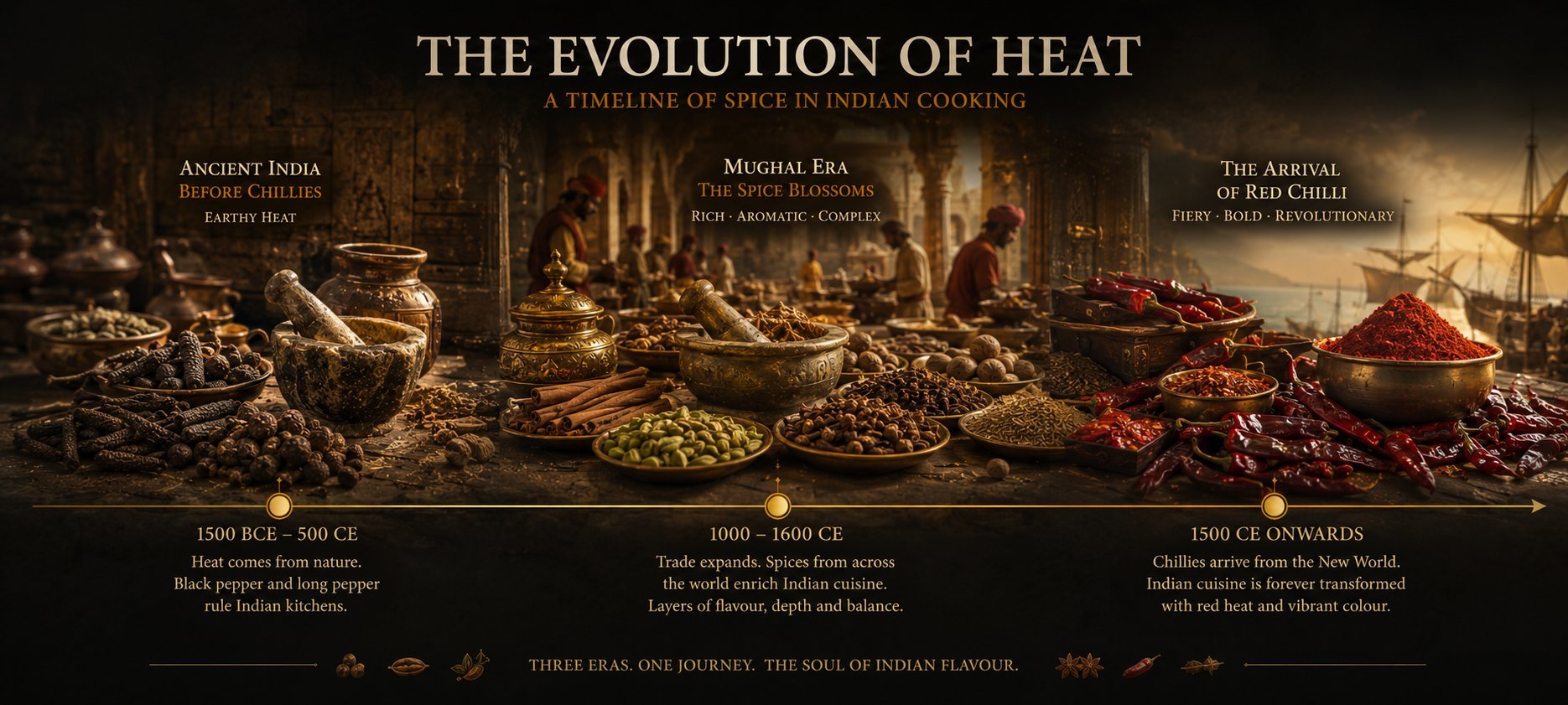
Five thousand years of Indian heat — from the first black pepper cultivation to the chilli's conquest of the subcontinent. Click to enlarge.
| Date | Event |
|---|---|
| c. 3000 BCE | Black pepper cultivated on India's Malabar Coast. Ginger and turmeric in use. |
| c. 1000 BCE | Long pepper (pippali) widely documented. Ayurvedic texts reference its therapeutic and culinary roles. |
| 4th Century BCE | Arthashastra regulates pepper trade. Mustard cultivation widespread across the subcontinent. |
| 1st Century CE | Roman pepper trade at its height. Enormous volumes exported from India's Malabar and Coromandel coasts. |
| 1492 | Columbus reaches the Americas. Chillies encountered by Europeans for the first time. |
| 1498 | Vasco da Gama reaches Calicut. Direct Portuguese sea route to India opens. |
| 1510 | Portuguese establish Goa. Chilli seeds begin arriving in coastal India. |
| 1600s | Chillies widespread across the subcontinent. Long pepper retreats to Ayurvedic medicine. |
| Present | India is the world's largest producer and consumer of chillies. Black pepper, ginger and mustard remain in use but no longer define Indian heat. |
The Forgotten King: Long Pepper
Before chillies, if black pepper was the king of Indian spices, long pepper — pippali in Sanskrit — was its more potent and more complex cousin. Long pepper is native to the Indian subcontinent and was one of the most important spices in the ancient world, yet it has been so thoroughly displaced by chillies that most modern cooks have never encountered it.
Long pepper produces a deeper, earthier, more lingering heat than black pepper, with subtle sweet and slightly camphor-like notes. Roman traders valued it enormously — in some periods it commanded higher prices than black pepper — and it moved through the same ancient trade networks that carried Indian spices to the Mediterranean.
Why did long pepper disappear? The chilli replaced it so completely and so rapidly that within a century of the Portuguese arrival, pippali had retreated from mainstream cooking into Ayurvedic medicine, where it remains in use today. Chillies were easier to grow, cheaper, and delivered more intense heat per unit. Economics and practicality won — as they always do in culinary history.
"Long pepper was the most sophisticated heat ingredient the ancient world produced. Within a century of the chilli's arrival, it had vanished from kitchens entirely. No ingredient in food history has been so completely and so swiftly dethroned."
Why Chillies Won: Six Reasons Long Pepper Lost
Easier to grow. Capsicum plants thrive in a wide range of Indian climates, from coastal Goa to the Deccan plateau. Long pepper requires specific tropical conditions and careful cultivation.
Higher yields. A single chilli plant produces dozens of fruits per season. Long pepper yields were comparatively modest and unpredictable.
More heat per kilogram. Capsaicin delivers more intense, persistent heat than piperine at equivalent quantities — making chillies dramatically more efficient as a heat source.
Superior colour. Dried red chillies give curries their characteristic colour. Long pepper adds no visual impact. In a cuisine where colour is as important as flavour, this mattered enormously.
Adapted to Indian climates. Within decades of arrival, Indian farmers had begun breeding regional chilli varieties suited to local soils and conditions — a process that produced the Guntur, Kashmiri, Byadagi, and Mathania varieties still in use today.
Lower cost. As local cultivation spread, chillies became cheaper than imported long pepper within a generation. The economics were decisive.
The Science of Heat — Why Chilli Feels Different
Black and long pepper create heat through piperine, which binds briefly to pain receptors and then dissipates — a sharp, quick sensation. Chilli heat comes from capsaicin, which binds to the same receptors but does not release quickly.
Capsaicin heat is lingering and cumulative: it builds with each bite, persists after the food is gone, and creates the characteristic burn that piperine never produced. This is not simply a difference of intensity. It is a fundamentally different sensory experience — which is why dishes built around black pepper taste so different from dishes built around chilli, even when both are described as hot.
Before vs After: What Actually Changed
Ancient Indian food was not mild. It was hot in different ways, using different ingredients that produced different sensations on the palate. Understanding this distinction is the key to understanding what was actually lost — and what was gained — when chillies arrived.
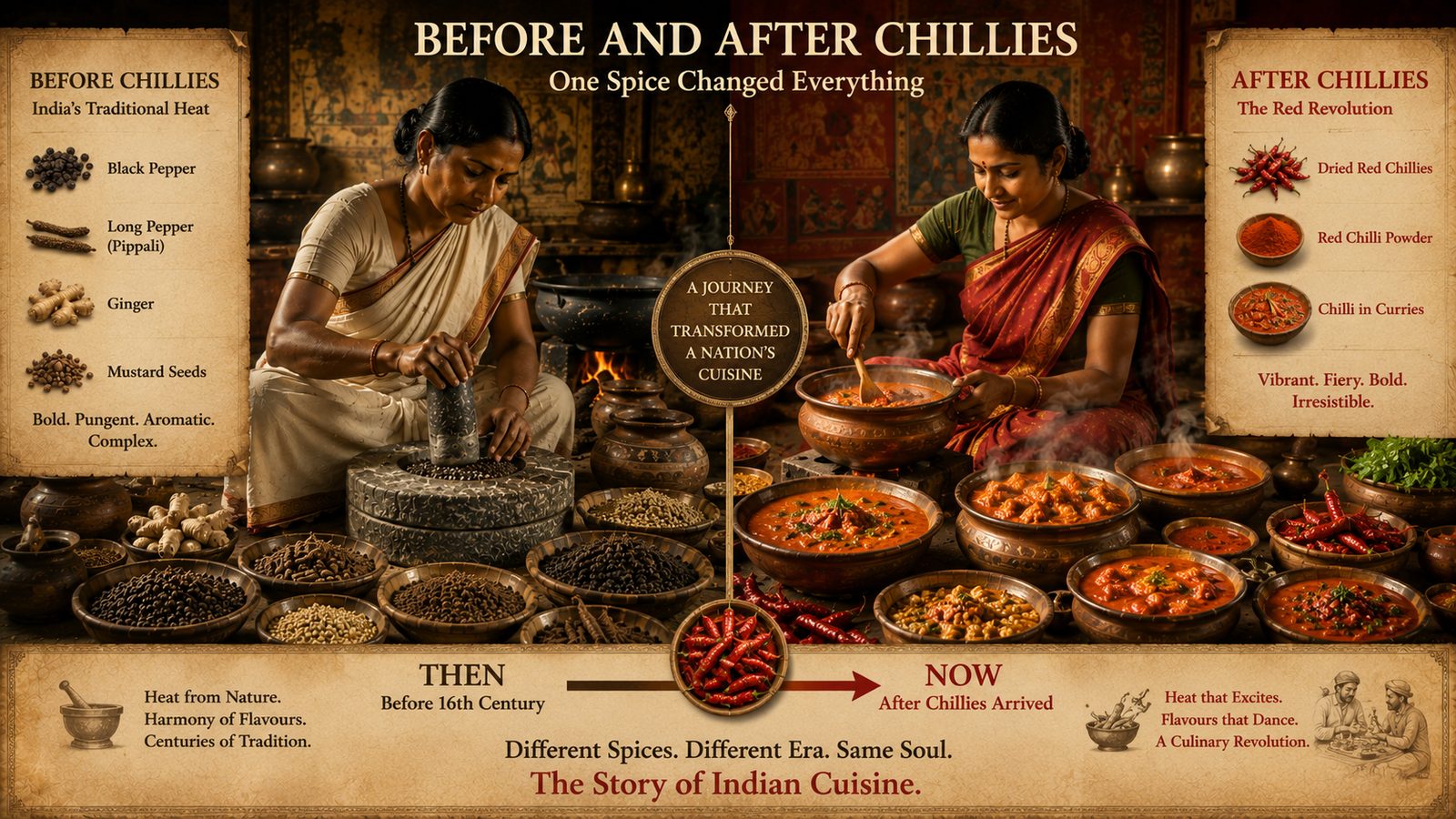
Before and after the chilli: two entirely different approaches to heat, built five centuries apart.
| Ingredient | Type of Heat | Character |
|---|---|---|
| Black Pepper | Sharp, quick | Clean pungency, dissipates fast |
| Long Pepper | Deep, lingering | Earthy, complex, slightly sweet |
| Ginger | Warm, volatile | Aromatic, fresh, disperses through the mouth |
| Mustard Seeds | Nasal, sharp | Penetrating, brief, particularly strong raw |
| Chilli | Burning, cumulative | Builds with repetition, lingers, intense |
A pre-chilli pepper rasam, built on black pepper and long pepper, would have delivered heat that came and went cleanly with each sip — sharp, bright, and brief. The modern version, built on dried red chillies, delivers heat that accumulates and persists. Neither is superior. They are genuinely different experiences.
How the Chilli Changed Each Region
Chillies did not transform all of India in the same way or at the same speed. Each region absorbed them differently, shaped by climate, existing cuisine, and proximity to the Portuguese entry point at Goa.
The Route the Chilli Travelled
The chilli's journey from Mexico to Maharashtra is one of the most consequential episodes in food history. It moved through a specific chain of hands — indigenous American farmers, Spanish conquistadors, Portuguese navigators, Goan merchants — before reaching the Indian interior.
The chilli's journey: from the Americas to Portugal, to Goa, to every corner of the subcontinent. Click to enlarge.
Debate & Myths
Was Indian Food Always Spicy?
This is the most commonly asked question about pre-chilli India — and the answer requires care. Indian food was never mild. It has been intensely flavoured and pungently hot for three thousand years. But the nature of that heat was fundamentally different.
The heat of ancient Indian cooking came from black pepper, long pepper, ginger, and mustard — all of which produce sharp, quick sensations that dissipate rapidly. Capsaicin heat — the persistent, building burn of the chilli — simply did not exist in Indian cuisine before 1510. When historians say Indian food changed with the chilli, they are not saying it went from bland to spicy. They are saying it went from one kind of heat to another kind entirely.
Did India Already Have Chillies Before the Portuguese?
A minority view holds that chillies may have reached India through pre-Columbian contact — through Arab or Chinese trade networks — before Vasco da Gama's arrival. The evidence for this is thin. No botanical, archaeological, or textual source from India before 1498 references capsicum. The word "mirchi" itself derives from the Portuguese "pimenta," strongly suggesting the arrival was Portuguese-mediated. The mainstream historical consensus is clear: chillies arrived with the Portuguese in the early sixteenth century.
What If Chillies Never Came to India?
This is not merely a hypothetical — it is the best tool for understanding what the chilli actually did. If the Portuguese had never arrived at Goa, or had arrived without chilli seeds from the Americas, Indian cooking would have continued developing its ancient heat system based on black pepper, long pepper, ginger, and mustard.
Long pepper would likely still be a mainstream cooking ingredient rather than an Ayurvedic relic. The black pepper trade — already one of the most important in the ancient world — would have remained the defining commodity of Indian spice culture. Kerala and the Malabar Coast would have retained their status as the world's primary suppliers of the world's primary heat ingredient.
The cuisines that most depend on chilli heat — Andhra, Goan Catholic, Rajasthani lal maas — would either not exist in their current form or would be built around entirely different flavour profiles. The word "vindaloo" would not exist. The Guntur chilli belt would be growing something else.
"The chilli did not complete Indian cooking. It transformed it — replacing an ancient, complex system of heat with something faster, cheaper, and more intense. What was lost is worth knowing about, even as what was gained is impossible to imagine giving up."
What Survived
The arrival of the chilli was so rapid and so complete that it is easy to assume the old heat system was simply wiped out. It was not. Every ingredient that provided heat before 1510 is still in use today — though the role each plays has shifted dramatically.
The Pre-Chilli Ingredients That Remain
Modern Legacy
Modern India is the world's largest chilli producer and consumer — a transformation that took less than two centuries from first arrival to total adoption.
India today produces roughly 36% of the world's chillies and consumes more than any other country. The ingredient that arrived as a Portuguese trading curiosity five centuries ago now defines how India is perceived globally — the "spicy" cuisine, the fiery curries, the pickles and chutneys that register as heat across every palate.
The irony is significant. The ingredient most associated with Indian identity is not Indian in origin. It arrived late, spread fast, and replaced a heat tradition far older and more complex than itself. That older tradition — the piperine system of pepper and long pepper — survives in fragments: in pepper rasam, in Ayurvedic formulations, in the black pepper underpinning of Chettinad and Malabar cooking.
Understanding the world before chillies does not diminish modern Indian cooking. It deepens it — by revealing the sophistication of what came before, and the remarkable speed and completeness with which a new ingredient was absorbed, adapted, and made entirely Indian.
Confidence Scale
Not all historical claims carry equal certainty. Here is how the key claims in this chapter rate against the available evidence.
| Claim | Confidence | Basis |
|---|---|---|
| Chillies arrived in India via the Portuguese | Very High | Botanical, textual, and linguistic evidence all converge. The word "mirchi" derives from Portuguese. No pre-1498 Indian source references capsicum. |
| Goa was the primary point of entry | Very High | Portuguese colonial records from Goa document chilli cultivation from c.1510. Well-established in mainstream scholarship. |
| Black pepper was cultivated in India from 3000 BCE | High | Strong historical and textual evidence. Precise archaeological dating of earliest cultivation continues to be refined. |
| Long pepper was widely used before chillies | Very High | Extensively documented in Ayurvedic texts, Roman trade records, and Sanskrit literature across multiple centuries. |
| Chillies spread across India within roughly two centuries | High | Supported by regional cookbooks, travellers' accounts, and agricultural records from the 17th and 18th centuries. |
| Pre-Columbian arrival of chillies in India | Very Low | No botanical, archaeological, or textual evidence. Fringe theory, not supported by mainstream scholarship. |
Further Reading
- K.T. Achaya — Indian Food: A Historical Companion
- Colleen Taylor Sen — Feasts and Fasts: A History of Food in India
- Arthashastra (attributed to Kautilya)
- Charaka Samhita (Ayurvedic text)
- Alfred Crosby — The Columbian Exchange