The Nattukotai Chettiar merchants traded across Southeast Asia for two centuries and came home with spices no other Indian community possessed. The result — a masala of 20+ ingredients including kalpasi and marathi mokku, found nowhere else — is India's most technically demanding cuisine.
⏱ 16 min read🗓 Updated June 2026★ Sub-Regional Guide
Sub-regional identity
Chettinad — India's Most Complex Spice Kitchen
The Nattukotai Chettiar merchants traded across Southeast Asia for two centuries and came home with spices no other Indian community possessed. The result — a masala of 20+ ingredients including kalpasi and marathi mokku, found nowhere else — is India's most technically demanding cuisine.
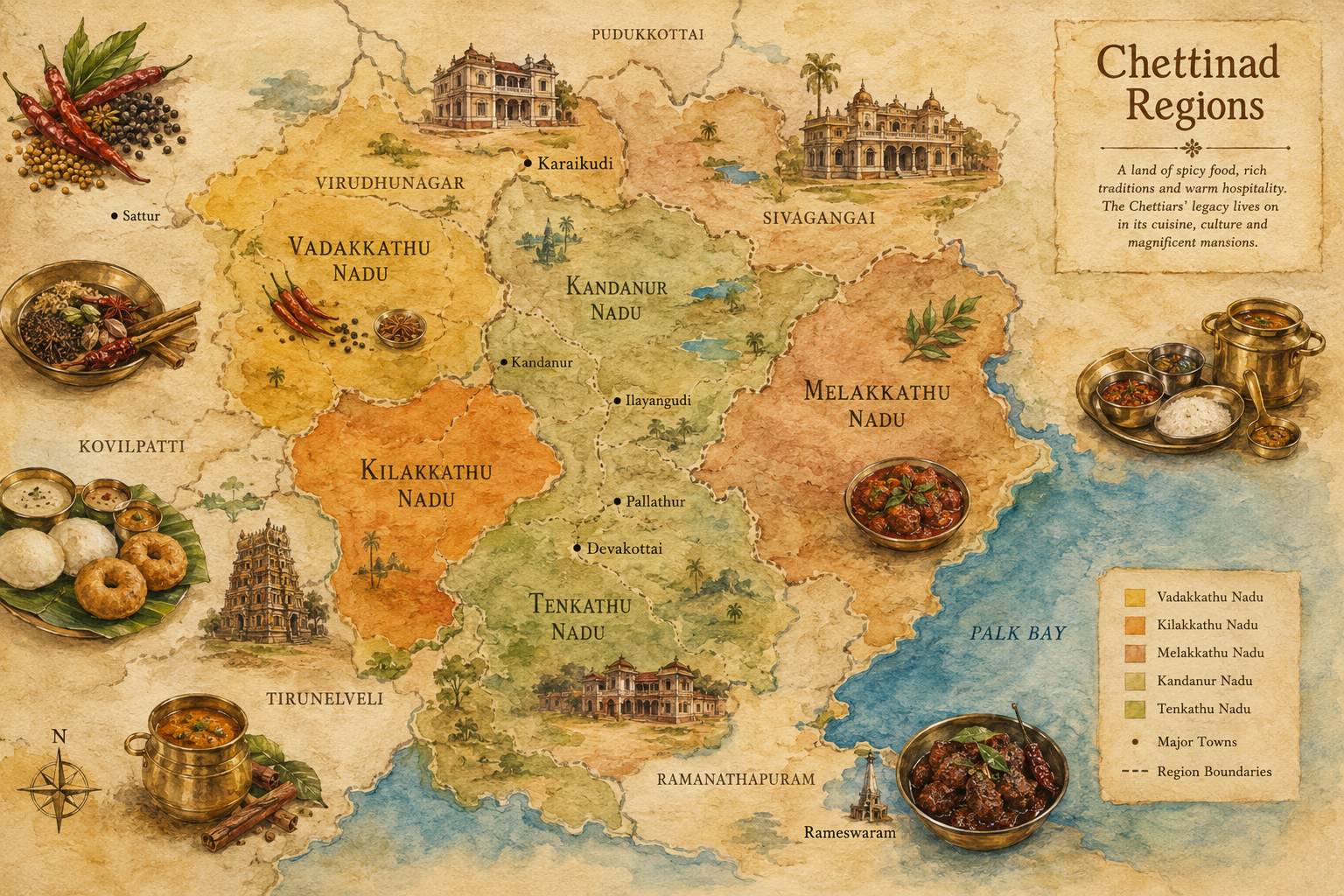
Sivaganga and Pudukottai districts, Tamil Nadu — semi-arid inland plateau, 60km from Madurai
Community
Nattukotai Chettiar (Nagarathar) — banker and trading caste, historically dominant across Southeast Asia
Religion
Hindu (Shaivite) — non-vegetarian: chicken, mutton, seafood; no beef
Climate
Hot and dry — average 35°C, low rainfall; not a coastal cuisine despite Tamil Nadu's nearby coast
Defining marker
The only Indian cuisine using kalpasi (stone flower lichen) as a base spice
Cooking fat
Sesame oil (gingelly) — carries and amplifies the spice layering
Key souring agent
Tamarind — standard Tamil Nadu base, used in combination with rich masala
What makes it unique
20+ spice masala including two spices found nowhere else in Indian cooking; fresh stone-ground daily
🗺
Geography
The place that made this food inevitable
Chettinad encompasses approximately 74 villages in the Sivaganga and Pudukottai districts of Tamil Nadu — a semi-arid inland plateau with poor soil and limited agriculture. The Nattukotai Chettiar community became bankers and traders precisely because the land offered so little. They financed colonial-era commerce across Southeast Asia, built palatial mansions in their home villages from trading profits, and returned with spices, knowledge, and ingredients that no community staying in Tamil Nadu could have accessed.
The geography of Chettinad directly explains the cuisine. A community that cannot feed itself from its land must trade. A community that trades across Southeast Asia accesses spice markets unavailable to anyone staying in place. The 74 villages of the Sivaganga plateau, unremarkable in agricultural terms, became the home base of one of India's most commercially ambitious communities — and the kitchen that community built when it returned home is the most complex in the country.
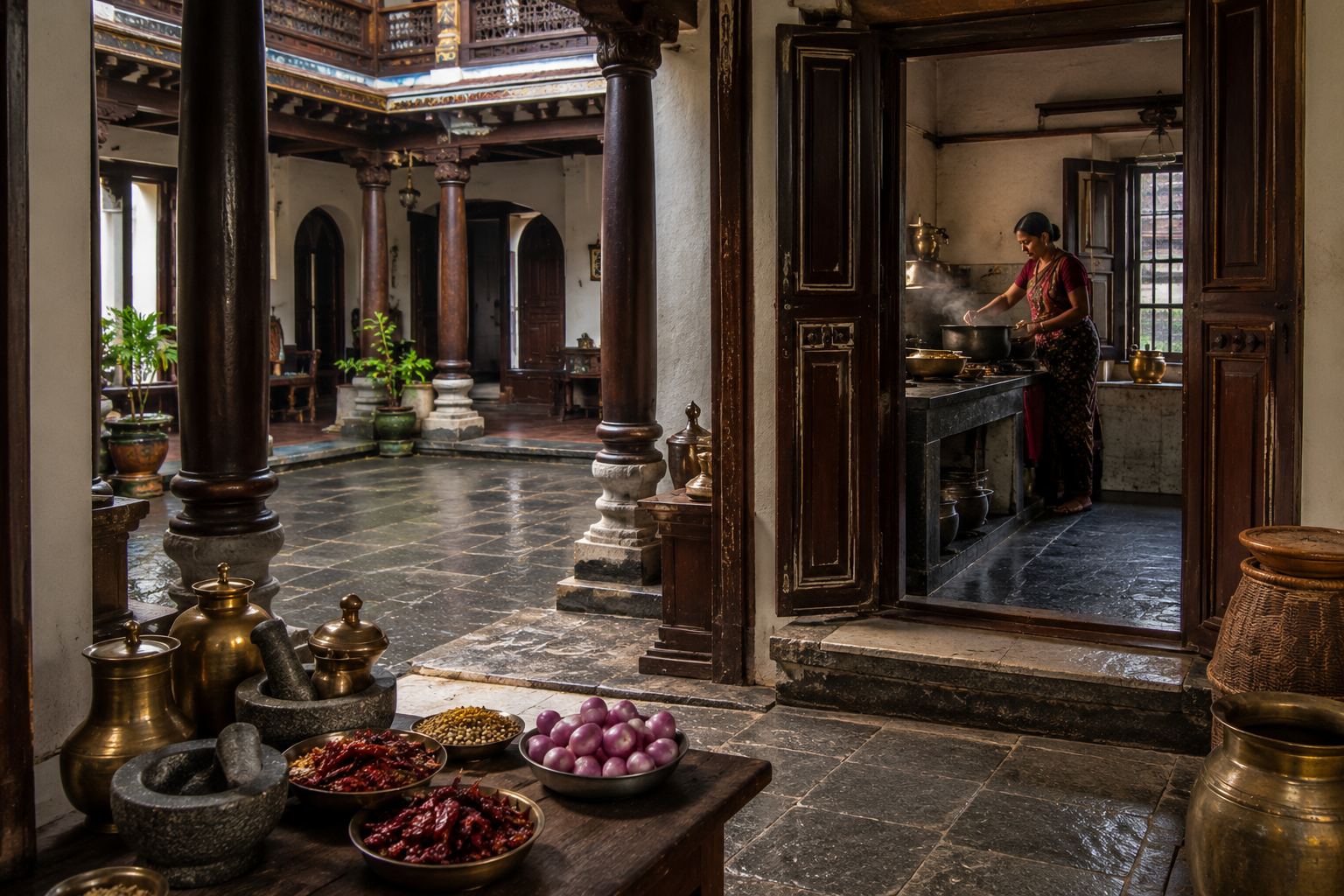
The physical evidence is still visible. Villages like Kanadukathan, Karaikudi, and Devakottai contain palatial mansions built with Burmese teak, Belgian crystal, Italian marble, and Athangudi floor tiles — each material from a different trade destination. The kitchen in these mansions was designed for sophisticated, large-scale cooking: massive stone grinding slabs (ammikal), multiple hearths, separate rooms for dry spice storage and wet masala preparation. The kitchen architecture is a direct record of the community's culinary ambitions and mercantile reach.
Location of Chettinad within its parent state and the geographic forces that produced the distinct food culture.
📜
Historical Origins
How this cuisine became distinct
The Nattukotai Chettiar community dominated banking and money-lending across British colonial Southeast Asia from the mid-19th century. At peak influence between 1900 and 1930, they maintained offices in Burma, Ceylon, Malaya, Singapore, South Africa, and Fiji — financing plantations, railway construction, and colonial commerce. The wives and cooks who travelled with merchant families encountered spice markets in Rangoon, Penang, and Colombo that no mainland Tamil cook ever accessed.
Spices they found — kalpasi (stone flower lichen from Parmotrema species), marathi mokku (dried pods from Ailanthus malabarica), specific dried flower pods, and Southeast Asian star anise in quantities unusual for South Indian cooking — were brought home and integrated into the Tamil spice vocabulary already possessed. The resulting cuisine is a hybrid of Tamil Nadu's existing spice intelligence and 200 years of mercantile access to Southeast Asian markets.
The post-1947 decline of the Southeast Asian banking networks brought the community home. The grand kitchens of the mansion era contracted. But the spice knowledge was embedded. Chettinad cooking survived the commercial decline of the community that created it, and is now recognised internationally as one of India's most important and irreplaceable culinary traditions.
The Chettinad Mansion Kitchen
The kitchen infrastructure of the great mansions tells the story of the cuisine's ambitions. Multiple hearths allowed simultaneous preparation. The ammikal — a large flat stone with a cylindrical roller — was the central kitchen equipment, grinding fresh masala every day. Separate rooms stored the Southeast Asian dry spices and the wet grinding materials. The architecture was designed for a masala requiring 20+ ingredients sourced, stored, and freshly prepared daily. This is not everyday kitchen infrastructure. It is the infrastructure of a community that took food as seriously as it took commerce.
🧬
Food DNA
The flavour architecture
Base Grain
Rice — the Tamil Nadu staple — multiple varieties used for different preparations
Idiyappam (string hoppers) — steamed rice noodle preparations that accompany specific Chettinad curries
Unique Spices (nowhere else)
Kalpasi — stone flower lichen — the single most defining Chettinad ingredient; earthy, smoky, resinous
Marathi mokku — dried flower pods of Ailanthus malabarica — bitter, complex aromatic background note
Kalpasi + marathi mokku together — used in every major masala — their combination defines the cuisine's character
Base Aromatics
Star anise — used more generously than in any other Tamil cuisine; Southeast Asian influence visible here
Fennel seeds — sweet aromatic contrast to kalpasi's earthiness
Cinnamon bark — added whole to oil at the start — never as powder
Heat Sources
Dried Guntur red chilli — primary heat — used in substantial quantity
Black pepper — secondary — the ancient Tamil heat source still present alongside chilli
Fresh green chilli — in specific lighter preparations
Cooking Fat
Sesame oil (gingelly) — the primary fat — carries and amplifies the layered spice flavours in ways other oils do not
Protein
Country chicken (nattu kozhi) — the authentic bird — 2–3 hours slow-cooking; categorically different from commercial breed
Mutton — richer festival preparations
Quail and crab — specific village preparations showing the cuisine's range
🌿
Signature Ingredients
The ingredients that define this cuisine
Ingredient
What It Is
Flavour Character
Availability
Kalpasi
Parmotrema perlatum — a lichen from hill forest rocks and trees, used dried
Earthy, smoky, slightly resinous — no equivalent anywhere in Indian cuisine
Sold in Chettinad spice markets; rare outside Tamil Nadu; barely available internationally
Marathi mokku
Dried pods of the Ailanthus malabarica tree
Mildly bitter, complex aromatic — a persistent background note that grounds the other spices
Specific to Chettinad markets; absent from standard Indian grocery stores
Kalpasi + marathi mokku together
Two spices used together in every major Chettinad masala — neither alone achieves the effect
Together produce an unmistakably Chettinad base — earthy, complex, slightly bitter, irreplaceable
If either is absent, the result is good Tamil Nadu cooking but not Chettinad
Country chicken (nattu kozhi)
Native breed — slower growth, more active, more flavour than commercial breeds
Dense, flavourful, with fat distributed differently from commercial chicken
Available at specific village markets; requires 2–3 hours of cooking to be tender
Kavuni arisi
Black sticky rice variety — Southeast Asian origin visible in the grain
Nutty, slightly sweet, completely distinct from white rice varieties
Grown in specific Chettinad and Tamil Nadu areas; the Southeast Asian origin still visible
🍽
Signature Dishes
The dishes that cannot exist elsewhere
Dish
What It Is
Why It Matters
Chettinad Chicken Curry
Country chicken slow-cooked in the full 20-spice masala including kalpasi and marathi mokku
The most internationally recognised Chettinad preparation — the masala is the dish; the chicken delivers it
Kavuni Arisi
Black sticky rice with coconut milk and jaggery — a festival sweet
The only preparation of its kind in Tamil Nadu; the black rice signals the community's Southeast Asian mercantile origin
Chettinad Kuzhambu
Thick, deeply spiced tamarind-based gravy — distinct from all other Tamil Nadu kuzhambu
The layered spice base — kalpasi, marathi mokku, star anise, Guntur chilli — is impossible to achieve with standard Tamil spices
Nandu (Crab) Masala
Crab in the full Chettinad masala
Demonstrates that the masala applies to any protein — the spice system is independent of any one meat choice
Vellai Paniyaram
Fermented rice flour dumplings cooked in ghee — a temple preparation
Among the oldest Chettinad preparations — pre-commercial in character; the festival food that existed before the trading wealth
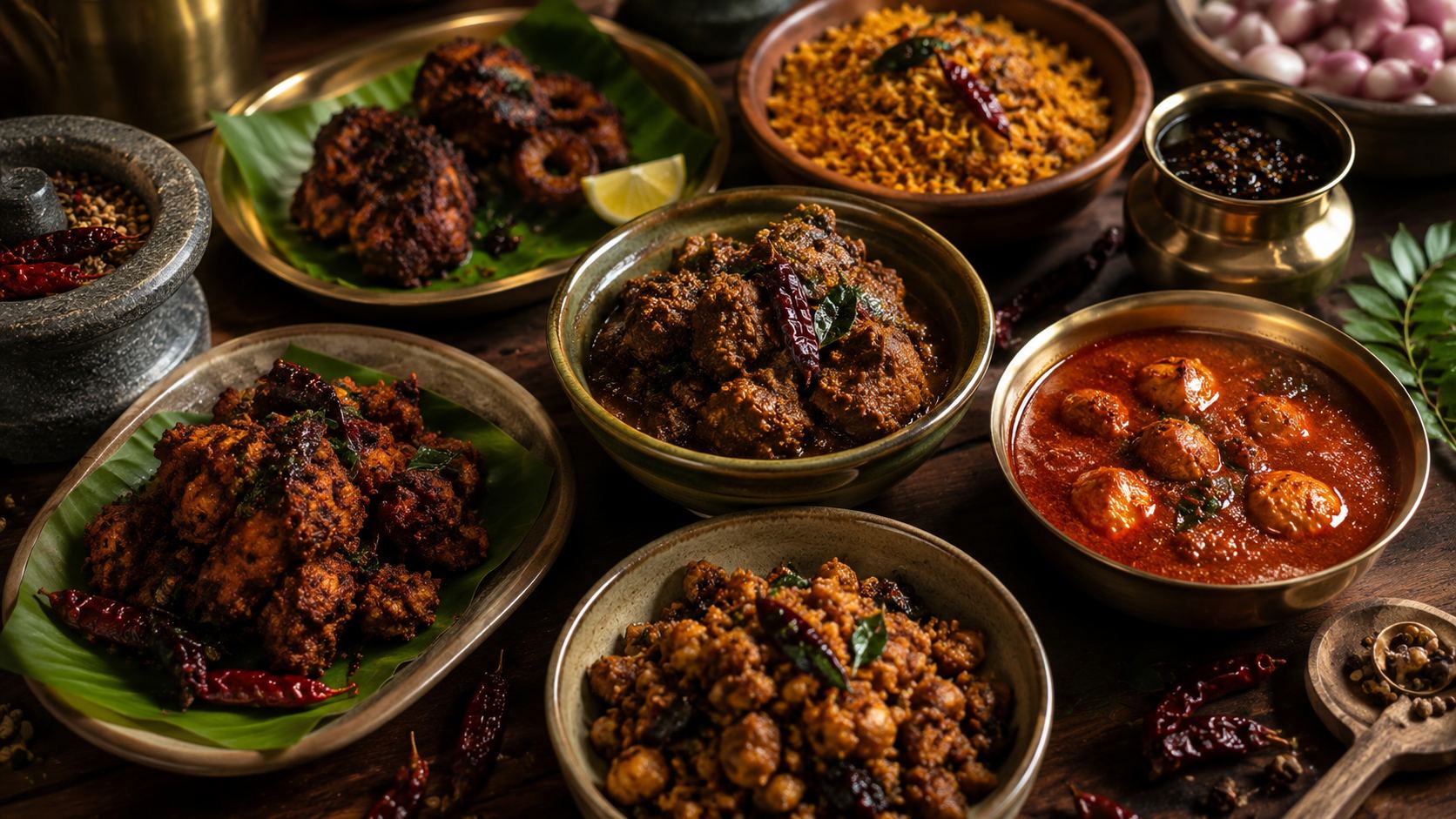
The defining preparations of Chettinad — each dish reflects a specific ingredient, technique, or cultural identity.
⚙️
Unique Techniques
What this cuisine does that others do not
The defining Chettinad technique is the daily fresh masala grind. No serious Chettinad kitchen uses pre-made spice powder for signature preparations. Every day, before cooking begins, the day's spices — kalpasi, marathi mokku, dried red chilli, coriander, cumin, fennel, star anise, cinnamon, black pepper, and the remaining 10+ ingredients — are ground fresh on the ammikal (stone grinding slab). Stone grinding generates less heat than mechanical blade grinding, preserving the volatile aromatic compounds in kalpasi and marathi mokku that are partially destroyed by machine heat. The difference between stone-ground and machine-ground Chettinad masala is demonstrable in the final flavour.
The second defining technique is the slow cooking of country chicken (nattu kozhi). Commercial breed chicken cooks in 20–30 minutes. The native breed used in authentic Chettinad cooking requires 2–3 hours — the extended time allows the 20-spice masala to fully integrate, the chicken's collagen to break down into the gravy, and kalpasi and marathi mokku to develop their full depth. The resulting texture and flavour are categorically different from any quick-cooked version.
The third technique is the earthenware vessel (man chatti). The most prized preparations are slow-cooked in a specific clay pot over a wood fire. Clay absorbs and redistributes heat more evenly than metal, and over years of use the pot develops a seasoning from absorbed spices that contributes to every subsequent preparation. In Chettinad villages, dedicated pots are kept for specific dishes — the chicken curry pot is never used for anything else.
Can Authentic Chettinad Be Made Outside Chettinad?
This is the central question for any restaurant or home cook attempting Chettinad cooking outside the source region. Kalpasi and marathi mokku are genuinely difficult to source outside Tamil Nadu — they do not appear in standard Indian grocery chains internationally and are rarely stocked even in Indian cities outside the southeast. Without these two ingredients, the result may be excellent Tamil Nadu cooking but it is not Chettinad. This explains why most "Chettinad" restaurant dishes feel like Tamil food with more chilli — the defining spices are absent. The cuisine is not withholding secrets. The secrets are the ingredients, and the ingredients grow in specific places.
🔗
Relationship to Parent Cuisine
How Chettinad differs from Tamil Nadu
Element
Tamil Nadu
Chettinad
Spice complexity
Sambhar powder: 5–8 standard Tamil spices
Full masala: 20+ ingredients including two spices unavailable elsewhere
Unique spices
None — all Tamil Nadu standard ingredients
Kalpasi and marathi mokku — defining ingredients found in no other Indian cuisine
Masala preparation
Fresh or pre-made powder acceptable
Fresh stone-ground daily on ammikal — non-negotiable for authentic results
Cooking vessel
Any vessel acceptable
Clay pot (man chatti) over wood fire for signature preparations
Country chicken cooking time
20–30 minutes for commercial breed chicken
2–3 hours — the extended time is the technique, not a convenience choice
Community identity
General Tamil Hindu tradition with regional variations
Specific merchant community with 200 years of Southeast Asian spice access — cuisine reflects this history directly
📅
Timeline
How this cuisine evolved
Pre-18th century
Tamil Hindu base cuisine established
The Nattukotai Chettiar community cooks within the Tamil Hindu tradition — tamarind, sesame oil, standard Tamil spices. The Southeast Asian ingredients have not yet arrived.
1820s–1900
Colonial-era Southeast Asian trade peak
Chettiar banking operations expand across Burma, Malaya, Ceylon. Spice market access in Rangoon and Penang introduces kalpasi, marathi mokku, and Southeast Asian star anise. The Chettinad masala begins forming.
1900–1930
Mansion era — the cuisine at its peak
Colonial-era wealth produces the great mansions and their elaborate kitchens. The ammikal grind is codified as daily practice. The full 20-spice tradition reaches its classic form.
1947–1980
Community contraction
Indian independence ends the Southeast Asian banking networks. The community returns home; prosperity declines. Elaborate feast traditions contract; many mansion kitchens fall silent.
1980s–present
Restaurant discovery and global recognition
Chettinad chicken appears on restaurant menus nationally and internationally. Chef interest in the unique spice system grows. Heritage tourism to the mansion villages begins. The cuisine is now internationally recognised.
Chettinad uses spices unavailable in any other Indian cuisine — kalpasi (stone flower lichen) and marathi mokku (dried flower pods) — alongside a masala of 20+ ingredients. The Nattukotai Chettiar trading community brought these spices from Southeast Asian markets over two centuries. The combination produces a flavour profile that cannot be replicated with substitute ingredients.
What is kalpasi?
Kalpasi (Parmotrema perlatum) is a lichen — a stone flower — used dried in Chettinad cooking. It has an earthy, smoky, slightly resinous flavour with no equivalent in any other Indian cuisine. It grows on rocks and trees in specific hill forests and is sourced from Chettinad-area spice markets.
Is Chettinad food extremely spicy?
Chettinad food is intensely flavoured but complexity comes from spice layering rather than pure heat. Authentic preparations use dried red chillies alongside kalpasi, marathi mokku, star anise, and 15+ other aromatics — the result is deep, warm, and complex rather than one-dimensionally hot.
Can you cook Chettinad without kalpasi?
You can cook Tamil Nadu-style food without kalpasi. You cannot cook authentic Chettinad. Kalpasi is the defining ingredient — its absence changes the fundamental character of the masala. Most "Chettinad" dishes served outside Tamil Nadu are Tamil food with extra chilli, not Chettinad, because the defining spices are unavailable.