The wazwan is not a cuisine but an event — a Kashmiri wedding feast of up to 36 courses prepared by the waza (master chef) that represents the most elaborate formal food ceremony in India. Rogan josh, gushtaba, and the traami (shared plate) define the world's most ceremonially structured meat feast.
⏱ 15 min read🗓 Updated June 2026★ Sub-Regional Guide
Sub-regional identity
Wazwan — Kashmir's 36-Course Feast
The wazwan is not a cuisine but an event — a Kashmiri wedding feast of up to 36 courses prepared by the waza (master chef) that represents the most elaborate formal food ceremony in India. Rogan josh, gushtaba, and the traami (shared plate) define the world's most ceremonially structured meat feast.
Not a cuisine but a feast — a Kashmiri wedding or celebration banquet of 36 courses
The waza
The master chef who prepares the wazwan — a hereditary specialist, not a household cook
Defining course
Gushtaba — minced mutton in yoghurt gravy — the closing course and the feast's culmination
Serving format
Traami — a large shared plate serving four guests — the collective eating ritual
Central protein
Mutton exclusively — no chicken, no fish in the formal wazwan
Spice philosophy
Kashmir's specific spice vocabulary — Kashmiri dried red chilli (colour not heat), saffron, fennel, dried ginger
Location
Kashmir Valley — mountain-locked at 1,600m; the geography that produces the specific spice needs
Why it matters
The most elaborately sequenced meat feast in India — the formal extreme of Indian celebration food
🗺
Geography
The place that made this food inevitable
The Kashmir Valley sits at 1,600 metres, mountain-locked by the Himalayas and the Pir Panjal range, with a climate unlike any other major Indian cultural centre. Winters are severe enough to require sustained caloric preparation; the short growing season concentrates agricultural production into specific months; and the geographic isolation that persisted until the 19th century produced a food culture that developed with limited external influence from the Indian plains below. What the valley produced — the specific spice vocabulary of Kashmiri cooking, the dried-food tradition that preserved the brief summer harvest through the long winter, the lamb-centred cooking that reflected the mountain pastoral economy — is the foundation on which the wazwan was built.
The Kashmiri spice vocabulary is the most immediately distinctive feature of the cooking tradition. Kashmiri dried red chilli produces brilliant colour and very little heat — exactly the opposite of what most people expect from a dried red chilli. The colour is a specific deep red; the heat is minimal; the character is slightly fruity. This is why rogan josh is a deep red preparation without the capsaicin burn of Andhra or Rajasthani cooking using the same visual cue. The saffron grown in Pampore (the only commercially significant saffron cultivation in India) is added not for heat but for fragrance. Fennel seed, dried ginger (saunth), and asafoetida provide the aromatic warmth that replaces the onion-garlic base in many Kashmiri Brahmin preparations.
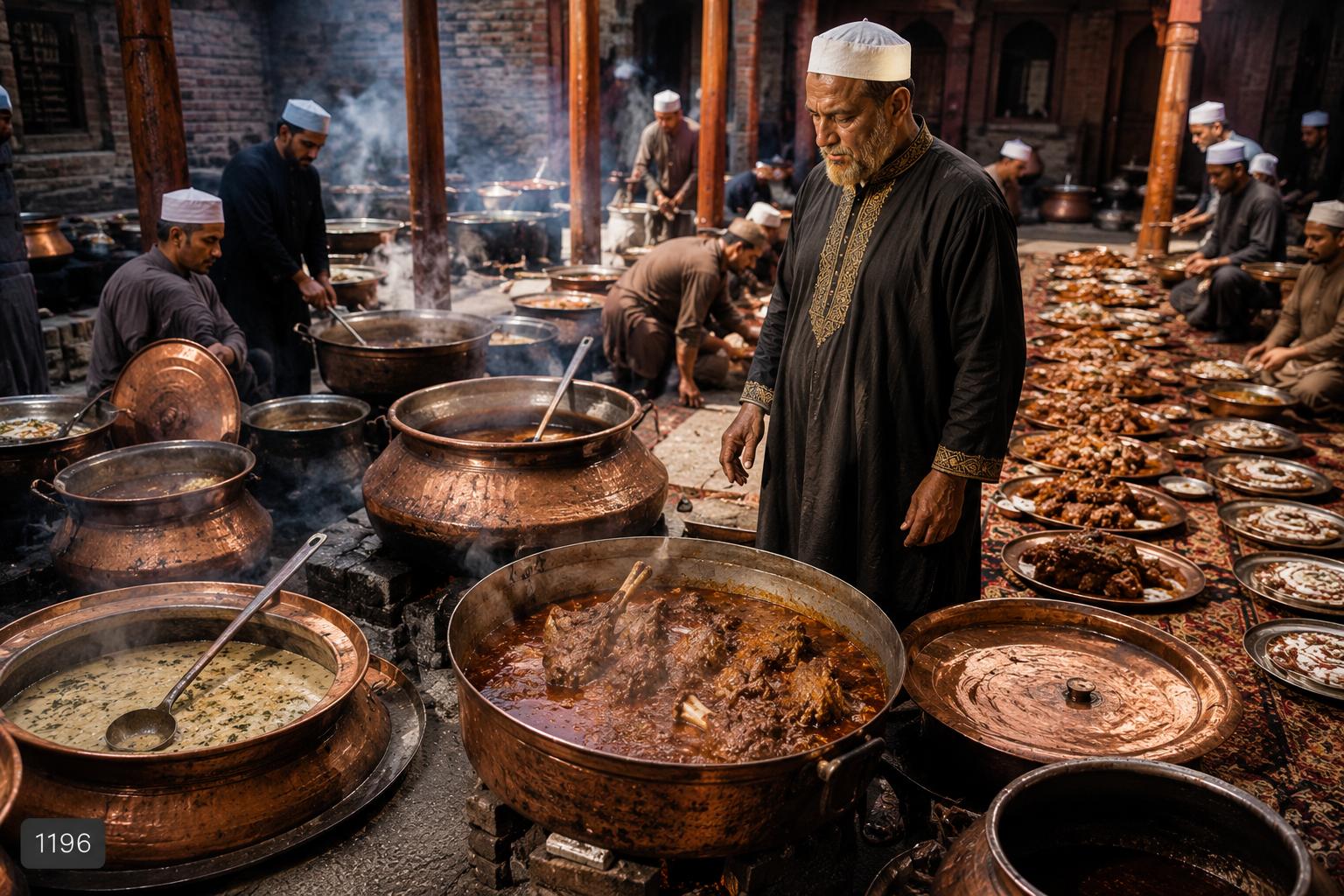
The valley's isolation also produced the waza as a hereditary specialist caste of master chefs — distinct from the household cook and from the halwai or sweet-maker. The waza's skill was passed from father to son over generations; the specific techniques of wazwan preparation (the grinding of the gushtaba meat on stone, the management of multiple simultaneous preparations for a feast of 36 courses, the timing of the traami service) were professional secrets maintained within families. The waza existed to produce a specific event — the wazwan — and the event existed to demonstrate the waza's mastery.
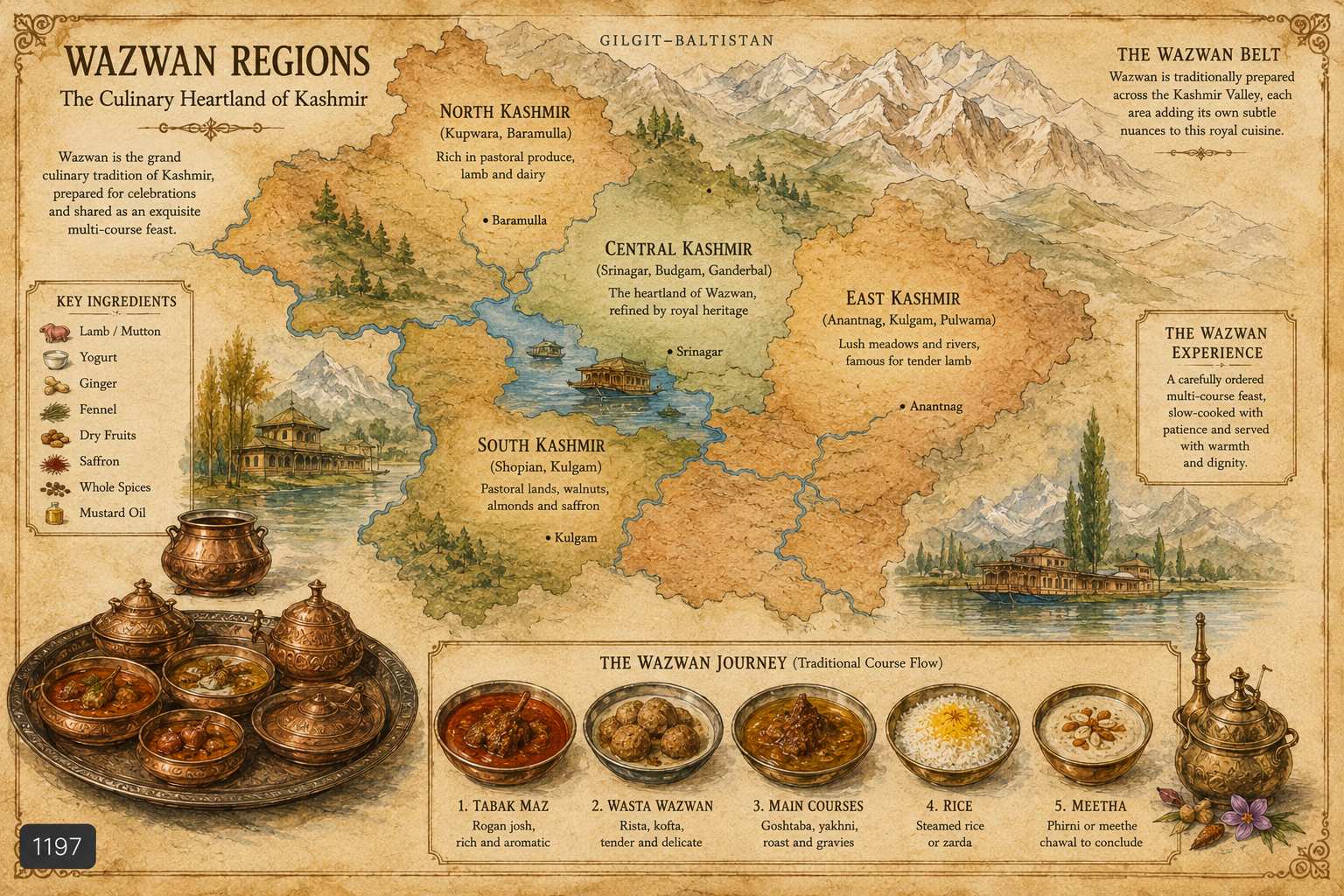
Location and regional context of Wazwan within its parent state.
📜
Historical Origins
How this cuisine became distinct from its parent
The wazwan's origins are debated but most food historians associate it with the Persian and Central Asian influence that arrived in Kashmir through the sultanate period (beginning 1320) and through the subsequent Mughal connection. The 36-course structure — with its specific sequence of preparations (salted, then roasted, then braised, then yoghurt-based, culminating in gushtaba) — has the architectural logic of the Persian multi-course feast tradition adapted to Kashmiri ingredients. The specific preparations (rogan josh, gushtaba, rista, tabak maaz) have names and preparation methods that reflect Persian, Mughal, and indigenous Kashmiri influences in varying proportions.
The most significant historical development in the wazwan tradition was the split between the Kashmiri Muslim (Waza) tradition and the Kashmiri Pandit (Hindu Brahmin) tradition. The two communities share many dishes but differ on specific ingredients: the Pandit tradition excludes onion and garlic and avoids certain meats that the Muslim tradition includes. Both traditions have their own version of rogan josh — the Pandit version uses asafoetida and dried ginger rather than onion and garlic, producing a different flavour architecture from the same visual preparation. The coexistence of two distinct spice philosophies within the same overall Kashmiri food tradition is one of the most interesting phenomena in Indian culinary history.
The 20th century disrupted the wazwan tradition significantly. Political instability from 1990 onwards reduced the number of large-scale celebrations in the valley; the migration of Kashmiri Pandits removed one of the two great communities from the valley; and the commercial restaurant adaptation of wazwan dishes in Delhi and beyond standardised preparations that were originally custom-made by specific waza families for specific occasions. What remains in the valley is a tradition under pressure but still practised — the great waza families still prepare the feast; the traami still arrives at the wedding table; the gushtaba still closes the feast.
The Traami — Eating Together as Architecture
The traami is a large copper plate from which four guests eat together — no individual plates in the formal wazwan. The courses arrive in sequence on the shared traami, and each guest eats from the same plate without division. The traami format enforces a specific relationship between the guests: they must negotiate pace, they must adapt to each other's eating speed, they must share every preparation simultaneously. The collective eating format is not incidental to the wazwan — it is the social architecture that the feast is designed to produce. A wazwan eaten from individual plates is not a wazwan; it is just the food.
🧬
Food DNA
The flavour architecture
The Wazwan Sequence
Tabak maaz — crisp-fried ribs — served first, to begin with the most tactile preparation
Rogan josh — lamb in Kashmiri red chilli and yoghurt — the most famous preparation
Methi maaz — lamb with fenugreek — aromatic, distinctive
Rista — minced lamb meatballs in red gravy — the round preparation before the finale
Gushtaba — minced lamb in white yoghurt gravy — the closing course and the feast's culmination
The Kashmiri Spice Vocabulary
Kashmiri dried red chilli (Degchi Mirch) — colour, not heat — the most deceptive spice in Indian cooking
Saffron (Pampore) — the world's most expensive spice, grown in Kashmir — fragrance and colour
Fennel seeds — the aromatic warmth of Kashmiri cooking
Dried ginger (saunth) — in place of fresh ginger — specific to the winter-preserved tradition
The Pandit vs Muslim Distinction
Asafoetida — used by Kashmiri Pandits in place of onion-garlic
Lamb (halal) — the Muslim wazwan preparation
Different rogan josh — both traditions claim their version — different ingredients, different philosophy
🌿
Signature Ingredients
The ingredients that define this cuisine
Ingredient
What It Is
Flavour Character
Availability
Kashmiri Degchi Mirch (dried red chilli)
Specific Kashmir Valley chilli variety — intense colour, minimal heat
Deep red colour; slightly fruity; almost no capsaicin heat — the colour deceives the eye
Grown in Kashmir; available nationally as 'Kashmiri chilli'; the authentic valley version has a specific character
Pampore saffron
Crocus sativus grown in the Pampore fields south of Srinagar — India's only commercial saffron
The most expensive spice by weight; warm honeyed fragrance; specific colouring agent
Grown only in Pampore, Kashmir; the world market has numerous fraudulent saffron products; genuine Pampore saffron is unmistakable
Mustard oil (Kashmiri use)
The primary cooking fat in the Kashmir Valley — different from Bengali or Rajasthani use
Pungent when raw; mellows when heated to smoking — the Kashmiri practice of smoking mustard oil before cooking is essential
Available everywhere; the specific Kashmiri technique of heating to smoking to neutralise raw pungency is the method
Dried ginger (saunth)
Ginger dried and ground — used in Kashmiri cooking where fresh ginger would be used elsewhere
More concentrated, more medicinal character than fresh ginger — the winter-storage version of the spice
Available broadly; the Kashmiri proportion is higher than in other traditions because winter preserved ingredients dominate
🍽
Signature Dishes
The dishes that cannot exist elsewhere
Dish
What It Is
Why It Matters
Rogan Josh
Lamb in Kashmiri dried red chilli — the most internationally known Kashmiri preparation
The specific colour (brilliant red from Kashmiri Degchi Mirch) with minimal heat is the paradox that defines the preparation. Rogan josh should be red but not burning. The colour is the statement.
Gushtaba
Minced lamb meatballs in white yoghurt gravy — the wazwan's closing course
The gushtaba closes the wazwan. It is deliberately the last preparation — the rich yoghurt gravy and the stone-ground mince meatball (the most labour-intensive preparation in the feast) are saved as the culmination. The feast ends when the gushtaba is served.
Rista
Minced lamb meatballs in red gravy — the round preparation before gushtaba
Rista precedes gushtaba in the sequence — both are minced lamb meatballs, but rista is in red (Kashmiri chilli) gravy and gushtaba is in white (yoghurt) gravy. The sequence of red then white is deliberate.
Tabak Maaz
Ribs braised then crisped in ghee — the tactile opening of the wazwan
Served first specifically because they are eaten by hand — the wazwan begins with the most direct physical engagement with the food. Bone-in ribs braised until tender then crisped in ghee.
Yakhni
Lamb in yoghurt and fennel — the aromatic white preparation
The fennel seed in yakhni is the defining spice — more prominent here than in any other Indian preparation. The fennel and yoghurt combination produces a preparation of extreme fragrance and gentle richness.
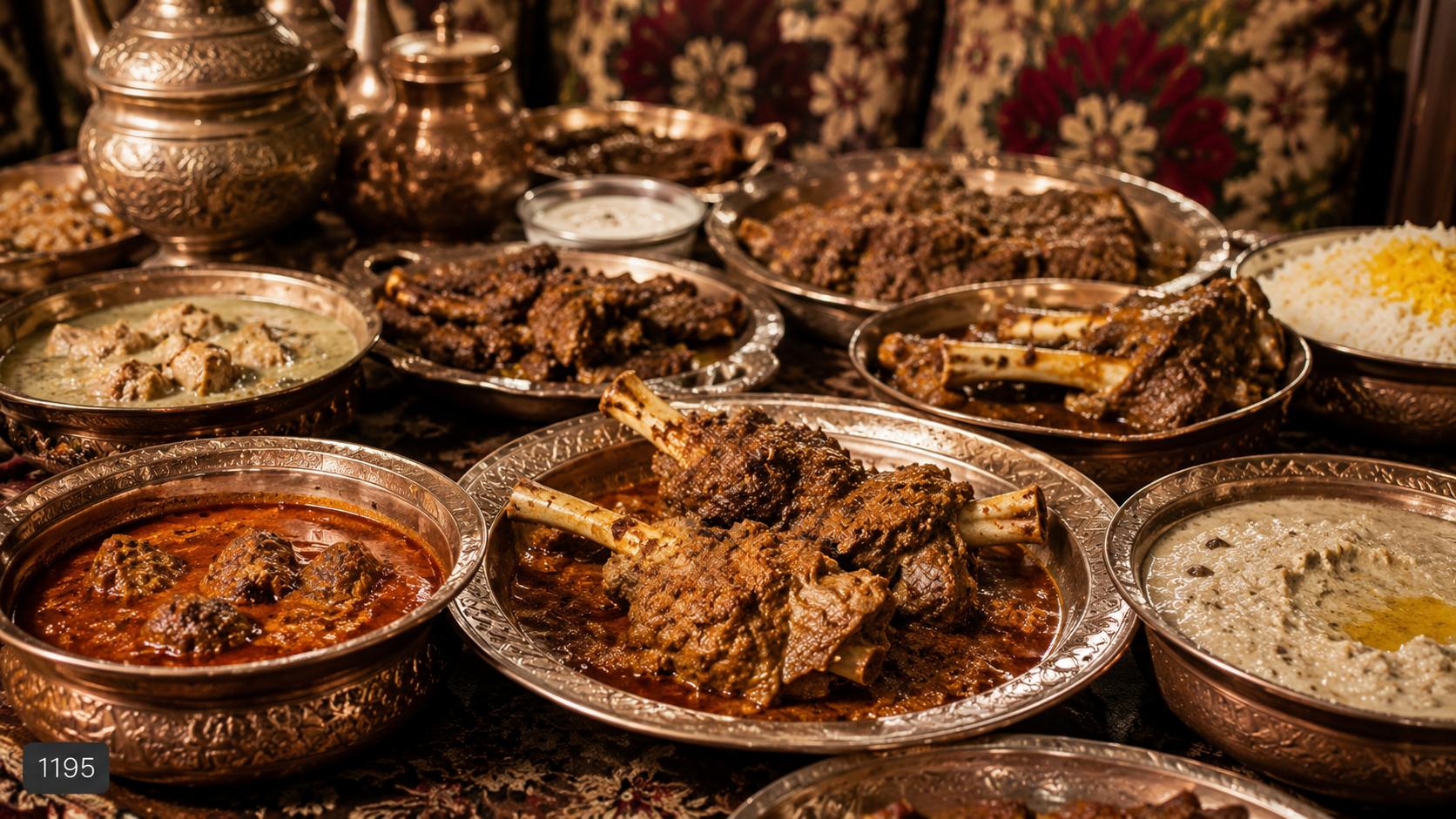
The defining preparations of Wazwan.
⚙️
Unique Techniques
What this cuisine does that others do not
The gushtaba technique is the most technically demanding preparation in the wazwan and the most specific to the Kashmiri tradition. The minced lamb must be ground on a stone surface — not in a processor — until it reaches a smooth, cohesive paste. The stone grinding is done with a wooden hammer, repeatedly, over an extended period. The cold temperature of the Kashmir Valley kitchen helps the process: cold fat maintains the cohesion of the mince. The resulting paste is shaped into large balls and cooked in a spiced yoghurt gravy — the yoghurt must be stabilised (mixed with water and a small amount of flour or cornstarch) before adding the meat, or it will break. The gushtaba balls must be cooked at a gentle simmer — boiling breaks both the meatball and the yoghurt gravy.
The mustard oil technique in Kashmiri cooking involves a specific preheating stage that most other Indian traditions skip. Kashmiri cooks heat mustard oil to its smoking point before adding any other ingredient — a process that drives off the allyl isothiocyanate compounds that give raw mustard oil its harsh pungency. The oil that results from this pre-heating has a nutty, mellowed character distinct from raw mustard oil. It is then cooled slightly before asafoetida or other aromatics are added. This smoking stage is not optional — mustard oil added without pre-heating produces a different, harsher result.
The traami service requires specific waza logistics. Multiple tramis (the large copper plates) must be simultaneously loaded with the same courses for different groups of four guests — the entire wedding feast receives each course simultaneously. For a wedding of 500 guests, this means 125 tramis must be loaded and served within minutes of each other. The waza and his team of assistants must coordinate the timing of 36 courses across 125 simultaneous service points — a logistical challenge that is part of the waza's professional skill.
Wazwan or No Wazwan — What Is Kashmiri Food?
International awareness of Kashmiri food is almost entirely limited to rogan josh — a single preparation from the wazwan tradition, divorced from its ceremonial context and often adapted in ways that compromise both the colour (using other red chillies) and the flavour. The wazwan is not Kashmiri food; it is the formal ceremonial extreme of Kashmiri food. Everyday Kashmiri cooking — haak (leafy greens), dum aloo (potatoes in Kashmiri spices), Kashmiri chai (pink noon chai) — is as important to understanding the tradition as the 36-course feast. The international reduction of Kashmir to rogan josh is approximately equivalent to reducing France to foie gras: accurate but entirely misleading about the full range.
🔗
Relationship to Parent Cuisine
How Wazwan differs from Kashmir
Element
Kashmir
Wazwan
Formality
Everyday Kashmiri home cooking
The wazwan is a feast event — not the daily food of Kashmir
Spice philosophy
Kashmiri dried chilli, saffron, fennel — shared across Kashmiri cooking
The same spice vocabulary but in feast proportions and combinations
Pandit vs Muslim
Both traditions present in Kashmir
The wazwan is primarily the Muslim Kashmiri tradition; the Pandit tradition has parallel but distinct preparations
Mutton
Present in both everyday and feast cooking
Exclusive — the formal wazwan is mutton only; no chicken, no fish
📅
Timeline
How this cuisine evolved
1320
Sultanate period begins in Kashmir
Persian and Central Asian culinary influence arrives with Islam. The feast tradition of Persian multi-course banquets begins adapting to Kashmiri ingredients and conditions.
16th century
Mughal connection deepens
Akbar's visits to Kashmir bring Mughal court cooking into contact with Kashmiri tradition. The wazwan absorbs Mughal influences while remaining essentially Kashmiri in its ingredients and structure.
18th–19th century
Wazwan reaches its codified form
The 36-course structure, the waza as hereditary specialist, and the traami service format are codified. The feast reaches the form in which it is still practised.
Post-1990
Disruption and diaspora
Political instability disrupts large celebrations in the valley. The Kashmiri diaspora carries the tradition to Delhi, Mumbai, and internationally — adapting it for restaurant contexts.
The wazwan is a Kashmiri wedding feast of up to 36 courses, prepared by the waza (master chef, a hereditary specialist) and served in the traami format — a large copper plate shared by four guests. It is not a cuisine but an event. Rogan josh, gushtaba, rista, and tabak maaz are its most celebrated preparations. The feast culminates with gushtaba — minced mutton meatballs in white yoghurt gravy.
What is gushtaba?
Gushtaba is the closing course of the wazwan — minced lamb meatballs in white yoghurt gravy. It is the feast's most technically demanding preparation: the lamb must be stone-ground to a smooth paste, the yoghurt gravy must be stabilised before the meat is added, and the preparation must cook at a gentle simmer without breaking. The wazwan is considered complete when gushtaba is served.