One dish. 26 versions. The most heated food argument in India. How Persian rice cooking became the Mughal court biryani, then fractured into Hyderabadi kachchi, Lucknawi pakki, Kolkata potato, and the Malabar biryani that bears no resemblance to any of them.
⏱ 14 min read🗓 Updated June 2026★ Food Story
Origin
Before biryani was Indian
Biryani's ancestor is the Persian and Central Asian tradition of cooking meat and rice together — pilaf, pulao, plov. The word biryani comes from the Persian biriyan (fried before cooking). The Mughal court brought this rice-and-meat tradition to India in the 16th century — but the Mughal biryani was the beginning of the Indian story, not the whole of it.
As the Mughal Empire fragmented, different regional courts developed different traditions. Each court's biryani reflected the local spice vocabulary, local rice variety, local meat tradition, and the specific innovations of its master chef. By the 19th century, the Lucknowi and Hyderabadi courts had developed the two most influential versions — and the argument between them has continued ever since.
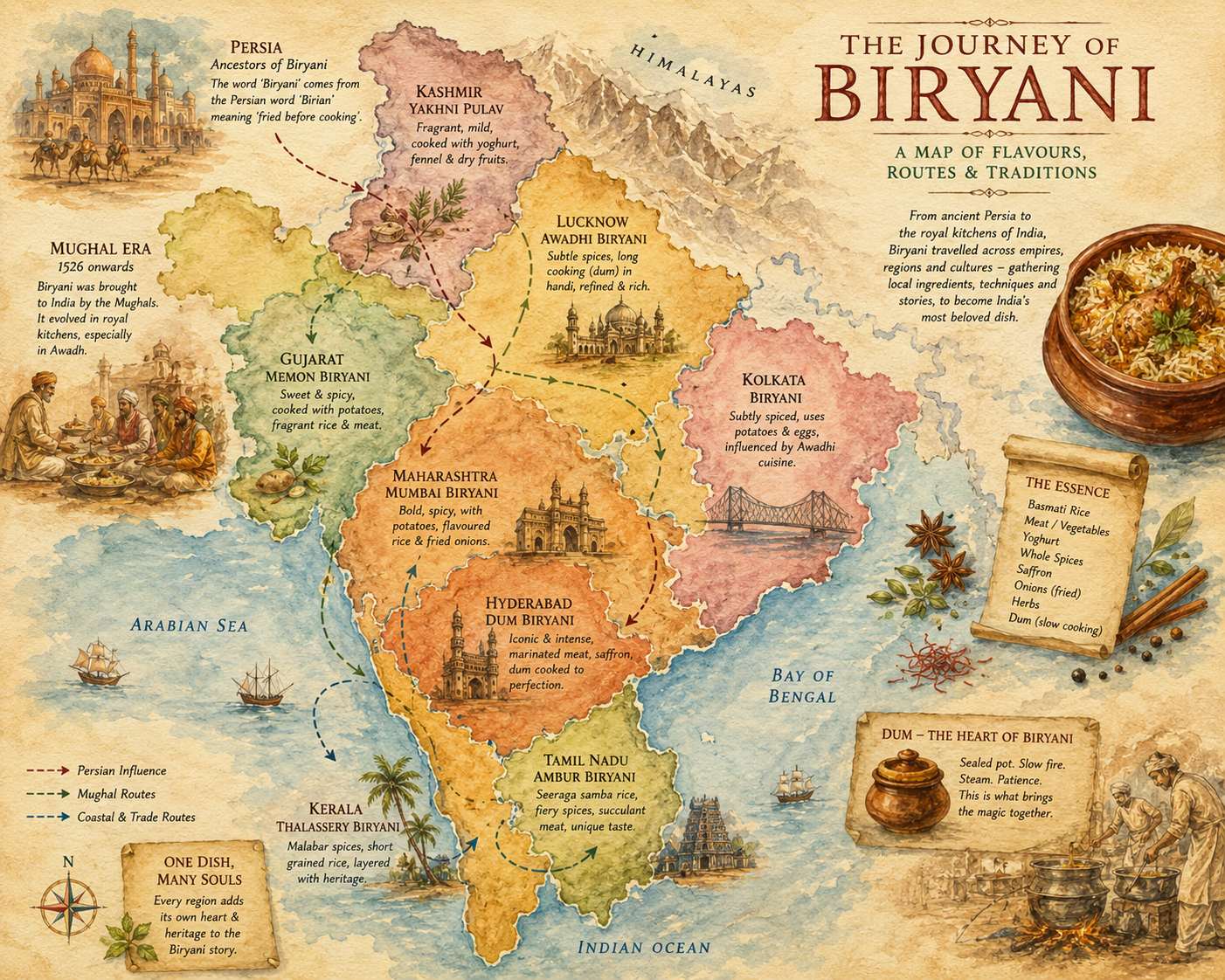
The geographic spread — each regional version reflecting the specific spices, rice, and cultural context of its location.
The Fork
Pakki vs Kachchi — the method divide
The most important divergence: pakki (Lucknowi) cooks meat and rice separately to completion, then combines under dum. Kachchi (Hyderabadi) layers raw marinated meat with partially cooked rice and cooks both simultaneously. These are not variations of the same method — they produce fundamentally different results and reflect different culinary philosophies.
Pakki vs Kachchi — The Eternal Argument
Pakki partisans argue that separate cooking gives more control and refinement. Kachchi partisans argue that cooking raw meat with the rice produces a bolder, more integrated result. Both arguments are correct within their own philosophy. The argument is about what biryani should be — and that is not a technical question but a cultural one.
Regional Versions
How one dish became 26 different preparations
Delhi Sultanate — 13th century
Origin Biryani — The Mughal Ancestor
Dum-cooked rice and meat. Long-grain rice, whole spices, sealed vessel. The template from which all Indian versions diverge.
Awadh — 18th century
Lucknawi Biryani — The Pakki Standard
The Nawabs refined Mughal method into pakki — fully cooking meat and rice separately before final dum. More restrained, more fragrant. The Kolkata biryani (with potato) descends from this when the last Nawab was exiled to Calcutta in 1856.
Hyderabad — 18th century
Hyderabadi Kachchi — The Raw Method
The Nizams developed the kachchi method — raw marinated meat cooked simultaneously with rice. Bolder, more robustly spiced. The most internationally recognised regional biryani.
Malabar — Kerala
Malabar Biryani — The Arab Influence
Uses Kaima rice (short-grain, fragrant) instead of basmati. The influence is Arab trading contact, not Mughal court. Completely different spice vocabulary — more pepper, more lemon.
Tamil Nadu
Dindigul Biryani — Seeraga Samba
Seeraga samba rice (short-grain Tamil variety) and cube-cut mutton. Unrecognisable as biryani to those who know only the Mughal tradition — yet fully biryani in its philosophy.
Why 26 Versions Are Still All Biryani
The extraordinary diversity raises the question: what makes something a biryani rather than a pulao? Broadly: biryani involves separately treating rice and protein (either cooking separately or marinating separately before dum), using fragrant rice, and the dum-sealing stage. The essential biryani is not a recipe but a philosophy of layering, sealing, and slow aromatic cooking. The potato in Kolkata biryani is adaptation; the kaima rice in Malabar is a regional alternative. Both are still biryani.
Biryani entered India through the Mughal court and dispersed across regional courts, each adapting to local rice varieties, spice traditions, and culinary philosophies. The pakki-kachchi split (Lucknow vs Hyderabad) is the most important division. Kolkata added potato after Nawabi exile; Kerala used Kaima rice through Arab trade contact rather than Mughal court influence.
What is the difference between pakki and kachchi biryani?
Pakki biryani (Lucknowi): meat and rice cooked separately until done, then combined under dum. Kachchi biryani (Hyderabadi): raw marinated meat cooks simultaneously with partially cooked rice under dum. Pakki is more restrained and controlled; kachchi is bolder and produces a more integrated result.