Awadhi Cuisine — The Nawabs' Dum-Cooked Perfection
The court cooking of Lucknow's Nawabs — dum technique taken to its absolute limit, galouti kebab that dissolves without chewing, and India's most restrained fragrant biryani tradition. Refinement as the highest culinary value.
⏱ 15 min read🗓 Updated June 2026★ Sub-Regional Guide
Sub-regional identity
Awadhi Cuisine — The Nawabs' Dum-Cooked Perfection
The court cooking of Lucknow's Nawabs — dum technique taken to its absolute limit, galouti kebab that dissolves without chewing, and India's most restrained fragrant biryani tradition. Refinement as the highest culinary value.
Lucknow, Uttar Pradesh — fertile Indo-Gangetic plain, Nawabs' capital 1722–1856
Defining technique
Dum — sealed slow-cooking in concentrated aromatic steam
Philosophy
Restraint over aggression. Fragrance over heat. Tenderness as mastery.
Key aromatics
Kewra (screwpine water), rose water, saffron — fragrance not heat
Primary fat
Ghee — generous in cooking and finishing
Defining dish
Galouti kebab — created for a toothless Nawab; dissolves without chewing
Biryani method
Pakki — both meat and rice fully cooked separately before layering
What makes it unique
Dum at its most systematised; stone-ground kebab technique; pakki biryani tradition
🗺
Geography
The place that made this food inevitable
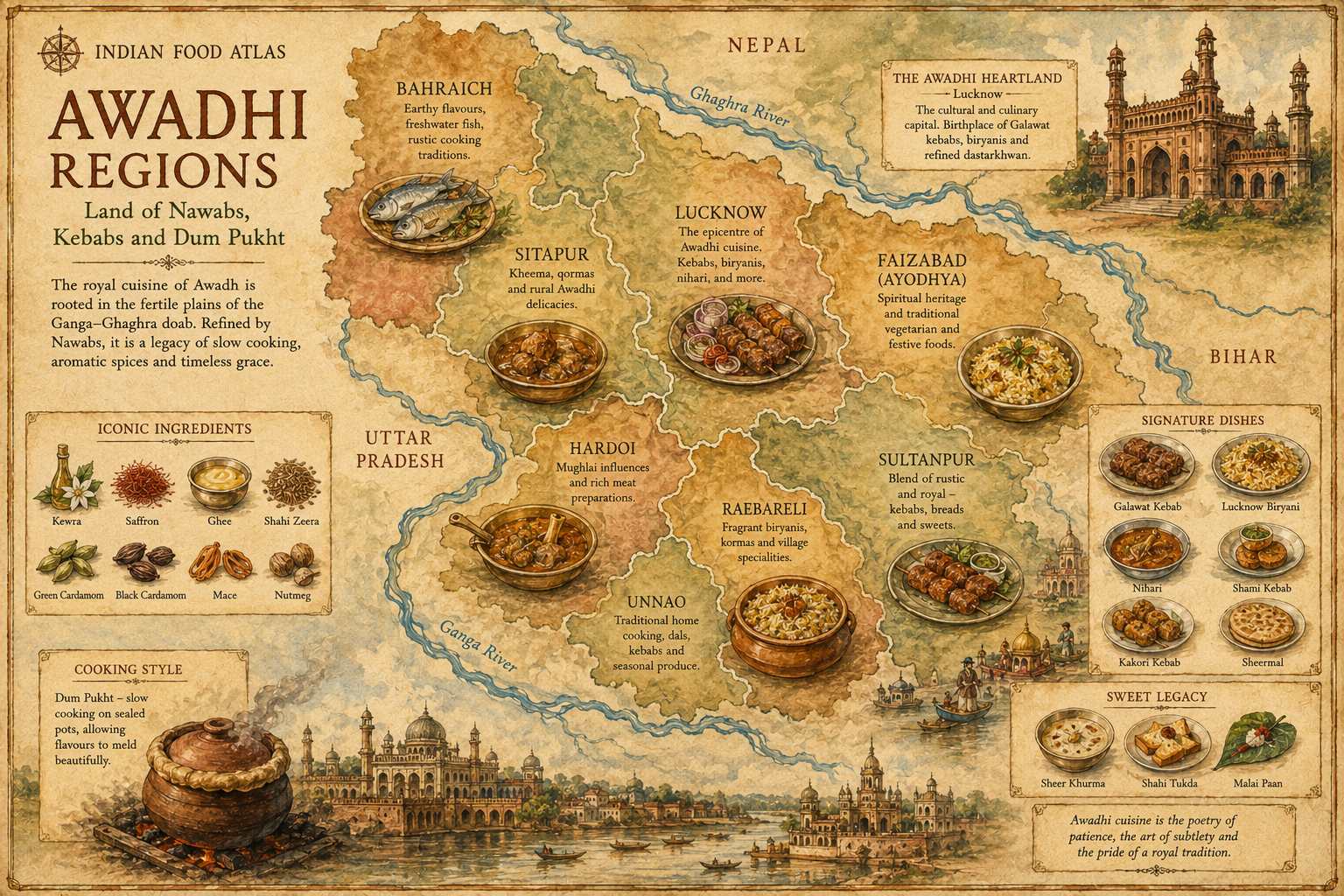
Awadh is the historical region centred on Lucknow — capital of the Nawabs from 1722 to 1856. Lucknow sits on the Gomti river on the fertile Indo-Gangetic plain, with wheat, dairy, and sugar in agricultural surplus. The Nawabs were Mughal-appointed provincial governors who became effectively independent as the Mughal Empire declined — and denied access to the imperial court in Delhi, they created a rival cultural centre that competed with it in poetry, architecture, and food.
The Indo-Gangetic plain provided the essential raw materials: winter wheat for refined breads, dairy in abundance from alluvial-pasture buffalo, saffron from Kashmir, kewra from coastal screwpine. These ingredients, applied with the Nawabi philosophy of maximum fragrance and minimum aggression, produced the most internally consistent court cuisine in Indian history.
The geographic position — in the heart of the Indo-Gangetic plain, between Delhi's Mughal culture and Bengal's Gangetic delta — gave Awadhi cooking its character: the refinement of the Mughal court, applied through North Indian agricultural abundance, produced in a competitive creative environment that pushed technique further than comfort ever would.
Location and regional context of Awadhi Cuisine within its parent state.
📜
Historical Origins
How this cuisine became distinct from its parent
The Nawabs of Awadh were cultural competitors, not just political administrators. When Nawab Asaf-ud-Daula reigned (1775–1797), the Lucknawi kitchen was producing preparations with no Mughal precedent. The galouti kebab was reportedly created for this Nawab after he lost his teeth but refused to relinquish his love of kebab. A practical problem became culinary history: the cook who solved the toothless Nawab's problem invented a preparation that now defines an entire cuisine.
The Nawabs also innovated on biryani technique. Where Mughal biryani (kachchi method) cooked raw meat and rice simultaneously, Lucknawi cooks developed the pakki method — fully cooking the meat separately, fully cooking the rice in aromatic stock, then layering and finishing under dum. The pakki method requires more steps and more skill. The Nawabs considered it superior. The argument with Hyderabad about which method is better has continued for 200 years.
When the British exiled the last Nawab, Wajid Ali Shah, to Calcutta in 1856, he took his court cooks with him. The Awadhi tradition arrived in Bengal and produced one of food history's most charming adaptations: the Kolkata biryani, distinguished by the addition of potato. Awadhi cooks in Calcutta extended the expensive preparation with a cheaper ingredient. Exile produced innovation.
The 160-Spice Galouti
The galouti contains, in some recipes, 160 spices — the list closely guarded by establishments claiming the original. Its melt-in-the-mouth texture comes from two sources: raw papaya paste (papain enzyme that breaks down muscle protein) and stone-grinding the meat on a stone slab rather than blade-mincing. Stone grinding compresses muscle fibre rather than cutting it, producing a texture no electric processor can replicate. The result dissolves without chewing — the ultimate expression of Nawabi refinement as culinary problem-solving.
Aged basmati — long-grain rice for biryani — fully cooked in aromatic stock before layering
Meat Preparations
Mutton (slow-cooked) — the primary protein — dum for 3–4 hours tenderness
Stone-ground mince — for galouti and kakori kebab — texture impossible with blade mincing
Marrow bones — in nihari — collagen and marrow dissolve into the overnight broth
Fragrance Agents
Kewra water — from Pandanus screwpine flower — the defining Awadhi aromatic
Rose water — in biryani finishing and kebab preparation
Saffron — dissolved in warm milk, drizzled as finishing — colour and fragrance together
Cooking Fats
Ghee — primary and generous — in cooking and finishing
Itar (food-grade attars) — concentrated fragrant oils — the final aromatic touch on premium preparations
🌿
Signature Ingredients
The ingredients that define this cuisine
Ingredient
What It Is
Flavour Character
Availability
Kewra water
Distilled water from Pandanus (screwpine) flower — fragrance finisher
Intensely floral, uniquely aromatic — no substitute creates the same character
Specialist Indian shops; used in finishing drops, not as a cooking medium
Raw papaya paste
Unripe papaya ground to paste — meat tenderiser in kebab preparation
No flavour contribution — acts through papain enzyme to break down muscle protein
Available wherever unripe papaya is sold; enzymatic function is the sole purpose
Stone-ground mince
Mutton worked on a stone slab and roller — not a blade mincer
Smooth, cohesive, near-liquid texture — stone compresses fibre rather than cutting
Specific to traditional Lucknawi establishments; electric mincing cannot replicate it
Aged long-grain basmati
Basmati stored 1–2 years — lower starch, longer grain, more fragrant
Delicate, fragrant, separating grains — the biryani rice standard
Specialist retailers; freshly harvested basmati has too much starch for pakki biryani
🍽
Signature Dishes
The dishes that cannot exist elsewhere
Dish
What It Is
Why It Matters
Galouti Kebab
Stone-ground minced mutton patty with up to 160 spices — dissolves without chewing
The most technically demanding kebab in India. Raw papaya enzyme, stone-grinding, and extraordinary spice layering produce a preparation that exists essentially nowhere outside Lucknow.
Lucknawi Biryani — Pakki
Fully cooked meat and separately cooked aromatic rice, combined under dum
More restrained than Hyderabadi kachchi. Both elements maintain integrity before combination. The dum finishing concentrates aromatics, not further cooking.
Nihari
Overnight slow-cooked lamb shank in deeply spiced gelatinous gravy — a dawn dish
Collagen from the shank produces the silky thick gravy that defines great nihari. Originally a working people's dawn meal. Now a Lucknowi institution.
Kakori Kebab
Minced mutton on skewers — more delicate than galouti, barely holding its shape
Binding deliberately minimal — the kebab should almost dissolve. Same stone-grinding technique as galouti applied to a skewer format.
The sweetness is deliberate — Awadhi cooking treats bread as a complete preparation, not a neutral vehicle.
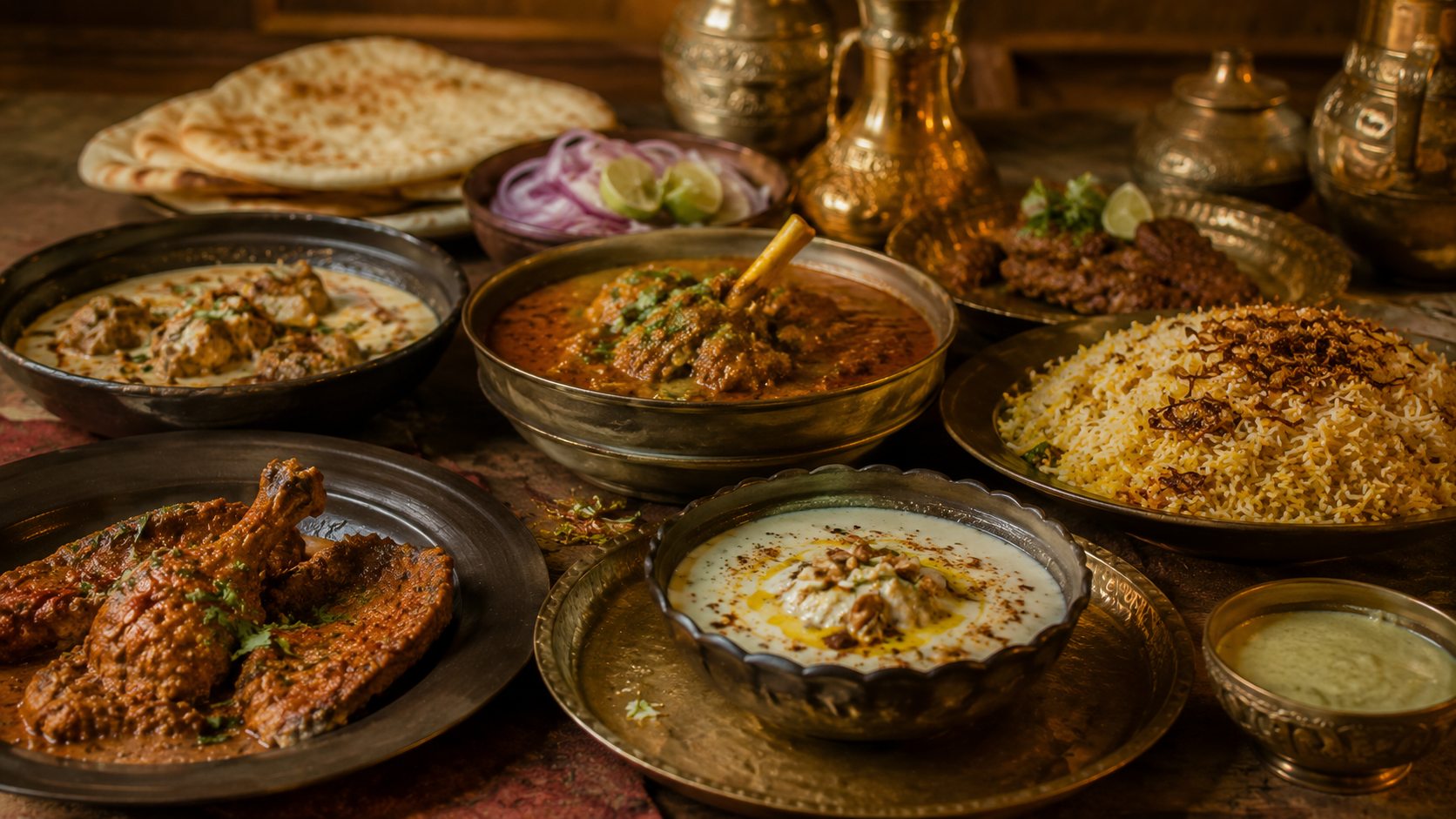
The defining preparations of Awadhi Cuisine.
⚙️
Unique Techniques
What this cuisine does that others do not
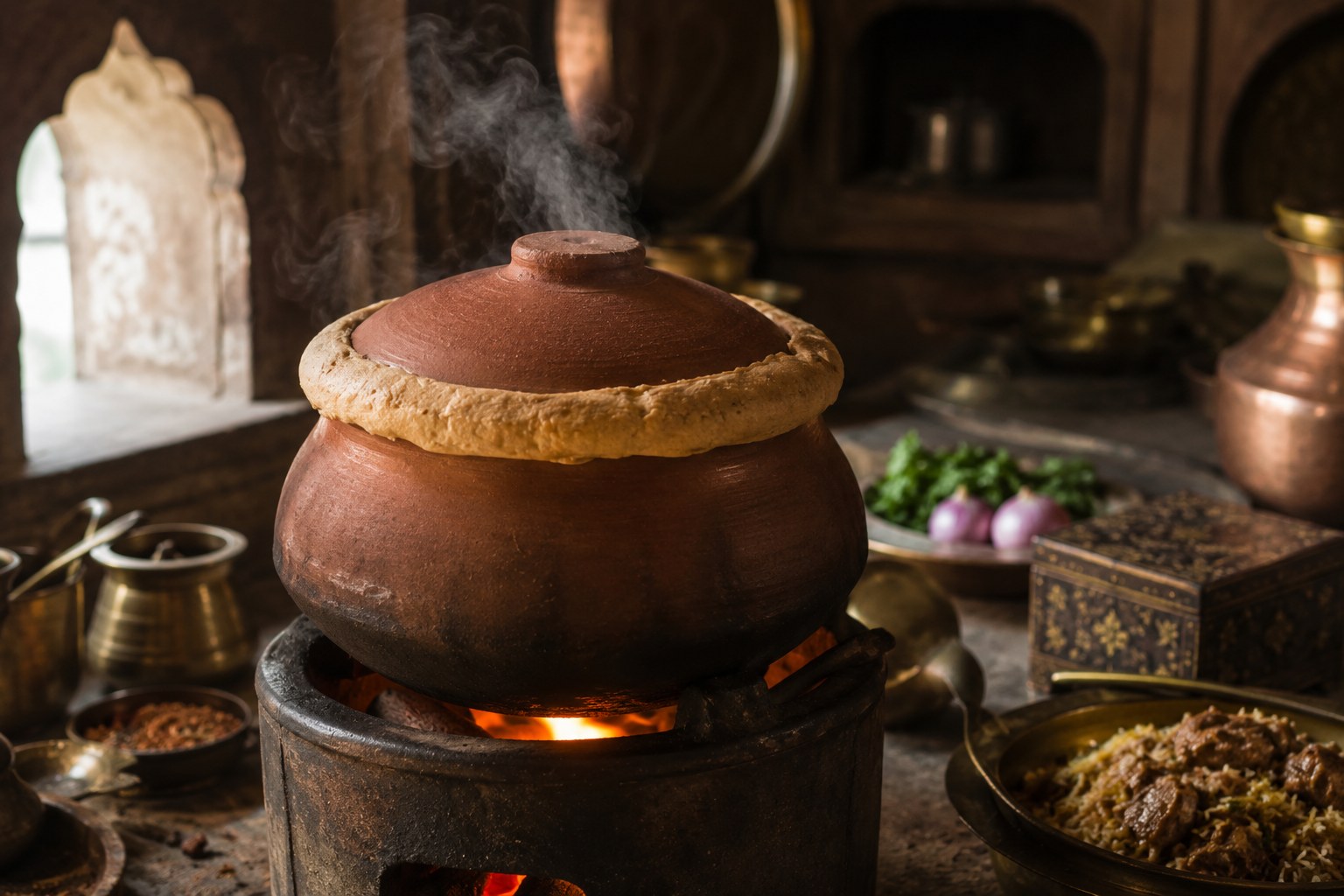
The dum technique is Awadhi cooking's defining technology. A sealed vessel placed over very low heat — sometimes with live coals on the lid, creating heat from above and below simultaneously — traps all aromatic steam inside. Kewra, rose water, saffron, and whole spices stay trapped rather than evaporating. The food absorbs them in concentrated form. This is why dum-cooked food has a fragrance no open-pot cooking can replicate.
Stone-grinding of kebab meat is the second defining technique. A stone slab and cylindrical roller work the meat repeatedly until it reaches near-liquid consistency. Blade grinding cuts fibres; stone grinding compresses them. The texture difference is fundamental: stone-ground mince has a smooth, cohesive character that electric grinding approaches but cannot match.
The pakki biryani method adds a third layer: fully cooking both elements separately before their final combination. This requires managing two simultaneous cooking processes — the meat braised to tenderness, the rice cooked to just-done in aromatic stock — before bringing them together under dum. The technique demands precision in timing and seasoning both elements individually, then harmonising them in the final sealed vessel.
Pakki vs Kachchi — Which Biryani Method Is Superior?
The two greatest biryani traditions differ fundamentally in technique. Pakki (Lucknowi): both meat and rice fully cooked before layering under dum. Kachchi (Hyderabadi): raw marinated meat cooks simultaneously with partially cooked rice. Pakki produces a restrained biryani where each element maintains its integrity. Kachchi produces a bolder biryani where the raw meat's juices permeate the rice. Lucknawis consider pakki more refined. Hyderabadis consider kachchi more technically demanding. The argument is 200 years old.
🔗
Relationship to Parent Cuisine
How Awadhi Cuisine differs from Uttar Pradesh
Element
Uttar Pradesh
Awadhi Cuisine
Heat level
Moderate North Indian heat
Minimal — warmth from whole spices, not capsaicin
Dum technique
Present in North Indian cooking generally
Systematised — the default method for all serious preparations
Kebab tradition
Present across North India
Its most refined expression — galouti and kakori require stone-grinding techniques found nowhere else
Biryani method
Both pakki and kachchi present across North India
Pakki specifically — fully cooked separately, more restrained and fragrant
Fragrance agents
Occasional kewra and rose water
Central — kewra, rose water, saffron, and attars are finishing requirements not optional extras
Bread tradition
Standard roti and naan
Roomali roti and saffron sheermal — bread as refined preparation
📅
Timeline
How this cuisine evolved
1722
Nawab Saadat Khan establishes Awadh
The Nawabi dynasty begins. Lucknow becomes an independent cultural centre competing with declining Delhi. Best cooks in North India recruited.
1775–1797
Nawab Asaf-ud-Daula — the golden era
Galouti kebab reportedly created for this Nawab. Pakki biryani method established. Dum cooking systematised into its definitive Lucknawi form.
1856
Exile to Calcutta
Wajid Ali Shah and court cooks relocate to Calcutta. The Awadhi tradition arrives in Bengal — producing the Kolkata biryani with its distinctive potato addition.
1905–present
Tunday Kababi and democratisation
The most famous galouti establishment opens in Lucknow. Awadhi cooking becomes accessible beyond the court — refined but no longer restricted.
Dum cooking seals a vessel with dough and slow-cooks over very low flame, sometimes with live coals on the sealed lid. Food cooks in its own aromatic steam — trapping kewra, rose water, and saffron that would evaporate in open cooking. Lucknow's Nawabi kitchen made this the default method for all serious preparations.
What is galouti kebab?
Galouti was created for a Nawab who lost his teeth — meat so finely minced it dissolves without chewing. Raw papaya paste provides papain enzyme that breaks down muscle protein; stone-grinding achieves the smooth cohesive texture. Some recipes list 160 spices.
How is Lucknawi biryani different from Hyderabadi biryani?
Lucknawi uses pakki method — meat and rice both fully cooked separately before layering under dum. Hyderabadi uses kachchi — raw marinated meat cooks simultaneously with partially cooked rice. Lucknawi is more restrained and fragrant; Hyderabadi is bolder and more intensely spiced.