The Journey of the Samosa — From Central Asia to Every Continent
The world's most globally distributed Indian food began as a Central Asian meat pastry. It entered India in the 13th century, became vegetarian under commercial pressure, and is now found on every continent where Indians have settled.
⏱ 12 min read🗓 Updated June 2026★ Food Story
Origin
Before the samosa was Indian
The samosa's ancestor is the sanbusak — a half-moon fried pastry with minced meat, documented in 10th-century Persian cookbooks. It travelled the Islamic trade routes from Central Asia through Persia to India, arriving by the 13th-14th century. Ibn Battuta, visiting the Delhi Sultanate in the 1330s, describes being served samushaks — meat-filled pastries fried in ghee — at the court.
The original Indian samosa was a meat preparation. The shift to potato filling happened in the 19th-20th century, after the Portuguese introduced the potato in the early 17th century and after potato became widespread. The potato samosa serves the widest possible customer base — accessible to Hindus, Jains, and all vegetarians. The meat samosa still exists in Muslim food traditions as the keema samosa.
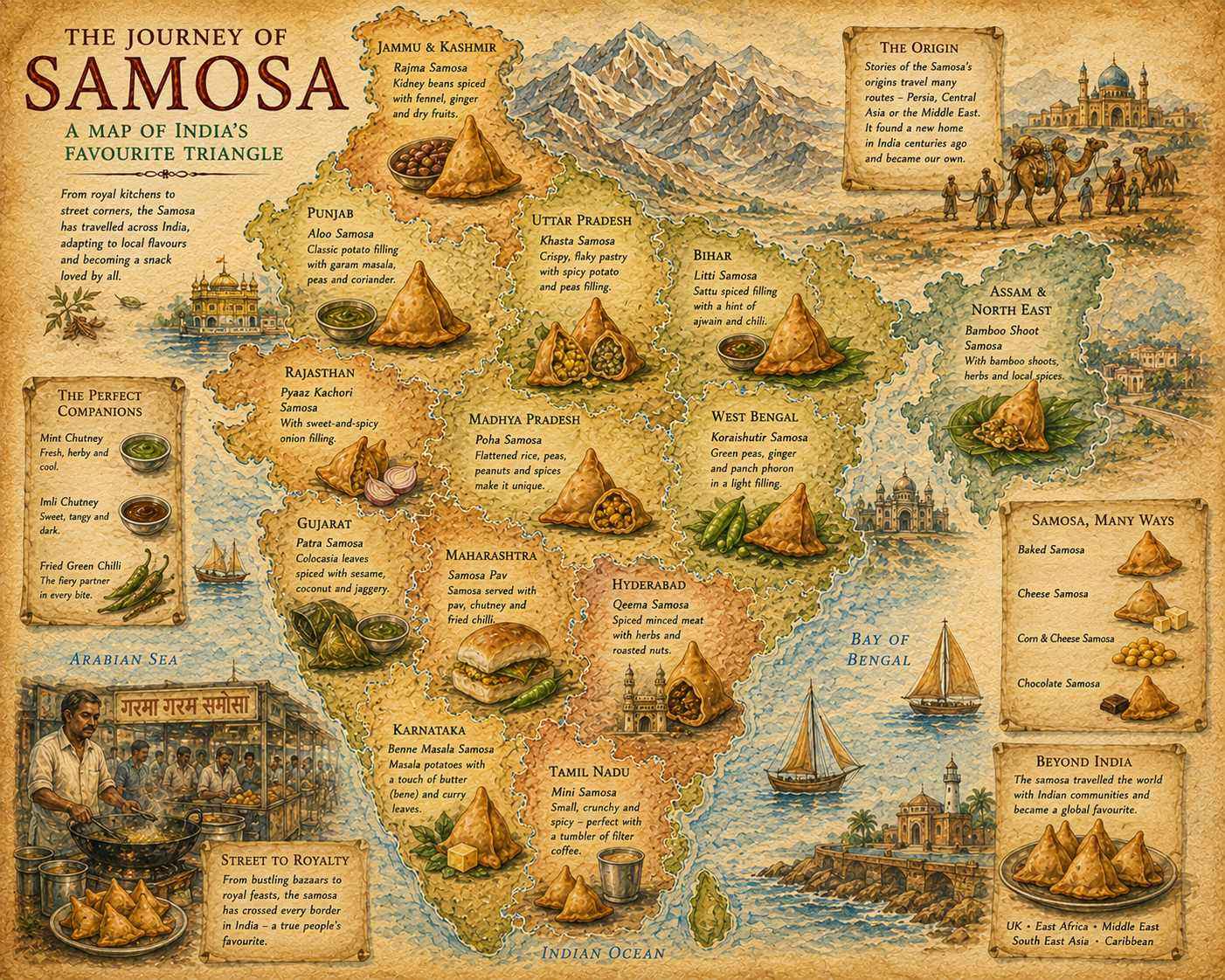
From Central Asian origin to global diaspora — how the samosa adapted everywhere it went.
The Transformation
From Central Asian meat pastry to the world's most global Indian food
Central Asia — 10th century
Sanbusak — The Meat Ancestor
Half-moon fried pastry with minced meat. Documented in 10th-century Persian cookbooks. Travelled to India through Muslim trade routes and the Delhi Sultanate.
Delhi Sultanate — 13th century
First Indian Appearance
Ibn Battuta (1330s) describes samushaks at the Delhi court. Meat-filled, ghee-fried. The Mughal courts continued and elaborated the tradition.
19th-20th century
The Potato Transition
After the potato becomes widely available, the filling shifts from meat to spiced potato-and-pea in North India. A commercial and practical adaptation — serves the widest customer base.
Bengal
Singara — The Thinner Shell
Bengali version: thinner, crispier pastry shell; potato and cauliflower filling instead of potato-and-pea. Enough difference to have its own name.
Hyderabad
Lukhmi — The Square Variant
Flat, square fried pastry with minced meat filling. Not triangular, not called a samosa — evolved far enough independently to be a different preparation with its own name.
Global diaspora — 20th century onward
The International Samosa
UK: sometimes with Cheddar cheese. East Africa: different spicing. Trinidad: with tamarind chutney. Mauritius: with specific Mauritian adaptations. The samosa adapted to every culture Indians settled in.
Why Samosa Became Vegetarian When Biryani Did Not
Both entered India through Muslim food culture. Biryani remained primarily meat — the vegetarian biryani is a concession, not the standard. The samosa, however, became primarily vegetarian. The difference is the filling: biryani's meat is the central element and cannot be easily substituted without changing the dish's nature. A samosa's filling is a small quantity enclosed in pastry — substituting potato for mince changes the filling without changing the format. The samosa's vegetarian transformation was a commercial adaptation; biryani's persistence as meat is a philosophical position.
The samosa originated in Central Asia as the sanbusak — a meat-filled fried pastry documented in 10th-century Persian cookbooks. It entered India through Islamic trade routes and the Delhi Sultanate by the 13th-14th century. Ibn Battuta describes being served samushaks at the Delhi court in the 1330s.
Why is the Indian samosa vegetarian when the original was meat?
The original Indian samosa was meat-filled. The potato filling became dominant in the 19th-20th century because it serves the widest possible customer base — accessible to all Hindus, Jains, and vegetarians. The meat samosa still exists in specific Muslim and Punjabi traditions as the keema samosa.