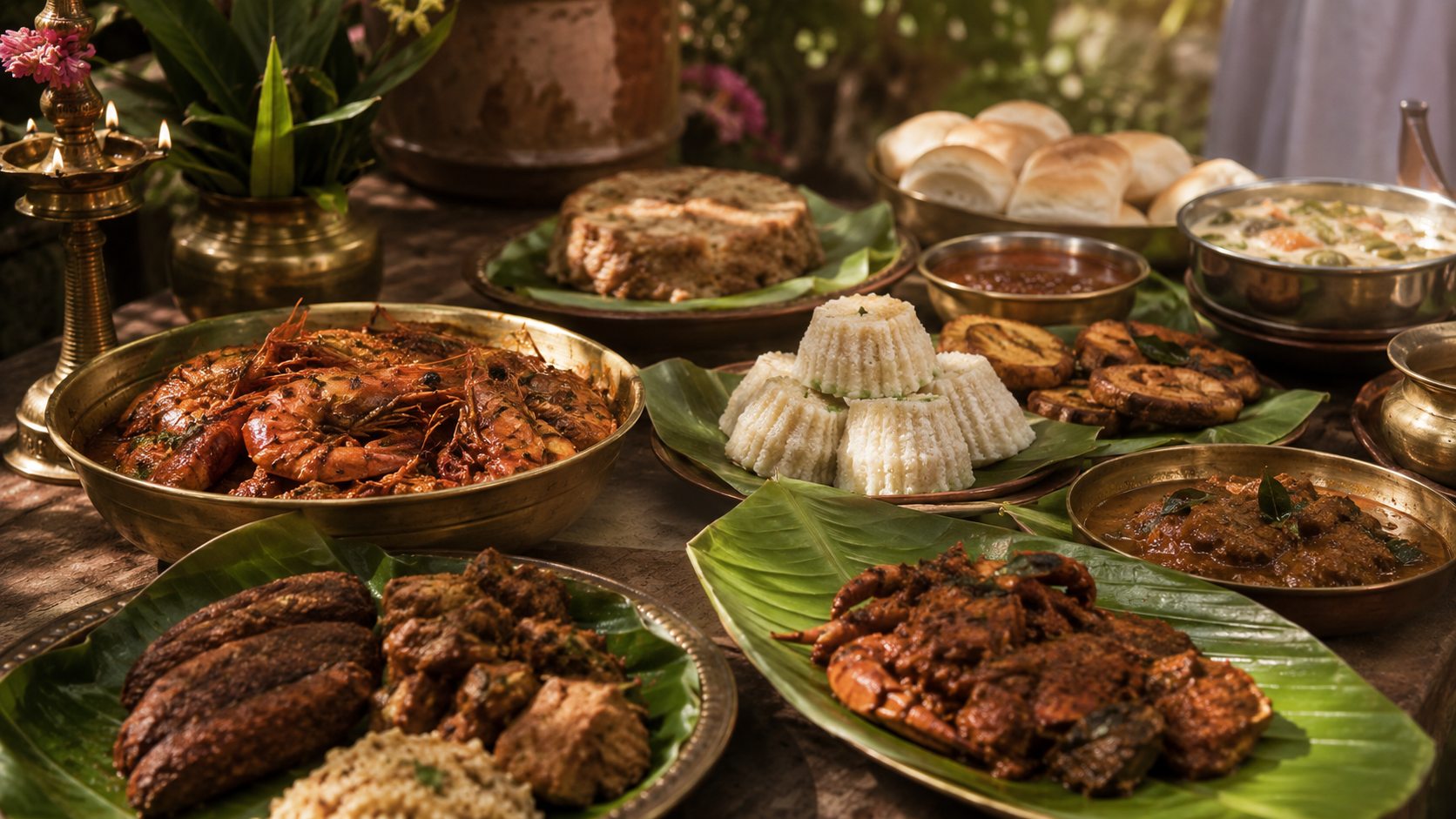
451 years of Portuguese colonisation made Goa the only Indian state with a genuinely hybrid cuisine — vinegar, pork, and New World crops integrated with Konkani coconut to produce something neither Indian nor European but entirely its own.
⏱ 14 min read🗓 Updated June 2026★ State Guide
Region
West India
Climate
Tropical Konkan coast — high monsoon rainfall
Staple Grain
Rice (coastal) + pav bread (Catholic tradition)
Defining Fat
Coconut oil
Religion
Hindu (Saraswat Brahmin), Goan Catholic, Muslim
Signature Dish
Vindaloo, Fish Curry, Bebinca
At a glance
Goa — quick reference
Factor
Summary
Climate
Tropical — high monsoon rainfall, Arabian Sea coast; interior has Western Ghats forests
Main grains
Rice on the coast; pav bread — the Portuguese bakery tradition — in cities
Main fat
Coconut oil universally; some lard in traditional Catholic preparations
Signature flavour
Vinegar-soured preparations unique in Indian cooking — the Portuguese legacy
Religious communities
Goan Hindu (Saraswat Brahmin), Goan Catholic (16th-century converts), Muslim
What makes it unique
The only Indian cuisine with vinegar as a standard souring agent; pork mainstream in Catholic tradition
Signature dish
Vindaloo — pork in vinegar-chilli marinade; Goan fish curry with coconut and kokum
Signature bread
Pão (pav) — the Portuguese bread integral to Goan identity; poder bakers supply fresh loaves daily
Signature drink
Feni — fermented cashew apple or coconut toddy; GI-tagged to Goa
Famous sweet
Bebinca — layered coconut pancake; Dodol — coconut and jaggery
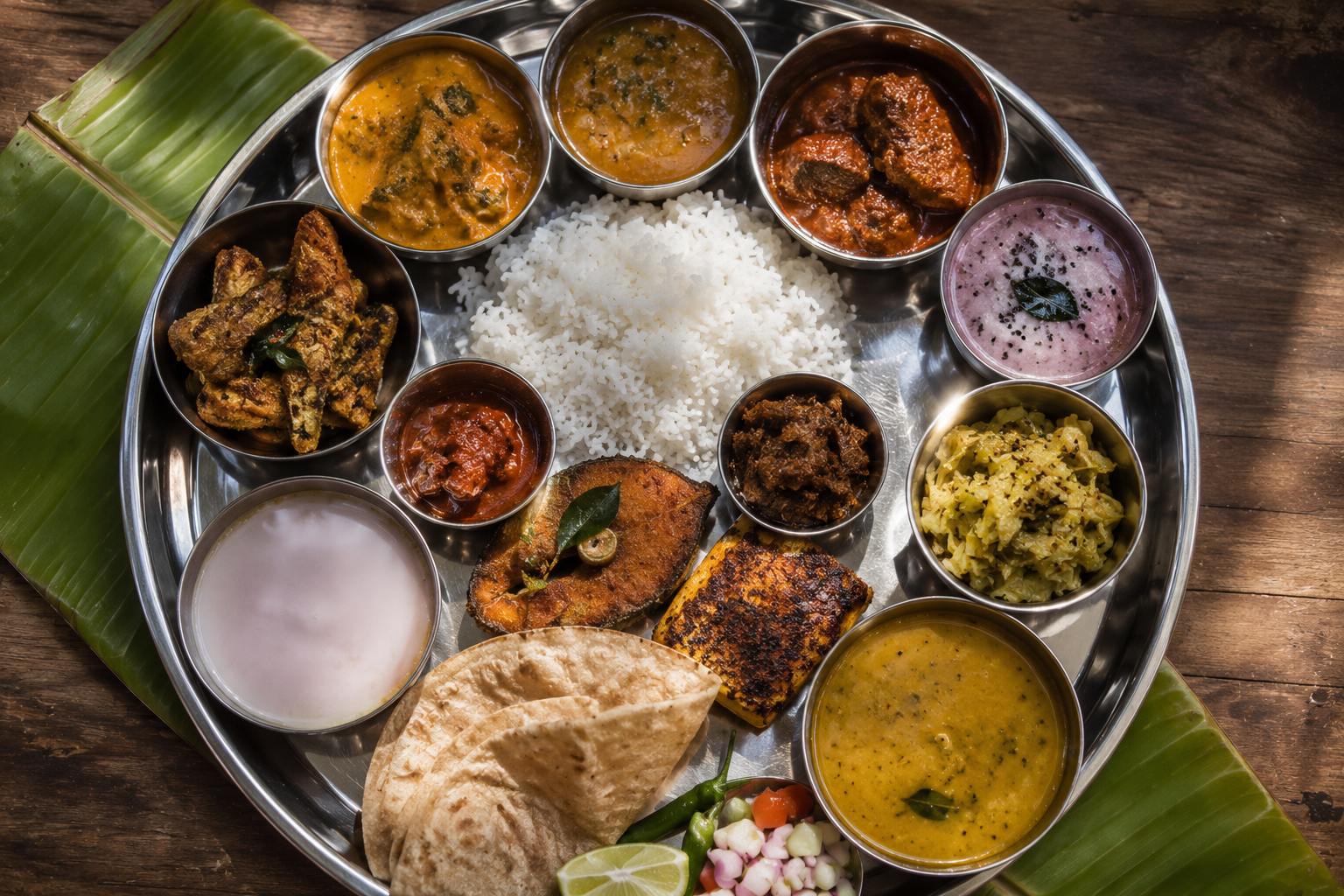
The Goan meal — rice with fish curry and kokum-soured coconut gravy (Hindu tradition), or pork vindaloo with pav bread (Catholic tradition). Two complete cuisines within one tiny state, 3,702 square kilometres.
Geography and identity
Goa — where geography shaped the plate
Goa is India's smallest state — 3,702 square kilometres on the Arabian Sea coast. For 451 years (1510–1961) it was a Portuguese colony. The Portuguese arrived with vinegar, lard, and bread; introduced New World crops (chilli, cashew, potato); and converted coastal Hindu communities to Catholicism, creating families who adopted pork and vinegar into their cooking. The result is the only Indian state with a genuinely hybrid cuisine — not fusion in the modern restaurant sense but centuries-long cultural integration producing something distinct from either its Hindu Konkani base or European cooking.
Why Goa Eats This Way
Three communities, three cuisines in 3,702 square kilometres
Goan Catholic cooking uses vinegar (from sugarcane or coconut toddy — Portuguese technique with Indian ingredient), pork, beef, and bread in ways with no parallel in mainland Indian cooking. Saraswat Brahmin Hindu cooking uses the coconut-kokum base of the Konkan coast — fish, rice, coconut oil — without Portuguese elements. Goan Muslim cooking brings coastal Muslim traditions from the Arab trade contacts predating the Portuguese. All three share a coastline and some ingredients but maintain distinct food identities.
🌊
Climate and agriculture
What the land grows — and why it dominates the plate
Goa's tropical climate — high monsoon rainfall, year-round warmth, Arabian Sea coast — produces coconut, fish, and rice in the same abundance as Kerala and coastal Karnataka. The Portuguese 451-year presence layered vinegar, pork, and New World crops onto this Konkani base. Chilli entered all of India through Goa — the Portuguese brought it from Brazil and it spread northward and eastward from Goa over the next 150 years, transforming all of Indian cooking.
🌊
Arabian Sea
Abundant fish — pomfret, mackerel, kingfish, prawns
🌿
Cashew
Portuguese introduced cashew from Brazil — Goa now produces most of India's cashew
🌶
Chilli first
Chilli entered India via Goa — spread across the subcontinent from here
🍷
Vinegar
Sugarcane and toddy vinegar — the Portuguese technique in Indian hands
🐷
Pork
Catholic tradition — the protein most distinctive to Goan Catholic cooking
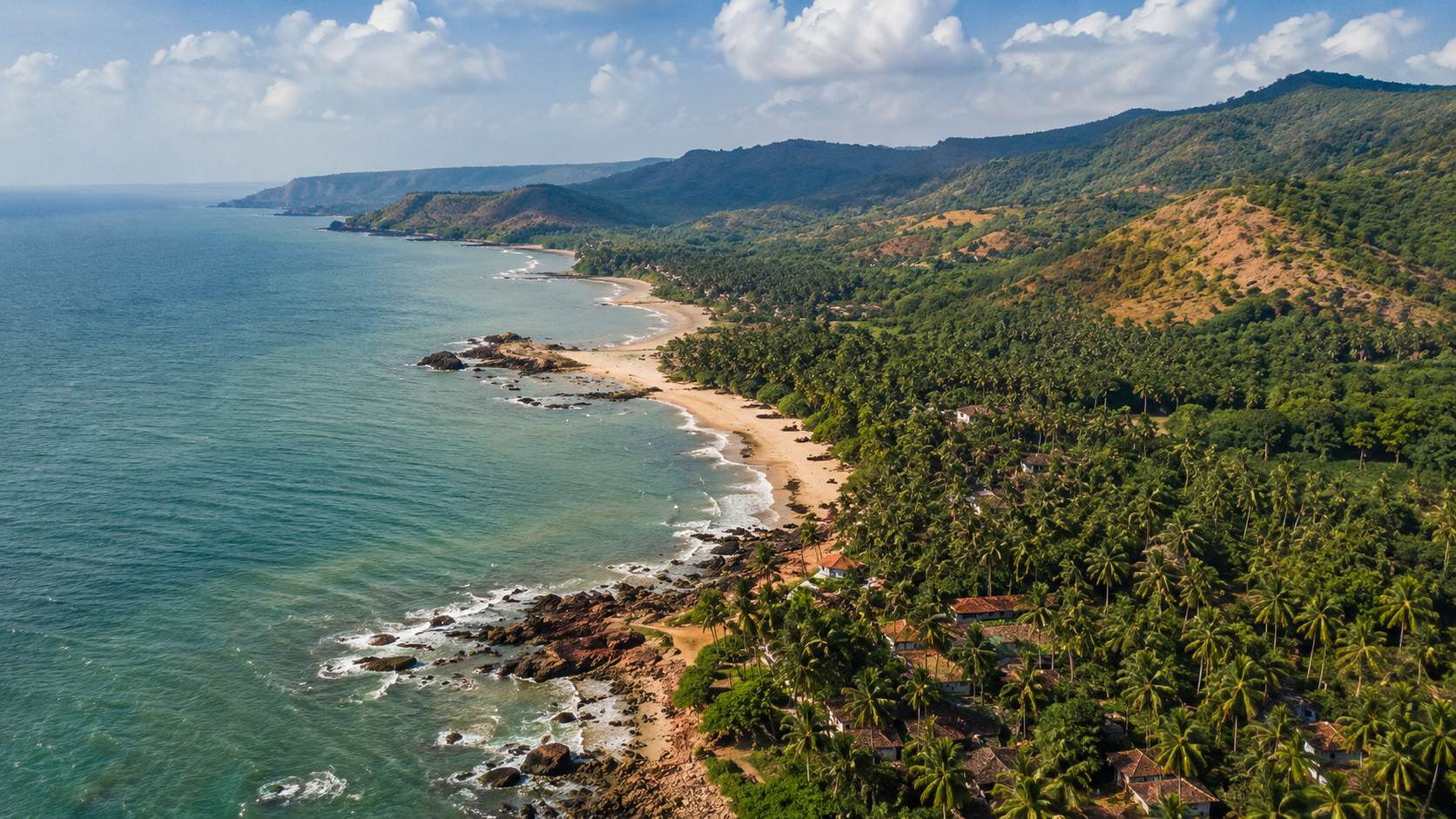
Goa's landscape — the Arabian Sea beaches and coconut groves of the coast (left), the Western Ghats forests that produce cardamom and pepper (right). The contrast between coast and interior mirrors the contrast between Goan Catholic and Goan Hindu food cultures.
Why Goa's Food Cannot Be Replicated Elsewhere
Goa is the only Indian state where vinegar is a standard cooking ingredient, pork is mainstream, beef is widely available, and leavened bread (pav) is a daily staple. Each element exists because of the specific 451-year Portuguese colonial history. Remove the Portuguese from Goa and you have a standard Konkan coast food culture — similar to coastal Karnataka and Kerala. The Portuguese presence is the only explanatory variable for Goa's distinctiveness.
🧬
Food DNA
The staple ingredients of Goa
Grains
Rice — coastal Goan staple — the Konkani base
Pão (pav) — Portuguese-origin daily bread; poder bakers supply fresh before sunrise
Sannas — fermented rice bread — a Goan adaptation of the fermentation tradition
Protein (Catholic)
Pork — vindaloo, sorpotel, chouriço — the defining Catholic proteins
Beef — mainstream in Catholic tradition — unavailable in most of India
Fish — central — pomfret, mackerel, kingfish
Protein (Hindu)
Fish — Saraswat Brahmin fish-eating tradition — similar to GSB Mangalorean and Bengal Hindu
Prawns — coastal harvest
No beef, no pork — standard Hindu restriction
Souring Agents
Vinegar — the unique Goan element — sugarcane or toddy vinegar in Catholic cooking
Kokum — the Konkani souring agent for Hindu preparations
Tamarind — secondary to kokum on the coast
Portuguese-introduced
Cashew — from Brazil via Portugal — Goa produces most of India's cashew; feni made from cashew apple
Chilli — the most consequential Portuguese introduction — entered India here
Tomato, potato — also Portuguese introductions through Goa
🕊
The Catholic-Hindu food divide that defines Goa
How three communities produce three distinct Goan cuisines
Goa's most distinctive food characteristic is the coexistence of three entirely different food cultures within 3,702 square kilometres — the physical size of a medium city. Each community's cuisine reflects its specific religious and historical experience while sharing the same coastline and many of the same ingredients.
Goa's Three Food Traditions
Goan Catholic
Vindaloo, sorpotel, bebinca, pav. Pork, beef, vinegar. The Portuguese-influenced tradition that makes Goa unlike any other Indian state.
Saraswat Brahmin Hindu
Fish-eating Brahmin tradition — coconut-kokum curries, rice-based meals. The pre-Portuguese Konkani coast food culture, maintained alongside the Catholic tradition.
Goan Muslim
Halal meat, specific biryani and curry traditions. Arab trade contacts predate Portuguese arrival — the oldest non-Hindu food culture in Goa.
🗺
Regional food zones
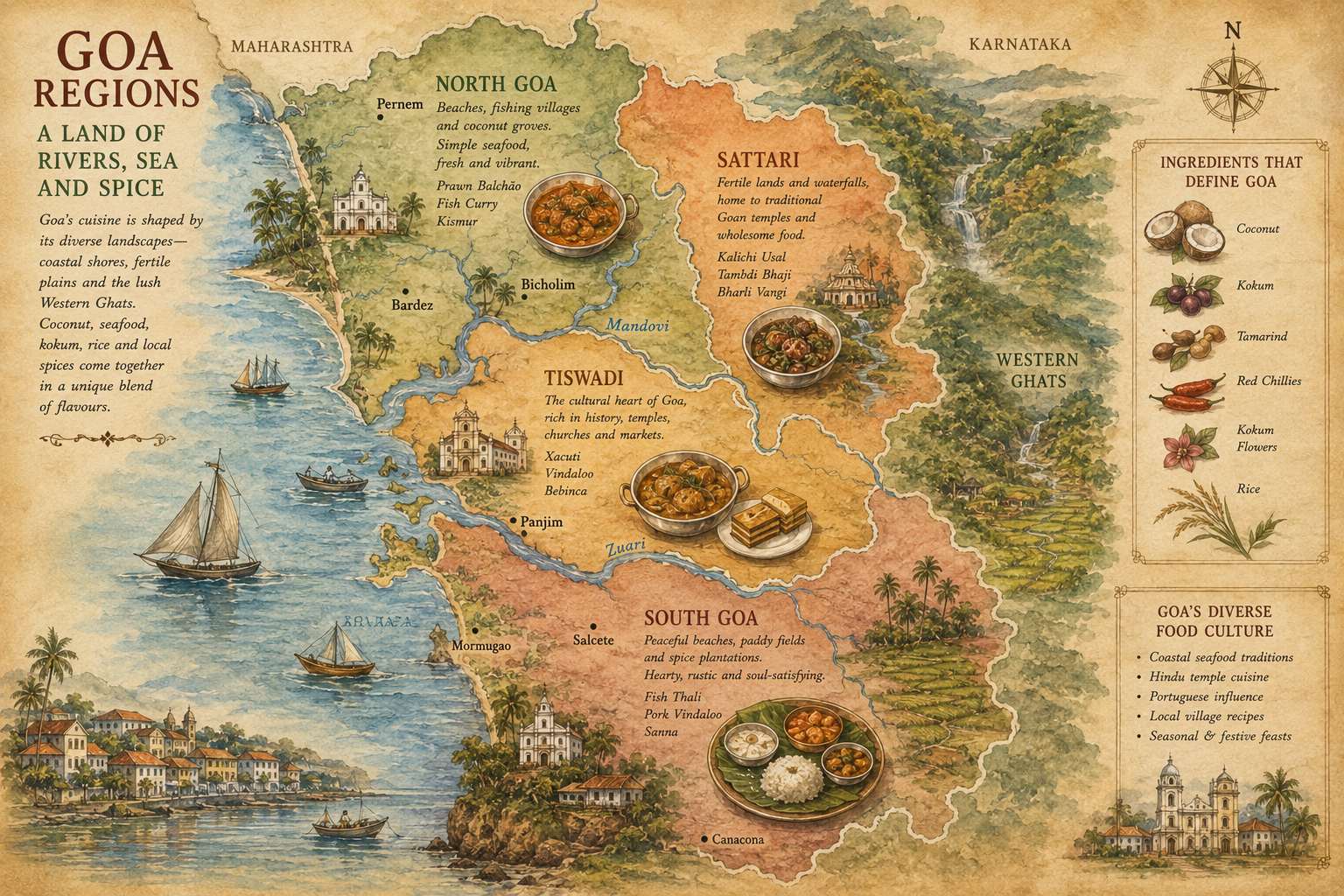
North Goa, South Goa, and the interior Ghats — three distinct food geographies
Despite Goa's small size, meaningful regional variation exists between the tourist-facing north, the traditional south, and the Ghats interior.
Region
Identity
Signature Characteristics
North Goa (Calangute, Anjuna, Vagator)
International tourist beach culture
Most internationally adapted — seafood shacks, Goan fish curry and rice for tourists, some tourist-modified preparations. Most visible internationally but least traditional.
South Goa (Margao, Salcete, Vasco)
Traditional Catholic heartland
The deepest Portuguese food integration — sorpotel, vindaloo, bebinca. The poder (baker) tradition strongest. Old Catholic houses with their specific preparation traditions.
Western Ghats interior (Ponda, Sanguem)
Pre-Portuguese Hindu tradition
Inland communities maintain Konkani Hindu food identity — coconut and kokum curries, river fish, no Portuguese influence. The food Goa had before 1510.
Goa's three culinary zones — the tourist-facing beach north, the Catholic heartland south, and the pre-Portuguese Hindu food culture of the Ghats interior.
🍽
Signature dishes
The dishes that define Goa's fusion identity
Dish
Region/Community
Why It Exists
Vindaloo
Goan Catholic — pork in vinegar and chilli marinade
Originally from Portuguese vinho e alhos (wine and garlic). Pork marinated in vinegar then slow-cooked. The British curry house version (lamb, extra chilli, no vinegar) is unrecognisable from the original.
Goan Fish Curry
All communities — different versions
Fish in coconut milk with kokum — the Konkani coastal standard. Catholic version may include vinegar; Hindu version uses kokum only. The national image of Goa on a plate.
Sorpotel
Goan Catholic — wedding and festival
Pork offal and blood slow-cooked in vinegar and spices for 2–3 days before eating. Improves significantly with time. One of India's most complex Catholic preparations.
Bebinca
Goan Catholic — festival sweet
Layered coconut pancake — up to 16 individually cooked layers of coconut milk, egg yolk, sugar, and ghee. 4–6 hours of patient layering. The defining Goan sweet.
Xacuti
Goan Hindu — specific masala
Chicken or lamb in a complex masala using dried coconut, poppy seeds, and specific spices distinct from Catholic preparations.
Chouriço
Goan Catholic — Portuguese-origin sausage
Spiced pork sausage using Goan spices — a direct Portuguese product adapted to Indian flavours. Cooked with potatoes or used to flavour preparations.
🎉
Festival foods
The food calendar of Goa
Carnival
February/March — Catholic pre-Lent
Goan Carnival — the most European-influenced festival in India. Bebinca, dodol, and pork preparations for the pre-Lenten feast.
Christmas
December — Catholic
The most elaborate Catholic food occasion. Sorpotel prepared days in advance, bebinca, roast pork, and specific Goan Christmas sweets.
Gudi Padwa
March/April — Hindu New Year
Saraswat Brahmin community celebrates with coconut-based sweets, fish preparations, and specific temple prasad.
Carnival Street Food
February/March
Street vendors during Carnival serve fried fish, local sausages, and Goan specialties to the festival crowds — the most concentrated Goan street food occasion.
Easter
Spring — Catholic
Easter Sunday meal — specific meat preparations, bebinca, and the Easter egg tradition unique to the Catholic community.
The Goan Catholic food festival calendar and the bebinca tradition that connects generations.
⚖️
Food economy
The economic forces that shaped Goa's unique cuisine
Economic Force
Impact on Cuisine
Portuguese colonial economy (1510–1961)
451 years of Portuguese rule brought the trade infrastructure that introduced chilli, cashew, pav, and vinegar — all of which changed not just Goan cooking but all of Indian cooking through Goa's position as the New World crop entry point.
Cashew economy
Goa produces most of India's cashew — a Portuguese introduction from Brazil. Feni (cashew apple liquor) is a GI-tagged Goan product; cashew-based sweets and snacks are economic and culinary legacies of this agricultural introduction.
Tourism economy
Goa's tourism industry is India's most developed. The seafood shack culture of the beaches became internationally recognisable — Goan fish curry and rice is arguably India's most internationally visible regional dish.
Poder (bakery) tradition
The Goan Catholic baker community supplies fresh pav bread before dawn to every household. This artisan bread tradition creates the infrastructure for a bread-eating culture unlike any other Indian state.
✈️
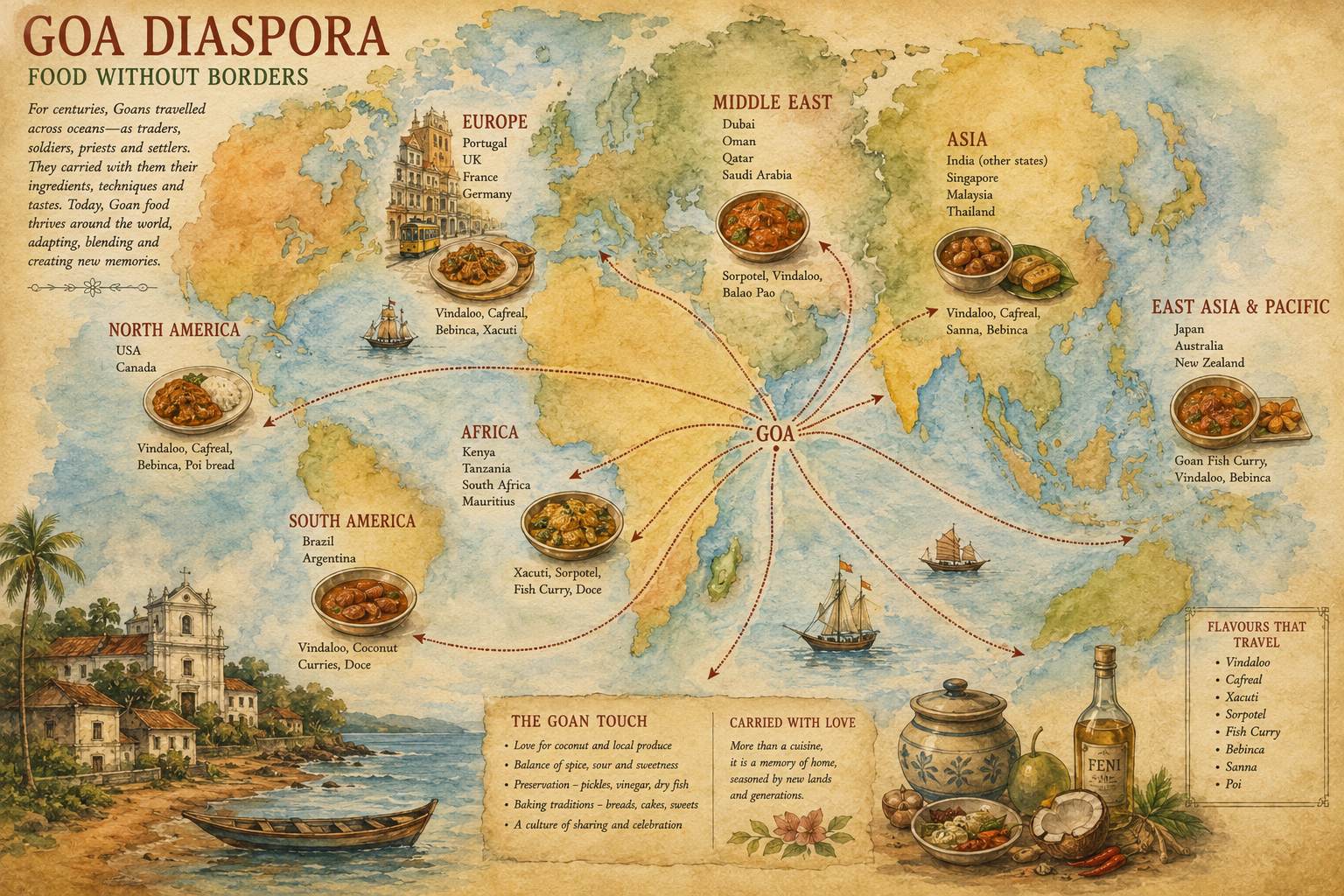
Food migration
Goa's cuisine travelled the world
The Goan Catholic and Saraswat Hindu diaspora — carrying vindaloo, fish curry, and feni to Mumbai, the UK, and East Africa.
Destination
When
What They Carried
Mumbai and Maharashtra
Post-1961 migration
Goan Catholics and Saraswat Brahmins migrated to Mumbai for work — establishing the Goan Catholic restaurant tradition and bringing chouriço and vindaloo to the city's food culture.
United Kingdom and Portugal
Colonial and post-colonial
Goan Catholics migrated to Britain and Portugal — bringing a food culture that influenced early Indian restaurant menus in the UK.
East Africa (Kenya, Uganda)
British colonial period
Goan Catholics in the British colonial administration carried their food traditions to East Africa — creating small but distinct Goan Catholic communities.
📜
Food timeline
How Goa's cuisine developed across history
Pre-1510
Saraswat Brahmin and Konkani Hindu food culture established
The Konkan coast food tradition — coconut, kokum, fish, rice — is the base. This food exists and is sophisticated before any Portuguese contact.
1510
Portuguese establish Goa
Afonso de Albuquerque captures Goa. Portuguese bakeries, mass conversion of coastal communities, and the introduction of pork and vinegar begin simultaneously.
1510–1600
Chilli and cashew enter India through Goa
The Portuguese introduce chilli from Brazil — the most consequential food event in Indian history. Chilli spreads from Goa across India over 150 years, transforming all Indian cooking. Cashew introduction follows.
16th–17th century
Vindaloo and sorpotel develop
The Catholic community integrates Portuguese wine-and-garlic technique with Indian chilli — producing vindaloo. Sorpotel develops as the Catholic festival preparation.
1961
Indian annexation
Goa becomes part of India after 451 years. The food culture is preserved — the Catholic tradition continues without Portuguese political authority.
Post-1961
Tourism and global recognition
Goa becomes India's premier beach destination. Goan fish curry and vindaloo achieve global recognition as distinct from mainland Indian food.
The original Goan vindaloo is pork marinated in vinegar and chilli — derived from the Portuguese vinho e alhos (wine and garlic). The British curry house version (lamb, extra chilli, no vinegar) is entirely different. Vinegar is the defining element of the original.
Why did chilli first arrive in Goa?
The Portuguese used Goa as their primary Indian Ocean trading hub from 1510. They introduced chilli from Brazil to their colonial outposts — Goa received it first among Indian territories. From Goa, chilli spread across India over 150 years, transforming all Indian cooking.
What is bebinca?
Bebinca is a layered Goan Catholic sweet — up to 16 individually cooked layers of coconut milk, egg yolk, sugar, and ghee, each layer cooked before the next is added. The 4–6 hour process requires patience and technique. It is the definitive Goan sweet.
How is Goan fish curry different from Kerala fish curry?
Goan fish curry uses kokum for souring and a coconut milk base — similar to Kerala. The key difference is the addition of local Goan spices, the specific coconut-spice paste, and in Catholic preparations, sometimes vinegar. Kerala uses kodampuli (Gamboge) rather than kokum, producing a different colour and sourness character.