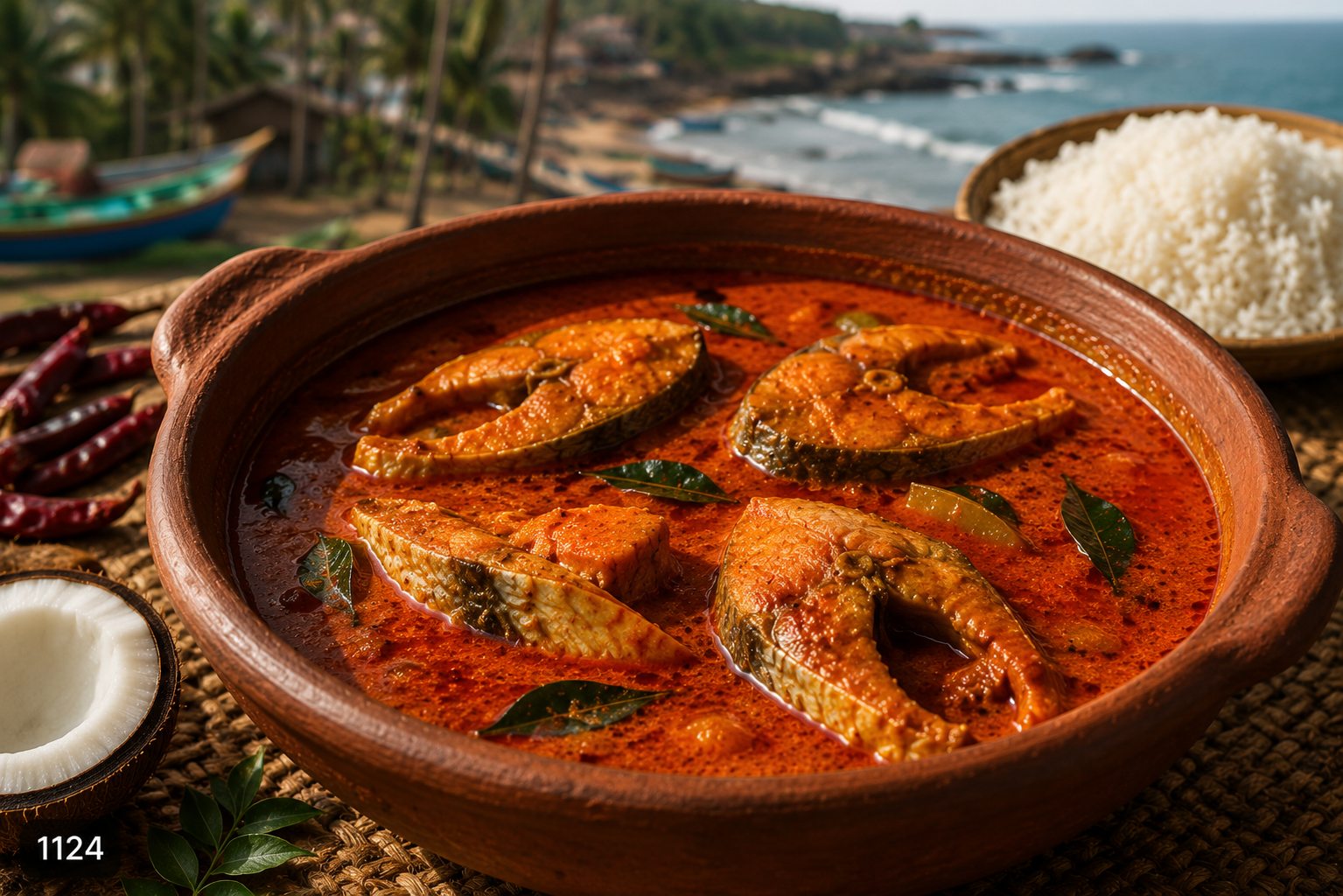
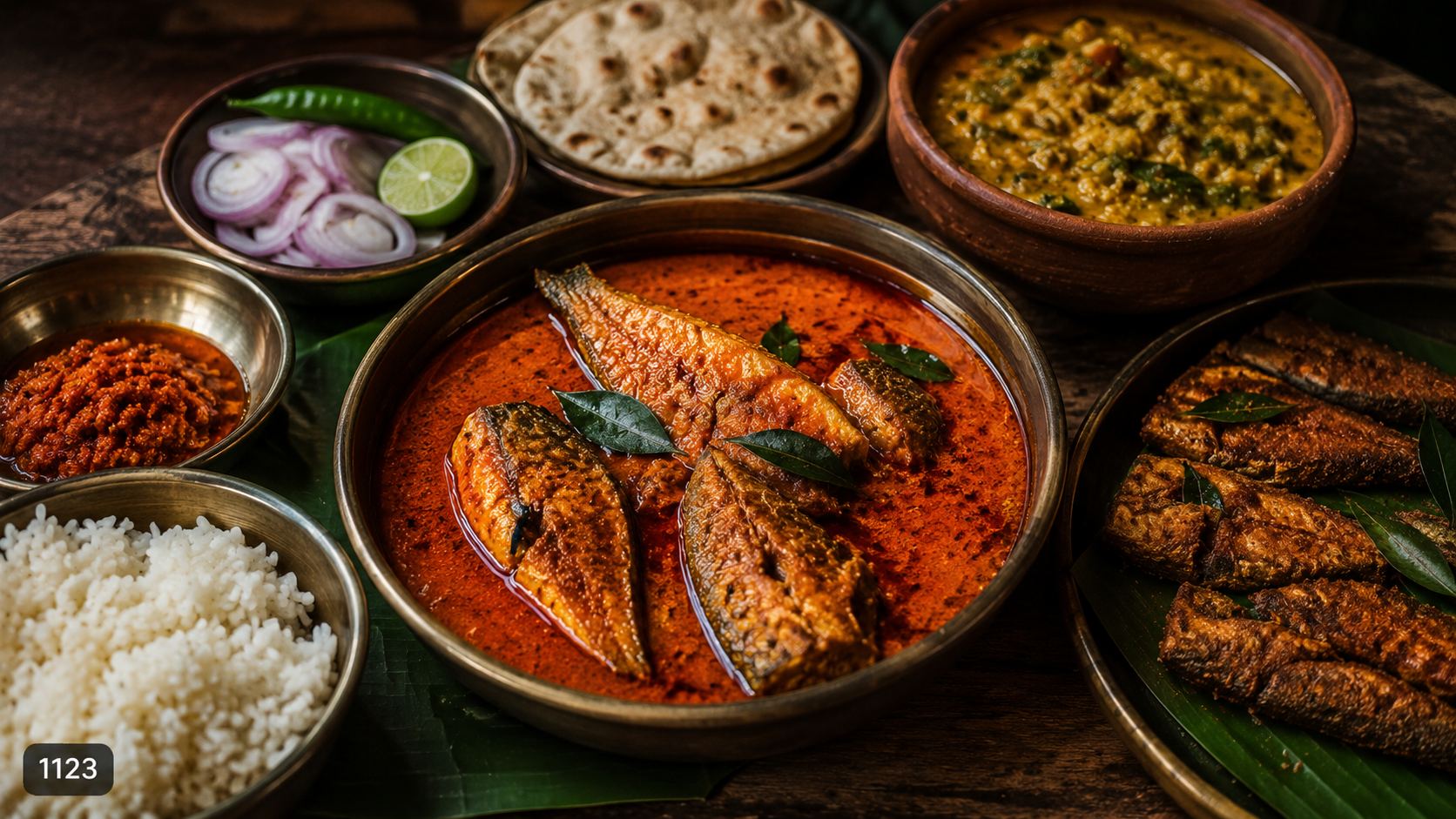
The coastal strip between Sindhudurg and Ratnagiri districts — the Malvan coast — produces Maharashtra's most intensely flavoured seafood tradition. Coconut milk, Malvani masala, kokum, and the specific fish of the Arabian Sea combine in a cuisine that out-spices its Goan neighbour to the south.
⏱ 13 min read🗓 Updated June 2026★ Sub-Regional Guide
Sub-regional identity
Malvani — The Konkan Coast's Boldest Kitchen
The coastal strip between Sindhudurg and Ratnagiri districts — the Malvan coast — produces Maharashtra's most intensely flavoured seafood tradition. Coconut milk, Malvani masala, kokum, and the specific fish of the Arabian Sea combine in a cuisine that out-spices its Goan neighbour to the south.
Sindhudurg and Ratnagiri districts — the southern Konkan coast of Maharashtra
Defining feature
Malvani masala — a specific spice blend distinct from both Kolhapuri kala masala and Goan spicing
Primary souring agent
Kokum (Garcinia indica) — the defining Konkan souring agent
Primary cooking medium
Coconut milk and fresh grated coconut
Prestige fish
Surmai (kingfish) and pomfret — the Arabian Sea fish at the heart of the tradition
Neighbour comparison
More spiced than Goan; less intensely hot than Kolhapuri; distinct from both
Meat tradition
Fish-forward but also goat and chicken in full Malvani masala
Cultural identity
Fishing community and agrarian Konkan — distinct from both Pune's Brahmin culture and Mumbai's cosmopolitan character
🗺
Geography
The place that made this food inevitable
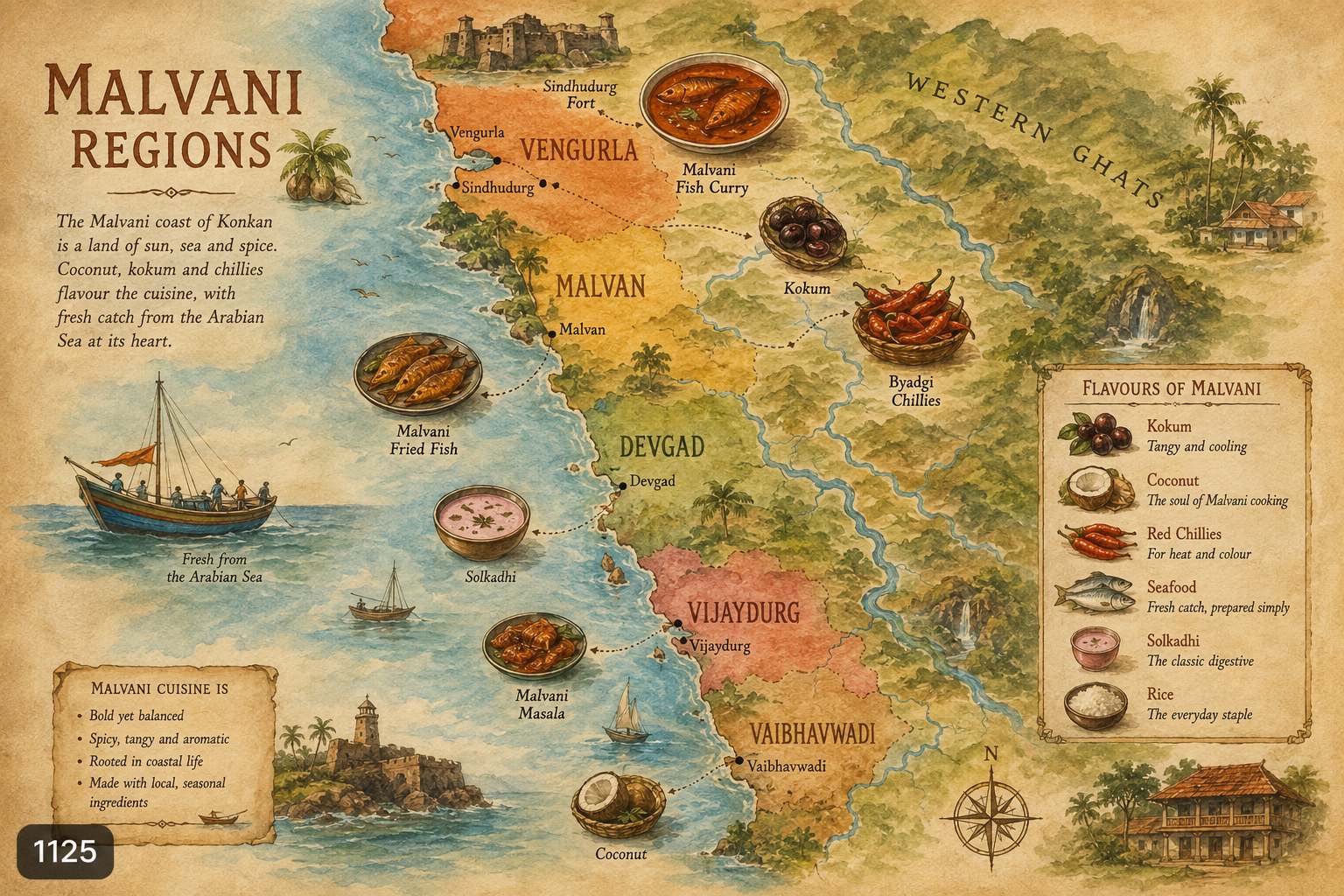
The Malvan coast runs along the southern Konkan strip — Sindhudurg and Ratnagiri districts, where the Western Ghats descend steeply to the Arabian Sea, leaving a narrow coastal belt of fishing villages, mango orchards, and cashew cultivation. The geography produces both the ingredients and the philosophy: fresh fish from the Arabian Sea, fresh coconut from the coastal belt, kokum from the Garcinia indica trees of the Ghats foothills, and the specific dried red chilli variety grown in Sindhudurg that gives Malvani masala its heat profile.
The Malvan coast sits south of Ratnagiri (home of the Alphonso mango) and north of Goa — a position that makes it adjacent to two cuisines of national fame but distinct from both. Goan cooking has a Portuguese-influenced coconut-vinegar base with a specific historical character. Ratnagiri's fish preparations emphasise the mango and Alphonso culture. Malvani cooking sits between them: more intensely spiced than Goa, using kokum rather than the vinegar that characterises Goan-Portuguese preparations, and without the Ratnagiri mango influence.
The Western Ghats backdrop is also significant. The steep hills that rise immediately behind the Malvan coast create a distinct microclimate — very high monsoon rainfall on the western slopes, producing the lush vegetation that supports kokum trees, specific spice plants, and the conditions in which the specific dried red chilli of Sindhudurg grows. The Malvani cuisine is a coastal preparation that draws equally from the sea and from the hill ecology immediately behind it.
Location and regional context of Malvani within its parent state.
📜
Historical Origins
How this cuisine became distinct from its parent
The Malvani masala is the cuisine's defining creation and the product of a specific community's accumulated knowledge. The fishing communities of Sindhudurg and Ratnagiri — primarily Agri, Koli, and CKP (Chandraseniya Kayastha Prabhu) communities — developed a spice blend adapted to the specific fish of the Arabian Sea coast and the souring and enriching agents available locally. The Malvani masala uses more dried coconut than the Kolhapuri kala masala and different chilli varieties than either Kolhapur or Goa; it is neither a variation of its neighbours' masalas nor a compromise between them, but a distinct creation.
Kokum is the defining Konkan souring agent, and the Malvani tradition uses it more centrally than almost any other coastal cuisine. Kokum (Garcinia indica) grows prolifically in the Western Ghats foothills and produces a deep purple-red fruit with an intense, specific sourness — fruity where tamarind is acidic, gentle where lime is sharp. The dried kokum petals are added directly to curries where they release their colour and sourness slowly, or dissolved in water to produce the characteristic Kokum sharbat (the Konkan summer drink). The specific flavour that kokum provides to Malvani fish curry is its most immediate distinguishing characteristic from the Tamil Nadu tamarind-based fish tradition or the Goan vinegar-based tradition.
The Malvani fish-drying tradition is important alongside fresh fish cooking. The Arabian Sea fishing seasons produce seasonal gluts; the specific fish-drying and pickling techniques of the Malvan coast preserve these gluts for year-round use. Dried Bombay duck (bombil), dried mackerel, and pickled fish preparations are all Malvani pantry staples that appear in preparations throughout the non-peak fishing months — a preservation culture as central to the cuisine as the fresh fish preparations that get more attention.
Malvani Masala vs Goan Masala — Not the Same Thing
The proximity of Malvan to Goa creates an assumption that Malvani cooking is a variation of Goan cooking, or vice versa. The masalas are fundamentally different. Goan cooking has Portuguese influence — vinegar or toddy vinegar as a souring agent in preparations like vindaloo and sorpotel; Goan masalas with specific Portuguese-introduced ingredients. Malvani masala uses kokum (not vinegar), a different dried red chilli variety, and a different coconut ratio. The cultural background is also entirely different: Goan Catholic food tradition vs Malvani Hindu fishing community tradition. The geography is adjacent; the food philosophies are separate.
🧬
Food DNA
The flavour architecture
The Sea Proteins
Surmai (kingfish) — the prestige fish — firm, white, ideal for Malvani masala preparations
Pomfret — the celebration fish — grilled whole or in coconut curry
Bombay duck (bombil) — the coast's most abundant fish — fresh and dried
Dried mackerel — the pantry staple — through the non-fishing season
The Malvani Masala Base
Sindhudurg dried red chilli — the specific local chilli — the heat foundation of Malvani masala
Dried coconut (dark-roasted) — roasted coconut ground into masala — the enriching base
Kokum — Garcinia indica — the Konkan souring agent
Coriander seeds, cumin — the aromatic base
Coconut in Three Forms
Fresh coconut (grated) — in chutneys and light preparations
Coconut milk (first and second extract) — in rich fish and meat curries
Dried coconut (roasted) — ground into Malvani masala
The Coastal Pantry
Cashew (Konkan) — grown along the Malvan coast — raw, roasted, and in specific preparations
Mango (raw and ripe) — sol kadi base and specific seasonal preparations
Dried petals of Garcinia indica — the Konkan souring agent
Intense fruity sourness — different character from tamarind (more acidic) or lime (sharper)
Grows in Western Ghats foothills; available in Maharashtra and Goa; rarely found in North India
Sindhudurg dried red chilli
Specific chilli variety grown in Sindhudurg district
Hot with a specific earthy-fruity character — different from Guntur, Byadgi, or Kashmiri varieties
Grown in Sindhudurg; available in Malvan coast markets; approximated elsewhere by other red chillies
Malvani masala (blended)
The complete Malvani spice blend — coconut, chilli, coriander, cumin, specific whole spices
Hot, coconut-rich, aromatic — distinctly different from Kolhapuri kala masala or Goan masala
Available from Malvan coast vendors; the home-made version differs from commercial approximations
Surmai (kingfish)
Scomberomorus commerson — the Arabian Sea's most prized food fish
Firm white flesh that holds in spiced gravy; rich enough to absorb full Malvani masala
Abundant on the Malvan coast and broadly in Maharashtra; the prestige fish of the entire Konkan
🍽
Signature Dishes
The dishes that cannot exist elsewhere
Dish
What It Is
Why It Matters
Surmai Malvani Curry
Kingfish in full Malvani masala and coconut milk — the defining seafood preparation
The firm white flesh of surmai holds its structure through the bold masala without falling apart. The kokum provides sourness; the masala provides heat and depth; the coconut milk provides richness.
Pomfret Rawa Fry
Pomfret coated in semolina and shallow-fried — the Malvan coast's celebratory fry
The pomfret is marinated in Malvani masala, coated in fine semolina (rawa), and shallow-fried until the coating is crisp and the fish just cooked. The crust provides texture; the masala marination provides depth inside.
Kombdi Wade
Chicken curry with fried wheat-flour bread — the meat equivalent of fish curry preparations
The combination of bold coconut-masala chicken and crisp fried wade (puffed bread) is the Malvani non-seafood standard — what is served at celebrations where not all guests eat fish.
Sol Kadi
Kokum and coconut milk drink-soup — the Konkan digestive served cold
Sol kadi is neither a curry nor a drink but occupies both roles. Kokum is soaked in water until it releases its colour and sourness; coconut milk is mixed in with green chilli, ginger, and coriander. Served chilled as a digestive alongside the main meal.
Bombil (Bombay Duck) Fry
Dried Bombay duck shallow-fried — the coastal pantry preparation
Bombay duck (Harpadon nehereus) is abundant on the Maharashtra coast. The dried version, rehydrated and fried, is one of the most pungent preparations in Indian cooking — acquired taste, fierce identity marker for anyone from the Konkan coast.
The defining preparations of Malvani.
⚙️
Unique Techniques
What this cuisine does that others do not
The Malvani masala preparation is the most time-intensive step in Malvani cooking. Dried coconut is grated and dry-roasted in a heavy vessel until golden-brown (less dark than Kolhapuri kala masala but darker than standard Maharashtra masala). Sindhudurg dried red chilli is roasted separately. Coriander seeds, cumin, black pepper, cloves, cinnamon, and specific whole spices are roasted individually at their respective temperatures before being combined and ground together with the roasted coconut. The order of grinding matters: the coconut and chilli ground first into a coarse paste, then the other spices added and ground to a finer consistency. The complete masala should be cohesive but not uniformly smooth — some texture distinguishes fresh-ground home masala from commercial versions.
The fish curry technique involves a specific sequence of coconut milk addition. First-extract coconut milk (the richest, thickest, with the highest fat content, squeezed from freshly grated coconut before any water is added) is reserved for the final few minutes of cooking. The curry is built with second-extract coconut milk (thinner, extracted after water is added to the squeezed coconut). When the fish is nearly done, the first-extract coconut milk is added and the curry immediately reduced to a simmer — it must not boil vigorously, as high heat breaks the fat-water emulsion in rich coconut milk, producing a grainy rather than creamy result.
Kokum is added in two stages in serious Malvani preparations. Dried kokum petals are added early in cooking to release their colour and sourness slowly through the preparation. A second addition of fresh kokum water (kokum soaked in water) is sometimes added near the end to brighten the sourness. The early-addition kokum gives depth; the late-addition brightens. The two-stage souring technique produces a more complex flavour than a single large kokum addition.
Malvani or Goan — Which Konkan Coastal Cuisine Is More Authentic?
The question is posed constantly by food tourists travelling the Konkan coast and lacks a useful answer. Goa is more internationally known (Portuguese colonial history, foreign tourism) but that recognition is the result of historical accident, not culinary superiority. Malvani cooking is arguably more representative of the pre-colonial Konkan Hindu fishing community tradition — the kokum and coconut masala that existed before Portuguese vinegar influence. Goan Catholic cooking (sorpotel, vindaloo, Goan sausage) is a genuinely distinct hybrid tradition with its own logic and brilliance. They are different cuisines, not better-and-worse versions of the same cuisine.
🔗
Relationship to Parent Cuisine
How Malvani differs from Maharashtra
Element
Maharashtra
Malvani
Primary souring agent
Kokum (Garcinia indica)
Kokum in Malvani; vinegar (toddy or coconut) in Goan Catholic tradition
Portuguese influence
None
None in Malvani; significant in Goan Catholic cooking
Masala type
Malvani masala — specific dried coconut and Sindhudurg chilli
Different in Goan — different chilli varieties, different coconut processing
Spice intensity
Bold — Malvani is more intensely spiced than standard Goan fish curry
Variable in Goa — Goan Catholic curries can be rich without being intensely hot
Location
Sindhudurg and Ratnagiri, Maharashtra
Goa — the Portuguese colonial territory to the south
📅
Timeline
How this cuisine evolved
Ancient period
Fishing community food culture on the Konkan coast
Koli, Agri, and CKP fishing communities establish the Malvan coast food tradition — fish, coconut, kokum, before any outside influence.
Pre-colonial period
Masala tradition codifies
The Malvani masala develops as a distinct spice blend adapted to the specific fish of the Arabian Sea coast. Kokum establishes itself as the primary souring agent.
19th–20th century
Bombay connection
The proximity to Bombay (Mumbai) and the fishing industry connection produces Bombay duck as the coast's most exported preparation. Malvani workers in Bombay maintain the food tradition in the city.
Present
Tourism and restaurant spread
Malvani restaurants in Mumbai introduce the cuisine to national audiences. Surmai curry and pomfret preparations achieve national recognition.
Malvani masala is a spice blend specific to the Sindhudurg and Ratnagiri coast of Maharashtra — dried coconut roasted until golden-brown, Sindhudurg dried red chilli, coriander seeds, cumin, black pepper, and specific whole spices ground together. It is different from Kolhapuri kala masala (less dark) and from Goan masala (different chilli, no vinegar influence).
What is kokum?
Kokum is the dried petals of Garcinia indica — a fruity, intensely sour souring agent used throughout the Konkan coast. It produces a specific sourness different from tamarind (more acidic, less fruity) or lime (sharper, less complex). The defining souring agent of Malvani cooking, it also produces Sol Kadi — the Konkan digestive drink of kokum and coconut milk served cold.