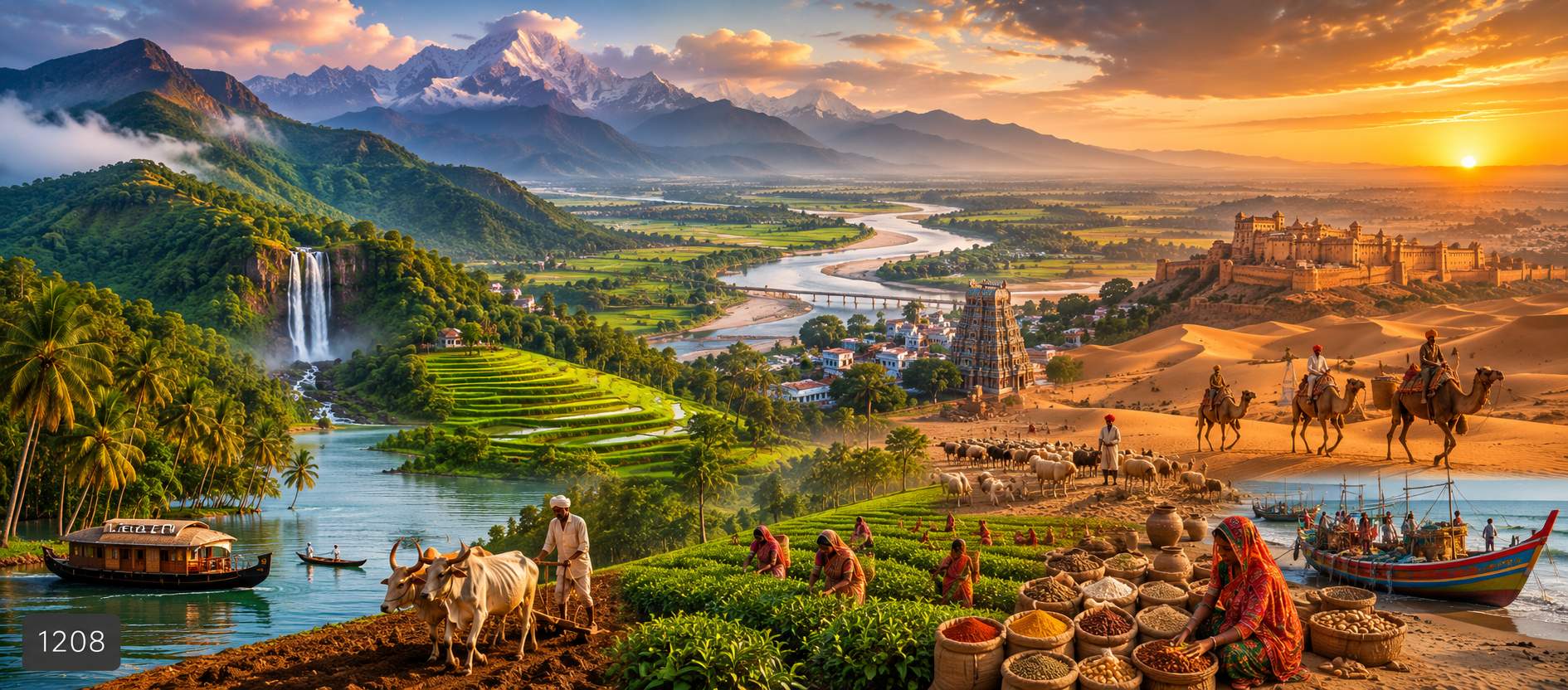
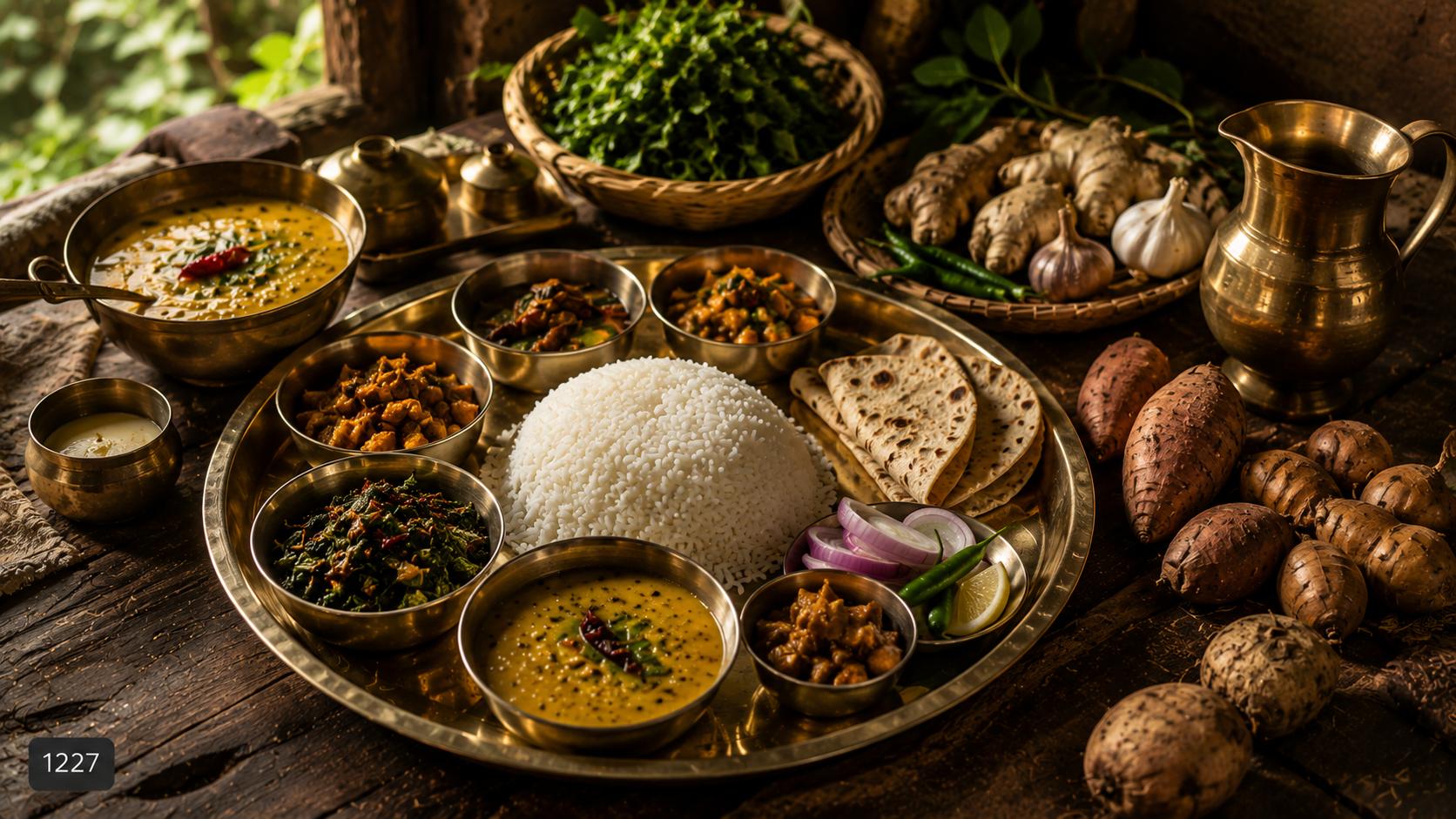
A dosa and a paratha are both Indian food. So are hilsa curry and dal baati. Seven identifiable forces explain why — and once you see them, India's regional food diversity — the geography of Indian food — stops seeming arbitrary and starts seeming inevitable.
⏱ 18 min read
🗓 Updated June 2026
★ Cornerstone Article
Number of Forces
Seven — operating simultaneously
Primary Force
Climate and rainfall
Most Underrated Force
Cooking fat
Most Recent Force
Colonialism — Goa 1510
Most Permanent Force
Geography — unchanged for millennia
Oldest Force
Agriculture — 8,000+ years
The central question
The same country. Completely different food.
A dosa from Chennai, a paratha from Amritsar, a dhokla from Ahmedabad, a mishti doi from Kolkata, a rogan josh from Kashmir, a vindaloo from Goa — six dishes from six cities in the same country, each completely unlike the others in ingredient, technique, flavour profile, and cultural meaning. To a newcomer, this diversity seems chaotic. Why would a single nation produce food this different in every direction?
The answer is that it is not chaotic at all. Each regional cuisine is the predictable output of identifiable forces — geographical, agricultural, religious, historical, economic — that operated over centuries in specific territories. The dosa exists because the Indian Ocean monsoon delivers 2,000mm of rain annually to the Tamil coast, which grows rice in surplus, and because Tamil Nadu's warm humidity makes fermentation reliable. The paratha exists because the Indo-Gangetic plain's moderate rainfall grows winter wheat in abundance, and because cold Punjabi winters require a high-calorie breakfast. The food is a logical consequence of the place.
This page identifies the seven forces that create India's regional food diversity. Understanding them transforms India's food geography from seeming random to seeming inevitable — and makes every state's cuisine make complete sense.
Every regional Indian cuisine can be understood as a unique combination of these seven forces — operating in a specific place, over a specific span of time, on a specific community of people.
How did political control standardise and spread food?
Mughal Empire → court cooking across North India · Nawab's exile → Kolkata biryani created in 1856
Why This Matters
The world's most diverse national food culture — explained
India is home to 29 states with distinct food cultures, multiple sub-regional cuisines within each state, six major religious dietary traditions, and thousands of community-specific food practices. No other country of comparable size has this depth of culinary diversity. The reason is not random — it is the product of India's extraordinary geographical range (from Himalayan alpine to tropical coastal to semi-arid desert), its position at the intersection of ancient trade routes, and the fact that six major religions with distinct dietary philosophies have coexisted on the subcontinent for millennia. India is not diverse despite being one country — it is diverse because of the specific forces that operated within it.
🌧️
Force 1 of 7
Climate — the most fundamental force
1
The Primary Driver
What grows where determines what people eat
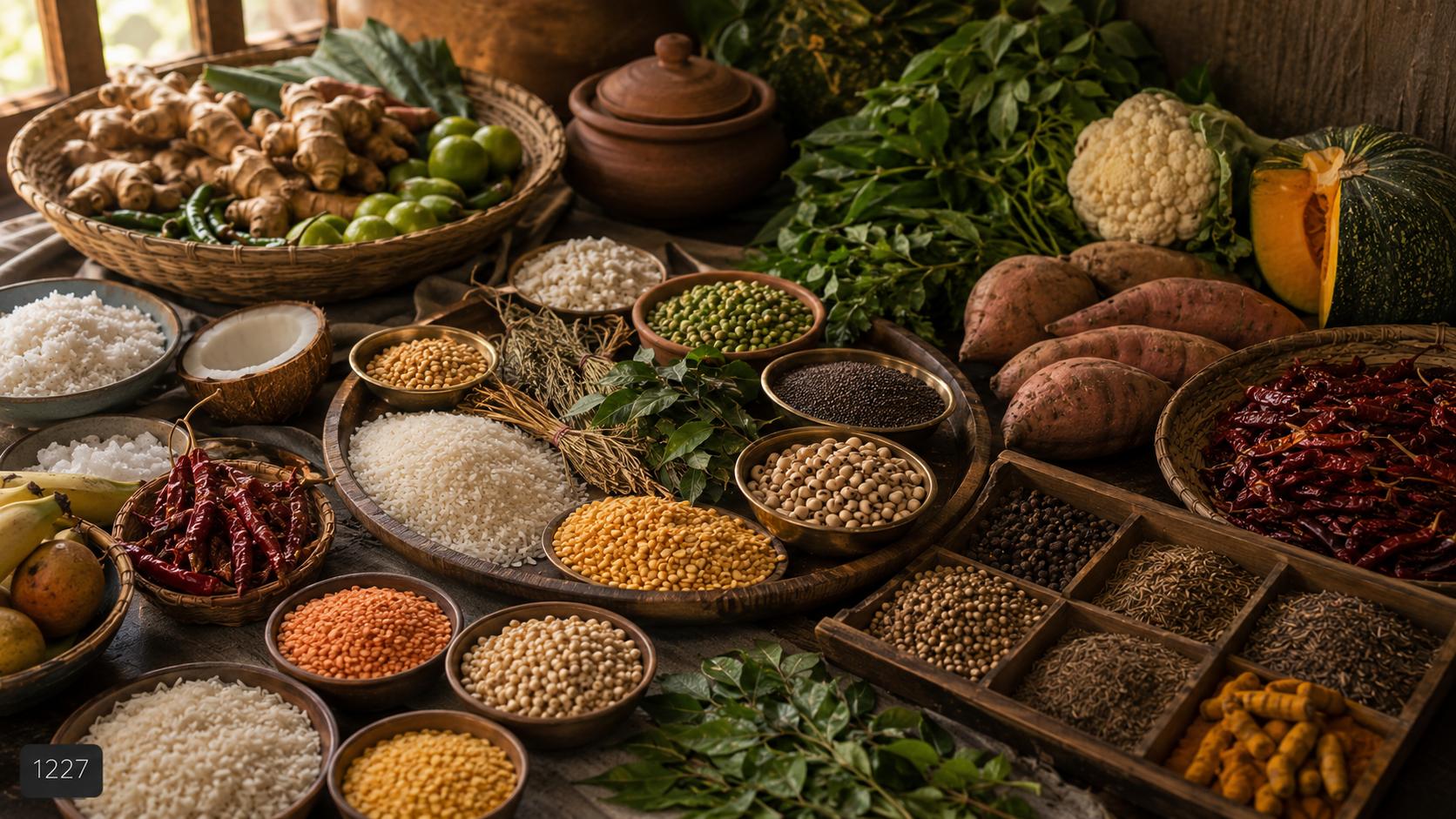
Climate is the foundation beneath every other force. Before trade routes, before religion, before empires — climate determined what could grow, and what could grow determined what people ate. Climate answers the prior question: why does this ingredient exist here at all? Coconut palms grow in Kerala because Kerala's tropical rainfall (2,000mm+) and warm temperatures are exactly what the palm requires. Mustard thrives in Bengal's alluvial delta because Bengal's rainfall and soil conditions produce it in surplus. Black pepper grows in the Western Ghats because the cool, wet highland forests are its natural habitat. Climate does not determine what recipe a cook will make — it determines which ingredients are on the table in the first place. Everything else follows from that.
Kerala → coconut oilBengal → mustard oilRajasthan → gheePunjab → dairy surplusTamil Nadu → tamarind
Climate Zone
States
What It Produces
Food Result
Tropical coastal 1,500–3,000mm+ rain
Kerala, coastal Karnataka, coastal Tamil Nadu, Bengal
Fish-centred cuisine, mustard oil, rice in multiple preparations
Rivers — Climate's Delivery System
The river systems that made regional cuisines possible
Climate determines what can grow; river systems determine where the agricultural surplus actually concentrates. Bengal exists as a fish-and-rice culture because the Ganges-Brahmaputra delta deposits some of the world's most fertile alluvial soil across its floodplain and keeps 2,500km of waterways permanently stocked with freshwater fish. Punjab is the breadbasket of India because five rivers (Sutlej, Beas, Ravi, Chenab, Jhelum) irrigate an otherwise moderate-rainfall plain into exceptional wheat productivity. Kerala's backwater network — 900km of interconnected canals and lagoons — created the inland rice-farming and fishing culture that feeds half the state. Kashmir's Jhelum valley produces saffron, apples, and walnuts in a highland climate that would otherwise be agriculturally marginal. Assam's Brahmaputra floodplain sustains the rice-fish culture of the Northeast. In every case, the river is not geography's footnote — it is its mechanism. Climate sets the possibility; rivers deliver it.
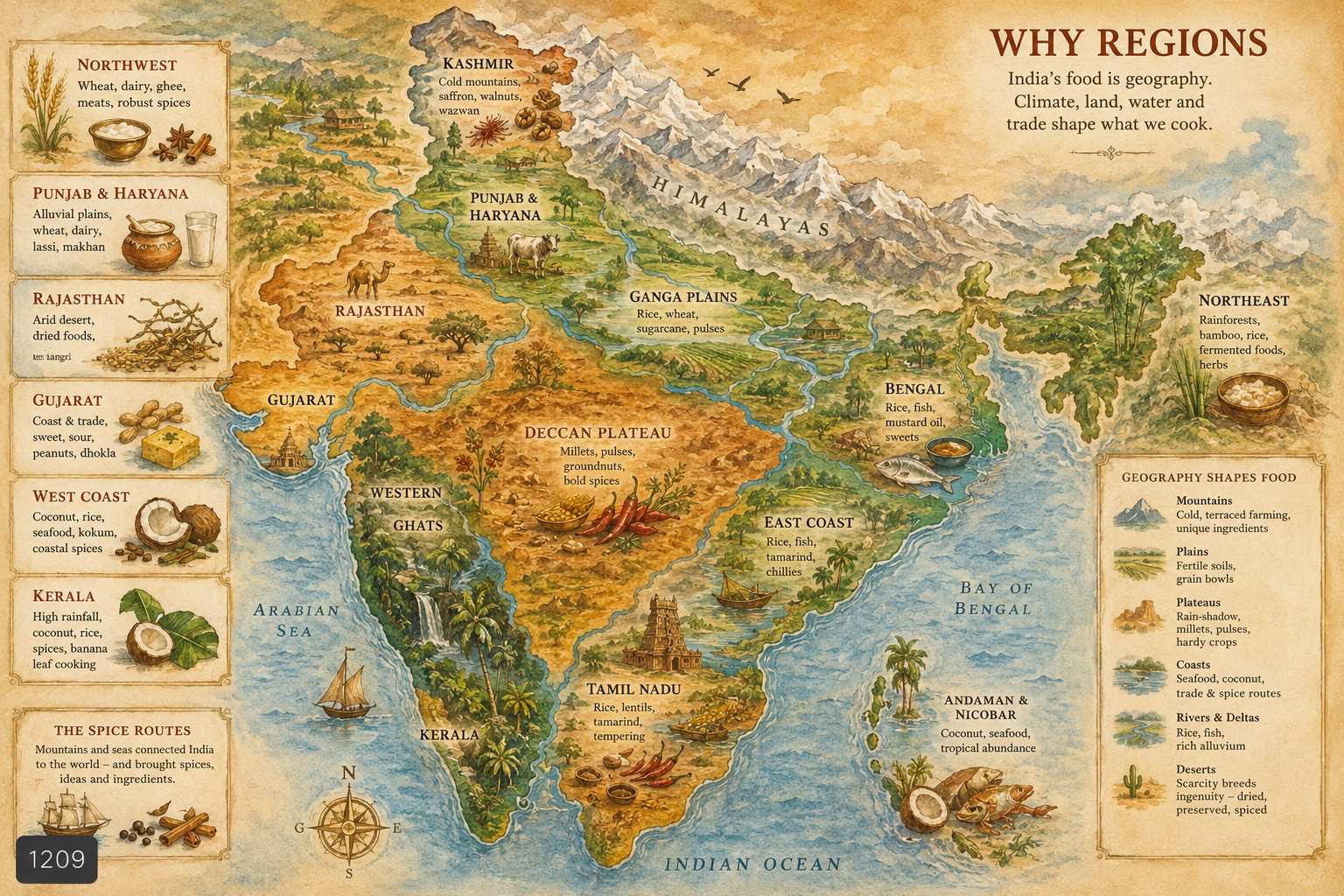
India's five climate zones mapped against their primary food outputs — rice and coconut on the tropical coast, wheat and dairy on the fertile plains, millet and preserved foods in the arid interior. Climate is the invisible hand behind every regional cuisine.
In pre-industrial India, food logistics were local. There were no refrigerated trucks, no national supply chains, no supermarket imports. People ate what grew within a reasonable distance, preserved through methods appropriate to their climate, and cooked using fats available locally. Every traditional Indian regional cuisine is therefore a portrait of its local ecology — encoded in recipes, preserved in festivals, and maintained through cultural tradition long after the original material necessity has passed.
This is why Kerala still uses coconut oil even though groundnut oil is cheaper and available everywhere. The original necessity became cultural identity — and cultural identity is far more durable than the supply chain that produced it.
🌾
Force 2 of 7
Agriculture — the grain that became the culture
2
The Foundation
The staple grain shapes everything around it
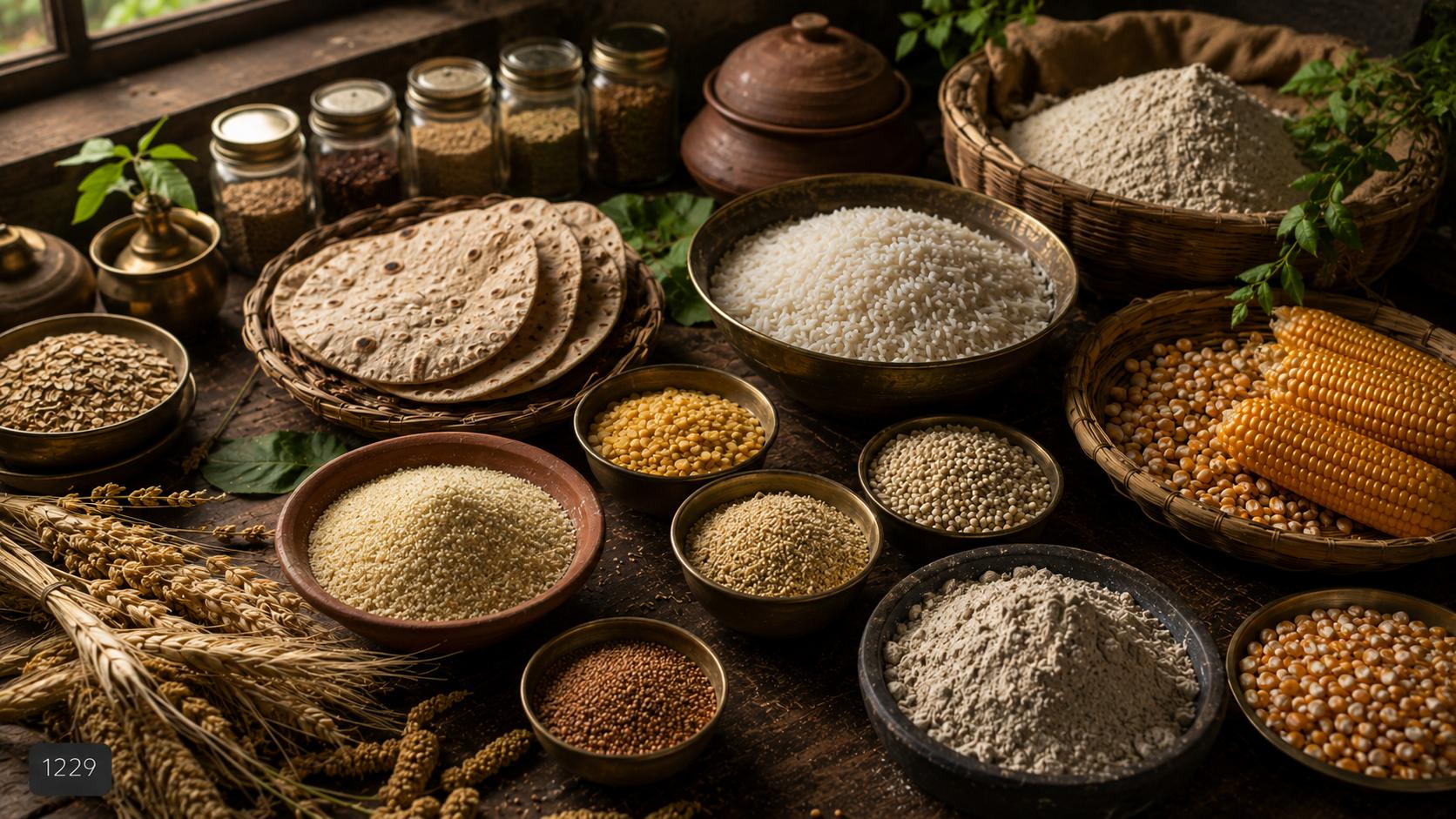
Once a grain becomes dominant, it reshapes everything around it. Agriculture answers the second question: what happens after the crop takes hold? Rice, once established as the staple, demands liquid accompaniments — sambhar, rasam, fish curry — because liquid clings to rice and creates a unified mouthful. Wheat demands thicker accompaniments — dal, sabzi — that bread can scoop. The cooking vessel changes (wide flat tawa vs. deep rice pot). The meal structure changes (portions of bread vs. measured cups of rice). Even the festival foods change — rice cultures make modak, payasam, and pongal; wheat cultures make ladoo, halwa, and pinni. The accompanying cuisine is designed to work with the base grain. Agriculture is the force that organises climate's raw material into a food system.
South India → riceNorth India → wheatRajasthan/Maharashtra → bajra/jowarTamil Nadu → multiple rice varietiesBengal → gobindobhog, atap, siddha
The practical implications run deep. A rice-based culture cooks its primary starch with water until done and serves it with liquid accompaniments — sambhar, rasam, fish curry — because liquid clings to the rice and creates a unified mouthful. A wheat-based culture bakes or fries its primary starch on a dry surface and serves it with thicker accompaniments — dal, sabzi — that the bread can scoop. The accompaniment is designed to work with the grain. Change the grain and you change the entire logic of the meal.
The rice-wheat-millet divide — the single most important food geography line in India. South and east: rice, liquid curries, coconut, tamarind. North and west: wheat, thick dal, dairy, tandoor. The millet belt threads through the semi-arid Deccan and Thar where neither grows reliably.
🕊
Force 3 of 7
Religion — what may be eaten and what must not be
3
The Cultural Shaper
Six religious traditions, six dietary systems
Climate determines what grows; religion determines what may be eaten. In India, where six major religious traditions have coexisted for millennia — each with distinct dietary laws and food-related practices — religion is the second most powerful shaper of regional food diversity. Gujarat is predominantly vegetarian not because of climate but because it has the highest concentration of Jain and Vaishnavite Hindu communities in India. Punjab's food culture of radical generosity is inseparable from the Sikh langar tradition. Bengal eats fish but not meat because of an ancient Hindu philosophical distinction specific to the region. Kerala has beef on mainstream menus because of its large Syrian Christian population.
Jainism → no root vegetablesSikhism → langar hospitalityIslam → halal, no porkBengali Hinduism → fish ≠ meatSyrian Christianity → beef mainstream
Tradition
Core Dietary Rule
Culinary Consequence
Jainism
No meat, fish, egg, or root vegetables (onion, garlic, potato, carrot, radish). No eating after sunset.
India's most sophisticated purely vegetarian cuisine, built entirely on above-ground vegetables and lentils. Strongly present in Gujarat and Rajasthan.
Hinduism (Brahmin vegetarian)
No meat. Beef strictly prohibited. Many communities avoid onion and garlic.
Defines the vegetarian mainstream of India. Wide variation by sect and region — South Indian Brahmin cooking differs enormously from Kashmiri Brahmin cooking.
Created the great meat-cooking traditions — Hyderabadi biryani, Mughal court cuisine, Lucknawi kebab, Moplah coastal cooking. The most globally influential Indian food tradition.
Sikhism
No formal prohibition except Amrit-dhari Sikhs avoid halal/kosher. Langar is mandatory vegetarian.
Langar culture produces the most generous food tradition in India. The Golden Temple feeds 100,000 daily. Food as seva (selfless service) is a Sikh principle that shaped Punjabi food culture broadly.
Christianity (Syrian Christian, Kerala)
No restriction. Beef, pork, duck historically central.
Introduced Kerala's beef and duck roast traditions — dishes that are now part of Kerala's mainstream identity despite originating in a small community.
Buddhism (Ambedkarite, Northeast)
Variable — Theravada more strictly vegetarian; Northeast Buddhist communities often omnivorous.
Northeast India's Buddhist tribal communities have distinct food practices including fermented foods and local foraging traditions entirely outside the Hindu-Muslim-Jain framework.
Before all six of these frameworks: India's 705 officially recognised tribal communities — Gond, Santhal, Bhil, Naga, Khasi, and hundreds more — maintained food systems shaped by forest ecology, shifting cultivation, hunting, and fermentation traditions entirely outside the Hindu-Muslim-Jain-Sikh-Christian-Buddhist framework. These systems predate every religious dietary code on this page and in many cases remain distinct from mainstream Indian food culture. See: India's Tribal Foods.
⛵
Force 4 of 7
Trade and colonialism — the ingredients that arrived from outside
4
The External Shaper
How the world's trade routes ran through India's kitchen
India sat at the intersection of the ancient world's most important trade routes — the Silk Road to the north, the Arabian Sea routes to the west, and the Bay of Bengal routes to the east. Long before Europeans arrived, Indian ports were trading continuously with Arabia, Persia, East Africa, and Southeast Asia — and those contacts left lasting culinary marks on Kerala's Moplah cuisine, Gujarat's merchant cooking, and the spice vocabularies of the entire Malabar coast. What came along those routes — spices, ingredients, techniques, crops — landed unevenly across the subcontinent, producing lasting local food changes. The Portuguese introduction of chilli, potato, and tomato — entering India via Goa from 1510 — was one of the most consequential food events in Indian history. These three New World crops, introduced through Goa, transformed Indian cooking more profoundly than any other external influence — and they did so within 150 years, which in food history terms is almost instantaneous.
Islam and Arab culinary traditions reach South India
Moplah cuisine emerges — Kerala spices combined with Arab rice techniques, meat traditions, and sweets. Thalassery biryani is the direct result.
1526 CE
Mughal Empire established
Persian and Central Asian court cooking enters North India
Dum cooking, kebab traditions, layered biryani, and rich sauces from dried fruit and nuts define Mughal cuisine — which then defined all of North Indian restaurant cooking.
1498 CE — 1510 CE
Portuguese reach Calicut; establish Goa
Chilli, potato, and tomato enter India via Goa
The most consequential food event in Indian history. Within 150 years, chilli replaces black pepper as the primary heat source across the entire subcontinent. Tomato and potato become universal. Indian food is permanently and irreversibly transformed.
18th–20th century
British colonial period
Tea, railways, and Anglo-Indian fusion
The British plantation economy produces Darjeeling and Assam tea — transforming India into a tea-drinking nation. Railways create the dhaba culture of roadside food. Anglo-Indian fusion in Kolkata and Chennai produces unique hybrid cuisines.
The trade routes that reached India's shores — Arab dhows bringing Islam and rice techniques to the Malabar coast, Portuguese ships bringing chilli and potato from the Americas, Silk Road caravans carrying Persian court cooking to the Mughal north, and Bay of Bengal routes connecting Tamil Nadu to Southeast Asia for a thousand years before any European arrived.
The Chilli Paradox
Here is the most disorienting fact in Indian food history: chilli is not Indian. It arrived from the Americas via Portugal less than 525 years ago. Before 1500, India had no chilli. The heat in Indian food came from black pepper, long pepper, and ginger. This means that the 'ancient' Indian food traditions involving chilli — from Chettinad to Andhra to Kolhapuri — are at most 400 years old. The traditions feel ancient because they are now deeply embedded, but they are historically recent. The same applies to potato (no aloo paratha before ~1600), tomato (no tomato-based curry before ~1700), and cashew (no kaju katli before ~1600). Indian food as we know it is partly a New World creation.
🚶
Force 5 of 7
Migration — when people move, their food moves with them
5
The Dispersal Force
Partition, displacement, and the food that travelled
When communities migrate — voluntarily or by force — they carry their food culture with extraordinary fidelity. The 1947 Partition of British India is the most dramatic example in modern Indian history: 12–14 million people displaced, carrying food traditions that transformed their destination cities. Delhi's food culture was permanently transformed by Punjabi cooks who arrived after Partition — the tandoor restaurant, the dhaba, butter chicken, and most of Delhi's street food identity are post-Partition Punjabi contributions. Similarly, East Bengali (Bangal) displacement into West Bengal after Partition created a richer Bengali food culture by merging two distinct traditions. The Marwari merchant diaspora spread Rajasthani vegetarian cooking to every Indian commercial city. Food migrates with people and persists for generations.
Partition 1947 → Punjabi food in DelhiBangal migration → richer Bengali cuisineMarwari traders → vegetarian food in Kolkata/MumbaiGulf migration → Kerala food globallyIT diaspora → South Indian food in USA
🫙
Force 6 of 7 — The Most Underrated
Cooking fat — the invisible differentiator
6
The Most Underrated Force
Same vegetables. Same spices. Different fat. Completely different cuisine.
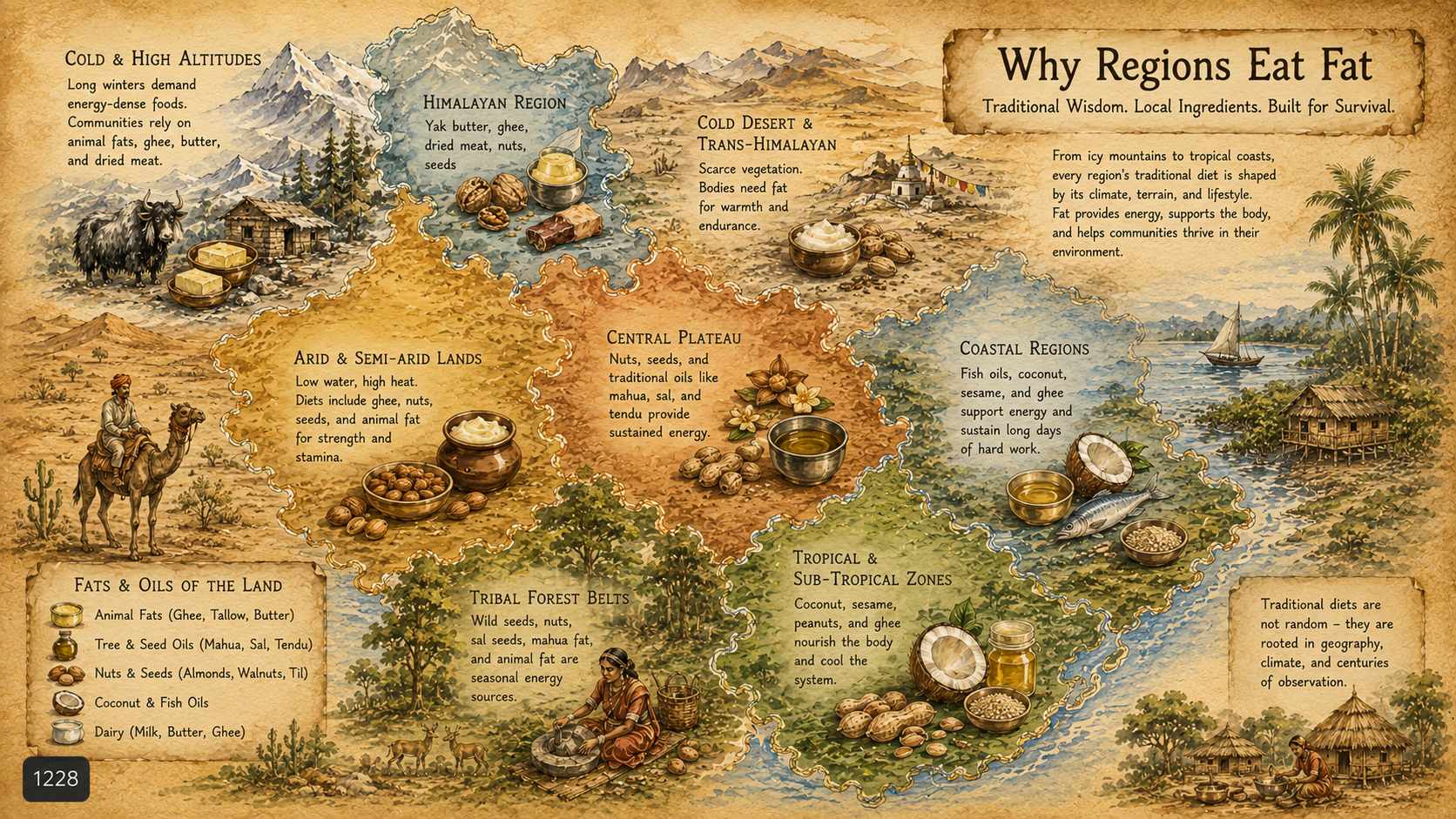
The cooking fat is the single most underappreciated force in regional Indian food diversity. Take a simple preparation — mustard seeds, curry leaves, green chilli, potato. Cook it in coconut oil: Kerala sabzi. Cook it in mustard oil: Bengali aloo. Cook it in groundnut oil: Maharashtrian preparation. Cook it in ghee: Rajasthani dish. The fat is not a neutral medium — it is an active flavour component that transforms everything cooked in it. Mustard oil has a pungent, sharp, almost wasabi-like quality raw, mellowing to a distinctive earthiness when heated. Coconut oil brings subtle sweetness and a tropical character. Ghee brings a toasty, nutty richness. Groundnut oil is relatively neutral but has its own mild character. Regional cuisines built around these fats over centuries taste fundamentally different even when the other ingredients are identical.
Pungent, sharp, earthy when heated. Applied raw to fish before marinating. Defines the flavour of everything it touches — impossible to replicate with another fat.
🥥
Coconut Oil
Kerala · Coastal Karnataka · Coastal Tamil Nadu
Subtly sweet, tropical character. High smoke point. Complements spices without competing. The fat of the monsoon coast.
✨
Ghee
Rajasthan · UP · Bihar · Festival use everywhere
Toasty, nutty, rich. Stable at high heat and in desert temperatures. Used as finishing oil, cooking medium, and as a substitute for water in Rajasthani cooking.
🥜
Groundnut Oil
Gujarat · Maharashtra interior · Andhra
Relatively neutral, slightly nutty. The workhorse fat of the semi-arid interior. High smoke point, stable, affordable in peanut-growing regions.
🧈
Butter
Punjab · Himachal · festival use
Used with extraordinary generosity in Punjabi cooking. The agricultural abundance of India's most productive dairy region expressed directly in cooking.
🌿
Sesame Oil
Tamil Nadu · parts of Karnataka
Nutty, distinctive. Gingelly oil is used for cooking and finishing in Tamil Nadu, particularly in Brahmin households where it is the traditional cooking fat.
The Same Potato — Four Completely Different Dishes
Take one potato. Cut it into identical cubes. Add the same spices: mustard seeds, curry leaves, green chilli, turmeric, salt. Now cook it four times, changing only the fat:
In mustard oil (Bengal): The raw oil carries a sharp, almost wasabi-like pungency. Heated past smoking point and cooled slightly, it mellows into an earthy, characterful base. The potato absorbs this distinctly — slightly bitter at the edges, deep and complex. This is aloo posto country. The fat is not background; it is foreground.
In coconut oil (Kerala): A subtle sweetness enters immediately. The tropical character of the fat rounds every spice note — the mustard seed pops the same way, the curry leaf smells the same, but the overall effect is softer, more tropical, unmistakably coastal. The potato becomes Kerala mezhukkupuratti.
In ghee (Rajasthan): Toasty, nutty, rich. The clarified butter coats the potato with a roundness that no other fat produces. The spices bloom differently in ghee — slightly sweeter, more aromatic. The dish arrives with a richness that explains why Rajasthani cooking is so calorie-dense despite using minimal water.
In sesame oil (Tamil Nadu): Nutty, slightly roasted in character even before heating. The gingelly oil brings a warm background note that makes the turmeric more golden and the curry leaf more fragrant. The same potato in the same spices becomes a distinctly Tamil preparation.
Four fats. Four completely different dishes. The fat is not a neutral cooking medium — it is the primary flavour identity of every regional cuisine. This is why substituting oils in traditional recipes is not a minor adjustment; it is a culinary category error.
The cooking fat map of India — same spices, same vegetables, six different fats, six completely different cuisines. The fat is not a neutral medium; it is the primary flavour signature of every regional tradition.
👑
Force 7 of 7
Empire and power — how political control standardised and spread food
Political power is a food force. When an empire controls a territory, it moves its court cuisine into that territory — through the preferences of rulers, through the supply chains that feed armies, through the administrative centres that concentrate wealthy consumers. The Mughal Empire's Persian-influenced court cooking spread across North India not because people chose it freely but because Mughal courts were the dominant cultural institution in the region for 300 years. The Chola Empire's maritime power spread Tamil food culture across Southeast Asia in the medieval period. The Maratha Empire's campaigns carried Maharashtra's military camp cooking across the Deccan. The British created the tea plantation economy that turned India into a tea-drinking nation — not through persuasion but through commercial and political power. Every empire leaves a food legacy in the territories it controlled.
Mughal Empire → North Indian court cookingChola maritime power → Tamil food in SE AsiaMaratha campaigns → Deccan food spreadBritish Raj → tea culture, railway dhabasNawab of Awadh in exile → Kolkata biryani
The Nawab Who Changed Kolkata's Food
In 1856, the British exiled Nawab Wajid Ali Shah of Awadh (Lucknow) to Kolkata. He brought his entire court — including his kitchen staff and the refined Awadhi cooking tradition. The Kolkata biryani — with its distinctive whole boiled potato — is a direct consequence of this forced political exile. The Nawabi kitchen adapted to Kolkata's ingredients and economics (meat was expensive; potato extended the dish) and produced a biryani entirely unlike any other in India. One political act in 1856 permanently changed the food culture of a city. This is how empire shapes cuisine — not through recipe books but through the movement of people and power.
🗺
Applied to the state pages
Every state page is an expression of these seven forces
Each Atlas state guide shows exactly how these seven forces operated in a specific territory. Read the state pages as case studies in applied food geography:
The Western Ghats + Arabian Sea + two monsoons produce coconut, pepper, cardamom, and fish in abundance. Every element of Kerala's cuisine is directly traceable to its geography.
The five-river system created India's most productive wheat and dairy agricultural system. Every element of Punjabi cooking — bread, butter, lassi, ghee — is an agricultural output.
The highest concentration of Jain and Vaishnavite Hindu communities in India produced a cuisine of extraordinary vegetarian sophistication — entirely shaped by religious dietary philosophy.
Four centuries of Portuguese colonisation introduced vinegar, chilli, pork, and bread — transforming a Konkani Hindu food culture into something unlike any other Indian cuisine.
Every wave of migration — Sultanate, Mughal, Partition — deposited a new food layer. Delhi's street food is an archaeological record of every community that ever arrived and stayed.
Mustard oil is not just a cooking medium in Bengal — it is applied raw, used to marinate, and defines the flavour identity of every dish. Remove the mustard oil and Bengali food ceases to be Bengali.
The Nawabi court at Lucknow produced dum cooking, galouti kebab, and the most refined biryani tradition in India — food created entirely by and for a specific political court culture.
The seven forces mapped across India — climate zones, primary cooking fats, grain divides, and religious food traditions. Each state sits at the intersection of multiple forces operating simultaneously.
The Synthesis — Why "Indian Food" Is Not One Thing
The question "what is Indian food?" has no single answer because India is not one food culture — it is a civilisation that contains dozens of food cultures, each produced by a specific combination of the seven forces described on this page. There is no more a single Indian food than there is a single European food. The difference is that Europe's culinary diversity is distributed across separate nation-states with separate names (French, Italian, Spanish), while India's culinary diversity exists within a single political border. This makes India's food geography appear more homogeneous than it is — until you look at it with the framework above.
The correct question is not "what does Indian food taste like?" but "which force dominated in this particular region, and what did that force produce?" Once you learn to ask that question, every regional Indian cuisine becomes immediately legible.
💡
The educational payoff
What this means — for every cuisine you encounter
The framework is not abstract. It is a practical tool. When you encounter any Indian regional cuisine — in a restaurant, in a home, in a recipe — you now have seven questions to ask: What climate produced these ingredients? What grain dominates and how does it organise the meal? What religious community shaped these prohibitions and permissions? What trade contact introduced these ingredients from outside? Who migrated here and left their food behind? What fat is this cooked in, and what does that fat do to the flavour? What political power once controlled this territory and what did it impose?
Ask those seven questions about any dish and the answer will make sense. The geography of Indian food is not chaotic — it is completely legible once you have the framework. A Hyderabadi biryani becomes an equation: Deccan climate + rice agriculture + Mughal court cooking + Nawabi political power + Telugu cultural exchange. A Kerala fish curry becomes: tropical monsoon climate + Malabar backwater geography + Arab trade contact + coconut oil fat system + Hindu-Christian-Muslim community food traditions. Every dish is a combination. Every combination is explainable.
"Climate explains the coconut. Agriculture explains the rice. Religion explains the vegetarianism. Trade explains the chilli. Migration explains the tandoor. Fat explains the flavour. Power explains the spread. Together, they explain India."
Explore Each Force in Depth
Every force on this page has its own dedicated Atlas article
What are the main reasons Indian food varies so much by region?
Seven forces create regional food diversity: climate and geography (what grows where), agricultural staples (the base grain), religion and community (what is permitted and what is sacred), trade routes and colonialism (what arrived from outside), migration and partition (who brought their food when they moved), cooking fat (mustard oil, coconut oil, ghee, groundnut oil — each transforms everything cooked in it), and empire & political power (how Mughal courts, Chola maritime expansion, and British colonial trade standardised and spread food across territories). No single force explains regional variation — all seven operate simultaneously.
Why does South Indian food use so much rice while North Indian food uses wheat?
Climate determines the staple grain. Rice requires high rainfall and warm temperatures — the coastal regions and river deltas of South India receive 1,000–3,000mm of annual rainfall. The Indo-Gangetic plain (Punjab, Haryana, UP) has moderate rainfall and cooler winters ideal for wheat. These agricultural realities, established over 8,000 years of cultivation, became the dietary foundation that everything else was built on.
Why is Gujarat predominantly vegetarian while Bengal and Kerala are not?
Religion and community shape dietary practice. Gujarat has the highest concentration of Jain and Vaishnavite Hindu communities in India — Jain philosophy prohibits harming any living being. Bengal's Hindu community has a long tradition of fish eating — fish is considered a 'fruit of the water,' conceptually distinct from meat. Kerala's mixed Hindu-Christian-Muslim population means beef, pork, seafood, and vegetarian cooking all coexist in the same small state.
How did the Portuguese change Indian food?
The Portuguese reached India's west coast in 1498 and established Goa as their principal colony in 1510, introducing chilli, potato, tomato, cashew, vinegar, and pav bread — all from the Americas. Chilli spread from Goa across India over 150 years, largely replacing black pepper as the primary heat source. Tomato provided a new souring agent. Potato became universal. These ingredients are now so central to Indian cooking that most people don't realise they arrived less than 500 years ago.
Why does the same dish taste different across Indian states?
Three forces simultaneously: different regional spice profiles produce different base flavours; different cooking fats (mustard oil in Bengal, coconut oil in Kerala, groundnut oil in Gujarat, ghee in Rajasthan) each contribute completely distinct character to everything cooked in them; and different locally available ingredients mean the raw materials themselves differ. Different fat + different spice + different local ingredient = different dish, even with the same name.
Why is Indian food so different from state to state?
Because each state sits at a different intersection of the seven forces: different climate, different staple crop, different dominant religion, different trade history, different migration patterns, different cooking fat tradition, and different political history. The combination of forces is unique in every territory — which is why a Gujarati thali and a Bengali fish curry can both be authentically Indian while tasting nothing alike.
What is the single biggest influence on Indian regional cuisine?
Climate and geography — because they operate before everything else. Climate determines what can grow, which determines what people eat, which determines every downstream choice about spices, fats, preservation methods, and cooking techniques. Religion is the second most powerful force, because it determines what may be eaten from everything the climate produces. But climate is prior to all other forces.
Is Indian food naturally vegetarian?
No — the majority of Indians eat meat. The perception of Indian food as predominantly vegetarian comes from two sources: the global dominance of Punjabi and Gujarati restaurant culture (both communities have strong vegetarian traditions), and the historical influence of Jain and Brahmin vegetarian philosophy on Indian food writing. In reality, most coastal and eastern Indian cuisines are heavily non-vegetarian — Kerala's beef and fish traditions, Bengal's fish culture, Goa's pork vindaloo, and the great meat-cooking traditions of Mughal and Hyderabadi cuisine all represent mainstream Indian food practice.
Why do different Indian states use different cooking oils?
Because each fat comes from a crop that grows in that region's specific climate. Bengal grows mustard in its alluvial delta — mustard oil became the cooking fat. Kerala has 80 million coconut palms in its tropical climate — coconut oil dominates. Rajasthan's desert climate produces dairy animals — ghee is the stable fat that survives desert heat. Gujarat and Maharashtra grow groundnuts in semi-arid soil — groundnut oil is the workhorse fat. The fat is not a cultural choice; it is an agricultural consequence that became a cultural identity.