Udupi — The Brahmin Vegetarian Kitchen That Fed a Nation
A small coastal town in Karnataka whose temple cooking tradition produced the Udupi restaurant — a format that spread to every Indian city and to every continent where Indians migrated. Masala dosa, sambar, rasam, and coconut chutney as the world knows them all come from this tradition.
⏱ 14 min read🗓 Updated June 2026★ Sub-Regional Guide
Sub-regional identity
Udupi — The Brahmin Vegetarian Kitchen That Fed a Nation
A small coastal town in Karnataka whose temple cooking tradition produced the Udupi restaurant — a format that spread to every Indian city and to every continent where Indians migrated. Masala dosa, sambar, rasam, and coconut chutney as the world knows them all come from this tradition.
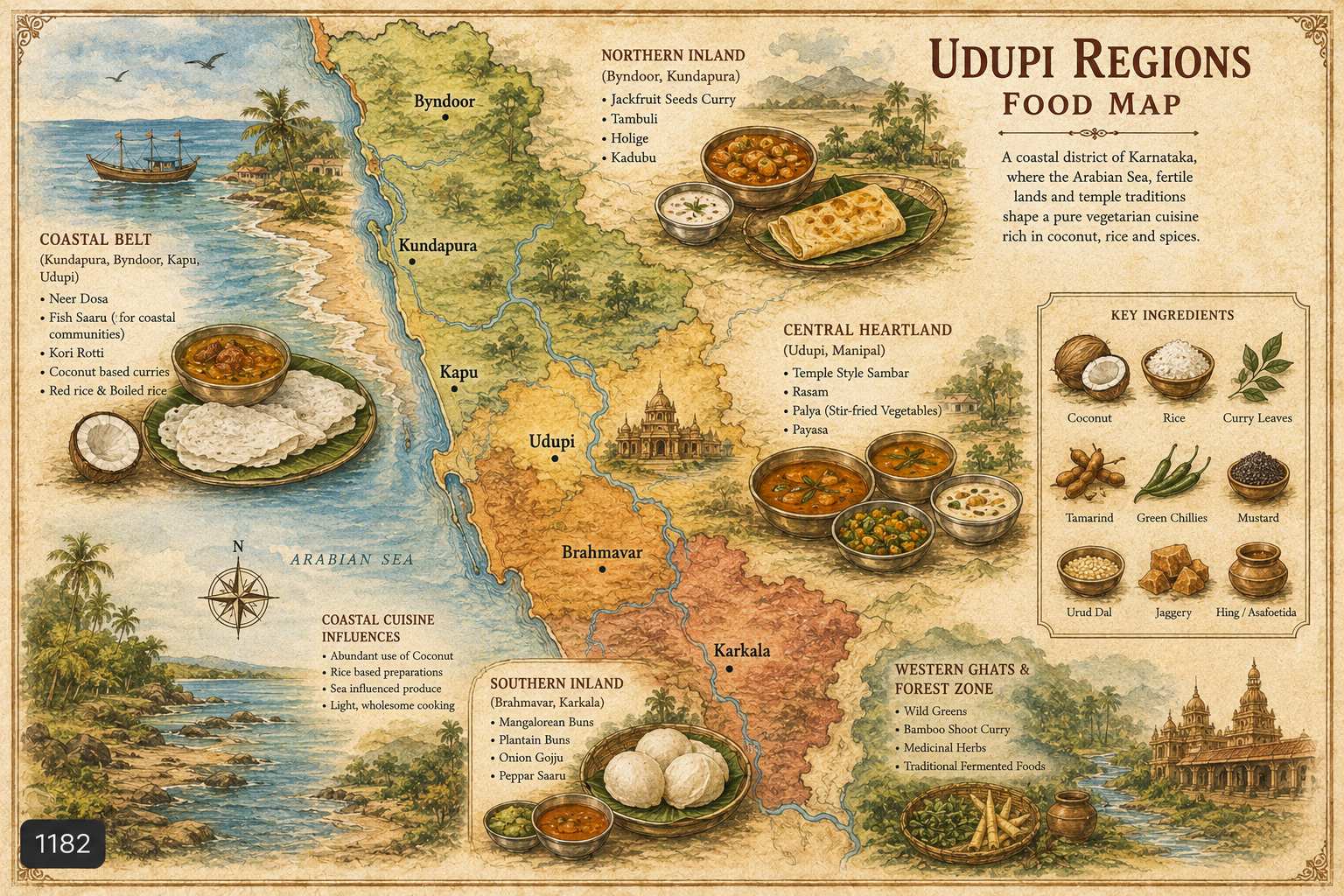
Udupi district, coastal Karnataka — on the Arabian Sea, south of Mangalore
Temple
Sri Krishna Math — 13th-century Vaishnava temple; the source of the food tradition
Community
Madhwa Brahmin — strictly vegetarian, specific ritual restrictions
Dietary restriction
No onion, no garlic — the Udupi tradition that spread nationally
Format spread
The Udupi restaurant format spread from Bombay in the 1940s to every Indian city
Global reach
Udupi-format restaurants exist in every country with significant Indian diaspora
Defining preparations
Masala dosa, idli, sambhar, rasam, coconut chutney — the 'South Indian standard' globally
Why it matters
The world's idea of South Indian food is almost entirely the Udupi tradition
🗺
Geography
The place that made this food inevitable
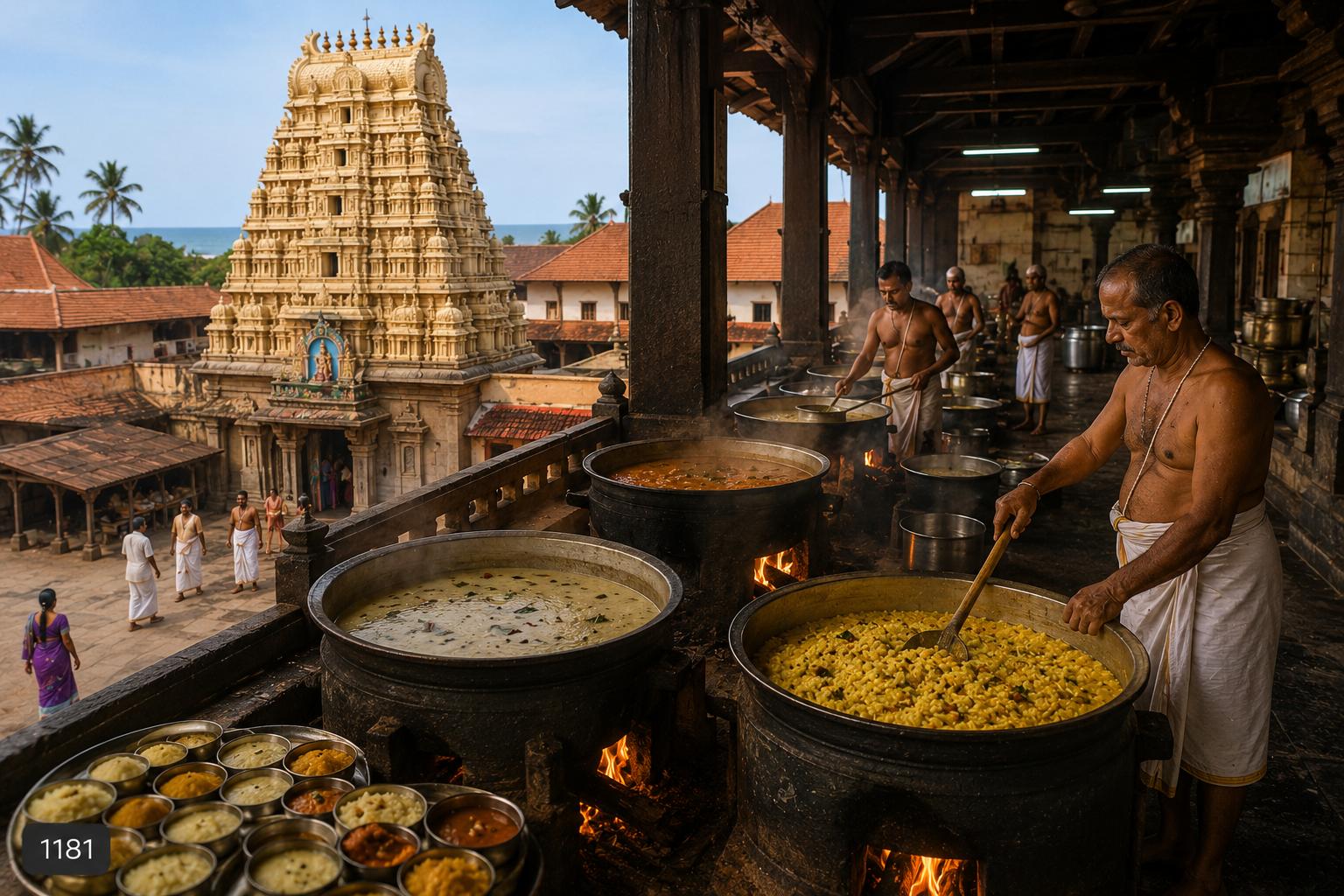
Udupi is a small coastal town in Karnataka — famous for the Sri Krishna Math, a 13th-century Vaishnava temple founded by the philosopher-saint Madhwacharya. The town's significance in Indian food history is entirely disproportionate to its size: the Udupi Brahmin kitchen tradition, developed over centuries to feed pilgrims and temple servants without onion or garlic, became the template for what the world calls South Indian food. Every masala dosa eaten in a restaurant in London, New York, or Sydney is a descendant of the Udupi temple kitchen.
The coastal Karnataka setting provides the specific ingredients: coconut in abundance (fresh, milk, and dried), tamarind from the coastal laterite soil, specific local vegetables (ash gourd, raw banana, drumstick) that appear in the Udupi vegetable repertoire, and the specific rice varieties suited to the fermented dosa and idli batter. The town's position on the Arabian Sea meant that despite being vegetarian (the Madhwa Brahmin tradition is strictly non-non-vegetarian), the coastal produce of the region shaped the spice and souring tradition.
The temple itself is the food source. The Sri Krishna Math feeds thousands of pilgrims daily through the Annadana (free food offering) tradition — and the food served in this context, for centuries, has been the Udupi Brahmin vegetarian kitchen's best expression. What the temple kitchen developed over centuries as a practical solution to feeding large numbers without onion and garlic, without meat, in a systematised and reproducible format, became the Udupi restaurant when the tradition's practitioners migrated to Bombay in the early 20th century.
Location and regional context of Udupi within its parent state.
📜
Historical Origins
How this cuisine became distinct from its parent
The Udupi restaurant format was invented in Bombay in the early 20th century, specifically in the Matunga neighbourhood that became the hub of South Indian migration to Bombay. Udupi Brahmin cooks who came to the city to find work or commerce established small, clean, affordable vegetarian restaurants that served the Udupi temple kitchen's preparations: idli, dosa, sambhar, rasam, and coconut chutney. These restaurants served not just the South Indian migrant community but Bombay's broader vegetarian population — Gujarati, Jain, and others who valued the cleanliness of a kitchen without onion or garlic and without meat.
The Udupi restaurant's commercial genius was its systematic reproducibility. The temple kitchen had already solved the problem of scaling a kitchen to serve thousands daily. The Udupi restaurant applied those solutions commercially: the idli batter could be fermented in large quantities and held; the sambhar could be made in advance and held at temperature; the coconut chutney was freshly ground but the technique was simple enough to standardise. The format spread — first within Bombay, then to every major Indian city, then internationally with the Indian diaspora. By the 1980s, the Udupi restaurant existed in every country where Indians had settled.
The specific Udupi contribution to the masala dosa deserves separate recognition. The masala dosa — a crisp, thin, fermented rice-and-lentil crepe filled with spiced potato — is found in various forms across South India. The Udupi version uses the specific dosa batter of the Madhwa Brahmin tradition (a specific urad dal to rice proportion, a specific fermentation time), a potato masala without onion and garlic (using only mustard seeds, curry leaves, chilli, turmeric, and the potato), and a cooking technique that produces a uniformly thin, crisp dosa rather than a thick or soft one.
Why No Onion No Garlic Conquered the Market
The Udupi Brahmin restriction on onion and garlic (standard in Madhwa and some Vaishnava traditions) seems like a commercial disadvantage — but proved to be a commercial advantage. A restaurant that serves neither onion nor garlic is automatically accessible to Jains, certain Brahmin communities, and anyone observing specific fast days (when onion and garlic are traditionally avoided). The Udupi restaurant in Bombay could serve the Gujarati Jain businessman, the Tamil Brahmin migrant, and the general vegetarian population simultaneously. The dietary restriction that was a religious requirement became a market differentiator that expanded the customer base beyond what onion-and-garlic cooking could reach.
🧬
Food DNA
The flavour architecture
The Core Format
Masala dosa — fermented rice-lentil crepe with potato filling — the global ambassador
Idli — steamed fermented rice-lentil cake — the most digestible bread in India
Sambhar — tamarind and lentil vegetable soup — the curry that accompanies idli and dosa
Rasam — thin pepper-tamarind soup — the digestive served after the main course
Without Onion or Garlic
Asafoetida (hing) — the aromatic substitute — used in every Udupi preparation that needs savoury depth
Curry leaves — fresh or dried — the primary flavouring in tempering
Fresh coconut — in chutney and as a cooking element — the Udupi kitchen's richest ingredient
Specific Udupi Vegetables
Ash gourd — the Udupi kitchen's most characteristic vegetable — in curries, raita, and specific preparations
Raw banana — in dry preparations and curries
Drumstick — in sambhar and specific curries
Temple Sweets
Payasam — rice or lentil pudding — the temple sweet served at festivals
Panakam — jaggery-pepper-cardamom drink — the specific temple offering drink
Kosambari — sprouted lentil salad — the fresh element served at the temple meal
🌿
Signature Ingredients
The ingredients that define this cuisine
Ingredient
What It Is
Flavour Character
Availability
Udupi dosa rice
Specific short-grain rice — different from the long-grain rice preferred in Tamil Nadu for dosa
Creates a crispier dosa with a different texture from Tamil Nadu-style dosa
Available in Karnataka; the specific variety produces different results from standard sona masoori
Urad dal (skinned black lentil)
Vigna mungo — the lentil that provides lift and protein to the fermented dosa and idli batter
Creates aeration on fermentation — the idli's rise and the dosa's crispiness both depend on urad dal
Available everywhere; the Udupi proportion and soaking time is the specific technique
Fresh coconut
The most important Udupi ingredient — used raw in chutney and cooked in curries
Sweet, mild, rich — the primary flavour foundation of the Udupi kitchen
Available on the Karnataka coast; fresh coconut chutney requires grinding fresh coconut within hours
Tamarind (Konkan variety)
The souring agent for sambhar and rasam — the coastal Karnataka tamarind
Complex sour-fruity — different character from the more astringent varieties of Tamil Nadu
Available broadly; the coastal Karnataka tamarind has a specific character important to the Udupi tradition
🍽
Signature Dishes
The dishes that cannot exist elsewhere
Dish
What It Is
Why It Matters
Masala Dosa
Fermented rice-lentil crepe with no-onion-no-garlic potato filling — the world's most famous Indian preparation
The global ambassador of Indian vegetarian food. The Udupi version is specifically thinner and crispier than most interpretations — made with a specific batter proportion and cooked with specific technique.
Idli
Steamed fermented rice-lentil cake — the most digestible bread in India
Requires a specific batter fermentation for 8–12 hours that produces both rise (aeration from fermentation) and a specific mild sourness. The lightest, most digestible bread preparation in India.
Sambhar
Tamarind and toor dal vegetable soup — the Udupi format's defining accompaniment
The Udupi sambhar specifically has a different spice proportion from Tamil Nadu sambhar — the Karnataka version uses less chilli and more coriander, producing a more aromatic, less heat-forward result.
Coconut Chutney
Fresh grated coconut ground with green chilli, ginger, and salt — the simplest Udupi preparation
Must be made within hours of serving — coconut chutney deteriorates quickly. The Udupi tradition of grinding fresh is the reason the chutney in a good Udupi restaurant tastes different from the pre-made versions elsewhere.
Rasam
Thin tamarind-pepper soup — the digestive served after the main course
Rasam's specific thinness and pepper-forward character distinguishes it from sambhar. Served as a digestive to drink, not as a curry to mix into rice.
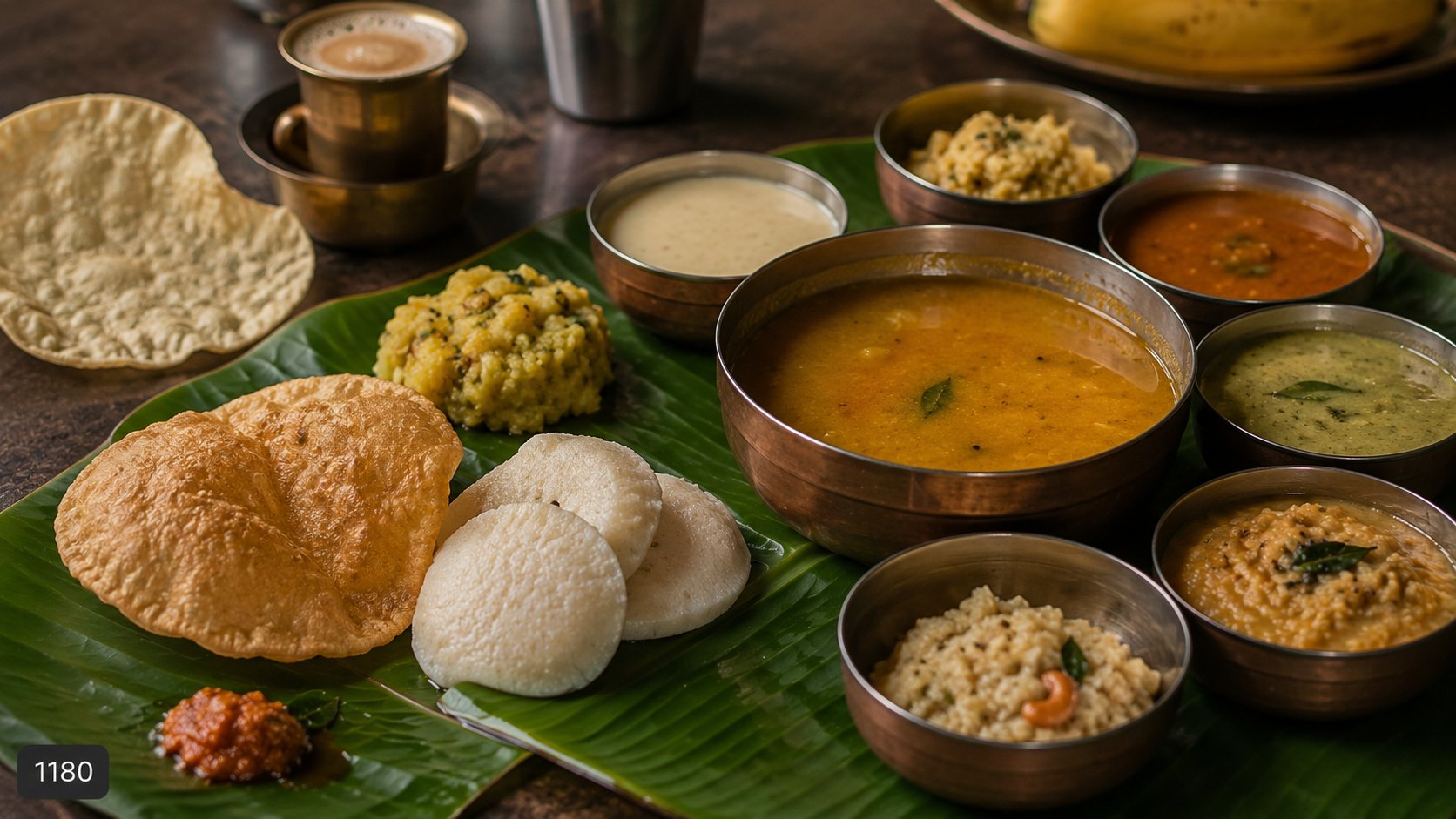
The defining preparations of Udupi.
⚙️
Unique Techniques
What this cuisine does that others do not
The idli-dosa batter technique is the foundational process of the Udupi kitchen. Urad dal and dosa rice are soaked separately for 6–8 hours, then ground separately and combined. The urad dal must be ground to an extremely smooth, aerated consistency — this is where hand-operated stone grinders (wet grinders) produce different results from blenders: the stone grinding creates aeration as it works the dal, producing a batter with thousands of tiny incorporated air pockets. These air pockets are what cause the batter to ferment and rise, and what create the lightness in idli and the crispiness in dosa. The combined batter ferments for 8–12 hours at room temperature (24–28°C is ideal) — the lactic acid fermentation produces the mild sourness and further rises the batter through carbon dioxide production.
The masala dosa cooking technique requires a specific sequence. A ladle of batter is placed at the centre of a very hot, lightly oiled tawa. The back of the ladle is used to spread the batter outward in a rapid spiral motion — the batter must be spread before it sets, which means the entire spreading motion must happen in 3–5 seconds. The thin edge dries and crisps first; a small amount of oil is added around the edge to assist. The centre remains slightly softer. The potato masala is placed in the centre when the dosa is nearly done, and one-third is folded over before serving. The specific thinness and crispiness of a good Udupi masala dosa is not achievable without this specific technique and a very hot tawa.
The sambhar preparation in the Udupi tradition uses a specific Karnataka sambhar masala — different from the Tamil Nadu version in its spice balance (more coriander, slightly less chilli, specific roasted coconut addition) and in the proportion of toor dal to tamarind. The Udupi sambhar is denser in dal and slightly less tamarind-forward than the Tamil Nadu version, producing a more substantial, less sour result. The specific Udupi vegetable additions — ash gourd, drumstick, shallots (in non-strict versions) — also distinguish it from the Tamil Nadu preparations.
Is Udupi Food Authentic South Indian or a Commercial Standardisation?
The Udupi restaurant format spread nationally and internationally through commercial standardisation — which raises the question of whether what the world calls South Indian food is actually Udupi food misrepresented as a broader tradition. The honest answer: the Udupi format is one specific sub-regional tradition (Madhwa Brahmin coastal Karnataka temple cooking) that became the global default through commercial success. It is authentic within its own tradition but not representative of Tamil, Telugu, Kerala, or even most of Karnataka cooking. The masala dosa is Udupi's creation, not South India's response to a brief. South Indian food without the Udupi lens includes fish curries, pork preparations, rice varieties, and spice vocabularies that the international Udupi restaurant menu never shows.
🔗
Relationship to Parent Cuisine
How Udupi differs from Karnataka
Element
Karnataka
Udupi
Onion and garlic
Used throughout Karnataka non-Brahmin cooking
Absent — the Madhwa Brahmin restriction that became the restaurant format's identity
Meat
Present in non-Brahmin Karnataka cooking
Absent — the Udupi format is strictly vegetarian
Regional scope
Diverse Karnataka food — Coorg pork, Mysore preparations, Beary biryani
The Udupi format represents only the Madhwa Brahmin coastal tradition within Karnataka
Udupi format = the world's definition of South Indian food
📅
Timeline
How this cuisine evolved
13th century
Sri Krishna Math founded by Madhwacharya
The Vaishnava temple that produces the food tradition is established. The Udupi Brahmin kitchen begins its development around the temple's cooking requirements.
1940s
Udupi restaurants open in Bombay-Matunga
The Udupi restaurant format is invented in Bombay's Matunga. The commercial application of the temple kitchen format begins its national spread.
1960s–80s
National spread of the Udupi format
Udupi restaurants appear in Delhi, Chennai, Calcutta, Hyderabad. The format standardises South Indian food nationally.
1980s–present
International spread with Indian diaspora
Udupi-format restaurants open wherever Indians settle. The masala dosa becomes the global ambassador of Indian vegetarian food.
Udupi food is the Madhwa Brahmin temple kitchen tradition of coastal Karnataka — strictly vegetarian, without onion or garlic, developed over centuries in the Sri Krishna Math temple. Its commercial format, the Udupi restaurant, spread from Bombay in the 1940s to every Indian city and internationally. What the world calls South Indian food — masala dosa, idli, sambhar, rasam, coconut chutney — is almost entirely the Udupi tradition.
Why is Udupi food without onion and garlic?
The Madhwa Brahmin community follows a Vaishnava dietary tradition that avoids onion and garlic — considered rajasic foods that agitate the mind and interfere with spiritual practice. Asafoetida (hing) provides the savoury aromatic depth instead. The restriction became commercially advantageous when the Udupi restaurant spread to Bombay, where Jain and other vegetarian communities found an accessible format that excluded all common taboo ingredients.