Marwari Cuisine — The Jain Vegetarian Trading Community
The Marwari merchant community from Rajasthan's Shekhawati region built commercial networks across India and the world — carrying the most strictly vegetarian food tradition in India to every city they settled. Their cooking influenced Indian vegetarian restaurant and catering culture nationally.
⏱ 13 min read🗓 Updated June 2026★ Sub-Regional Guide
Sub-regional identity
Marwari Cuisine — The Jain Vegetarian Trading Community
The Marwari merchant community from Rajasthan's Shekhawati region built commercial networks across India and the world — carrying the most strictly vegetarian food tradition in India to every city they settled. Their cooking influenced Indian vegetarian restaurant and catering culture nationally.
Marwari business community — predominantly Jain and Vaishnavite Hindu
Dietary practice
Strict vegetarian — many families Jain (no root vegetables, no eating after sunset)
Commercial presence
Mumbai, Kolkata, Delhi, Chennai, East Africa, and globally — wherever trade took them
Influence
Marwari vegetarian catering and halwai tradition spread nationally through their commercial network
Key constraint
Portability — food needed to survive long trade journeys without refrigeration
Defining sweet tradition
Moong dal halwa, ghewar, churma — the Marwari halwai (specialist sweet-maker) tradition
What makes it unique
Jain philosophy + desert food tradition + diaspora spread = national influence beyond proportional community size
🗺
Geography
The place that made this food inevitable
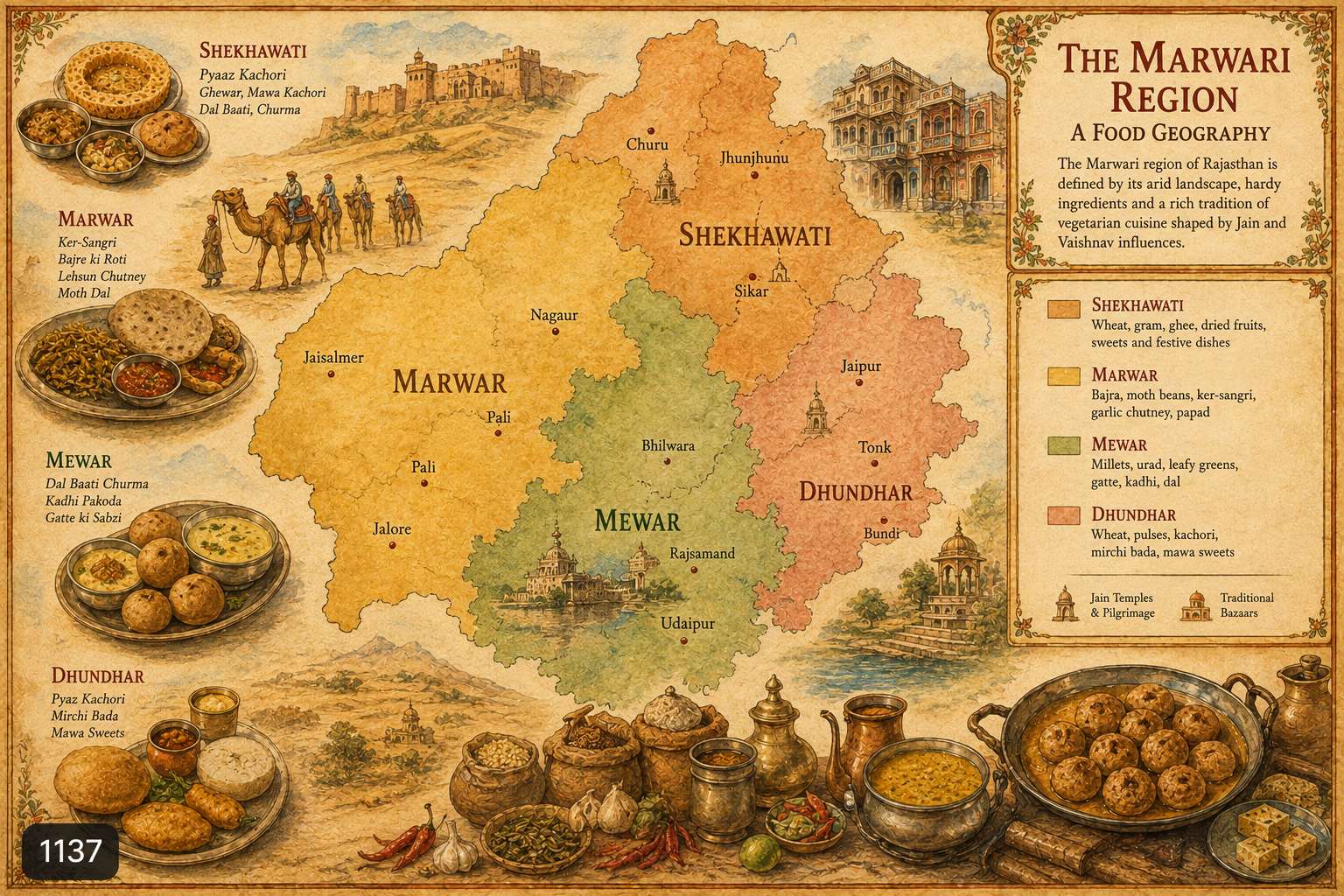
The Marwari community originates from the Marwar region of Rajasthan — specifically the Shekhawati belt of Jhunjhunu, Sikar, and Churu districts, known for its elaborately painted merchant havelis (mansions) that document the commercial wealth accumulated over generations. As traders and bankers, Marwaris expanded across India and internationally during the colonial period, creating business networks that made them one of India's most commercially successful communities. Their food tradition travelled with them — adapted to new cities but essentially unchanged in its Jain philosophical foundation.
The Shekhawati landscape — semi-arid scrubland with limited reliable agriculture — is the geographic origin of the Marwari food tradition. Like the Nattukotai Chettiar of Chettinad, the Marwari community became traders precisely because their land offered limited agricultural returns. Where they differed from the Chettiar is in the Jain philosophical framework that governed their diet: no meat, no fish, no egg, and in the most observant households, no root vegetables (whose harvest kills the entire plant), no eating after sunset, and specific festival fasting traditions that take the dietary constraint to its logical limits.
This combination — Jain philosophy as the dietary framework, desert conditions as the practical constraint, commercial diaspora as the delivery mechanism — produced a food tradition of extraordinary ingenuity within restriction. The Marwari halwai (specialist sweet-maker) community that spread with the commercial network became the sweet-makers of choice for Hindu festivals across North India. The Marwari dry-food tradition (papad, dried lentils, shelf-stable sweets) became the template for Indian provisions that survive long journeys.
Location and regional context of Marwari Cuisine within its parent state.
📜
Historical Origins
How this cuisine became distinct from its parent
The Marwari food tradition is shaped by two simultaneous pressures that are more demanding than either alone. The Jain philosophical tradition of ahimsa (non-violence) extended to the dietary sphere means avoiding not only meat but the root vegetables whose harvest kills the plant — onion, garlic, potato, carrot, radish, beet. In the most observant households, this is not negotiable regardless of what is available in the market. The desert trade environment meanwhile demanded food that survived long journeys without refrigeration, required minimal preparation on arrival, and provided sufficient nutrition to sustain commercial activity in multiple locations simultaneously.
The halwai tradition emerged directly from these pressures. Specialist sweet-makers who worked to order for community occasions — weddings, festivals, commercial celebrations — developed preparations that were technically complex (requiring skilled labour), shelf-stable (surviving transport), highly caloric (required for long-distance merchants), and entirely within the Jain dietary framework. Moong dal halwa requires 2–3 hours of continuous stirring and produces a calorie-dense, nutritionally complete sweet that keeps well. Ghewar is a lattice-fried preparation of specific architectural complexity. Churma is simplest — crushed wheat with ghee and jaggery — but its long shelf life made it the trade-journey staple.
The Marwari diaspora spread these traditions nationally. By the late colonial period, Marwari communities in Mumbai, Calcutta, Delhi, and Chennai maintained their Jain dietary practices in cities where the specific ingredients they needed from Rajasthan were unavailable. This created a supply chain: Rajasthani ingredients (specific lentils, specific dried preparations, specific cooking fats) were transported to diaspora cities, and the Marwari kitchen maintained its identity in cities thousands of kilometres from Shekhawati.
The Asafoetida (Hing) Solution
Observant Jain cooking avoids onion and garlic — the primary aromatic foundations of most Indian cooking. The Marwari solution is asafoetida (hing, Ferula asafoetida) — a resinous gum from the roots of a plant native to Iran and Afghanistan, with a pungent sulphurous character that when cooked in hot oil produces an unmistakably onion-like savoury depth. Hing is not a flavour substitute for onion — it is a different flavour that achieves the same culinary function. Jain and Marwari cooking built on hing as the primary aromatic has a distinct character that is recognisably different from onion-based cooking — and is considered by many Marwari cooks to be more refined.
🧬
Food DNA
The flavour architecture
Without Root Vegetables (observant Jain)
Hing (asafoetida) — replaces onion and garlic — the savoury aromatic depth of Jain cooking
Dried ginger powder (saunth) — warmth without fresh root
Rock salt (sendha namak) — during fasting periods — regular salt prohibited on specific Jain fast days
Desert Shelf-Stable Ingredients
Moth bean (matki) — drought-resistant lentil that stores indefinitely
Papad — sun-dried lentil wafer — the portable Marwari staple
Ghee (clarified butter) — primary cooking fat — stable in desert heat, long shelf life
Ghewar — lattice-fried festival sweet — requires specialist technique
Churma — crushed wheat with ghee and jaggery — the desert journey staple and dal baati churma's sweet component
Marwari Festival Calendar
Paryushana (Jain festival) — most strict fasting period — specific Jain foods, many observant Marwaris eat boiled water and raw vegetables only
Diwali — the sweet-making peak — moong dal halwa, ghewar, and specific Rajasthani mithai
Holi — thandai and specific Rajasthani colour-festival foods
🌿
Signature Ingredients
The ingredients that define this cuisine
Ingredient
What It Is
Flavour Character
Availability
Hing (asafoetida)
Dried resinous gum from Ferula asafoetida — the Jain aromatic solution
Sulphurous when raw; onion-like and savory when cooked in hot fat — the Jain substitute for the onion-garlic aromatic base
Available everywhere; the Marwari kitchen uses higher-quality, higher-quantity hing than mainstream Indian cooking
Moth bean (matki)
Vigna aconitifolia — drought-resistant legume grown in Rajasthan's semi-arid conditions
Earthy, nutty, slightly chewy — a denser, more robust lentil than moong or toor
Grown in Rajasthan and Gujarat; available nationally but most central to Rajasthani and Marwari cooking
Moong dal (split yellow)
Vigna radiata — used specifically in moong dal halwa
Neutral when raw; deeply nutty and rich when slow-roasted in ghee for 2+ hours
Available everywhere; the Marwari halwa tradition transforms a standard lentil into a celebration sweet
Ghee (high quality)
Clarified butter — the primary Marwari cooking fat and finishing agent
Rich, nutty, fragrant — the fat that makes Marwari cooking calorie-dense and shelf-stable
The Marwari tradition specifically uses high-quality ghee in generous quantities; quality is the distinction
🍽
Signature Dishes
The dishes that cannot exist elsewhere
Dish
What It Is
Why It Matters
Dal Baati Churma
The desert trilogy — baked wheat balls, five-lentil dal, and sweet churma
Although shared with all Rajasthan, the Marwari version is strictly Jain-adapted: no root vegetables in the dal, moth bean and specific lentil combinations, hing rather than onion-garlic.
Moong Dal Halwa
Split mung lentil slow-roasted in ghee with sugar — the most labour-intensive Indian sweet
Requires 2–3 hours of continuous stirring while the lentil absorbs ghee and transforms into a golden, fragrant, intensely rich halwa. Often made only by specialist halwai for weddings — the complexity is the signal of celebration.
Gatte ki Sabzi
Chickpea flour (besan) dumplings in yoghurt gravy — no water, no root vegetables
The defining Marwari vegetable preparation. No fresh vegetables required — besan dumplings in yoghurt gravy satisfies the vegetable course while complying with both Jain restrictions and desert ingredient availability.
Ker Sangri
Desert berry (ker) and desert bean (sangri) — sun-dried, cooked with spices
The most distinctly Rajasthani-Marwari ingredient combination — ker (from Capparis decidua) and sangri (from Prosopis cineraria) are Thar Desert plants, dried in the summer sun and cooked as a tangy, spiced vegetable preparation.
Ghewar
Lattice-fried sweet of refined wheat and ghee — the Rajasthani festival sweet
A preparation of specific architectural complexity — a honeycomb-like structure of fried dough assembled in a circular form, soaked in sugar syrup, and garnished with rabri or saffron. Requires the specialist halwai technique.
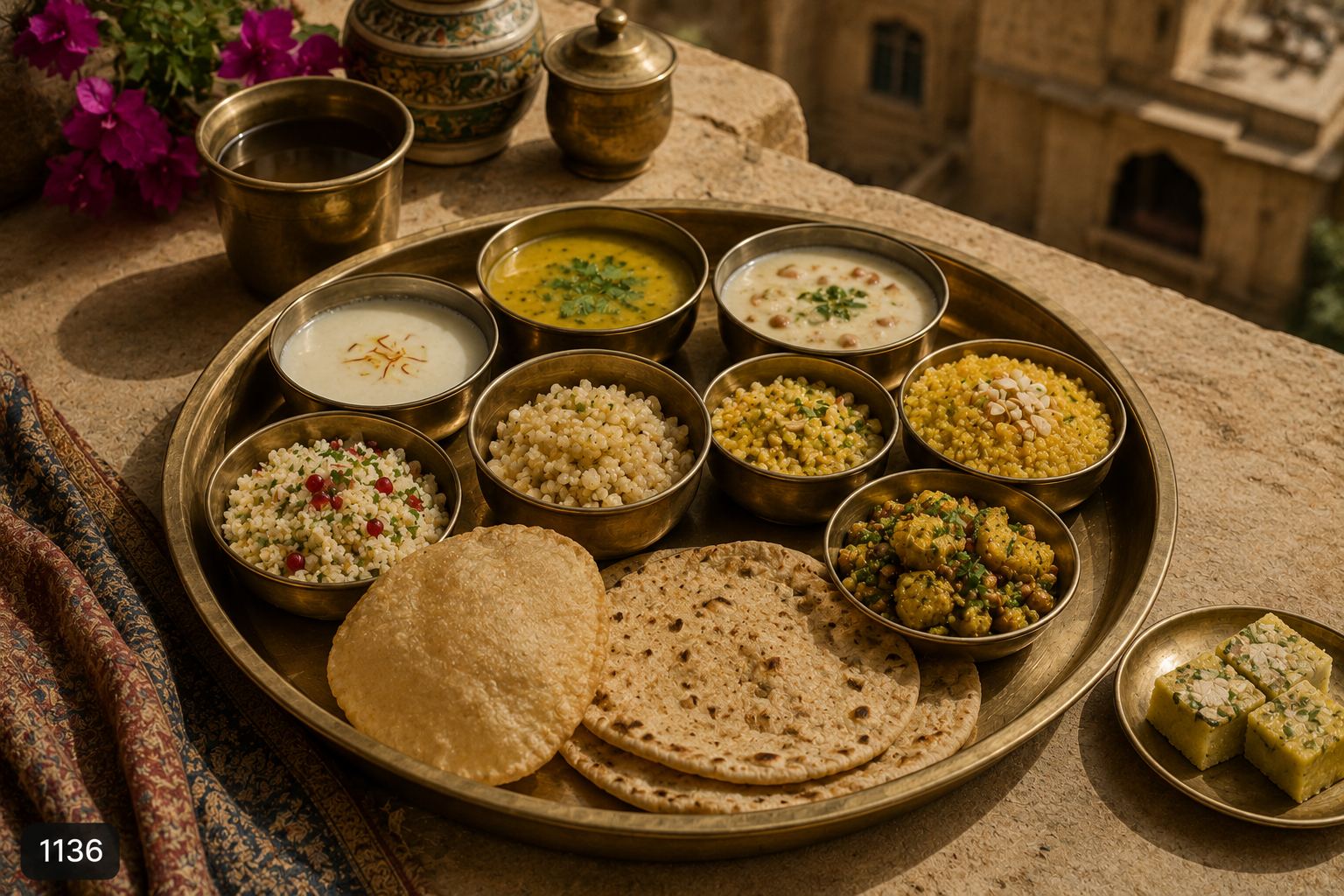
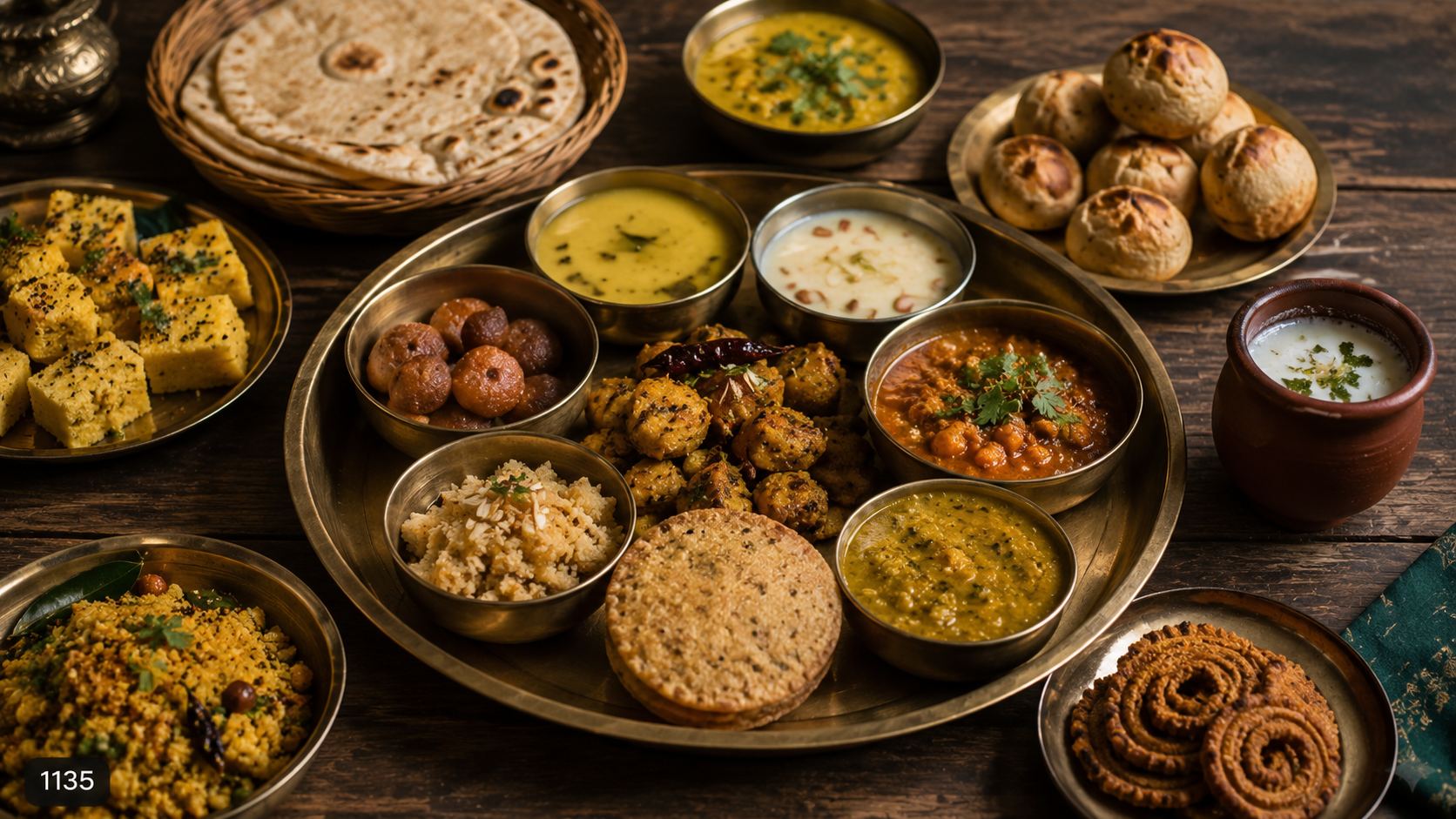
The defining preparations of Marwari Cuisine.
⚙️
Unique Techniques
What this cuisine does that others do not
The Jain dietary constraint drives Marwari cooking's most distinctive techniques. Without onion and garlic as aromatic foundations, the sequence of flavour building is entirely different from mainstream Indian cooking. A Marwari dal begins with hing bloomed in hot ghee — the hing must be added at the right moment (hot but not burning oil) to produce its aromatic transformation. Dried ginger and specific whole spices follow. The savoury depth comes from the hing and from the slow cooking of the lentil itself rather than from onion-garlic caramelisation.
The moong dal halwa technique is the most technically demanding regular Marwari preparation. Raw moong dal is soaked and ground to a coarse paste, then added to a generous quantity of hot ghee in a heavy-bottomed vessel. The cook stirs continuously — and must stir continuously — for 2–3 hours while the dal absorbs the ghee, loses its raw character, and develops a deep golden colour and nutty fragrance from the slow Maillard reaction. The stirring cannot stop: paused stirring produces uneven colour and scorching. The wrist strength required is significant; professional halwai who make large quantities develop specific musculature from the labour.
The portability principle is the third defining Marwari culinary technique. Every major Marwari food preparation can be evaluated against the question: will this survive three days in a hot climate without refrigeration? Churma (crushed wheat, ghee, jaggery) — yes. Papad — indefinitely. Ker sangri (sun-dried desert plants) — months. Ghewar (if dry, not soaked in rabri) — several days. The food tradition is a travel ration elevated to cultural celebration, which is exactly what a diaspora trading community needs.
The National Reach of the Marwari Halwai
The Marwari halwai (specialist sweet-maker) community spread with the Marwari commercial network across India — and became the default sweet-makers for Hindu festivals nationally. A Diwali celebration in Kolkata might feature Marwari-community halwai producing moong dal halwa and ghewar. A wedding in Chennai might commission Marwari sweet specialists. The Marwari halwai tradition achieved a national reach disproportionate to the community's size — because the combination of technical skill, Jain-compliant preparations (accessible to all Hindu communities), and commercial network created a sweet-making tradition that transcended its geographic origin.
🔗
Relationship to Parent Cuisine
How Marwari Cuisine differs from Rajasthan
Element
Rajasthan
Marwari Cuisine
Root vegetables
Used freely across Rajasthani cooking
Avoided in observant Jain Marwari households — hing substitutes for aromatic depth
Onion and garlic
Used throughout Rajasthani non-Jain cooking
Absent in Jain Marwari cooking — the Jain prohibition on underground roots includes both
Marwari halwai tradition spread nationally through the commercial network — the catering influence is disproportionate to community size
📅
Timeline
How this cuisine evolved
16th–18th century
Shekhawati merchants begin pan-India expansion
Marwari traders establish themselves in Calcutta, Bombay, and commercial centres. Their food culture travels — strict Jain vegetarian kitchens maintained in every new city.
19th century
Colonial-era commercial expansion
Marwaris finance British colonial infrastructure. Their kitchens in Bombay and Calcutta influence local vegetarian restaurant culture through the halwai tradition.
Post-Independence
National restaurant and catering influence
Marwari vegetarian catering companies and restaurants operate nationally. The halwai tradition produces the sweet-makers of choice for Hindu festivals across North India.
Present
Globalisation
Marwari communities in the US, UK, East Africa, and Southeast Asia maintain Jain dietary practice internationally — making Marwari food one of the most globally distributed specific Indian food traditions.
What makes Marwari food distinct from other Rajasthani cooking?
Marwari food is the strictly vegetarian — often Jain-adapted — expression of Rajasthani cuisine, shaped by the merchant community's Jain philosophical tradition and the need for portable, shelf-stable food. The halwai sweet-maker tradition spread nationally through the Marwari commercial network. Marwari Jain cooking avoids root vegetables (onion, garlic, potato, carrot) and uses asafoetida (hing) as the primary aromatic instead.
Do Marwaris avoid onion and garlic?
In observant Jain Marwari households, yes — onion, garlic, and all root vegetables are avoided per Jain dietary philosophy. Asafoetida (hing) provides the savoury depth that onion and garlic otherwise supply. Not all Marwaris are Jain — Vaishnavite Hindu Marwaris may use onion while maintaining strict vegetarianism.