Mangalorean — The Port City's Three-Community Table
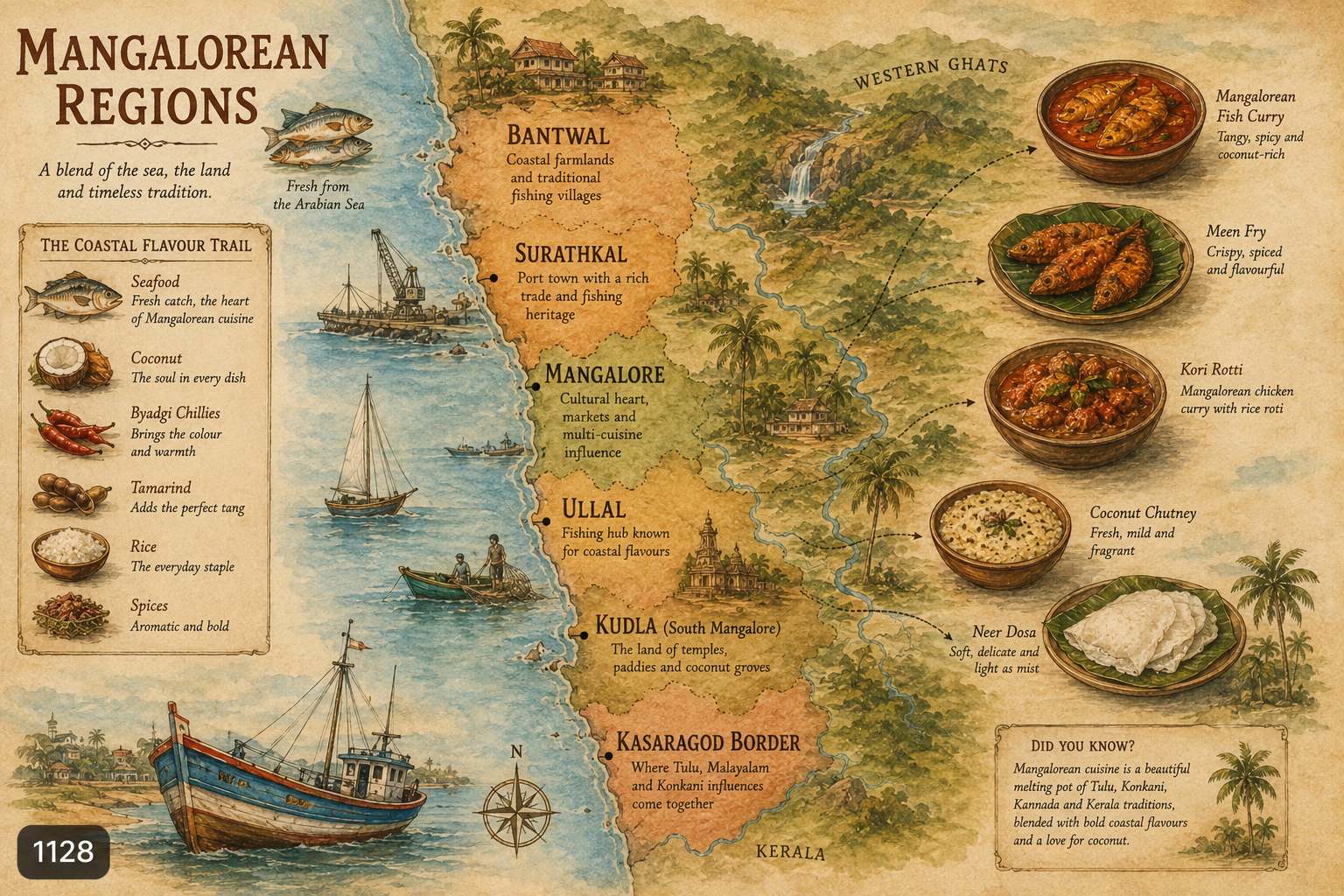
Mangalore sits where the Western Ghats meet the Arabian Sea — a port city with three distinct food traditions (Tulu Hindu, Catholic, and Muslim) that share coconut, kokum, and the Arabian Sea's fish but produce entirely different cuisines from those shared starting points.
⏱ 13 min read🗓 Updated June 2026★ Sub-Regional Guide
Sub-regional identity
Mangalorean — The Port City's Three-Community Table
Mangalore sits where the Western Ghats meet the Arabian Sea — a port city with three distinct food traditions (Tulu Hindu, Catholic, and Muslim) that share coconut, kokum, and the Arabian Sea's fish but produce entirely different cuisines from those shared starting points.
Dakshina Kannada district — where the Western Ghats descend to the Arabian Sea
Three communities
Tulu-speaking Hindu (GSB, Billava); Catholic (Mangalorean Catholic); Muslim (Bearys)
Shared base
Coconut, kokum, Arabian Sea fish — the same three starting points
Result
Three completely different food traditions from the same ingredients
Defining Catholic dishes
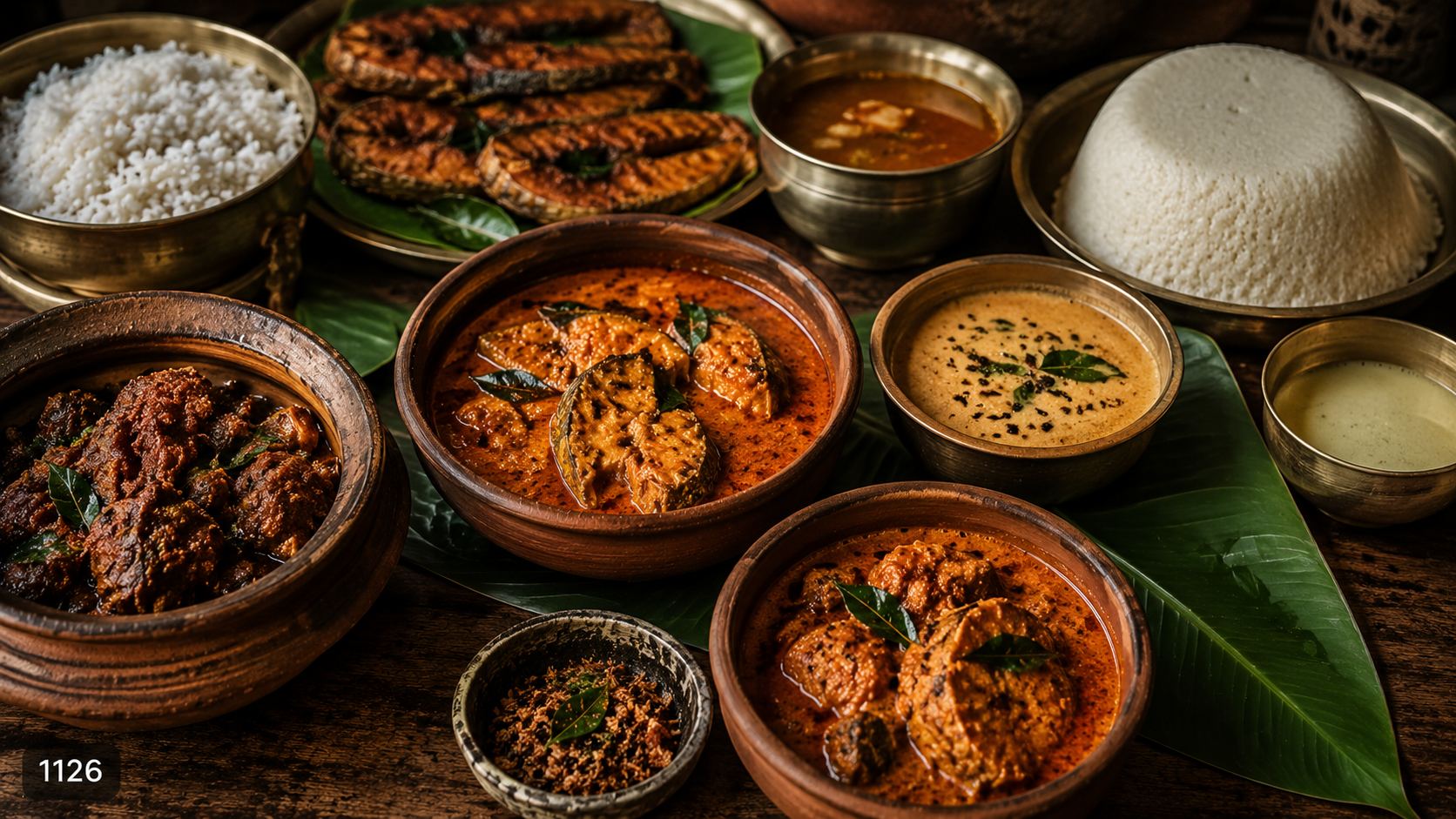
Kori Rotti (chicken and rice wafer), Pork Bafat, Chicken Sukka
Defining Hindu dishes
Goli Baje (fritters), specific GSB preparations, Neer Dosa
Defining Muslim (Beary) dishes
Beary biryani, Naan with prawn masala — distinct from both Hindu and Catholic tradition
What makes it unique
Three-community diversity from a shared coastal ecology — arguably the most community-layered coastal cuisine in India
🗺
Geography
The place that made this food inevitable
Mangalore sits at the junction of two of India's most dramatic geographic forces — the Western Ghats and the Arabian Sea. The Ghats descend to the coast in a series of river valleys (the Netravati, the Gurpur) that break the western escarpment; the sea provides the port that made Mangalore a trading city from at least the medieval period. The resulting geography — hills, rivers, coast, and port — produced a multicultural city where three distinct communities developed food traditions from the same coastal ecological base.
Coconut is the single most defining ingredient of the Mangalore coast — not because it is the same everywhere but because each community adapted it differently. The Hindu Tulu community (including the high-caste GSB, Goud Saraswat Brahmin, and the toddy-tapping Billava community) uses coconut in the grinding pastes and fresh chutneys specific to the GSB tradition. The Mangalorean Catholic community uses coconut milk in the rich gravies of kori (chicken) and bafat (pork). The Beary Muslim community uses coconut in a distinctly different proportion and preparation approach. The ingredient is identical; the results are three entirely distinct food traditions.
Kokum (Garcinia indica) is the second shared souring agent — used by all three communities along this coast, including in the specific way that distinguishes the Konkan souring tradition from the tamarind-dominant south and the lime-and-vinegar north. The Arabian Sea provides the shared protein base — the same fish (surmai, pomfret, crabs, prawns) available to all three communities. What each community makes of these shared resources is the story of Mangalorean food.
Location and regional context of Mangalorean within its parent state.
📜
Historical Origins
How this cuisine became distinct from its parent
The Mangalorean Catholic community has roots in the Portuguese colonial period — specifically in the mass baptisms that the Portuguese conducted on the Konkan and Karnataka coast from the 16th century onwards. The Catholics of Mangalore maintained an identity through the Mysore Wodeyar period and the Tipu Sultan campaigns (during which many were forcibly relocated to Srirangapatna) and developed a specific food tradition that combines pre-Christian Tulu coastal elements with Portuguese-influenced preparations. Pork is central — prepared in bafat masala, a specific spice blend with no exact counterpart elsewhere in India.
The Beary Muslim community (Beary from the Arabic word for trader) are the descendants of Arab traders who settled on the Karnataka coast from the medieval period. They maintain a distinct identity from both the mainstream Karnataka Muslim community and from the Moplah Muslims of adjacent Kerala. Their food tradition — the Beary biryani, the specific Beary prawn preparations — combines the Arabic trader influence (specific spice traditions) with the Tulu coastal base. Their language, Beary Basha, is itself a blend of Arabic, Kannada, and Tulu — the food reflects the same synthesis.
The Hindu Tulu tradition is the oldest and most diverse — encompassing both the strict GSB Brahmin vegetarian tradition (no onion, no garlic on specific days; very refined seafood preparation) and the more robust non-Brahmin Billava and Bunt community cooking. The Neer Dosa — a lacy, delicate rice crepe cooked with just water (no lentil, no fermentation) — is the GSB community's defining preparation, representing extreme refinement and lightness as the vegetarian ideal.
GSB Brahmin Seafood — Strict but Not Vegetarian
The Goud Saraswat Brahmin (GSB) community is one of the few Brahmin communities in India whose traditional food includes fish. The GSBs consider fish a gift of the ocean rather than meat in the dietary-restriction sense, and their fish preparations are extremely refined — delicate curries, minimal spicing, coconut-milk based preparations that let the fish character speak. The GSB tradition produces the most refined fish cooking in the Mangalore tradition — more delicate than the Catholic bafat or the Beary biryani approach — because the Brahmin aesthetic of restraint has been applied to a non-vegetarian protein. The paradox of Brahmin fish cooking is specific to this coastal Saraswat community.
🧬
Food DNA
The flavour architecture
Mangalorean Catholic
Kori rotti — chicken curry with thin crisp rice wafer — the Catholic signature
Pork bafat — pork in bafat masala — the most specifically Mangalorean Catholic preparation
Chicken sukka — dry chicken preparation with coconut and spices
Tulu Hindu (GSB and non-Brahmin)
Neer dosa — lacy rice crepe — water and rice only, no fermentation
GSB fish curry — refined coconut milk fish curry — Brahmin fish preparation
Goli baje — GSB deep-fried fritters — the most popular Mangalorean street snack
Beary Muslim
Beary biryani — distinct from both Hyderabadi and Moplah biryani — the Arabian merchant tradition
Beary prawn masala — specific spice tradition of the Beary community
Naan (Mangalore style) — different from North Indian naan — the Beary bread tradition
Shared Coastal Base
Surmai (kingfish) — the prestige fish shared across all three communities
Crab masala — the coastal celebration preparation
Kokum sharbat — the shared Konkan digestive drink
🌿
Signature Ingredients
The ingredients that define this cuisine
Ingredient
What It Is
Flavour Character
Availability
Bafat masala
Mangalorean Catholic spice blend — coriander, cumin, dried red chilli, black pepper, cinnamon, cloves, turmeric
Aromatic, warm, slightly hot — different from Malvani or Goan masalas
Available from Catholic community vendors in Mangalore; approximated elsewhere
Neer dosa rice
Specific rice variety soaked overnight and ground fine — no fermentation, no lentil addition
The batter must be thin enough to produce a lacy crepe; specific rice starch character
Rice available everywhere; the specific overnight soaking and thin batter is the technique
Kokum (Garcinia indica)
Dried Garcinia petals — the shared Konkan souring agent used by all three communities
Fruity, intensely sour — different from tamarind or lime; releases colour and sourness slowly
Grows in Western Ghats foothills; available in Karnataka and Maharashtra
Coconut (three forms)
Fresh grated, first-extract milk, and dry-roasted — used differently by each community
The same coconut processed differently produces entirely different culinary results across the three traditions
Available everywhere on the coast; the processing technique is the differentiator
🍽
Signature Dishes
The dishes that cannot exist elsewhere
Dish
What It Is
Why It Matters
Kori Rotti
Chicken curry poured over crisp, dry rice wafers — the Mangalorean Catholic icon
The rice wafer (rotti) is thin, large, and completely dry — it softens progressively as it absorbs the curry. Eaten immediately before full softening for the contrasting texture, or left to soak fully for a single unified preparation.
Pork Bafat
Pork in bafat masala — the Mangalorean Catholic preparation with no equivalent elsewhere
Bafat masala is not a Portuguese transplant but a specifically Mangalorean Catholic creation — the coastal Hindu spice tradition adapted for pork-eating post-conversion. The result is uniquely local.
Neer Dosa
Lacy, delicate rice crepe — water and rice only, no fermentation, no lentil
The lightest dosa in India. No sourness from fermentation, no density from lentil, just rice starch and water producing a crepe that tears at the lightest touch. The GSB ideal of restraint applied to a bread.
Goli Baje (Mangalorean Fritters)
Deep-fried slightly sour fritters in a specific GSB tradition
The slightly fermented batter (maida, coconut, green chilli, ginger) produces fritters of specific soft-inside, crisp-outside character. The most popular Mangalorean street snack, now served at restaurants nationally.
Beary Biryani
The Beary Muslim community's biryani — distinct from both Hyderabadi and Moplah styles
Different spice proportion from Hyderabadi (less saffron, different masala foundation) and from Kerala Moplah biryani (different rice variety and technique). The Arabic merchant tradition's biryani as adapted to the Konkan coast.
The defining preparations of Mangalorean.
⚙️
Unique Techniques
What this cuisine does that others do not
The neer dosa technique is the most instructive illustration of the Mangalorean food philosophy of restraint. Soaked rice is ground with just enough water to produce a thin, smooth batter — no lentil for protein or density, no fermentation for sourness or lift, no salt beyond a pinch. A hot cast-iron pan is wiped with coconut oil. A ladleful of batter is poured from the edge inward in a slow circular motion — the thin batter sets almost immediately, producing the characteristic laciness where the batter does not connect. The crepe is steamed briefly under a lid, not flipped. The result should be translucent, delicate, and tear easily. The technique punishes too much batter (too thick, no lace) or too hot a pan (burns before setting).
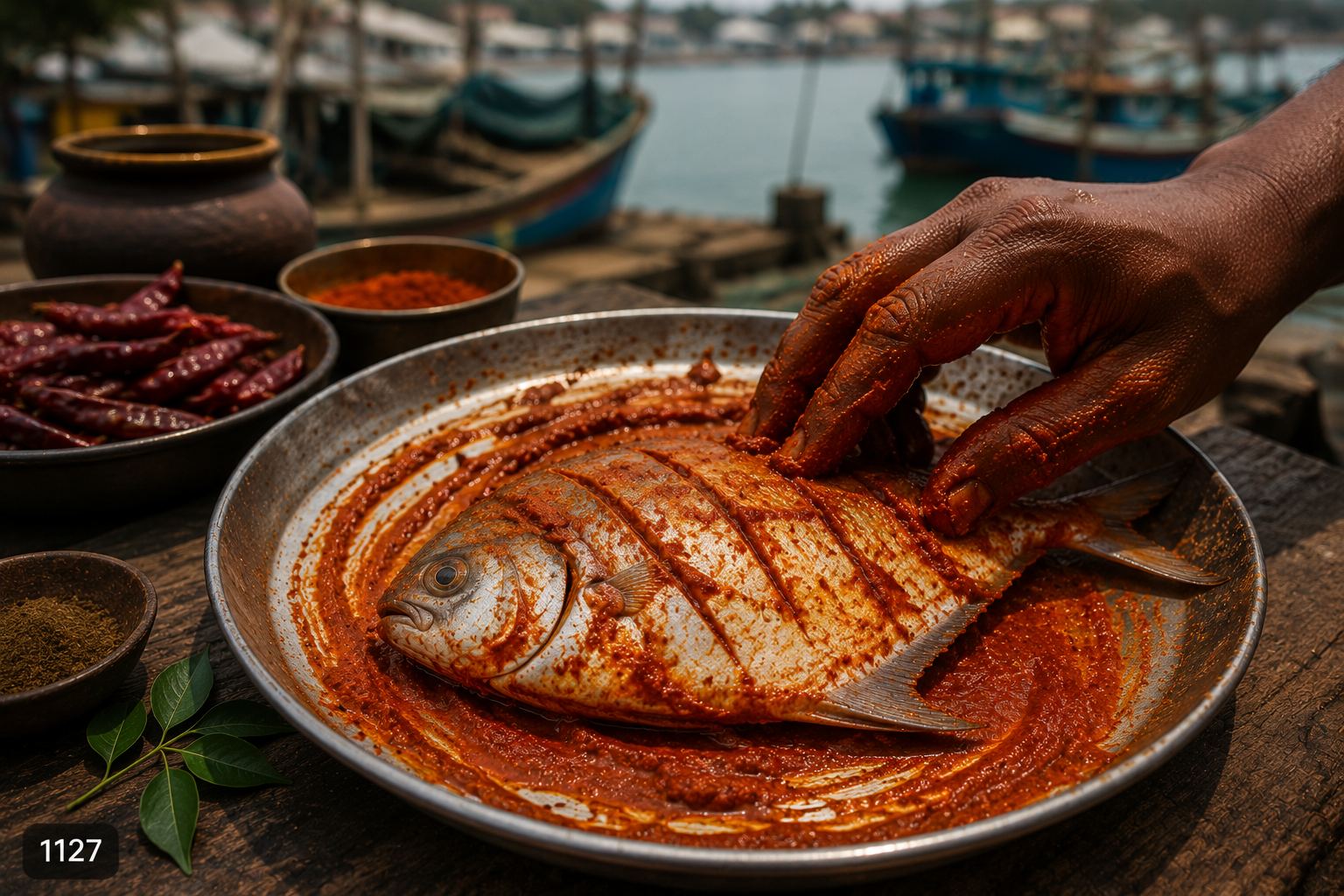
The bafat curry technique is the Catholic community's most distinctive culinary process. Pork is marinated in bafat masala and vinegar for at least 4 hours — often overnight — before cooking. The marination is the flavour-building stage: the bafat spices penetrate the pork and the mild acid tenderises the fat. The pork is then slow-cooked in its own marinating liquid until the fat renders and the gravy darkens to deep orange-brown. The bafat masala's coriander and cumin provide the aromatic base; the chilli provides colour and measured heat; the cloves and cinnamon provide the warmth that distinguishes bafat from mainstream Hindu Karnataka masalas.
The kori rotti assembly technique requires specific timing. The rice wafer (rotti) is placed flat on the plate. The chicken curry is poured over it at the table — not in the kitchen — so that the diner controls the saturation. Eating immediately produces a contrasting texture: crisp rotti meeting the rich curry. Waiting 2–3 minutes produces partial softening. Waiting longer produces complete softening. The diner's preference determines how they eat it — the most democratic possible presentation of a dish.
Which Mangalorean Community Makes Better Food?
The question is posed and answered differently depending on which community you ask. Catholics will highlight the bafat masala and kori rotti. GSB Hindus will point to the refinement of neer dosa and GSB fish curry. Bearys will argue for the biryani. The honest answer is that the competition is unfair because the three traditions are doing fundamentally different things from shared ingredients. They cannot be ranked on a common scale — a neer dosa and a pork bafat are not comparable preparations. The richness of Mangalorean food is precisely that it contains all three, not that one is better than the others.
🔗
Relationship to Parent Cuisine
How Mangalorean differs from Karnataka
Element
Karnataka
Mangalorean
Primary protein
Fish for Hindu and Catholic communities; halal meat and fish for Beary
Shared Arabian Sea fish base; pork central for Catholics; specific halal tradition for Bearys
Souring agent
Kokum across all three communities
Shared kokum use — one of the clearest points of culinary unity across the three traditions
Fat tradition
Coconut oil for Hindu; some lard historically for Catholic; refined vegetable oils for Beary
Community-specific fat traditions within a shared coconut-oil coastal base
Bread tradition
Neer dosa (Hindu); pork bafat with bread (Catholic); naan and roti (Beary)
Three different bread traditions from the same city
Religious calendar food
Brahmin fasting traditions (GSB); Catholic Lenten traditions; Muslim Ramadan traditions
Three calendars of food restriction and festival food operating simultaneously
📅
Timeline
How this cuisine evolved
Medieval period
Arab traders establish Beary community
The Beary community forms from Arab merchant settlers on the Karnataka coast. Their food tradition begins as a synthesis of Arabic and Tulu coastal elements.
16th century
Portuguese contact and Catholic community formation
Portuguese baptisms create the Mangalorean Catholic community. The Catholic food tradition begins to develop — the coastal Hindu spice base adapted to pork-eating Christianity.
18th century
Tipu Sultan relocation of Catholics
Mangalorean Catholics forcibly relocated to Srirangapatna during Tipu's campaigns. They return after the fall of Seringapatam (1799) — maintaining their food traditions through the displacement.
Present
Three-community food culture as Mangalore's identity
The three-community food tradition is recognised nationally as one of India's most complex and interesting coastal food cultures. Kori rotti, neer dosa, and Beary biryani all achieve national restaurant presence.
Mangalorean food has three distinct traditions from the same coastal ecological base: Tulu Hindu (including the refined GSB Brahmin fish tradition and neer dosa); Mangalorean Catholic (kori rotti, pork bafat, bafat masala); and Beary Muslim (Beary biryani, specific prawn preparations). All three use coconut, kokum, and Arabian Sea fish — and produce completely different cuisines.
What is neer dosa?
Neer dosa is a lacy, delicate rice crepe — soaked rice ground with water only, no lentil, no fermentation, no sourness. Cooked on a hot iron pan without flipping, under a lid for steam. The lightest dosa in India — barely there, translucent, tearing easily. The GSB Brahmin ideal of restraint applied to a bread.