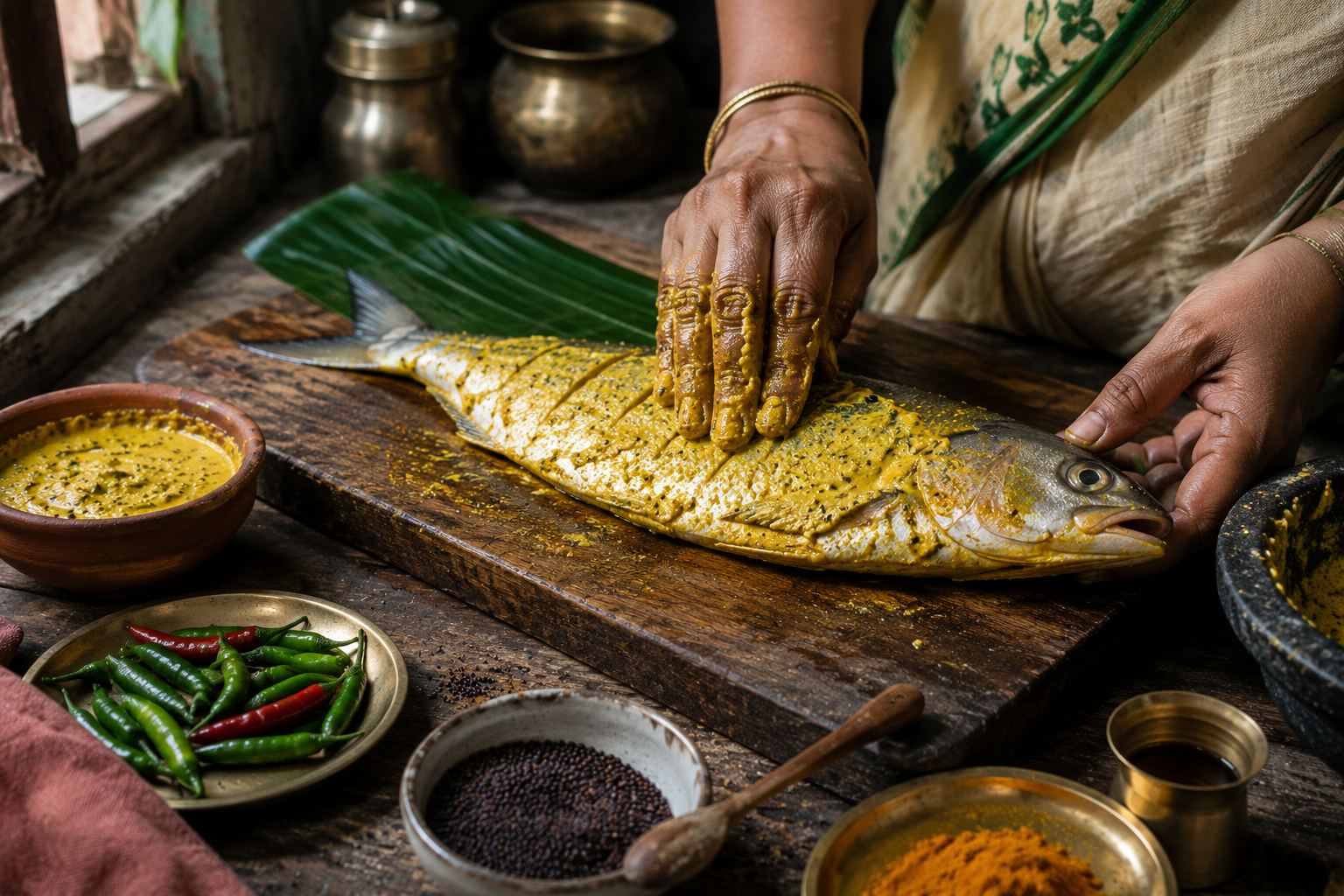
The Ganges delta where a billion-year-old river meets the Bay of Bengal — producing the most diverse freshwater fish tradition in India, the most sophisticated sweet-making culture, and the Ghoti-Bangal culinary debate that is Bengal's most beloved cultural institution.
⏱ 15 min read🗓 Updated June 2026★ State Food Guide
State Food Guide
Bengal — The Fish and Rice Delta Kitchen
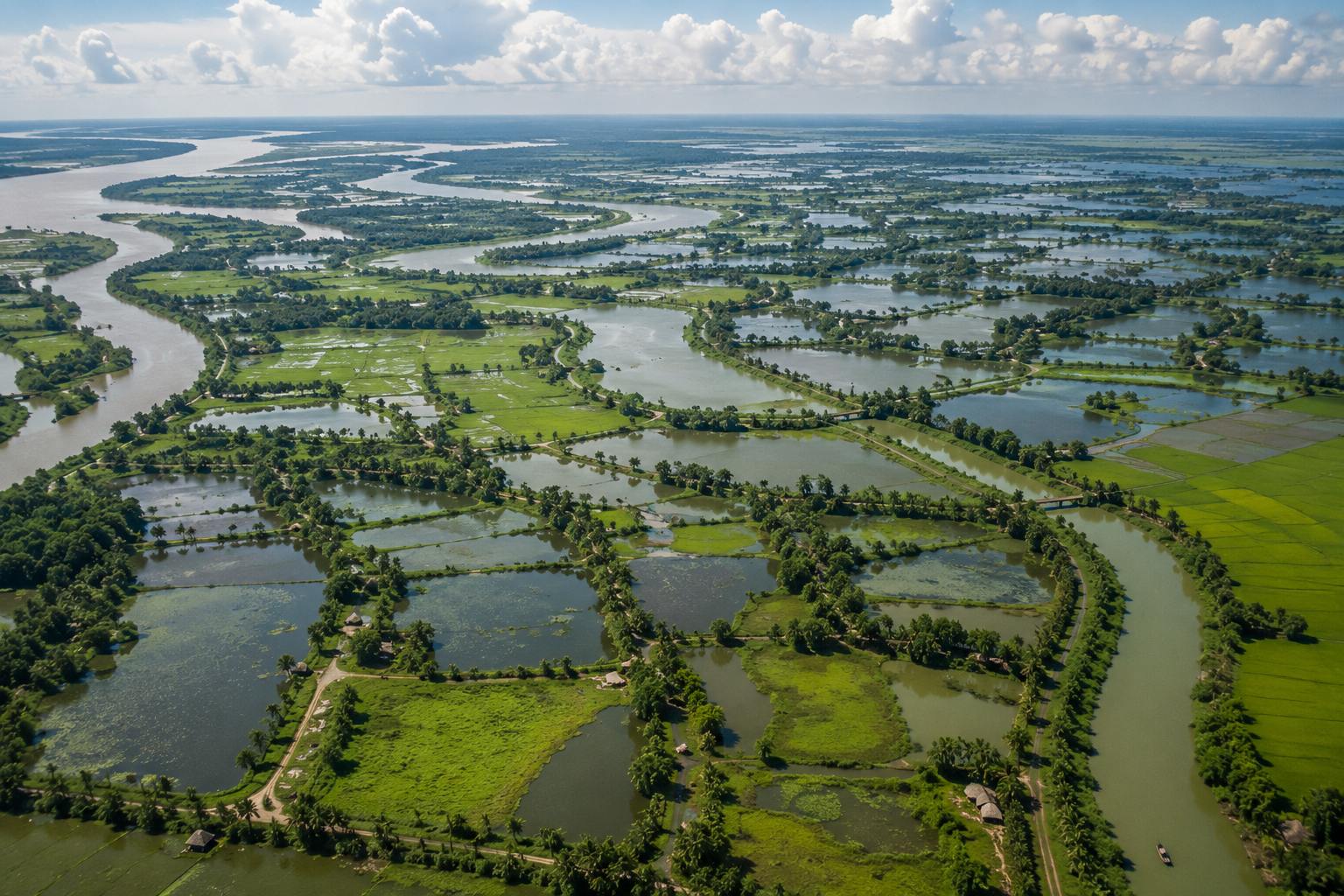
Bengal's geography is the Ganges-Brahmaputra delta — the world's largest river delta, where multiple major rivers meet the Bay of Bengal across a 350km front. This delta ecology produces an extraordinary freshwater fish abundance; the specific fish varieties of the Padma, Ganges, Hooghly, and Brahmaputra systems are the primary protein and the primary culinary identity marker of Bengal.
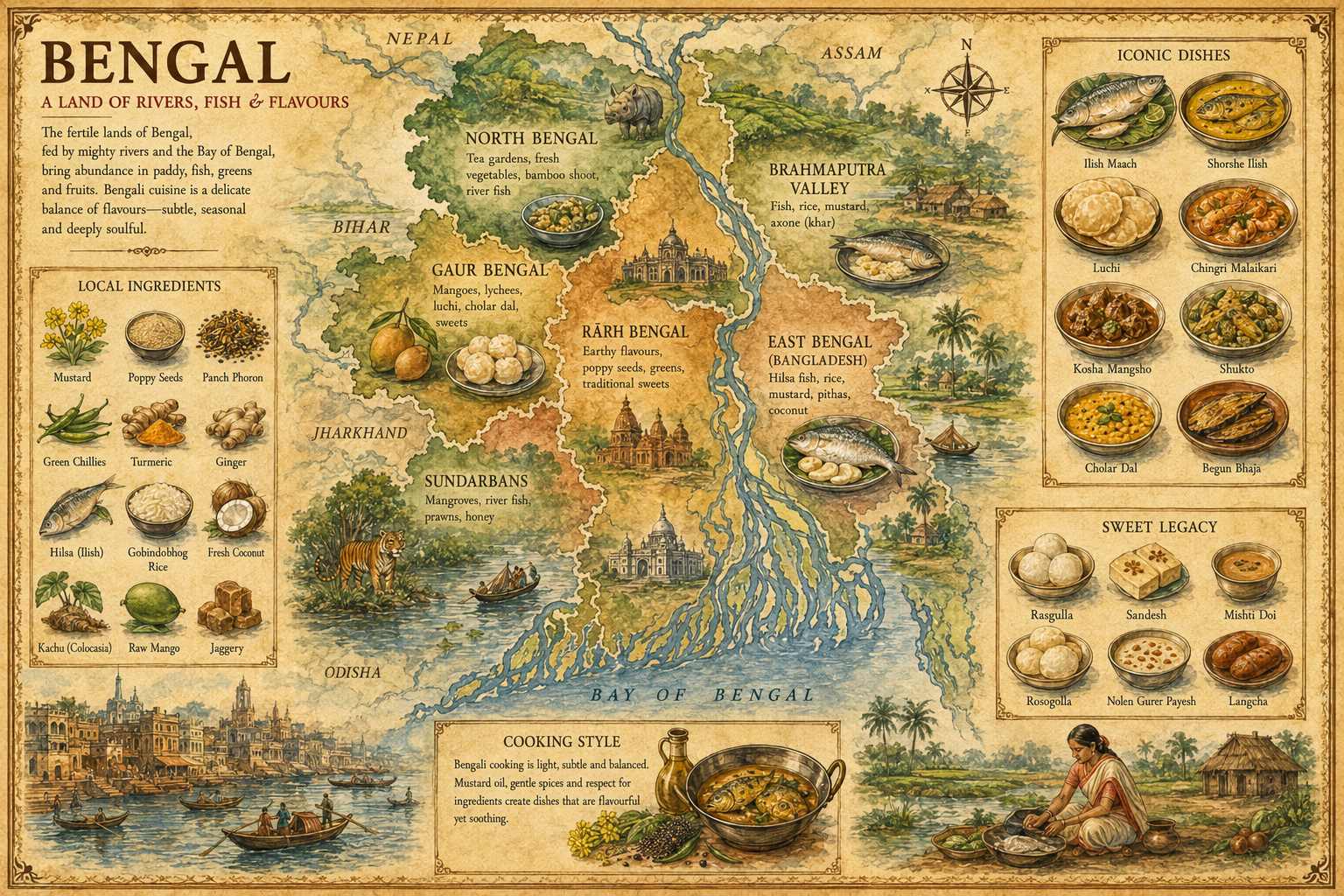
The geographic regions and food zones of Bengal Food Guide.
🗺
Geography & Climate
The land that made this food inevitable
The Bengal delta is one of the most productive freshwater ecosystems in the world — multiple major river systems, jheels (wetlands), tidal floodplains, and the mangrove Sundarbans where fresh and salt water mix. This ecology produces approximately 700 freshwater fish species and the most diverse fish-eating culture in India. The Bengalis do not merely eat fish; they have a 700-word vocabulary for describing fish preparation methods, a specific market hierarchy for fish by prestige, and a cultural relationship with the hilsa (ilish) that has no counterpart in any other fishing community.
Mustard is the defining flavour of Bengal — mustard oil as the primary cooking fat, mustard paste in fish preparations, mustard as the raw flavour applied to fish before cooking. The specific pungency of mustard oil — at its most potent when raw, mellowing when heated — is the aromatic marker that identifies Bengali cooking immediately. No other Indian state uses mustard oil in the same depth of integration.
The 1947 Partition of Bengal divided the province into West Bengal (India) and East Pakistan (now Bangladesh) and produced the Ghoti-Bangal culinary divide that remains Bengal's most beloved cultural institution. Ghotis (native West Bengalis) prefer smaller, sweeter fish and more restrained mustard; Bangals (East Bengali migrants) prefer larger, oilier fish (particularly Padma hilsa) and more forward mustard. The argument about which hilsa is superior has continued for 75 years with passionate seriousness and increasing affection.
The Ilish — The Fish That Is Also a Religion
The hilsa (Tenualosa ilisha) is the most emotionally important fish in India. Bengalis write poems about it, argue about it, build communal identities around it. The hilsa migrates from the Bay of Bengal upstream through the delta rivers to spawn — during the monsoon migration, when the fish is fattest, the entire state focuses on its arrival. The specific debate about whether Padma hilsa (from the Bangladesh river) or Ganges hilsa (from the West Bengal river) is superior has divided families, defined communities, and generated the most sustained culinary argument in Indian food history. Both fish are the same species. Both rivers are connected. The argument continues regardless.
The terrain and agricultural landscape that produces the defining ingredients.
🧬
Food DNA
The flavour architecture
Fish Hierarchy
Ilish (hilsa) — the prestige fish — the argument-starter, the identity marker
Chingri (prawn) — the second prestige category — malai curry with coconut milk
Parshe, bele, mourola — smaller everyday fish — the Ghoti tradition
Chital, boal — large oily fish — the Bangal tradition
Mustard
Mustard oil — primary cooking fat — pungent when raw, mellowing when heated
Mustard paste (shorshe) — in fish preparations — the most specifically Bengali preparation method
Kasundi — fermented mustard condiment — the Bangal tradition particularly
The Sweet Tradition
Sandesh — fresh chhena with sugar — the Bengali sweet par excellence
Rasgulla — chhena balls in sugar syrup — the most contested sweet in India (Bengal vs Odisha)
Mishti doi — sweetened yoghurt in terracotta — the Bengali cultural sweet claim
Nolen gur — winter date palm jaggery — the most prized seasonal ingredient
Fish in ascending richness — from light jhol to rich kalia — the formal arc
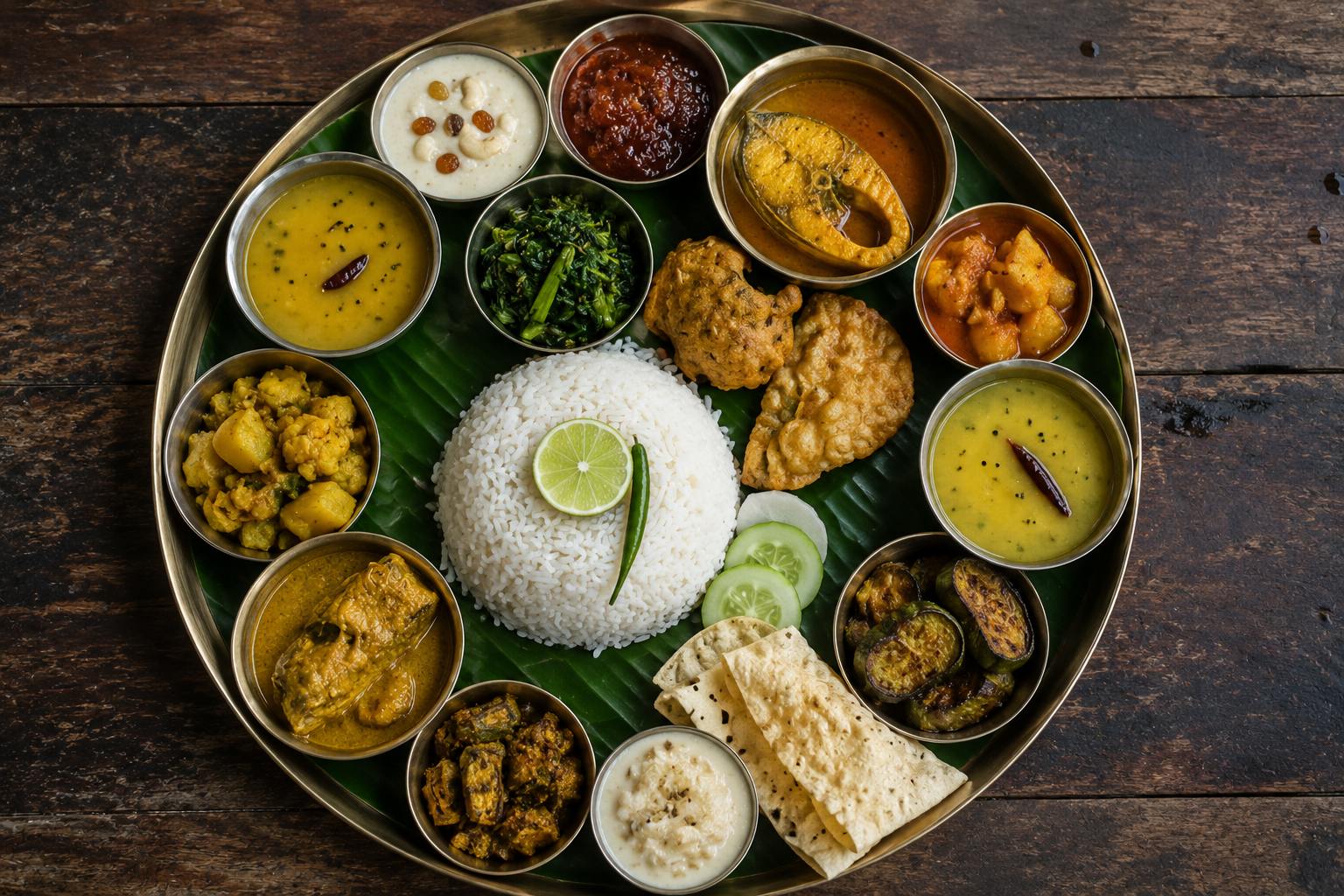
A complete thali representing the full flavour range.
🎉
Festival Foods
When the calendar drives the kitchen
Durga Puja
The great Bengali festival — and the greatest celebration of Bengali street food. The pandal food culture (specific Puja street food) is unique to Bengal.
Eid
Biriyani and Mughlai preparations — the Muslim Bengali food calendar's peak.
Naban (harvest)
New rice preparations — patishapta (crepe with coconut filling) and specific new-rice sweets.
Poila Boishakh (Bengali New Year)
Hilsa curry as the new year meal — the fish carries symbolic weight as the year's beginning.
Jamai Shashti
The son-in-law's day — the most elaborate home cooking occasion in Bengali culture; the host prepares the maximum possible dishes.
🌍
Diaspora & Reach
How this cuisine spread beyond its borders
The Bengal diaspora — distributed through Kolkata's historical position as colonial India's capital, then through migration to Delhi, Mumbai, and abroad — carried Bengali intellectual and food culture nationally. Kolkata's street food (kathi roll, puchka, jhal muri) has spread nationally and internationally.
The chhena sweet tradition (sandesh, rasgulla, rosogolla) has become the template for Indian mithai sophistication. The rasgulla origin dispute between West Bengal and Odisha — resolved officially (though not culturally) by India's Geographical Indication registry in Bengal's favour — reflects how culturally significant these sweets are to regional identity.
Ghoti refers to native West Bengalis; Bangal refers to East Bengali communities who migrated after the 1947 Partition. Ghotis prefer smaller, sweeter fish with restrained mustard; Bangals prefer larger, oilier fish (particularly Padma hilsa) with more forward mustard. The hilsa origin argument — Padma vs Ganges — is Bengal's most beloved and sustained cultural dispute.
What is sandesh?
Sandesh is fresh chhena (pressed cheese from curdled milk) worked with sugar until smooth, shaped, and served. The purest sandesh is just chhena and sugar — nothing obscuring the dairy quality. The chhena technique was adapted by Bengali sweet-makers from Portuguese cheese-making contact in the 16-17th centuries, producing the foundation of Indian patisserie.