Ghoti Cuisine — West Bengal's Native Food Tradition
The food of native West Bengal — smaller sweeter fish, restrained mustard, and a sandesh and mishti doi tradition that defines the Ghoti half of Bengal's most beloved culinary argument. The merged Ghoti-Bangal tradition is richer than either could produce alone.
⏱ 12 min read🗓 Updated June 2026★ Sub-Regional Guide
Sub-regional identity
Ghoti Cuisine — West Bengal's Native Food Tradition
The food of native West Bengal — smaller sweeter fish, restrained mustard, and a sandesh and mishti doi tradition that defines the Ghoti half of Bengal's most beloved culinary argument. The merged Ghoti-Bangal tradition is richer than either could produce alone.
Native West Bengal Bengalis — communities predating 1947 Partition migration
Fish preference
Smaller sweeter fish — parshe (mullet), bele, mourola; and river prawns
Mustard use
Present but restrained — controlled proportion rather than Bangal forwardness
Sweet attribution
Credited with the classic Kolkata sandesh and mishti doi tradition
Self-perception
More refined and nuanced — the Ghoti view of their own cuisine
Key technique
Jhol — thin spiced gravy letting the fish's sweetness dominate
River allegiance
Ganges and Hooghly — the West Bengal river system
Most celebrated preparation
Parshe maacher jhol — small mullet in a delicate spiced gravy
🗺
Geography
The place that made this food inevitable
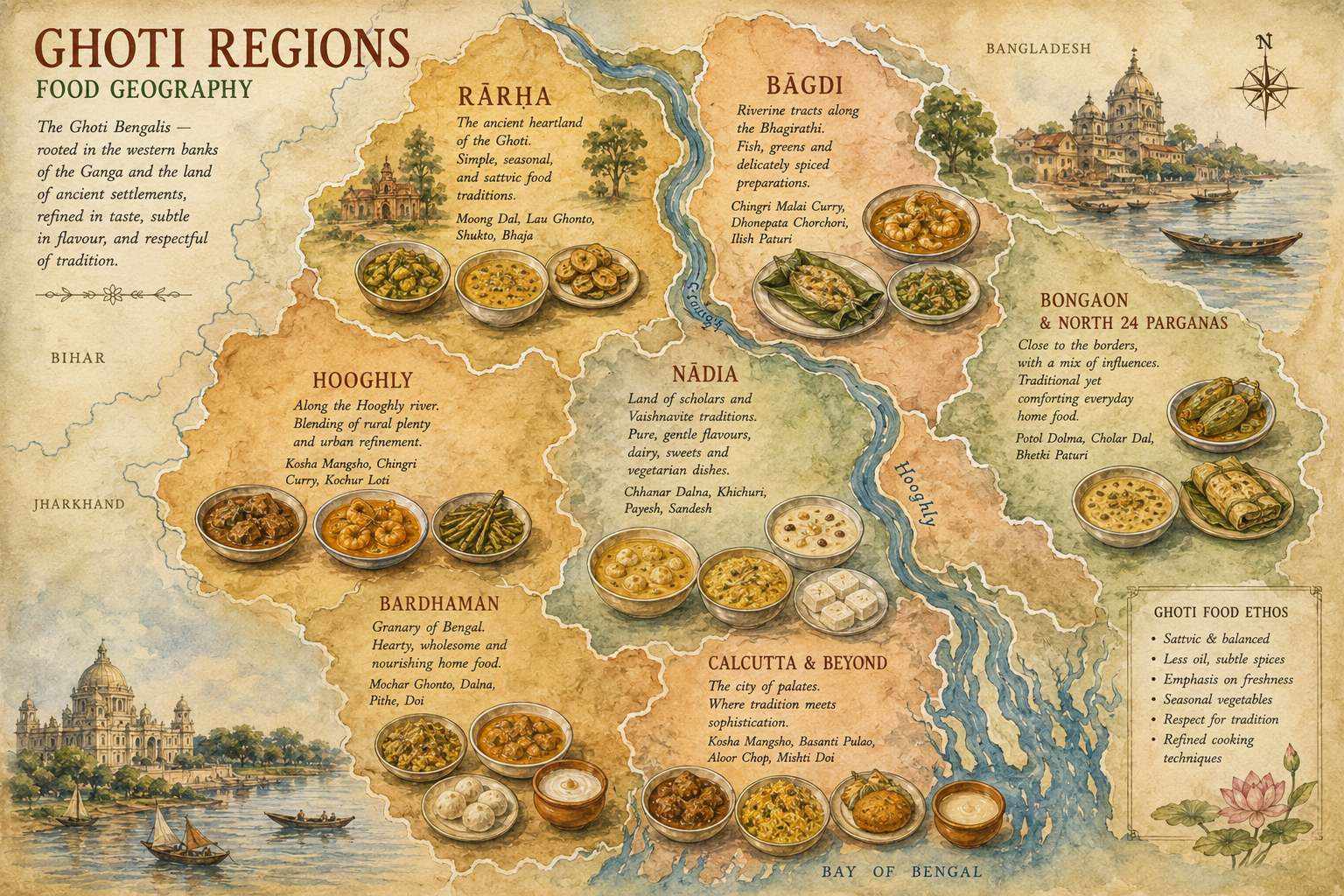
Ghoti refers to communities native to West Bengal whose families lived in the Bengal Province before the 1947 Partition. The Ghoti food tradition reflects the Ganges and Hooghly river systems — producing specific West Bengali fish varieties (parshe, bele, mourola) as preferred proteins, and a cooking philosophy the Ghoti community describes as more subtle and refined than the Bangal tradition that arrived with 1947 migrants.
The Ganges and Hooghly rivers of West Bengal differ from the Padma in speed, chemistry, and the fish species they support. The slow-moving Hooghly estuary produces different fish from the fast-moving Padma delta. The Ghoti food tradition developed around these specific West Bengali fish — smaller, sweeter species suited to a more delicate cooking approach. The mustard that defines all Bengali cooking appears in Ghoti preparations in more restrained proportions than in Bangal cooking.
The historically dominant bhadralok (educated gentry) of Bengali society were predominantly Ghoti — one reason Ghoti cooking has been more extensively written about and credited with the refined Bengali tradition. The Ghoti claim to sandesh and mishti doi is associated with the fact that most of Kolkata's great historic mishti shops are Ghoti-community businesses. Whether this proves superior sweet-making or simply earlier market establishment is one of Bengal's endless gentle arguments.
Location and regional context of Ghoti Cuisine within its parent state.
📜
Historical Origins
How this cuisine became distinct from its parent
The Ghoti food tradition evolved over centuries along the Ganges, Hooghly, and Bengal delta waterways — producing a cuisine reflecting both the river ecology and the social character of the bhadralok class that dominated Kolkata intellectual and cultural life from the 18th century. The bhadralok were the professional and intellectual elite — lawyers, doctors, writers, government servants — who defined Bengali cultural identity in the colonial period.
The bhadralok meal structure is characterised by moderation, variety, and a formal sequence (shukto-dal-fish-sweet) that reflects both Ayurvedic principles and refined social sensibility. The meal moves from bitter (shukto) through neutral (dal) through flavourful (fish in ascending richness) to sweet — a journey Ghoti cooking treats as a formal arc rather than unrelated courses.
The Ghoti sweet tradition — sandesh (fresh chhena with sugar) and mishti doi (sweetened yoghurt in terracotta) — developed in Kolkata's mishti dokan culture from the 18th century. Most of Kolkata's great sweet establishments — Balaram Mullick, Nakur Nandy, KC Das — are Ghoti-community businesses. The chhena-based sweet tradition is a Ghoti innovation, developed in Bengal and essentially unknown in most of India before the 19th century.
The Chhena Revolution
Sandesh and rasgulla are made from chhena — fresh pressed cheese, curdled from milk with lemon juice and pressed dry. This technique was almost certainly introduced to Bengal through Portuguese contact in the 16th-17th centuries. The Ghoti sweet-makers adapted it and produced the chhena-based sweet tradition that now defines Indian patisserie at its finest. Without Portuguese cheese-making contact and Ghoti sweet-maker innovation, there would be no rasgulla, no sandesh, and no mishti doi.
🧬
Food DNA
The flavour architecture
Preferred Fish
Parshe (grey mullet) — the prestige small fish — Ghoti identity in a single preparation
Bele (sleeper gobies) — specific small West Bengal fish — sweeter than large oily river fish
Mourola (mola carplet) — tiny fish eaten whole — distinctly Ghoti; too small for Bangal interest
Sweet Tradition
Sandesh — fresh chhena worked with sugar — the Ghoti sweet standard
Mishti doi — sweetened yoghurt set in terracotta — the Ghoti cultural sweet
Nolen gur preparations — winter date palm jaggery — the most celebrated seasonal Ghoti sweet tradition
Mustard (restrained)
Mustard oil — present and important but in controlled Ghoti proportion
Mustard paste — in some preparations but less dominant than Bangal use
Bhadralok Meal Structure
Shukto — bitter opening course — the formal Bengali meal that Ghoti cooking follows most strictly
Thin dal — fragrant, lentil-forward — the second formal course
Fish in ascending richness — from light jhol to richer kalia — the formal fish arc
🌿
Signature Ingredients
The ingredients that define this cuisine
Ingredient
What It Is
Flavour Character
Availability
Parshe (grey mullet)
Small mullet (Mugil cephalus) — the specific Ghoti prestige small fish
Sweet, delicate — less assertive than large oily fish; suited to light jhol
Common in West Bengal fish markets; the Ghoti identity fish
Fresh chhena
Pressed fresh cheese from curdled milk — the base of Ghoti sweets
Neutral dairy character that takes sweeteners without resistance
Made fresh in every sweet shop; the Portuguese-influenced technique adapted by Ghoti sweet-makers
Nolen gur
Date palm jaggery harvested in winter — the most prized seasonal ingredient
Deep caramel-molasses flavour unlike any other jaggery — seasonal, precious
Available only in winter in Bengal; the restriction makes Ghoti nolen gur sweets a seasonal event
Mustard oil (measured)
Mustard oil in controlled Ghoti proportion — less than Bangal standard
Present and important — Bengali cooking's defining fat — but restrained
Available everywhere; the measurement and proportion is the Ghoti technique
🍽
Signature Dishes
The dishes that cannot exist elsewhere
Dish
What It Is
Why It Matters
Parshe Maacher Jhol
Grey mullet in a light, delicate spiced gravy
The quintessential Ghoti fish preparation. The thin jhol lets the small fish's sweetness speak through a minimal spice frame. The Bangal preference for large fish in bold preparations is the philosophical opposite.
Shukto
Bitter mixed vegetable opening course — the formal beginning of a proper Ghoti Bengali meal
Uniquely Bengali and most formally observed in Ghoti cooking. Bitter first stimulates digestion and sets the palate. No other Indian cuisine begins a meal with deliberate bitterness.
Sandesh
Fresh chhena worked with sugar — the essential Bengali sweet in its simplest, purest form
The Ghoti claim to sandesh is associated with Kolkata's great Ghoti mishti shops. The purest sandesh is just chhena and sugar — nothing obscuring the dairy quality.
Mishti Doi
Sweetened yoghurt set overnight in terracotta — the Ghoti cultural sweet claim
The terracotta pot absorbs excess moisture and produces specific texture. Set overnight with concentrated milk and jaggery, it becomes thick and slightly caramelised.
Mourola Maacher Chorchori
Tiny whole fish cooked with vegetables — bones and all
Fish so small they are eaten whole, bones and all. Distinctly Ghoti — the Bangal preference for large fish makes this a Ghoti identity statement.
The defining preparations of Ghoti Cuisine.
⚙️
Unique Techniques
What this cuisine does that others do not
The defining Ghoti philosophy is restraint as sophistication — the belief that the finest Bengali cooking does not announce itself. A small parshe fish in a thin jhol; mustard oil present but not aggressive; sandesh made from chhena and sugar with nothing added. The Ghoti argument is that restraint reveals quality. Add nothing unnecessary; let the ingredient speak.
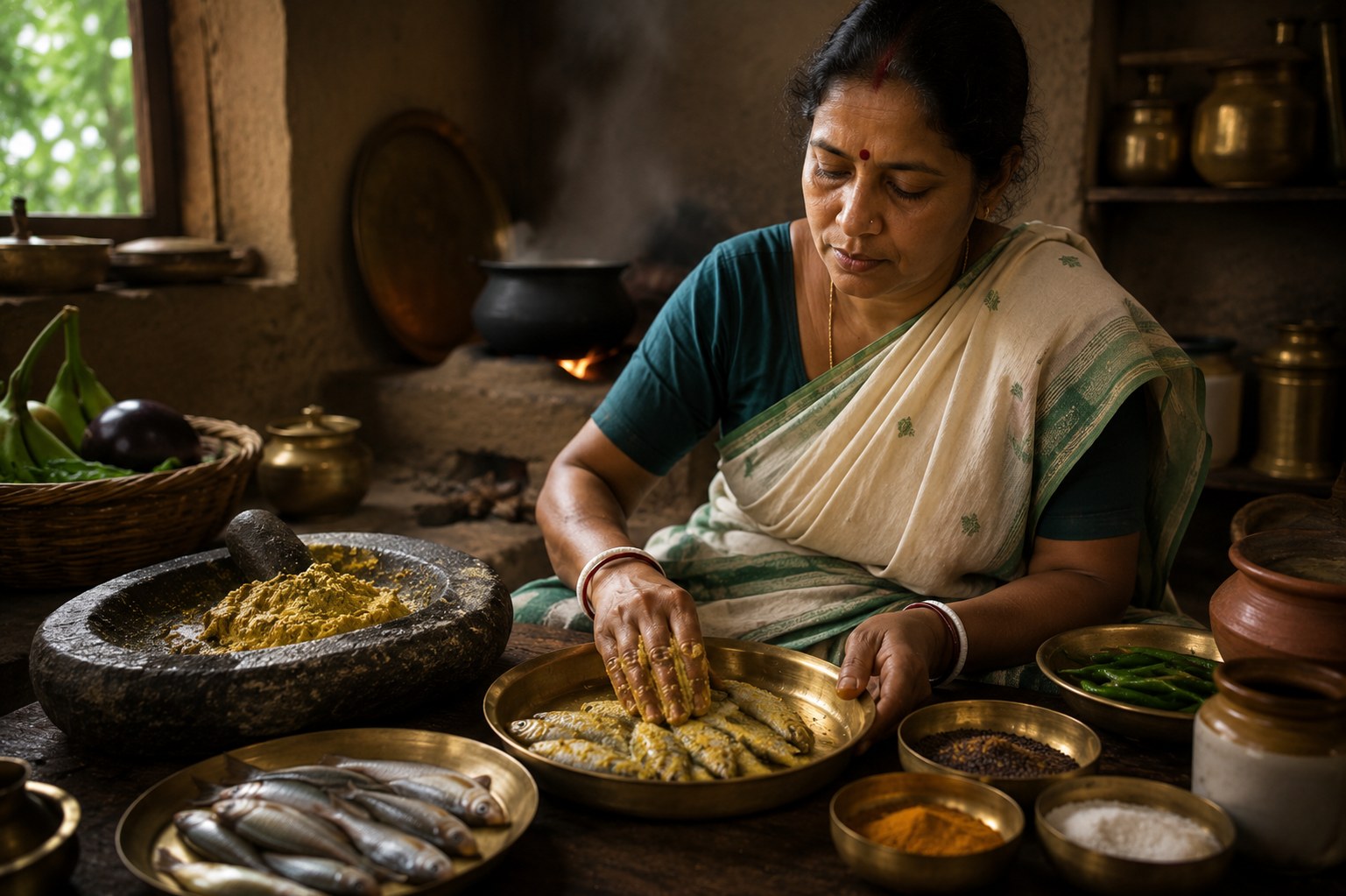
The jhol technique is the primary Ghoti fish preparation method. A thin spiced gravy — turmeric, cumin, green chilli, mustard oil — in which specific small fish are cooked briefly. The jhol is thin enough to drink and designed to mix into rice. The fish is essentially poached in the spiced liquid rather than cooked in a gravy that coats it. The result is a preparation where the fish's own sweetness is the dominant flavour and the spicing is a frame rather than a presence.
The chhena sweet technique requires specific skill. Milk is boiled, curdled with lemon juice, and the curds pressed in muslin to produce fresh chhena. The chhena is then kneaded repeatedly until smooth and pliable. This kneading releases remaining moisture and produces the cohesive texture that allows sandesh to hold its shape. Too little kneading and it crumbles; too much and it becomes rubbery. The right texture is the skill, and the skill is the tradition.
Ghoti vs Bangal — Who Makes Better Bengali Food?
The Ghoti-Bangal debate is conducted with seriousness but affection. Ghotis claim refinement — smaller fish, restrained mustard, delicate preparations, and the great mishti tradition. Bangals claim depth — Padma hilsa, forward mustard, kasundi, and preparations Ghotis lack the palate to appreciate. The honest answer is that both are right about themselves. The merged tradition, produced by 75 years of shared tables and intermarriage, is richer than either alone — which is the actual food legacy of Partition, and possibly its only unambiguously positive consequence.
🔗
Relationship to Parent Cuisine
How Ghoti Cuisine differs from Bengal
Element
Bengal
Ghoti Cuisine
Fish preference
Smaller sweeter fish — parshe, bele, mourola (Ghoti)
Larger oilier fish — Padma hilsa, boal, chital (Bangal)
Mustard
Present and controlled — the Ghoti proportion
Forward — raw oil applied before cooking, higher paste proportion (Bangal)
Sweet tradition
Strong Ghoti claim — sandesh, mishti doi, nolen gur
Specific Bangal sweets from East Bengal coconut and jaggery traditions
Meal structure
Strict shukto-dal-fish-sweet sequence
Similar sequence but less formally observed
Self-description
Refined, nuanced, subtle
Bold, assertive, true to Padma river tradition
📅
Timeline
How this cuisine evolved
Pre-1947
Ghoti food culture established along Ganges and Hooghly
Native West Bengali food culture matures — specific fish traditions, mishti shops, and bhadralok food culture of Kolkata.
1947 Partition
Bangal migration creates the dialogue
4+ million Bangal communities arrive. The Ghoti-Bangal culinary dialogue begins. Both communities define themselves partly in relation to the other.
1950s-70s
The merged tradition emerges
Both traditions maintain their identities but the best Bengali cooks incorporate elements of both. The merged tradition is richer than either alone.
Present
The rivalry becomes cultural institution
The Ghoti-Bangal argument continues as one of Bengal's most beloved cultural institutions — passionate, affectionate, unresolved.
What is the difference between Ghoti and Bangal cooking?
Ghoti cooking uses smaller, sweeter fish (parshe, bele, mourola) with restrained mustard in thin, delicate jhol preparations. Bangal cooking uses larger, oilier fish (Padma hilsa, boal, chital) with more forward mustard. Ghotis credit themselves with refined subtlety; Bangals credit themselves with depth and boldness. Both are right about their own traditions.
Did Ghotis invent sandesh?
The Ghoti claim to sandesh is associated with Kolkata's great historic mishti shops being Ghoti-community businesses. The chhena-based sweet tradition is a Ghoti-associated innovation, developed in Bengal from Portuguese cheese-making contact in the 16th-17th centuries. Without this Portuguese contact and Ghoti sweet-maker adaptation, there would be no sandesh, rasgulla, or mishti doi.