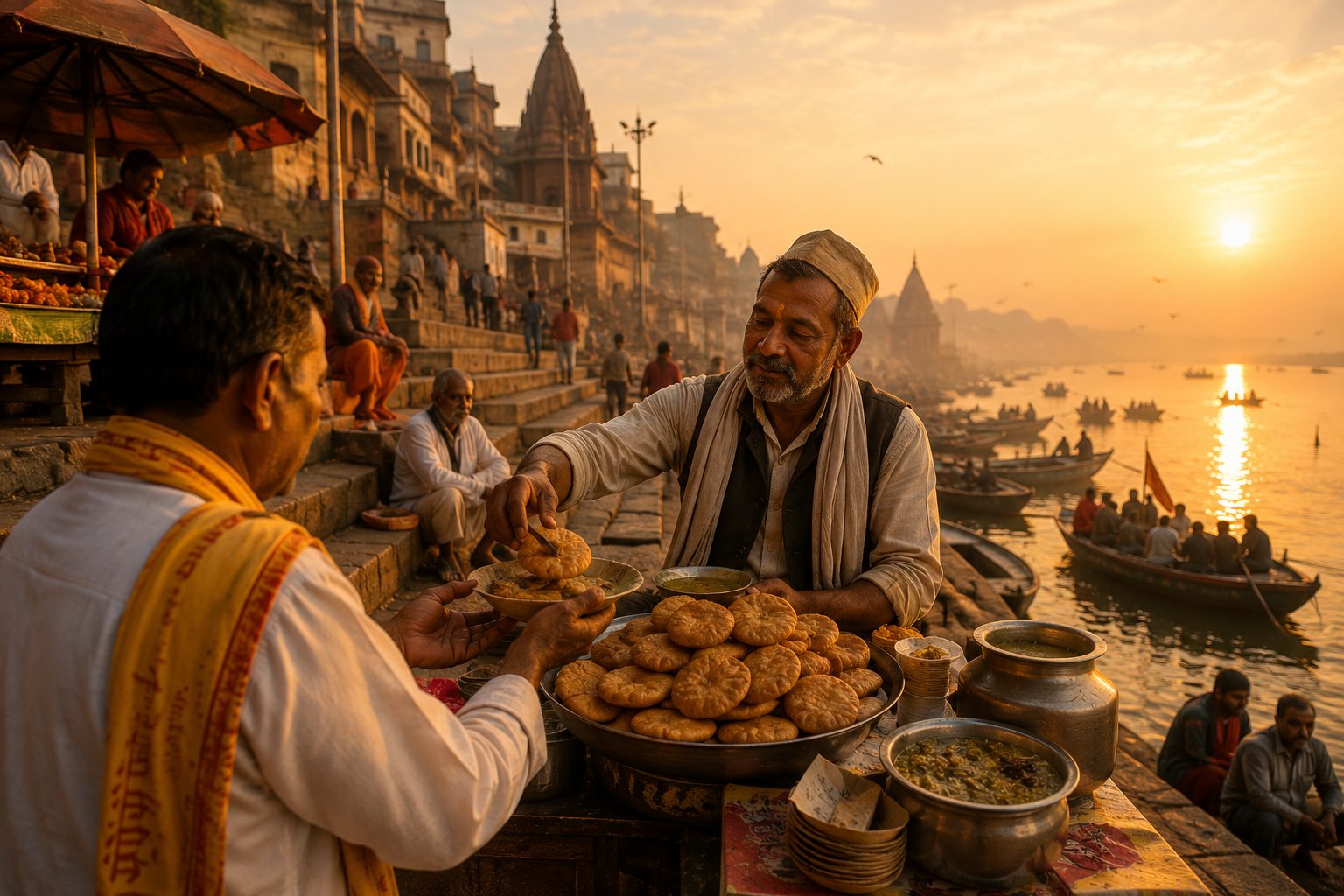
Varanasi is one of the world's oldest continuously inhabited cities. Its food reflects 3,000+ years of Sanskrit learning, pilgrim economy, and ritual calendar — kachori-sabzi before dawn at the ghats, malaiyyo only on cold winter mornings, thandai at Holi. Seasonal, ritual, and ancient.
⏱ 13 min read🗓 Updated June 2026★ Sub-Regional Guide
Sub-regional identity
Banarasi Cuisine — The Ancient City's Street Food
Varanasi is one of the world's oldest continuously inhabited cities. Its food reflects 3,000+ years of Sanskrit learning, pilgrim economy, and ritual calendar — kachori-sabzi before dawn at the ghats, malaiyyo only on cold winter mornings, thandai at Holi. Seasonal, ritual, and ancient.
Varanasi (Banaras), eastern Uttar Pradesh — on the western bank of the Ganges
Age
3,000+ years of continuous habitation — one of the world's oldest living cities
Food character
Pilgrim city and Sanskrit learning centre — democratic street food, not court cooking
Contrast with Awadhi
Banarasi = street food for pilgrims; Awadhi = court cooking for Nawabs. The two poles of UP food.
Most specific food
Kachori-sabzi-jalebi before dawn at the ghats — the most specific eating occasion in Indian food
Most seasonal food
Malaiyyo — winter foam dessert available only on cold mornings when dew can be incorporated
Festival drink
Thandai with optional bhang — consumed specifically at Holi in Shiva's city
Vegetarian character
Very strong — pilgrimage city with Brahmin tradition; minimal meat presence
🗺
Geography
The place that made this food inevitable
Varanasi sits on the western bank of the Ganges — the most sacred city in Hinduism, continuously inhabited for at least 3,000 years, and the centre of Sanskrit learning and Hindu pilgrimage. The river runs northward through the city for a stretch, making it uniquely sacred in Hindu cosmology and drawing pilgrims from across the subcontinent. This geography created an economy. The economy created the street food tradition.
The city's population layers created its food. At the core, Sanskrit scholars and Brahmin priests associated with thousands of temples, producing a strict vegetarian food tradition. Surrounding them, the working weaving and artisan class — Varanasi has been India's silk weaving capital for centuries — who needed affordable, filling, fast food. And flowing through both, millions of annual pilgrims who need to eat quickly, cheaply, and vegetarianly at all hours including before dawn. Street food met all three requirements simultaneously.
The Ganges provides one more geographic contribution: the winter mist and dew that makes malaiyyo possible. The foam dessert — churned cream collected with overnight dew — requires the cold, damp winter mornings specific to the Gangetic plain in this latitude. Remove the Varanasi winter and malaiyyo ceases to exist. The food is literally inseparable from the place's climate.
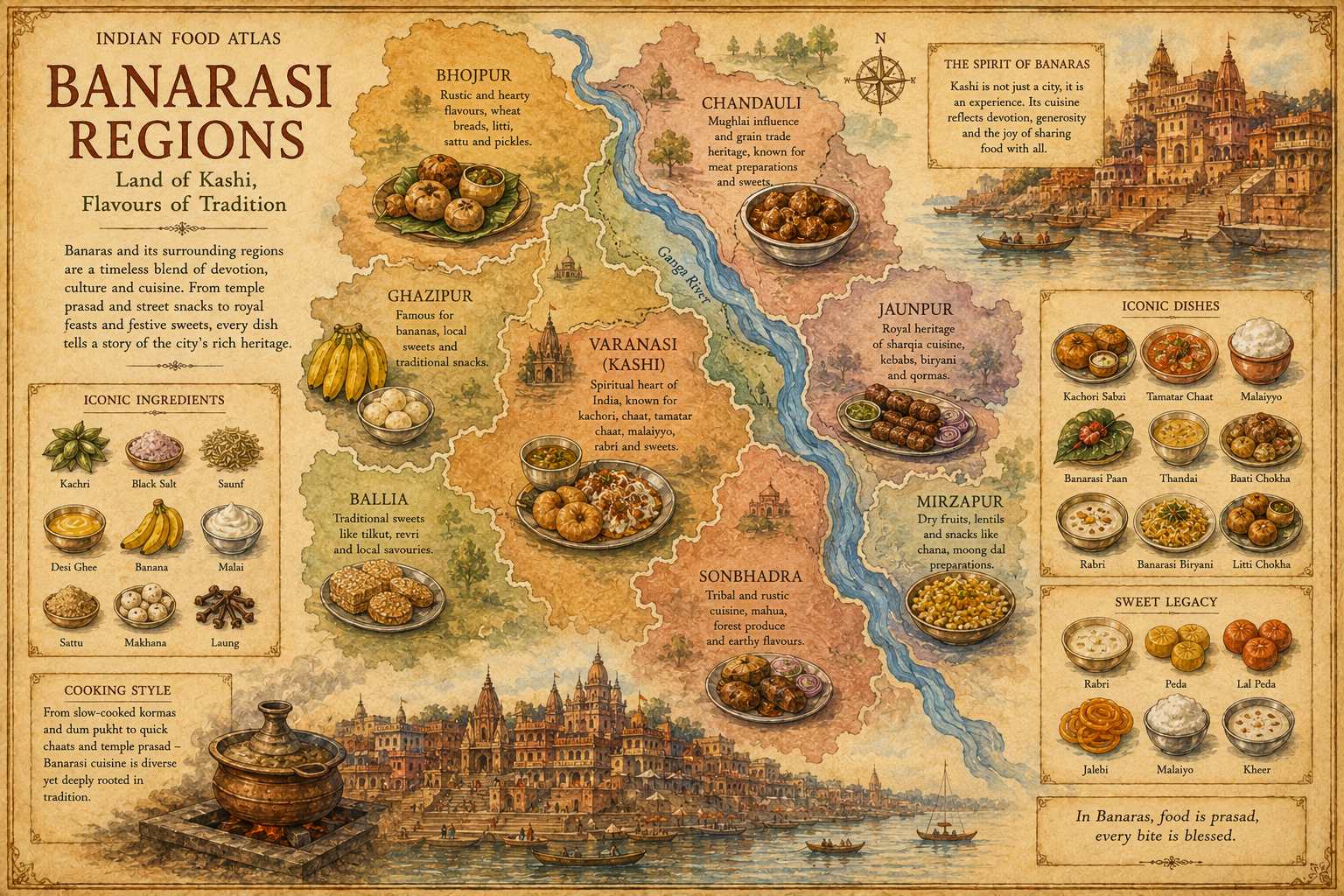
Location and regional context of Banarasi Cuisine within its parent state.
📜
Historical Origins
How this cuisine became distinct from its parent
Banarasi street food developed from the intersection of three communities and one economy. The Brahmin scholarly community required pure vegetarian food prepared with ritual care — this produced the temple-prasad tradition and the specific Brahmin sweets (kheer, launglata, specific dal preparations). The working weaving community required fast, affordable, filling food — this produced the kachori-sabzi tradition that operates from before dawn until mid-morning. The pilgrim economy required food at all hours for people arriving tired and hungry from long journeys — this produced the 24-hour food culture of the ghats.
The kachori-jalebi combination — fried pastry with spiced vegetable, eaten alongside the sweet simultaneously rather than sequentially — is specific to Varanasi and has no precedent in general UP cooking. The sweet-savoury simultaneous combination is deliberately juxtaposed. In Varanasi food philosophy, the jalebi sweetness does not conclude the kachori experience — it runs through it, creating a continuous sweet-savoury alternation that Varanasites consider the correct way to experience the morning meal at the ghats.
Malaiyyo is a creation of the climate calendar rather than culinary invention in the conventional sense. The technique has likely existed as long as there have been vendors selling cream-based sweets on cold Varanasi mornings — which is to say, centuries. It was not invented; it was discovered, by the specific winter conditions of a specific place on the Gangetic plain.
The Ritual Calendar of Banarasi Food
In Varanasi, food is governed by the ritual calendar more explicitly than anywhere else in India. Malaiyyo appears only in winter (roughly November to February) when temperatures allow foam to set. Thandai with bhang is specifically a Holi preparation — associated with Lord Shiva's city. Kachori-sabzi is dawn-specific; by 9am the stalls shift to other preparations. The temporal specificity of Banarasi food is not marketing or tradition — it is climatic and ritual logic embedded in centuries of daily practice. The food and the city's sacred calendar are inseparable.
🧬
Food DNA
The flavour architecture
Street Food Foundation
Kachori — deep-fried urad dal-stuffed pastry — the morning staple outside every ghat
Sabzi — thick spiced potato and vegetable — designed for kachori scooping, not rice mixing
Jalebi — fried sweet spirals eaten simultaneously with kachori — the sweet-savoury simultaneous combination
Sattu sherbet — summer cooling — roasted gram flour in water with spices and lemon
Temple and Sweet Tradition
Banarasi paan — the city's defining digestive — specific fillings distinct from all other regional paan
Launglata — deep-fried pastry with clove-spiced filling — the sweet most specific to Varanasi
Kheer — rice pudding — temple offering and everyday sweet, made daily at most temples
Brahmin Vegetarian Base
Sattu — roasted gram flour — ancient high-protein staple of the Gangetic plain
Dal-puri — lentil-stuffed fried bread — the Brahmin festival bread
Aloo-tamatar sabzi — potato and tomato — the universal accompaniment
🌿
Signature Ingredients
The ingredients that define this cuisine
Ingredient
What It Is
Flavour Character
Availability
Sattu
Roasted gram flour — chickpea, barley, or mixed grain, dry-roasted then ground
Nutty, dense, nutritionally complete — both food and a flavour agent
Available throughout eastern UP and Bihar; the ancient protein staple of the Gangetic plain
Malaiyyo
Churned cream with overnight dew incorporated — available only in winter
Extremely light foam with rich cream character — the dew creates bubbles that set only in cold
Made only by specialist vendors in Varanasi; genuinely unavailable outside cold winter mornings
Banarasi paan
Betel leaf with specific Varanasi fillings — gulkand, specific supari, specific pastes
The closing note of any Varanasi meal — digestive, aromatic, city-specific
The specific Banarasi fillings available in Varanasi; approximated but not replicated elsewhere
Launglata
Deep-fried pastry with clove (laung) and sugar filling
Sweet, clove-forward, slightly caramelised from frying — the most Varanasi-specific sweet
Specific to Varanasi sweet shops; rarely found outside the city with the correct filling character
🍽
Signature Dishes
The dishes that cannot exist elsewhere
Dish
What It Is
Why It Matters
Kachori-Sabzi-Jalebi at dawn
The dawn combination — fried pastry, spiced vegetable, sweet — eaten together before ghat rituals
One of India's most specific food occasions. This combination, at this time of day, at these ghat-side locations, is the entire context. It cannot be separated from the Varanasi morning experience.
Available only on cold winter mornings when foam holds. The most climatically specific food in India. By mid-morning as temperatures rise, the foam collapses and the day's production is finished.
Thandai
Holi milk drink — almonds, poppy seeds, rose, fennel, melon seeds in cold milk, optionally bhang
Consumed specifically at Holi in the city of Lord Shiva. The connection between Varanasi's sacred identity and this festival drink is 500+ years old and remains fully active.
Banarasi Paan
Betel leaf with city-specific fillings — gulkand, selected supari, specific pastes
The closing punctuation of any Varanasi meal. Different from Calcutta or Mumbai paan in its specific filling combination — the closing bracket to the morning kachori's opening bracket.
Sattu Sherbet
Roasted gram flour in water with spices and lemon — the summer cooling drink
Ancient, practical, nutritious. Was the marching ration of North Indian soldiers. The sherbet form is its most specifically Banarasi expression — sold from clay pots at ghat-side stalls in summer.
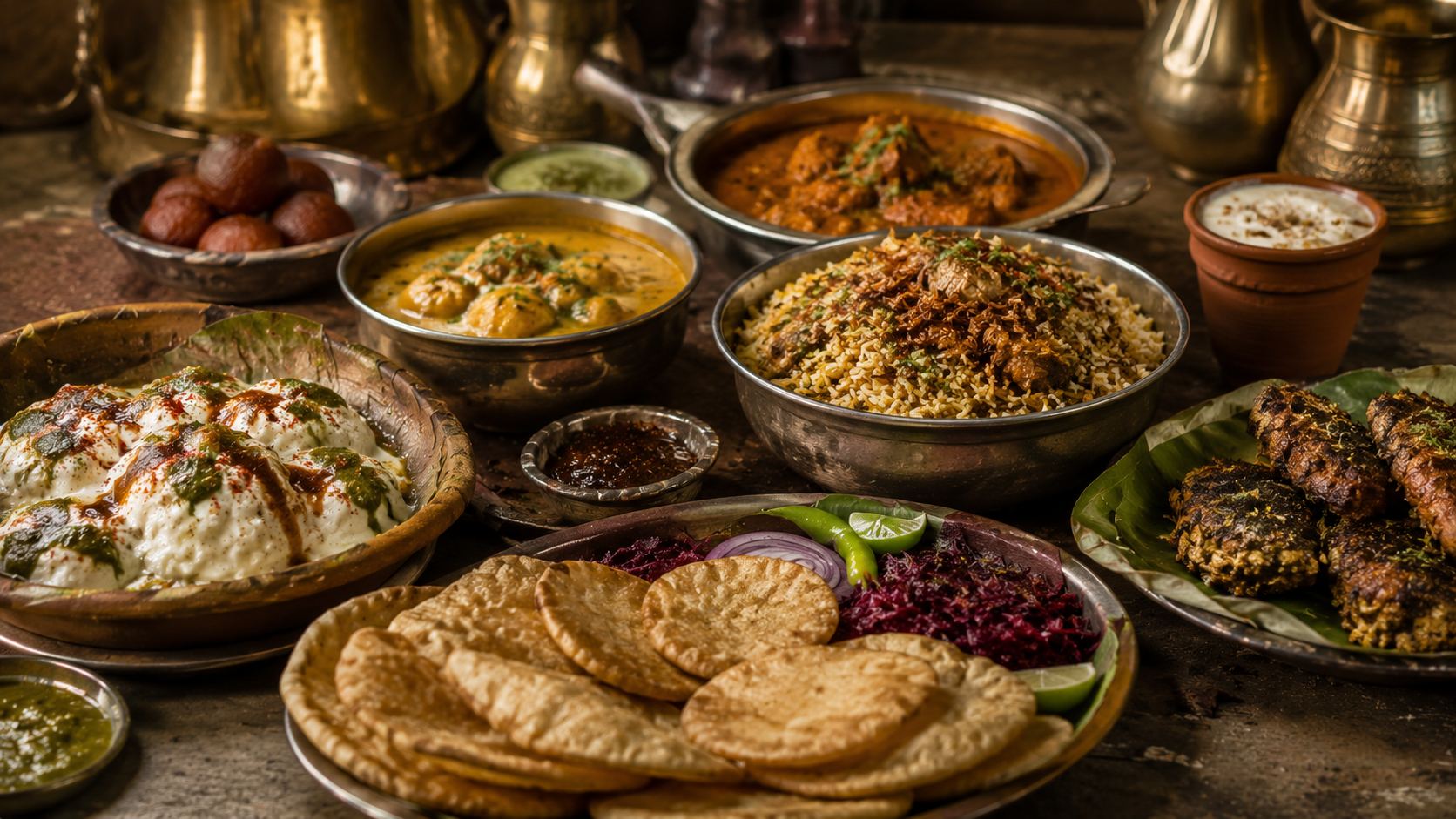
The defining preparations of Banarasi Cuisine.
⚙️
Unique Techniques
What this cuisine does that others do not
The defining Banarasi culinary technique is temporal precision rather than cooking sophistication. Food is tied to specific times of day, specific seasons, and specific ritual occasions with a rigour found nowhere else in India. The technique is the schedule, and the schedule is the technique.
The kachori frying technique is specific: Banarasi kachori uses a proportion of urad dal filling that is drier than standard kachori. The filling must not create steam that softens the shell during frying. The oil temperature is higher than standard pakora frying — the shell sets immediately, producing the specific crunch that defines the Banarasi version. The sabzi accompaniment is deliberately thick and dry — thin gravy would make the kachori soggy from the bottom up.
Malaiyyo production is climate-dependent technology. Fresh cream is warmed and churned in the evening. The churned cream is spread in flat vessels left outdoors overnight. Cold night air and dew that forms on the cream surface create thousands of tiny bubbles that incorporate into the cream. Before sunrise, the vendor works the cream into a foam and serves immediately. By mid-morning, as temperatures rise, the foam collapses irreversibly. There is no technique adjustment that makes malaiyyo viable in summer. The winter is the technique.
Why Varanasi Street Food Differs from Lucknawi Court Food
Both are UP food traditions but they occupy opposite ends of Indian cooking's social range. Awadhi cooking is elite — created by specialists for patrons, built on imported ingredients (saffron, kewra), expressing refinement through restraint and technique complexity. Banarasi street food is democratic — created for pilgrims, scholars, and weavers, built on local ingredients (sattu, lentils, wheat), expressing identity through occasion and season. Together they represent the full social spectrum of Indian food: from the Nawab's sealed dum vessel to the pre-dawn kachori stall outside the ghat. Both are expressions of the same culinary intelligence operating at different social registers.
🔗
Relationship to Parent Cuisine
How Banarasi Cuisine differs from Uttar Pradesh
Element
Uttar Pradesh
Banarasi Cuisine
Identity
Elite Nawabi court cooking
Democratic street food and pilgrim economy food
Season-specificity
Present but not extreme
Extreme — malaiyyo, thandai, and sattu sherbet are all season-locked preparations
Brahmin influence
Present in general UP Hindu cooking
Very strong — the Sanskrit learning city with Brahmin temple tradition throughout
Meat presence
Common in UP's Muslim and non-Brahmin communities
Minimal — the vegetarian imperative of the pilgrimage city is dominant
Dawn food culture
Limited
Strong — the most developed dawn food occasion in Indian street food
Ritual calendar link
General connection to Hindu festival seasons
Very strong — malaiyyo, thandai, and kachori each tied to specific seasons or occasions
📅
Timeline
How this cuisine evolved
3000+ years ago
Varanasi established as sacred Gangetic city
Continuous habitation begins. The ghat economy creates the pilgrim food culture that will define Banarasi street food.
Pre-Mughal period
Sanskrit learning centre food tradition established
Brahminical vegetarian tradition of the scholars shapes the dominant food philosophy. Temple prasad and scholar community food practices codified.
18th–19th century
Street food and ghats culture reach classic form
Kachori-sabzi at dawn, malaiyyo in winter, thandai at Holi — the specific Banarasi food calendar reaches its recognisable form alongside the weaving economy's prosperity.
Present
Tourism and pilgrimage economy continues
Varanasi remains India's most visited Hindu pilgrimage city globally. The food traditions persist in their seasonal and ritual specificity.
Malaiyyo is a winter-morning foam dessert unique to Varanasi — churned cream mixed with overnight dew collected in flat outdoor vessels, then worked into foam before sunrise with saffron. Available only on cold winter mornings when temperatures allow the foam to hold. By mid-morning the foam collapses and the day's production is finished.
Is Banarasi food the same as Awadhi food?
No — entirely distinct UP traditions. Awadhi (Lucknow) is elite court cooking: dum technique, galouti kebab, restrained fragrant spicing, biryani as ceremony. Banarasi is democratic street food: kachori before dawn, malaiyyo in winter, thandai at Holi — tied to the pilgrim economy and ritual calendar. They represent UP food's two opposite poles.
What makes Banarasi paan different?
Banarasi paan uses Varanasi-specific fillings — gulkand (rose petal preserve), selected supari, and specific pastes — distinguishing it from Calcutta or Mumbai paan. The closing bite of paan after a Varanasi meal is as culturally specific as the opening kachori before it.