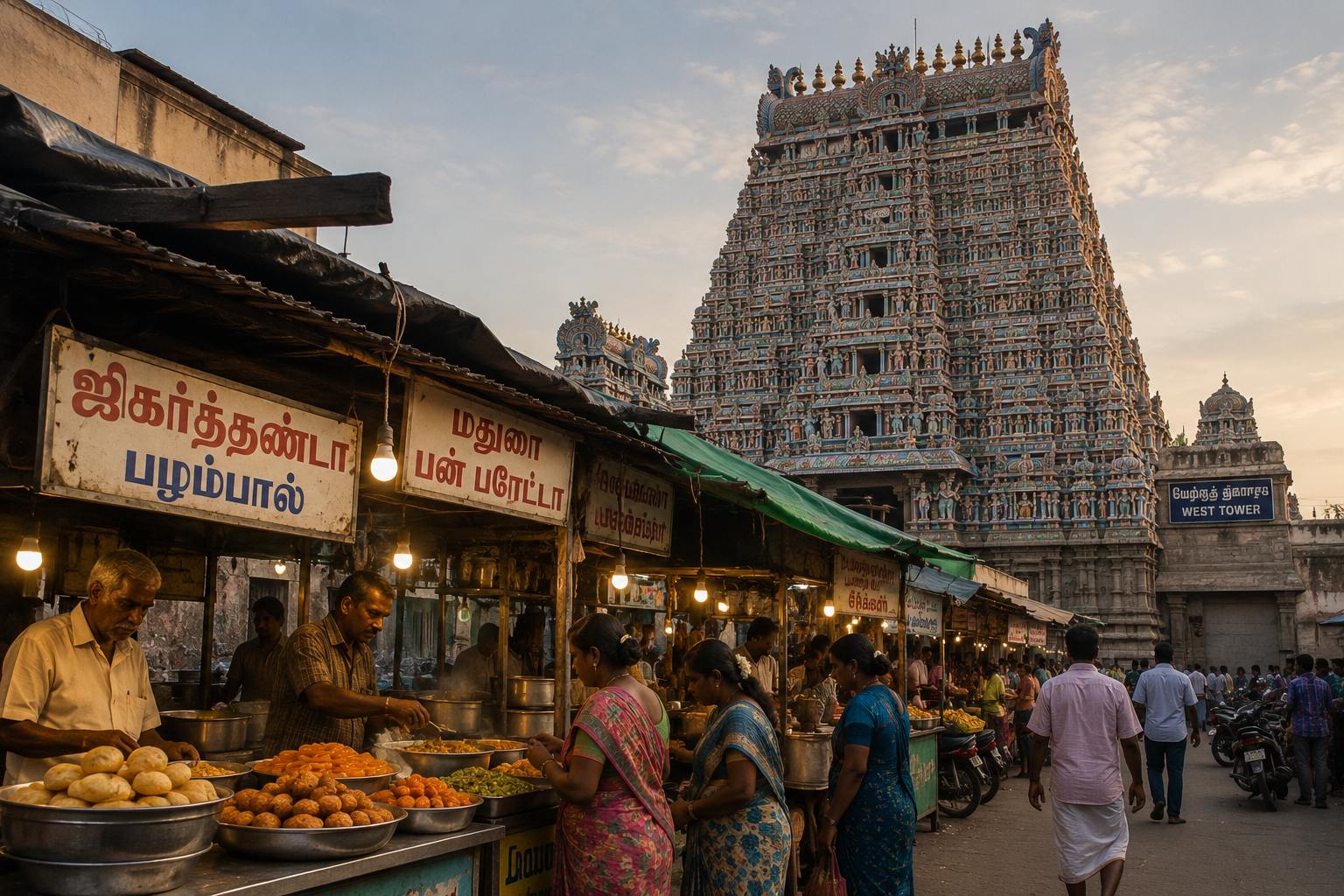
Tamil Nadu's oldest city — built around the 2,500-year-old Meenakshi Amman temple — with a street food identity centred on parotta, kari dosa, and a non-Brahmin meat curry tradition that reflects the city's working-class trading culture.
⏱ 12 min read🗓 Updated June 2026★ Sub-Regional Guide
Sub-regional identity
Madurai — The Temple City's Street Food Tradition
Tamil Nadu's oldest city — built around the 2,500-year-old Meenakshi Amman temple — with a street food identity centred on parotta, kari dosa, and a non-Brahmin meat curry tradition that reflects the city's working-class trading culture.
Madurai, southern Tamil Nadu — the ancient temple city on the Vaigai river
Temple
Meenakshi Amman temple — 2,500+ years old, one of India's most significant pilgrimage destinations
Food identity
Street food, parotta culture, non-Brahmin meat tradition — distinct from Brahmin Tamil Nadu
Defining bread
Parotta — layered wheat flatbread, the Madurai staple eaten with salna (thin curry)
Signature night food
Kothu parotta — shredded parotta on a hot tawa with egg and meat; the sound defines the city's nights
Unique drink
Jigarthanda — cold sarsaparilla, almond gum, milk, and ice cream; found only in Madurai
Cultural character
Working class, non-Brahmin, meat-forward — distinct from the Brahmin idli-dosa tradition of Chennai
Most famous non-vegetarian dosa
Kari dosa — dosa with minced meat filling; the non-vegetarian adaptation of Tamil Nadu's most famous preparation
🗺
Geography
The place that made this food inevitable
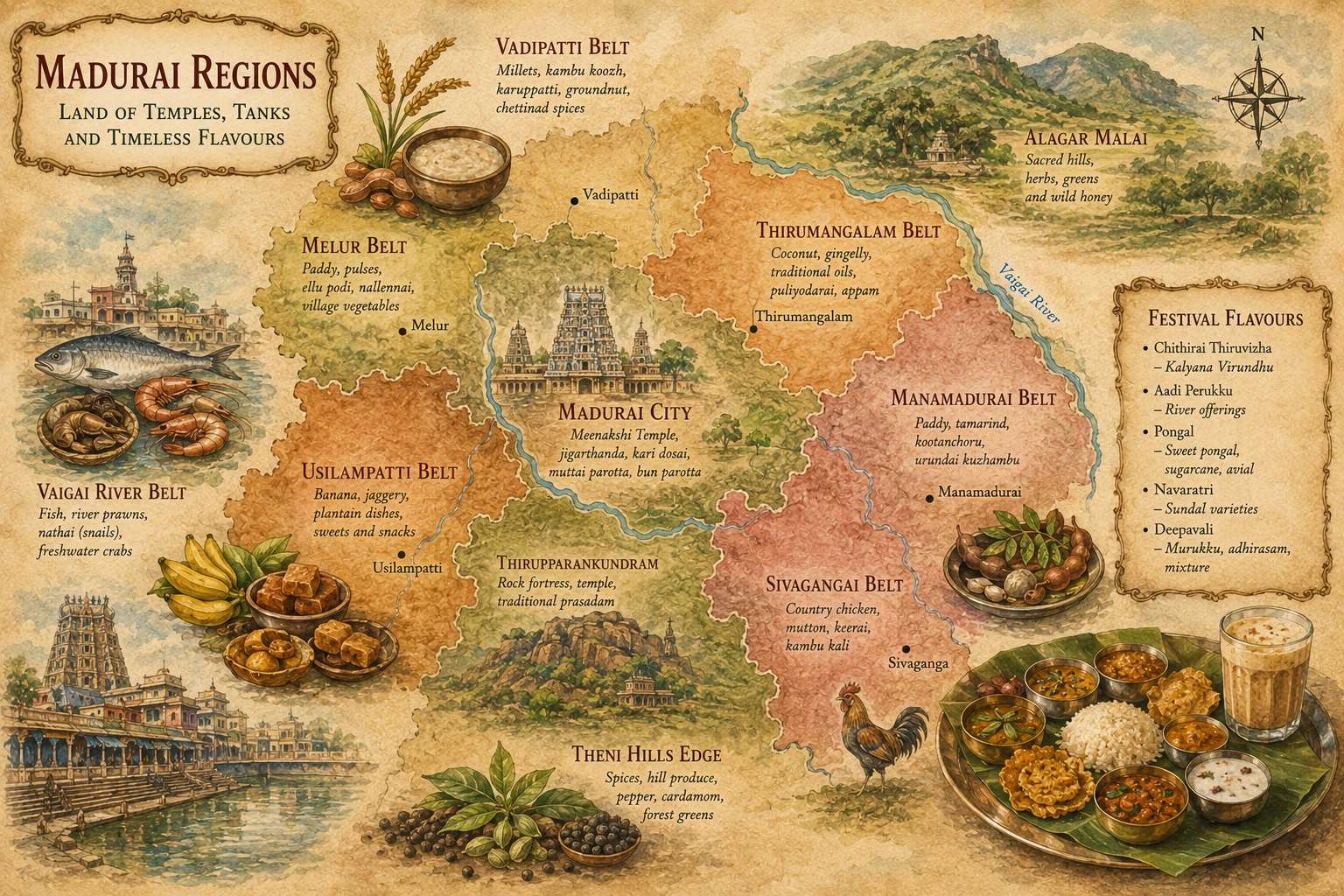
Madurai is Tamil Nadu's oldest city — its Meenakshi Amman temple considered to be at least 2,500 years old and one of Hinduism's most important pilgrimage sites. The city sits on the Vaigai river in the hot, dry interior of southern Tamil Nadu, and its food culture reflects the layered economy of a pilgrimage city: Brahmin vegetarian food for the temple-serving community, but surrounding and outnumbering it, the robust non-Brahmin working-class food tradition that the vast majority of Madurai's residents actually eat.
The geography produces specific conditions. Madurai's hot, dry interior climate — hotter than coastal Tamil Nadu and drier than the Nilgiris — makes heavier, more sustaining food appropriate. The parotta, with its layered wheat structure and the oil worked into each fold, provides the calorie density that the working day requires. The salna that accompanies it is thin enough to eat quickly, bold enough to provide the flavour that makes the plain parotta satisfying. The food is engineered for the working city.
The temple economy creates the dual food structure. The Meenakshi Amman temple feeds thousands daily through its own kitchen and attracts pilgrims whose eating occasions are governed by festival timing and ritual. Alongside this sacred food culture, the secular working city operates its street food tradition from early morning (parotta stalls opening at 5am) through the late night kothu parotta scene that defines Madurai's streets until 2am. The two food cultures coexist without competition — the pilgrims eat at the temple; the working city eats on the street.
Location and regional context of Madurai within its parent state.
📜
Historical Origins
How this cuisine became distinct from its parent
Madurai's food identity is primarily Nayak-era in origin. The Madurai Nayak kings who ruled from the 16th century explicitly patronised non-Brahmin artisan and food culture alongside the ancient temple tradition. The Nayaks were not Brahmin — they were warrior-administrators from what is now Andhra Pradesh — and their court culture celebrated the working and artisan classes that surrounded the temple economy. The parotta tradition, the meat curry tradition, and the specific street food culture of Madurai developed under and after this Nayak patronage.
The parotta itself — a layered wheat bread made by repeatedly folding oil-enriched dough to create hundreds of thin layers — is not exclusively Madurai but the Madurai preparation and its specific accompaniments (salna, kari) are the city's most celebrated food form. The kothu parotta adaptation — shredding the parotta on a hot tawa with egg, meat, and vegetables, producing the distinctive metallic sound of scraper on iron that defines Madurai's nights — is a Madurai innovation now spread across Tamil Nadu and globally.
Jigarthanda — the cold drink combining sarsaparilla root syrup, almond gum (badam pisin), chilled milk, and ice cream — is a Madurai-specific creation with no counterpart anywhere else in Tamil Nadu. It emerged from Madurai's Muslim community (the word jigarthanda means 'cool liver' in Hindi-Urdu) as a summer cooling drink and became the city's most iconic non-food preparation. The combination of ingredients found nowhere else defines it as specifically local.
The Sound of Kothu Parotta
In Madurai's night food stalls, the kothu parotta is prepared on a large flat iron griddle with two heavy metal scrapers that shred, mix, and fold the parotta pieces against the griddle in a rapid, rhythmic motion. The resulting sound — a metallic clatter-clatter-clatter — carries 100 metres down the street and signals, to any Madurai resident, that the night food scene is active. Kothu parotta is identifiable by sound before it is identifiable by smell or sight. The sonic signature of the preparation is now considered part of its identity — recordings of kothu parotta being made circulate globally among Tamil diaspora as a specifically Madurai sound.
🧬
Food DNA
The flavour architecture
Parotta Culture
Parotta — layered wheat bread — the defining Madurai daily bread, not idli or dosa
Salna — thin intensely spiced curry — the specific parotta accompaniment, designed for dipping not mixing
Kothu parotta — shredded parotta on a hot tawa with egg and meat — the late-night preparation
Non-Brahmin Meat Tradition
Mutton — the prestige meat in Madurai's non-Brahmin tradition
Country chicken (nattu kozhi) — the local bird — more flavour than commercial breeds
Kari (minced meat) — in kari dosa and as a filling in various preparations
Madurai Specific
Jigarthanda — sarsaparilla, almond gum, chilled milk, ice cream — found only in Madurai
Kari dosa — dosa with minced meat filling — the non-vegetarian adaptation
The specific Madurai salna is thinner and more intensely spiced than standard Tamil Nadu kuzhambu — designed for dipping parotta, not for mixing into rice. The combination is complete without rice.
Kothu Parotta
Shredded parotta cooked on a hot tawa with egg, meat, and spices — the late-night preparation
The sound of preparation is the signal. The metallic clatter of scrapers on iron at 11pm means kothu parotta. The shredded parotta absorbs the egg and meat while staying in distinct pieces.
Jigarthanda
Cold drink of sarsaparilla syrup, almond gum, chilled milk, and ice cream
Madurai-specific and completely non-reproducible with the same character outside Madurai. The sarsaparilla root gives a cooling character found in no other Indian popular drink.
Kari Dosa
Dosa with minced meat filling — the non-Brahmin adaptation of Tamil Nadu's most famous preparation
The kari dosa adapts the Brahmin vegetarian dosa format for the meat-eating majority of Madurai. The filling uses the specific Madurai spice vocabulary applied to minced mutton.
Mutton Curry (Madurai Style)
Mutton in a specific Madurai masala — less complex than Chettinad, more direct than Chennai
The Madurai mutton preparation uses a direct spice vocabulary — dried red chilli, coriander, cumin, black pepper — without the 20-spice complexity of Chettinad or the restraint of Chennai
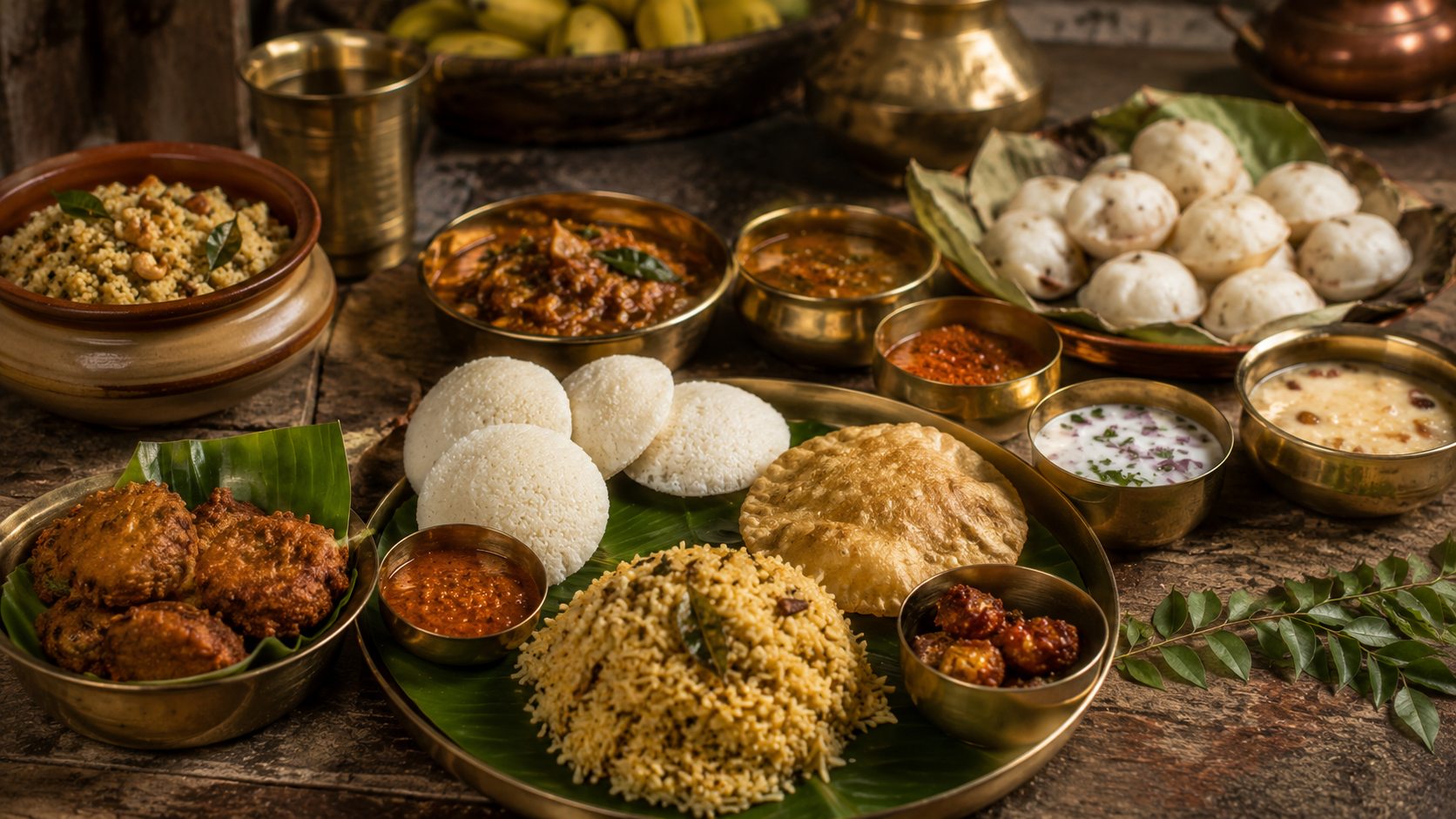
The defining preparations of Madurai.
⚙️
Unique Techniques
What this cuisine does that others do not
The parotta technique is Madurai's most specific culinary skill. Refined wheat flour is mixed with water, oil, and salt into a soft dough, then divided into balls. Each ball is rolled as thin as possible, then stretched further by swirling it on the work surface until nearly transparent. Oil is spread on the surface and the dough is pleated into a cylinder, then coiled. After resting, the coiled dough is flattened again and cooked on a hot tawa with oil. The cooking produces hundreds of distinct thin layers that separate slightly — the parotta's defining texture.
The kothu parotta technique is the second Madurai-specific skill. Cooled parotta is torn into pieces on a hot, well-oiled tawa. Two heavy metal scrapers are used simultaneously to shred, fold, mix, and press the parotta pieces against the tawa. Egg is cracked over the pieces and mixed in. Minced meat or vegetables are added and incorporated. The simultaneous two-scraper motion, producing the distinctive metallic sound, takes practice to master — the aim is to shred without reducing to mush, to mix without losing the distinct parotta pieces.
Jigarthanda preparation requires specific sourcing. The sarsaparilla syrup is made from nannari root, boiled with sugar until concentrated. Badam pisin (almond tree gum) is soaked overnight in water until it swells into soft, translucent spheres. The glass is assembled: sarsaparilla syrup at the base, soaked badam pisin in the middle, chilled milk poured over, ice cream on top. The layering is not just visual — each layer is consumed at different temperatures, creating a cooling progression through the glass.
Is Madurai the Non-Brahmin Capital of Tamil Nadu Food?
Madurai's food culture is explicitly non-Brahmin in its dominant character — parotta and meat curry rather than idli and sambar; kothu parotta and kari dosa rather than the Brahmin vegetarian standard. Chennai's Brahmin-influenced food culture (the filter coffee, the idli-dosa format, the Udupi restaurant tradition) is the internationally recognised Tamil Nadu food tradition. But Madurai's working-class non-Brahmin tradition is what most Tamils actually eat. The question of which is more 'authentically Tamil' is not answerable — both are ancient, both are deeply embedded. But the demographic reality is clear: the majority population's majority meal in Tamil Nadu is not the idli-dosa of Brahmin tiffin culture.
🔗
Relationship to Parent Cuisine
How Madurai differs from Tamil Nadu
Element
Tamil Nadu
Madurai
Primary bread
Idli and dosa — the fermented rice tradition of coastal and Brahmin Tamil Nadu
Parotta — layered wheat bread; Madurai eats parotta as its daily bread, not idli
Non-Brahmin character
Variable — Brahmin tradition strong in Chennai and Brahmin-majority areas
Dominant — Madurai's working-class non-Brahmin identity is the primary food culture
Night food culture
Variable — Chennai has some late-night food
Strong — kothu parotta until 2am defines Madurai's nights
Unique preparations
Tamil Nadu broadly — idli, dosa, sambhar, rasam
Jigarthanda, kothu parotta, kari dosa — preparations specific to Madurai
Temple influence
Present in Tamil Nadu broadly
Strong in terms of the dual food culture — sacred temple food parallel to secular street food
📅
Timeline
How this cuisine evolved
Ancient period — 2,500+ years ago
Meenakshi Amman temple established
The pilgrimage economy creates the dual food culture: Brahmin temple food and working-class non-Brahmin secular food coexisting in the same city.
The Nayak kings explicitly support artisan and working-class food culture. The parotta and meat curry tradition develops under and after this patronage.
20th century
Kothu parotta and Jigarthanda
The kothu parotta as a distinct preparation is codified in Madurai's night markets. Jigarthanda emerges from the Muslim community as a summer cooling drink and becomes the city's signature.
Present
Global recognition
Kothu parotta achieves recognition across Tamil Nadu and internationally in the Tamil diaspora. The sound of its preparation is shared globally as a specifically Madurai sonic identity.
Parotta is a layered wheat flatbread made by repeatedly folding and coiling oil-enriched refined flour dough to create hundreds of thin layers — similar in principle to puff pastry but heartier. It is Madurai's daily bread, eaten with salna (thin spiced curry) rather than rice. The specific Madurai salna is designed for parotta-dipping, not rice-mixing.
What is kothu parotta?
Kothu parotta is shredded parotta cooked on a hot iron tawa with egg, meat or vegetables, and spices — two heavy metal scrapers used simultaneously to shred and mix. The metallic clatter of the scrapers against the iron griddle at 11pm is the sound that identifies Madurai's night food scene to anyone who has heard it before.