Kongunadu — Western Tamil Nadu's Distinct Tradition
The foothills of the Western Ghats in western Tamil Nadu — Coimbatore, Erode, Salem belt — with drier climate, millet alongside rice, horsegram as an identity ingredient, and a spice philosophy distinct from both coastal Tamil Nadu and the complex Chettinad masala.
⏱ 12 min read🗓 Updated June 2026★ Sub-Regional Guide
Sub-regional identity
Kongunadu — Western Tamil Nadu's Distinct Tradition
The foothills of the Western Ghats in western Tamil Nadu — Coimbatore, Erode, Salem belt — with drier climate, millet alongside rice, horsegram as an identity ingredient, and a spice philosophy distinct from both coastal Tamil Nadu and the complex Chettinad masala.
More black pepper-forward than Chettinad; less complex; direct and agricultural
What makes it distinct
Kollu rasam, the semi-arid foothills agricultural tradition, goat-centred meat cooking
🗺
Geography
The place that made this food inevitable
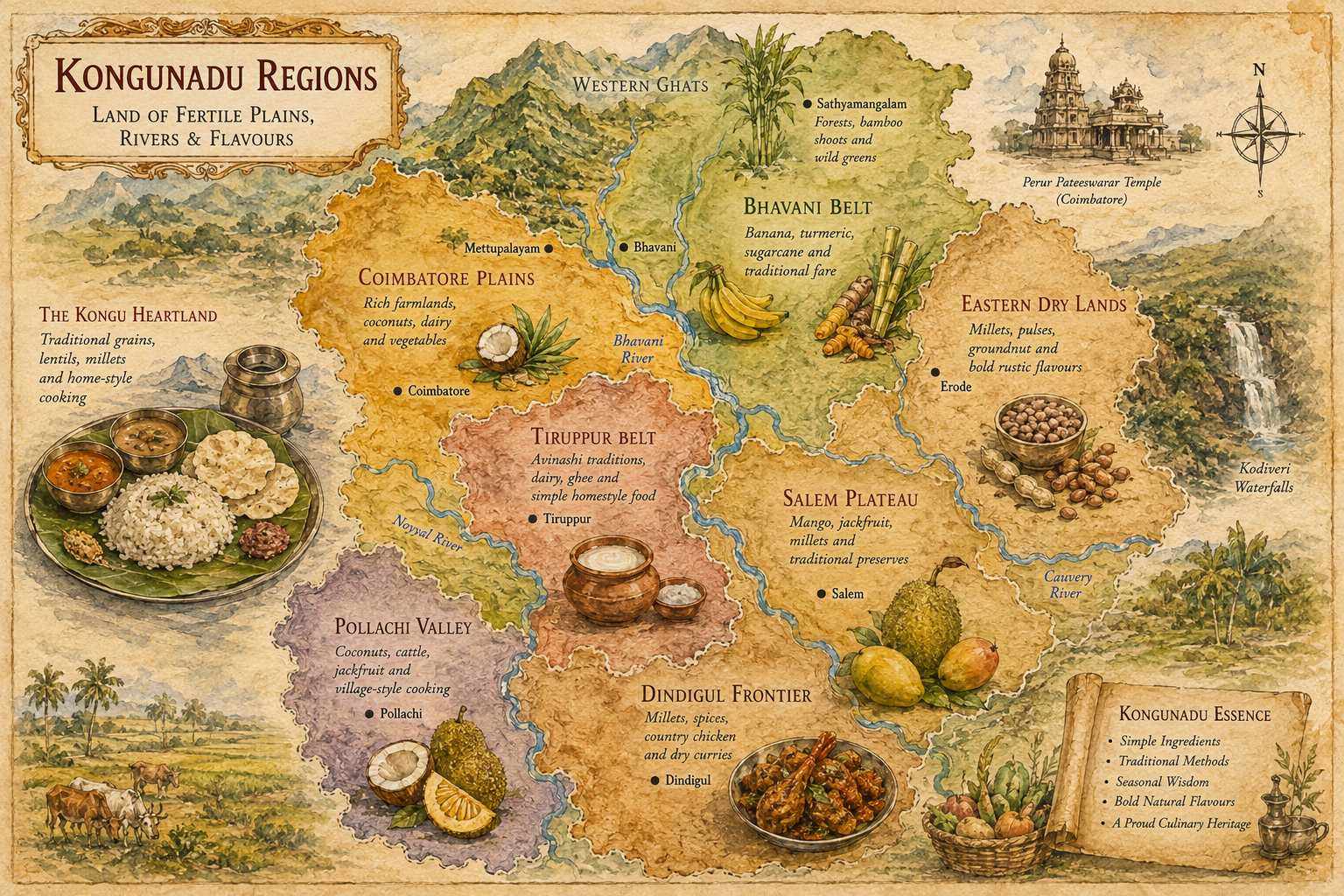
Kongunadu is the western foothills region of Tamil Nadu — the Coimbatore-Erode-Salem-Tiruppur belt, historically a zone of textile manufacturing and cotton cultivation, now one of India's most industrialised agricultural regions. The drier climate of the Western Ghats foothills (less monsoon rainfall than coastal Tamil Nadu) produces different agricultural conditions: millet and jowar alongside rice, cotton and groundnut in the dry fields, and a pastoral tradition that makes goat the primary meat rather than fish.
The geography creates a food culture that sits between the two great Tamil Nadu traditions without fully belonging to either. It is less coastal than Chennai or the Coromandel Coast food culture — no dominant fish tradition, no tamarind-and-coconut coastal rhythm. It is less complex than Chettinad — no kalpasi or marathi mokku, no 20-spice masala. What it has instead is a directly agricultural character: horsegram (kollu) as the identity lentil, black pepper as the primary heat rather than dried red chilli, and specific semi-arid produce (drumstick, specific lentil varieties, specific chilli varieties) that define the flavour.
The Coimbatore textile economy also shaped food culture: a large working-class population needed affordable, sustaining food that could be prepared quickly in urban settings. Kongunadu's restaurant culture in Coimbatore serves this population — quick, filling, direct, without the elaboration of temple or court food. The food reflects the agricultural and industrial character of the people who eat it.
Location and regional context of Kongunadu within its parent state.
📜
Historical Origins
How this cuisine became distinct from its parent
Kongunadu's food identity was shaped by the Gounder community — the dominant agricultural caste of the western Tamil Nadu foothills — and by the specific conditions of the Western Ghats semi-arid zone. The Gounder community farmed the foothills for centuries, then moved into the Coimbatore textile industry as it industrialised in the 20th century. Their food tradition reflects both: the farmers' direct relationship with specific crops (horsegram, drumstick, specific lentil varieties) and the industrial workers' need for sustaining, calorie-dense, quickly prepared food.
Horsegram (kollu) is the most distinctive Kongunadu ingredient and the clearest marker of the region's agricultural character. Kollu is a drought-resistant legume that grows in poor soils with minimal rainfall — ideal for the Western Ghats foothills. It is significantly more nutritious than toor dal or moong dal: higher protein, higher fibre, and associated in traditional Kongunadu medical practice with preventing kidney stones and aiding digestion. The kollu rasam — a thin, clear soup made from boiled horsegram water — is the most specifically Kongunadu health preparation and the dish that most distinguishes Kongunadu from other Tamil Nadu sub-regions.
The spice character of Kongunadu cooking reflects its semi-arid agricultural base. Black pepper is the primary heat source — more dominant here than in coastal Tamil Nadu, where dried red chilli has largely replaced it. The pepper grows locally in the foothills; its presence in Kongunadu cooking at higher proportions than elsewhere in Tamil Nadu is a direct consequence of local agricultural abundance. Coriander and cumin round the base. The result is a more aromatic, less intensely hot profile than Chettinad or coastal Tamil Nadu.
Horsegram — The Superfood That Mainstream India Ignored
Horsegram (kollu, Macrotyloma uniflorum) is one of the world's most nutritionally complete legumes — higher protein than toor dal, higher fibre than most lentils, and significantly higher calcium and iron. It was cultivated in the Western Ghats foothills for at least 4,000 years. It was ignored by mainstream Indian food culture because it was associated with cattle feed and with 'poor people's food' in the plains. Kongunadu never abandoned it because the foothills ecology was too dry for toor dal to grow reliably — horsegram grows in poor soils where other lentils fail. The global superfood trend has begun recognising what Kongunadu knew for millennia.
🧬
Food DNA
The flavour architecture
Kollu (Horsegram)
Kollu rasam — the identity dish — boiled horsegram water as a clear thin soup
Kollu kuzhambu — horsegram in tamarind gravy — the main lentil preparation
Kollu sundal — boiled spiced horsegram — festival and everyday snack
Meat Tradition
Goat — the primary meat — the pastoral animal of the semi-arid foothills
Country chicken (nattu kozhi) — free-range chicken — more assertive flavour than commercial breed
Semi-Arid Produce
Drumstick (murungakkai) — grown locally and used more centrally than in coastal Tamil Nadu
Raw banana — specific preparations different from coastal Tamil Nadu use
Spice Character
Black pepper — dominant heat source — higher proportion than other Tamil Nadu sub-regions
Coriander and cumin — the aromatic base — agricultural and direct
Dried coconut — used in masala preparations — less coconut milk than coastal tradition
🌿
Signature Ingredients
The ingredients that define this cuisine
Ingredient
What It Is
Flavour Character
Availability
Kollu (horsegram)
Macrotyloma uniflorum — drought-resistant legume grown in poor semi-arid soils
Earthy, slightly bitter, dense — more nutritionally complete than standard lentils
Grows in Western Ghats foothills; available throughout Tamil Nadu; little known outside South India
Drumstick (murungakkai)
Moringa oleifera — the seed pods and leaves both used
Slightly bitter, earthy — the pod flesh scooped and eaten; leaves used in sambhar and soups
Grown throughout Tamil Nadu but central to Kongunadu in a way it is not in coastal cooking
Black pepper (local)
Piper nigrum grown in Western Ghats foothills — local production at relevant altitude
The original Indian heat source — more aromatic and complex than dried red chilli
Grown in the foothills; locally available in proportion that makes it the primary rather than secondary heat
Kongunadu dried red chilli
Specific chilli variety grown in Kongunadu — different from both Guntur and Byadgi varieties
Heat with a specific earthy undertone — less intensely hot than Guntur, different flavour from Byadgi
Grown in the Kongunadu region; approximated but not exactly replicated by other Tamil Nadu chilli varieties
🍽
Signature Dishes
The dishes that cannot exist elsewhere
Dish
What It Is
Why It Matters
Kollu Rasam
Horsegram-based thin soup — the Kongunadu health food
Kollu is considered in Kongunadu traditional medicine to prevent kidney stones and aid digestion. The rasam made from boiled horsegram cooking water is the most specifically Kongunadu preparation — distinct from all other Tamil Nadu rasam.
Mutton Kuzhambu (Kongunadu)
Goat curry with Kongunadu spice base — black pepper-forward
More black pepper than Chettinad and less chilli-forward than coastal Tamil Nadu mutton preparations. The goat is the prestige protein rather than fish — reflecting the pastoral rather than coastal geography.
Kollu Kuzhambu
Horsegram in tamarind gravy — the main lentil preparation
The tamarind and horsegram combination produces a specific sour-earthy flavour distinct from toor dal kuzhambu. The horsegram's higher protein and fibre content makes it a more sustaining preparation.
Drumstick Sambar (Kongunadu style)
Sambar with drumstick as the central vegetable, Kongunadu spice proportion
Drumstick is more central to Kongunadu sambar than in coastal Tamil Nadu versions — the semi-arid foothills produce it abundantly, making it the default vegetable addition.
Kavuni Saadam (black rice)
Black rice preparations from the foothills — distinct from coastal white rice culture
The black rice varieties grown in the Kongunadu foothills appear in specific festival preparations — a reminder that the foothills had a different grain ecology from coastal Tamil Nadu
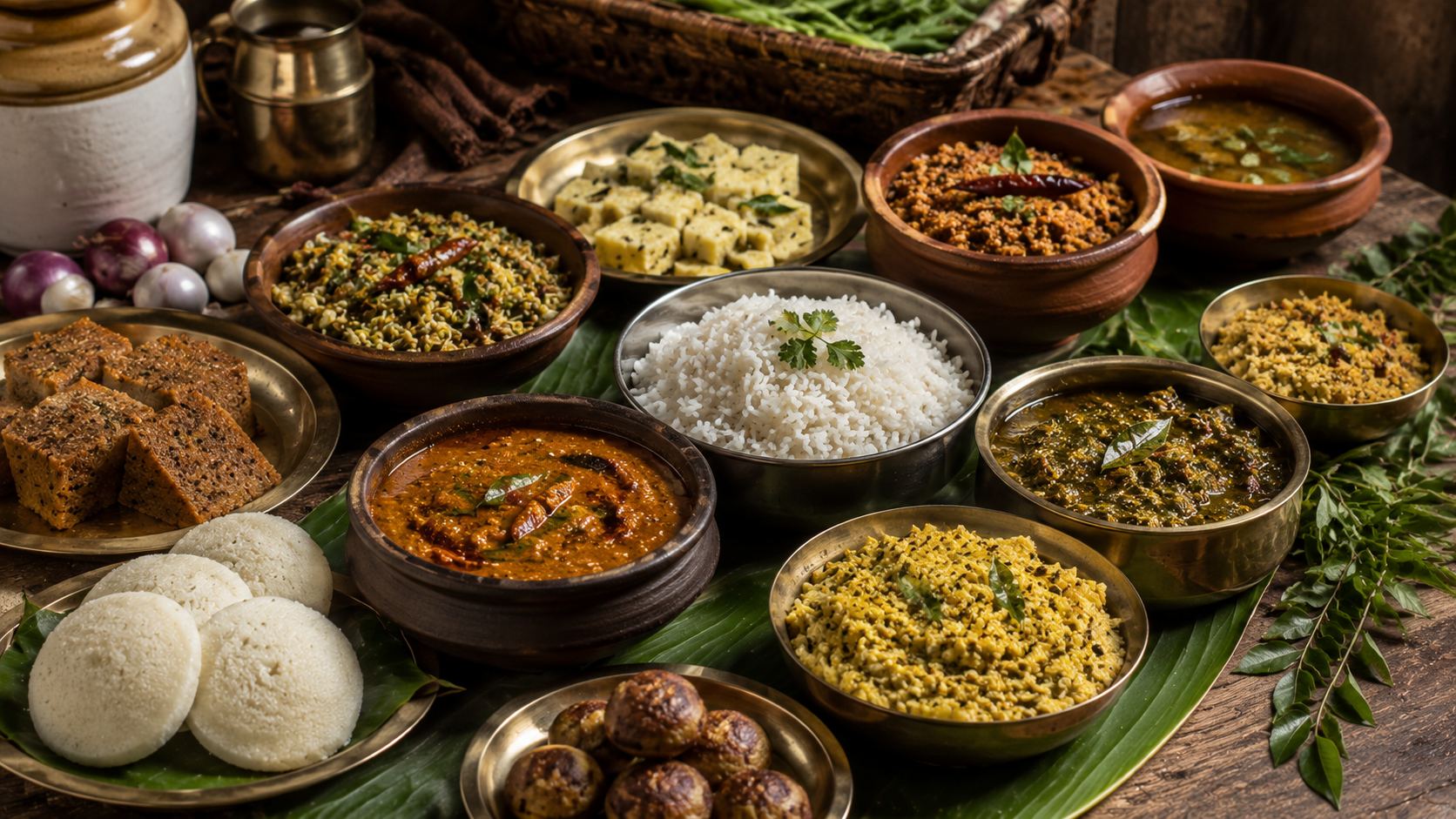
The defining preparations of Kongunadu.
⚙️
Unique Techniques
What this cuisine does that others do not
The defining Kongunadu technique is the kuzhambu philosophy — building a thick, substantial gravy from tamarind, horsegram or other lentil, and spice that serves as the main preparation rather than an accompaniment. Where coastal Tamil cooking is rice-centred with multiple small side dishes orbiting the rice, Kongunadu cooking builds one central kuzhambu of real body and nutrition. This reflects the agricultural philosophy of sustaining, direct food for working communities.
The kollu rasam technique is specifically Kongunadu. After horsegram is boiled until soft (typically 2–3 hours of long cooking), the boiling water is reserved. This cooking water, strained and spiced with black pepper, cumin, garlic, and tamarind, becomes the rasam. The horsegram itself becomes kuzhambu or sundal. Nothing is wasted. The cooking water — often discarded in other lentil preparations — is the health-bearing element in Kongunadu tradition.
The black pepper tempering is the third defining technique. Where most Tamil Nadu cooking uses dried red chilli as the primary heat in tadka, Kongunadu cooking uses black pepper alongside or instead of red chilli. The black pepper is added to hot oil early, before curry leaves and mustard seeds, producing a warm, aromatic heat that permeates the preparation differently from the sharper, more immediate heat of dried red chilli.
How Coimbatore Made Kongunadu Food Urban
Kongunadu was historically a rural, agricultural tradition — horsegram, goat, millet, and the specific produce of the Western Ghats foothills. The industrialisation of Coimbatore (one of India's largest textile manufacturing cities) through the 20th century urbanised this food culture without changing its character. The same kollu rasam that sustained Gounder farmers in the foothills became the weekday lunch of Coimbatore textile workers. The industrialisation preserved rather than diluted the food tradition — because the workers who moved from villages to Coimbatore's mills brought their food culture with them and replicated it in the city's restaurants.
🔗
Relationship to Parent Cuisine
How Kongunadu differs from Tamil Nadu
Element
Tamil Nadu
Kongunadu
Seafood presence
Strong in coastal Tamil Nadu
Minimal — landlocked foothills; goat and chicken are the proteins
Primary lentil
Toor dal dominant across Tamil Nadu
Horsegram (kollu) as a specific Kongunadu identity marker
Spice complexity
Chettinad 20+ spices to the east
More direct — black pepper dominant, fewer total spices
Primary heat
Dried red chilli across Tamil Nadu
Black pepper alongside dried chilli — the foothills proportion
Grain
Rice dominant in coastal Tamil Nadu
Rice plus jowar — millet presence reflects the drier foothills climate
📅
Timeline
How this cuisine evolved
Ancient period
Gounder agricultural community establishes foothills food culture
The semi-arid foothills farming tradition is established — horsegram, millet, goat. The specific agricultural ecology shapes the food vocabulary.
Pre-colonial
Textile economy integration
The Coimbatore textile zone develops around hand-loom weaving. Food culture reflects the working class of the textile industry — sustaining, direct, kollu and horsegram as economic protein choices.
20th century
Industrialisation of Coimbatore
The textile industry industrialises. Rural food culture moves to the urban factory environment and is preserved rather than lost — the same kollu rasam sustains factory workers as it sustained farmers.
Present
Restaurant culture recognition
Kongunadu restaurants in Coimbatore and Chennai maintain the regional identity. Kollu rasam gains health-conscious recognition nationally as a superfood preparation.
Kollu (horsegram, Macrotyloma uniflorum) is the lentil most associated with Kongunadu cooking. It is significantly more nutritious than standard lentils — higher protein, higher fibre, and associated in traditional medicine with preventing kidney stones. The horsegram rasam of Kongunadu is the most widely credited health preparation in the sub-region.
How is Kongunadu different from Chettinad?
Chettinad uses 20+ specific spices (including kalpasi and marathi mokku) in a complex masala built on Southeast Asian mercantile access. Kongunadu uses fewer spices with black pepper more dominant; horsegram rather than coconut-heavy preparations; and goat rather than chicken as the primary meat. Kongunadu is the more everyday, agricultural tradition; Chettinad is the more mercantile and complex one.