The extreme south of Tamil Nadu — Tirunelveli, Thoothukudi, Kanyakumari districts — with a food tradition defined by Tirunelveli halwa (the world's most celebrated wheat halwa), the specific river Thamirabarani's water, pearl spot fish from the backwaters, and a non-Brahmin meat tradition distinct from both Chennai and Madurai.
⏱ 13 min read🗓 Updated June 2026★ Sub-Regional Guide
Sub-regional identity
Tirunelveli — The Southernmost Kitchen
The extreme south of Tamil Nadu — Tirunelveli, Thoothukudi, Kanyakumari districts — with a food tradition defined by Tirunelveli halwa (the world's most celebrated wheat halwa), the specific river Thamirabarani's water, pearl spot fish from the backwaters, and a non-Brahmin meat tradition distinct from both Chennai and Madurai.
Extreme southern Tamil Nadu — Tirunelveli, Thoothukudi (Tuticorin), Kanyakumari districts
Defining sweet
Tirunelveli halwa — wheat halwa made specifically with Thamirabarani river water
The water claim
Halwa makers insist the Thamirabarani's specific mineral content is essential to the halwa's character
Regional identity
The southernmost distinct food tradition in India — below this is only the tip of the subcontinent
Backwater fish
Pearl spot (Karimeen) from the backwaters of Kanyakumari and coastal Thoothukudi
Non-Brahmin character
The dominant food tradition is non-Brahmin meat-eating — distinct from Chennai and Brahmin Tamil Nadu
Neighbour
Adjacent to Kerala — some coconut use similar to Kerala tradition, particularly in Kanyakumari
What makes it unique
Tirunelveli halwa; specific backwater fish; the southernmost tip's Kerala border influence
🗺
Geography
The place that made this food inevitable
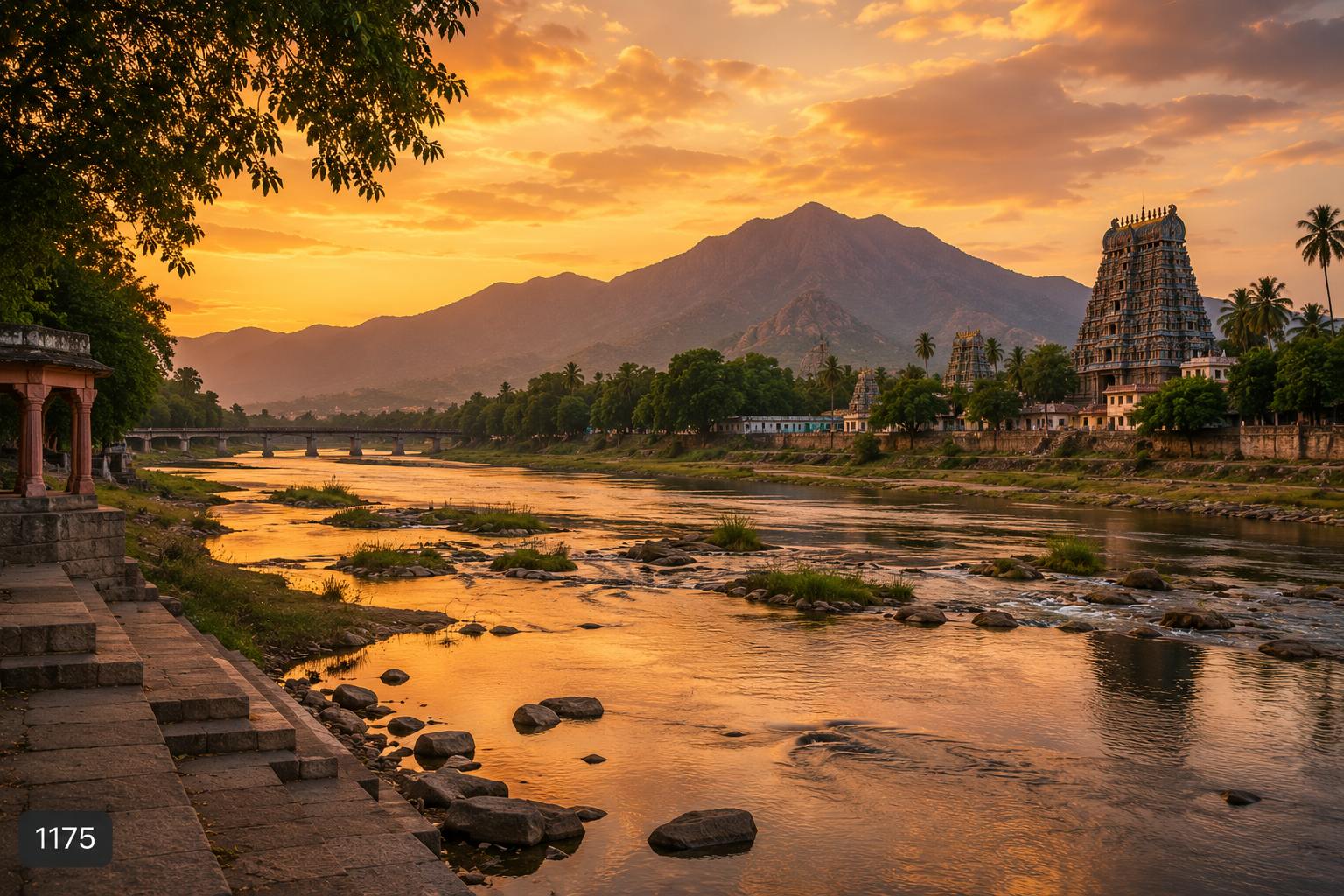
Tirunelveli district occupies the extreme south of Tamil Nadu — the land tapers toward the subcontinent's tip, with the Thamirabarani river running west to east across the district from the Western Ghats foothills to the Gulf of Mannar. The geography produces a specific ecology: the Thamirabarani is one of the few perennial rivers in Tamil Nadu (most Tamil Nadu rivers run dry in summer), fed by the Western Ghats' reliable rainfall. This perennial river produces specific agricultural conditions along its banks — and, according to the halwa makers of Tirunelveli, a specific water chemistry that is essential to the preparation of the most celebrated wheat halwa in India.
The Kanyakumari coast, at the subcontinent's southern tip where the Arabian Sea, Bay of Bengal, and Indian Ocean converge, produces specific fish that are associated with no other Indian coastal region. The Karimeen (pearl spot, Etroplus suratensis) is the prestige backwater fish of this region — also found in Kerala's backwaters across the border, which reflects the geographic reality that food cultures do not stop at political borders. The Kanyakumari belt has more in common culinarily with coastal Kerala than with northern Tamil Nadu, and the food tradition reflects this — more coconut milk, slightly different spice vocabulary, the Karimeen as a shared prestige fish.
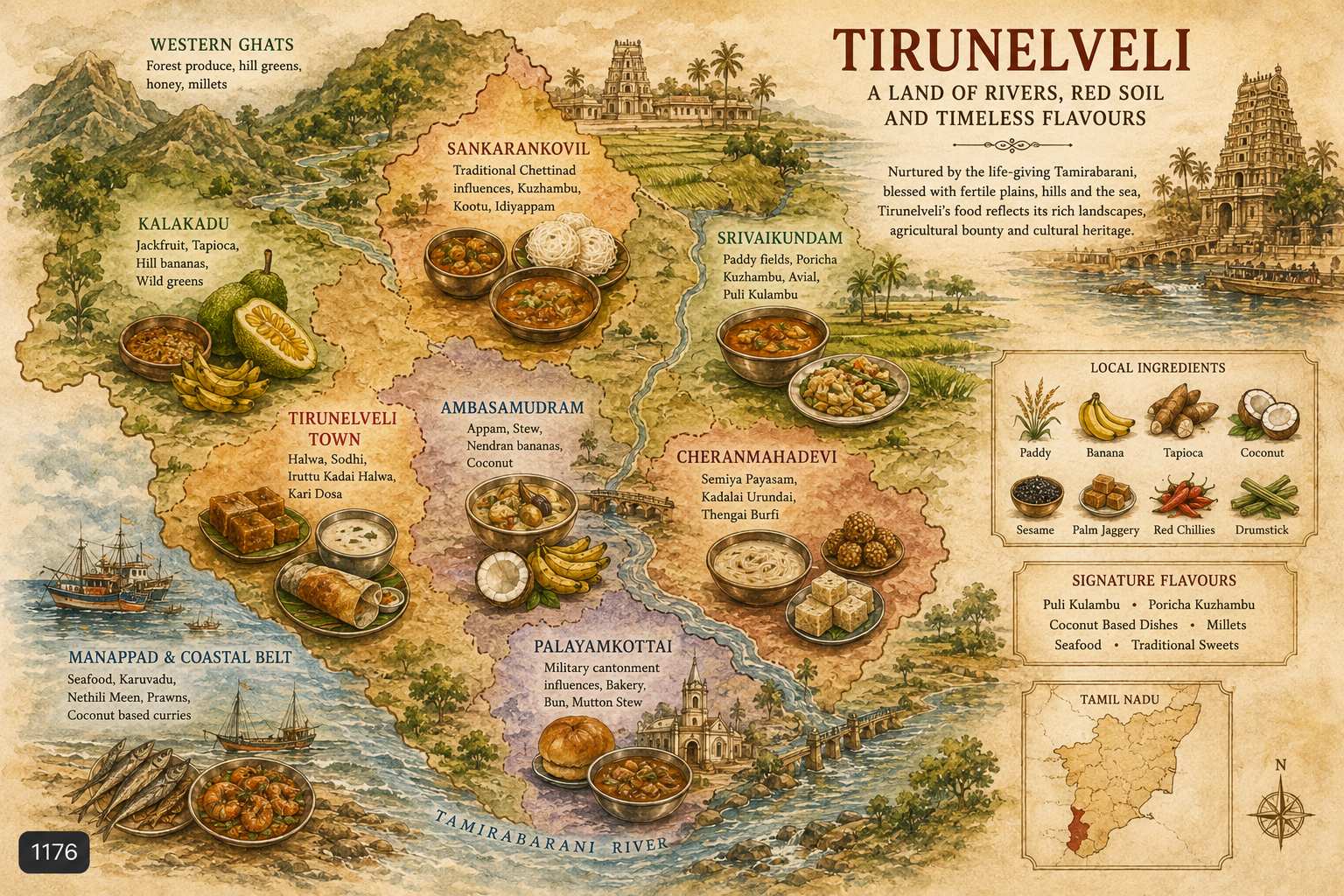
The district's position adjacent to Kerala also means that the Tirunelveli food tradition is one of the most hybridised in Tamil Nadu — incorporating Kerala coastal elements in the south (Kanyakumari), a robust non-Brahmin interior meat tradition in the centre (Tirunelveli town), and the pearl fishing and port heritage of Thoothukudi (Tuticorin) in the east. Each zone has its own food character within the broader Tirunelveli identity.
Location and regional context of Tirunelveli within its parent state.
📜
Historical Origins
How this cuisine became distinct from its parent
Tirunelveli halwa is the most geographically specific sweet in India. The claim is not merely that the best halwa is made in Tirunelveli — it is that Tirunelveli halwa made anywhere else produces a different result, because the Thamirabarani river's specific mineral composition is an active ingredient in the preparation. The halwa makers of Tirunelveli's Iruttu Kadai (Dark Shop) — a sweet shop that has operated by candlelight without electric lighting for over 100 years — have refused to open branches outside the city, citing this water dependency.
The halwa itself is made from wheat flour (maida), ghee, sugar, and Thamirabarani water — no artificial colour, no flavouring beyond the specific wheat-ghee-sugar combination. The technique involves continuous stirring of the wheat flour paste in a large vessel with ghee being added progressively over 3–4 hours, until the mixture transforms from a pale paste to a translucent, deep amber, intensely rich confection. The transformation from raw wheat flour to the finished halwa depends on the Maillard reaction operating slowly and continuously — too high heat and the flour scorches; too low and the transformation does not occur. The ideal is continuous medium-low heat with continuous stirring for the full duration.
The non-Brahmin meat tradition of Tirunelveli — primarily associated with the Nadar, Mudaliar, and Thevar communities who historically dominated the town's commercial life — uses a spice vocabulary distinct from both Chennai and Madurai. The dried red chilli varieties grown in southern Tamil Nadu have different heat and colour profiles from those of the north; the specific preparations (kari meenkulambu, the fish curries; the specific mutton preparations) use these local chilli varieties in ways that reflect the southernmost Tamil food tradition.
Iruttu Kadai — The Dark Shop That Refuses to Modernise
The Iruttu Kadai (literally, Dark Shop) in Tirunelveli has operated by the light of oil lamps for over 100 years, refusing to install electric lighting despite the modernisation of everything around it. The owners maintain this practice as a tradition and as an identity marker — the dark shop's halwa is the original; establishments with electric lighting are adaptations. The shop sells out its entire production most days without advertising or delivery, purely by the reputation of the Tirunelveli halwa tradition. It represents the kind of hyper-local food specialisation that the internet age has brought to global attention — the most specific possible identity for the most specific possible product.
🧬
Food DNA
The flavour architecture
The Halwa Tradition
Tirunelveli halwa — wheat halwa made with Thamirabarani water — the defining preparation
Therattipal — condensed milk sweet — the Tamil Nadu version of milk fudge
Kozhukattai — steamed rice dumplings — the festival sweet of the region
The Backwater Fish
Karimeen (pearl spot) — the prestige backwater fish — shared with Kerala across the border
Nethili (anchovies) — abundant in the coastal waters — fried or in fish pickle
Red snapper and kingfish — from the Gulf of Mannar — the prestige sea fish
Non-Brahmin Meat Tradition
Mutton kari — in local southern Tamil Nadu spice — distinct from Chennai and Madurai
Country chicken — the everyday meat
Egg preparations — in the working-class food culture of Tirunelveli town
Southern Border Influence
Coconut milk (Kerala influence) — more coconut milk than northern Tamil Nadu — Kanyakumari's Kerala border shows
Appam — the Kerala lace-crepe bread appears in Kanyakumari district cooking
Stew (Kerala-influenced) — mild coconut milk vegetable stew at the border zone
🌿
Signature Ingredients
The ingredients that define this cuisine
Ingredient
What It Is
Flavour Character
Availability
Maida (refined wheat flour)
The base of Tirunelveli halwa — not semolina or rice flour as in other regional halwas
Neutral starch that transforms through extended ghee cooking — its specific gluten character is essential
Available everywhere; the technique of slow transformation from raw flour to amber confection is the art
Thamirabarani river water
Specific mineral-content water from the perennial river flowing through Tirunelveli
Mineral character claimed to affect the halwa's texture and flavour — the specific claim the halwa makers make
Available only at the source; the claim cannot be objectively verified but the halwa's reputation is the evidence
Karimeen (pearl spot)
Etroplus suratensis — backwater fish of the southern coastal zone and Kerala
Rich, firm white flesh; specific backwater character — slightly earthy from the brackish water habitat
Found in Kerala and Kanyakumari district backwaters; the fish is not a sea fish but a backwater species
Southern Tamil Nadu dried red chilli
Specific chilli varieties grown in southern Tamil Nadu — different from Guntur or Byadgi
Hot with a specific southern Tamil character — slightly earthy, different colour from Kashmiri or Guntur
Grown in southern Tamil Nadu; the local character distinguishes the southern Tamil preparations from northern Tamil Nadu
🍽
Signature Dishes
The dishes that cannot exist elsewhere
Dish
What It Is
Why It Matters
Tirunelveli Halwa
Wheat halwa made with maida, ghee, sugar, and Thamirabarani water — slow-cooked for 3–4 hours
The most geographically specific sweet in India. The claim that the water is an active ingredient cannot be easily dismissed — the best Tirunelveli halwa has a texture and character that the most skilled halwa-makers outside the city cannot fully replicate.
Karimeen Fry (Pearl Spot)
Pearl spot marinated and shallow-fried or cooked in coconut milk gravy
The prestige fish of the extreme south. The Kanyakumari preparation uses more coconut than the rest of Tamil Nadu, reflecting the Kerala influence at the border. The fish's firm flesh holds in both frying and curry formats.
Mutton Kari (Tirunelveli style)
Mutton in southern Tamil Nadu masala — drier than Chennai, different from Madurai
The dry mutton preparation of Tirunelveli uses local dried red chilli varieties and a coconut-based masala that produces a semi-dry curry different from the wetter gravies of northern Tamil Nadu.
Nethili Fry (Anchovy)
Tiny anchovies fried whole — bones and all, in southern Tamil Nadu style
The most common affordable fish of the Thoothukudi coast. The preparation is pure and direct — marinated briefly, fried at high heat, eaten whole. One of India's most perfectly direct fish preparations.
Iruttu Kadai Halwa
The specific halwa of the Dark Shop — prepared under oil lamp light, sold daily until it runs out
The most specific food preparation in Tamil Nadu — a specific sweet, from a specific shop, made with specific water, sold under specific lighting conditions. Identity so specific that any change would destroy what makes it what it is.
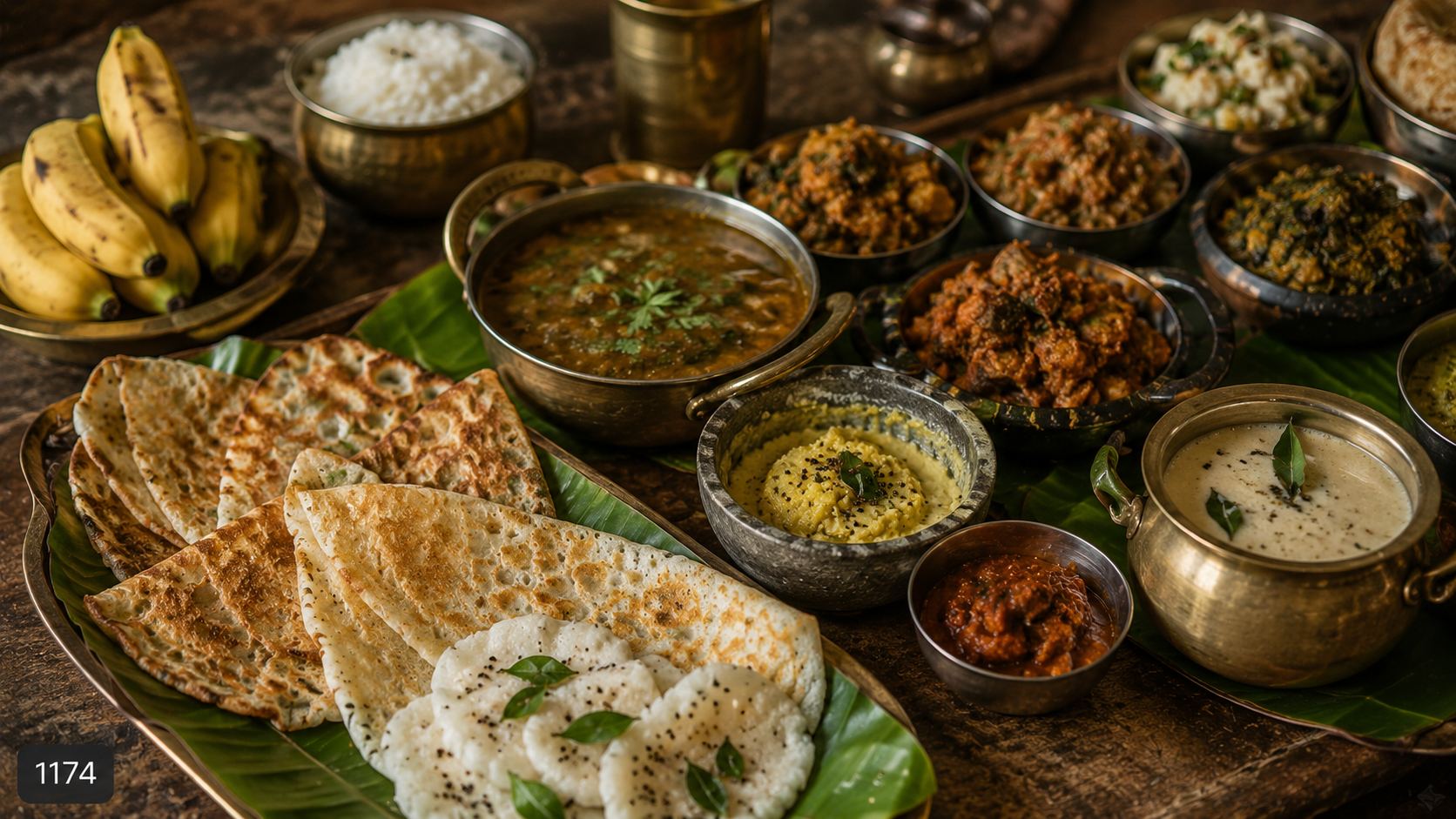
The defining preparations of Tirunelveli.
⚙️
Unique Techniques
What this cuisine does that others do not
The Tirunelveli halwa technique requires specific equipment and patience. A large, heavy-bottomed vessel (traditionally brass or iron) is placed over a medium flame. Maida is dissolved in Thamirabarani water until smooth, then strained. The strained batter is poured into the vessel and stirred continuously as it heats. Ghee is added gradually — not all at once — as the batter begins to thicken and lose its raw character. The continuous stirring must cover the entire bottom of the vessel to prevent sticking and ensure even heat distribution. The colour change progresses: pale yellow, then golden, then deep amber — the deepening colour tracking the Maillard reaction's progress. The total time, from raw batter to finished halwa, is 3–4 hours of continuous stirring. This is not a preparation that can be interrupted.
The karimeen preparation technique reflects the Kerala border influence. The fish is first scored deeply on both sides — the scoring allows the marinade and the cooking medium to penetrate the flesh more quickly, which matters for a fish cooked in coconut milk where overlong cooking would reduce the milk and change the gravy's character. The fish is marinated in a paste of red chilli, coriander, cumin, and turmeric, then cooked in coconut milk at a gentle simmer until just cooked through. The coconut milk is added in two stages: the thin second extract for cooking, the thick first extract to finish — the two-stage addition that Mangalorean fish cooking also uses, preserving the richness of the first extract by avoiding high-heat breakdown.
The nethili (anchovy) fry technique is the simplest and most direct in the southern Tamil tradition. The tiny fish are rinsed and patted dry. A marinade of red chilli powder, turmeric, salt, and sometimes coriander powder is applied by hand and left for 15–20 minutes. Oil is heated to high temperature in a flat tawa. The marinated fish are added in a single layer without crowding — crowding lowers the oil temperature and produces steamed rather than fried fish. The high-heat fry takes 2–3 minutes per side. The result is crisp from skin to fin, with the bones so small they eat without notice. The fish disappears: only the crisp, flavoured shell remains.
The Thamirabarani Water Claim — Fact or Food Myth?
The Tirunelveli halwa-makers' claim that the Thamirabarani river's specific water is essential to the halwa's character is impossible to completely verify or dismiss. Water chemistry affects starch gelatinisation, gluten development, and the Maillard reaction — all processes relevant to halwa production. The Thamirabarani is one of Tamil Nadu's few perennial rivers with a specific mineral composition from the Western Ghats granite catchment area. Whether this specific composition produces a measurable and irreplaceable difference in the final halwa, or whether it is a powerful story that sustains a specific geography's food identity, is a question that only rigorous controlled testing could answer. The halwa makers are not interested in the test. The reputation is their answer.
🔗
Relationship to Parent Cuisine
How Tirunelveli differs from Tamil Nadu
Element
Tamil Nadu
Tirunelveli
Primary sweet
Pongal, payasam — standard Tamil Nadu sweets
Tirunelveli halwa — the most geographically specific sweet in India
Coastal fish
Bay of Bengal fish from the Coromandel coast (eastern Tamil Nadu)
Gulf of Mannar fish and Kanyakumari backwater fish — the southern sea
Brahmin food culture present throughout Tamil Nadu
Non-Brahmin dominant in Tirunelveli's commercial food culture
Regional fame
Tamil Nadu's nationally known food is Chennai and Chettinad
Tirunelveli known primarily for the halwa — the most specific possible fame
📅
Timeline
How this cuisine evolved
Ancient period
Tirunelveli established as southern Tamil centre
The Thamirabarani river valley produces the agricultural base. The town develops as a southern Tamil trading centre — the pearl fishery of Thoothukudi and the river agriculture of Tirunelveli form the economic base.
Pre-colonial
Halwa tradition develops
The wheat halwa tradition arrives with Muslim trading communities — the sweet has Persian origins. Tirunelveli's version adapts to local ingredients (Thamirabarani water, locally produced ghee) and produces the specific preparation.
Colonial period
Iruttu Kadai established
The Dark Shop begins its century-long operation by oil lamp. The Tirunelveli halwa tradition reaches the form in which it is now known.
Present
National recognition
Tirunelveli halwa achieves national recognition through food tourism and online ordering. The Iruttu Kadai becomes a destination for food tourists from across Tamil Nadu and beyond.
Tirunelveli halwa is a wheat halwa made from maida (refined wheat flour), ghee, sugar, and Thamirabarani river water — slow-cooked for 3–4 hours with continuous stirring until the batter transforms from pale to deep amber. The halwa makers claim the river's specific mineral content is essential to the character. The most geographically specific sweet in India.
What is the Iruttu Kadai?
The Iruttu Kadai (Dark Shop) is a sweet shop in Tirunelveli that has operated by oil lamp and candle light for over 100 years, refusing to install electric lighting. It sells only Tirunelveli halwa and sells out its entire daily production most days without advertising or delivery. The most extreme expression of hyper-local food identity in Tamil Nadu.