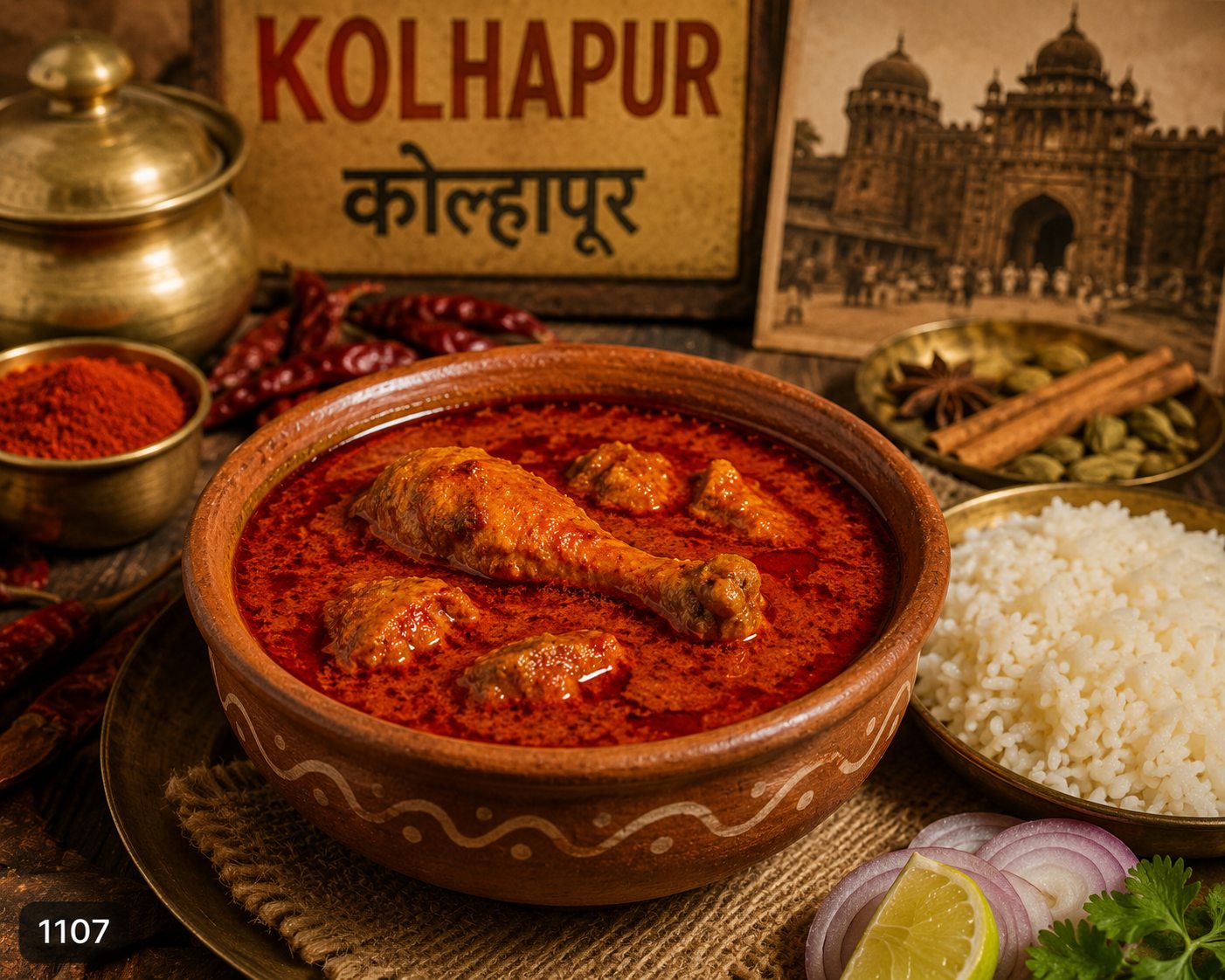
Kolhapur is a city of wrestlers, leather craft, and the most intensely spiced food in Maharashtra. The kala masala — a dark, deeply roasted spice blend — and Kolhapuri chillies produce curries of genuine heat and depth that stand apart from everything else in the state.
⏱ 12 min read🗓 Updated June 2026★ Sub-Regional Guide
Kolhapur is a city of wrestlers, leather craft, and the most intensely spiced food in Maharashtra. The kala masala — a dark, deeply roasted spice blend — and Kolhapuri chillies produce curries of genuine heat and depth that stand apart from everything else in the state.
Kolhapur district, southern Maharashtra — near Karnataka border, semi-arid interior
Known for
Wrestling culture, leather industry, kolhapuri chappals (sandals), and Maharashtra's boldest food
Defining spice blend
Kala masala — dark, deeply roasted, smoky and complex
Chilli type
Kolhapuri chilli — specific variety grown in the region; different heat and colour from standard
Community
Maratha warrior tradition — Kunbi, Mahar, and other communities with robust non-vegetarian cooking
Character
Working class, meat-forward, genuinely hot — not the subtle complexity of Pune or the coastal richness of Konkan
Defining dish
Tambda rassa — mutton in red kala masala curry; pandhra rassa — white mutton curry
Cultural context
Kolhapur is associated with traditional wrestling (akhada culture) — the food reflects the caloric needs of physical culture
🗺
Geography
The place that made this food inevitable
Kolhapur sits in the southern Deccan plateau near the Karnataka border — geographically distant from coastal Konkan and culturally distinct from Pune's Brahmin-influenced cooking. The city's geography — hot and dry semi-arid interior, one of Maharashtra's most intensely warm regions — produces a food culture built on bold spicing, high caloric density, and meat-forward preparation suited to the physically demanding life of the traditional wrestler and leatherworker communities that have defined Kolhapur's identity.
The Kolhapuri landscape — rolling semi-arid hills, cotton and jowar (sorghum) cultivation, limited fresh produce in the hottest months — pushes cooking toward preserved and dried ingredients alongside seasonal fresh ones. The kala masala, with its dark-roasted dried ingredients, is itself a preservation technology: heavily roasted spices have lower moisture content and can be stored longer in heat without deteriorating. The extreme roasting that produces kala masala's flavour is also the technique that makes it shelf-stable.
The proximity to Karnataka produces some culinary exchange — Kolhapuri cooking shares certain spice elements with neighbouring Karnataka's non-Brahmin tradition. But the kala masala and the specific Kolhapuri chilli variety make the cuisine fundamentally distinct. The cultural identity of Kolhapur — wrestlers, artisans, a specific Maratha warrior pride — embedded in the food a philosophy of unapologetic boldness that separates it from both coastal Maharashtra's coconut richness and Pune's historical Brahmin restraint.
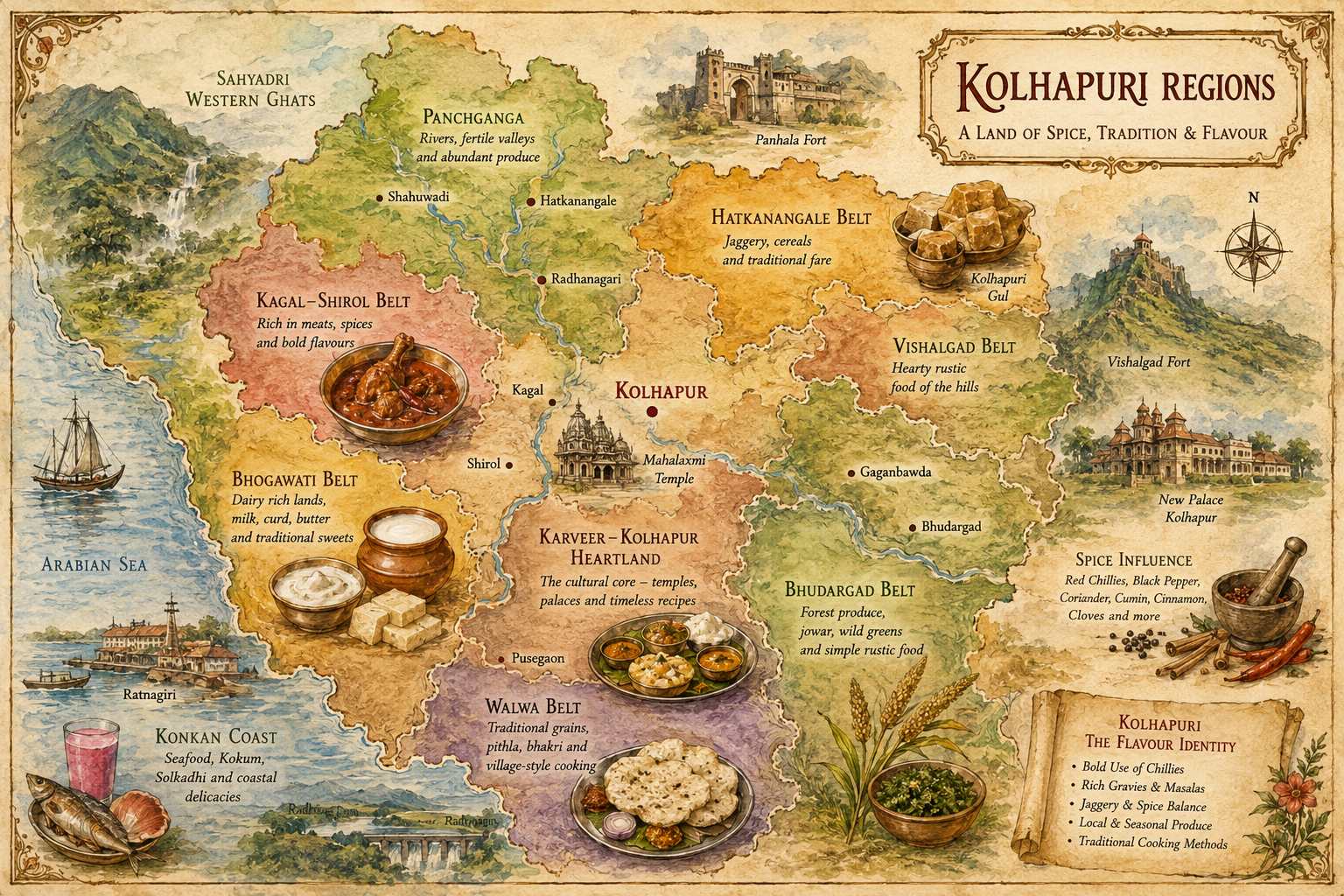
Location and regional context of Kolhapuri Cuisine within its parent state.
📜
Historical Origins
How this cuisine became distinct from its parent
The Kolhapuri food identity is built on the Maratha warrior tradition — the same cultural force that produced Chhatrapati Shivaji Maharaj's empire in the 17th century. The warrior community required sustaining, high-calorie food with bold flavouring suited to military and physical demands. The specific Kolhapuri chilli variety — grown in the region for generations — and the specific kala masala development gave this warrior-community food tradition its defining markers.
The kala masala is not a standardised product — every household and restaurant has its own version, varying in the proportion of dried coconut darkness, chilli quantity, and specific spice ratios. But all versions share the fundamental characteristic: dried coconut roasted until very dark (nearly but not quite burned), sesame toasted deep gold, and Kolhapuri chilli in proportions that produce genuine heat. The extreme roasting produces a spice blend with a smoky, deep, complex character unlike any other Maharashtra preparation.
The wrestling (akhada) culture of Kolhapur — which produced Maharashtra's most celebrated traditional wrestlers and is still active today — embedded a specific food-for-physical-performance tradition: tambda rassa (the bold red mutton curry) eaten after morning training, pandhra rassa (white mutton curry) as a lighter counterpoint, and the jowar bhakri that provides the sustained energy of complex carbohydrate. This is not restaurant food — it is fuel, elevated to an art form by the quality of the kala masala.
The Kala Masala Roasting Process
Kala masala's defining characteristic is the darkness of the roast — darker than any other Maharashtra masala. The dried coconut is roasted until it is very dark brown, approaching but not reaching black (the distinction matters: scorched coconut is bitter; deeply roasted coconut is smoky and complex). The Maillard reaction at high heat produces hundreds of flavour compounds that do not exist in lighter-roasted coconut. The sesame is toasted until deep gold. The Kolhapuri chilli is dry-roasted separately. The combination, ground together, produces a masala of extraordinary depth that takes weeks of practice to get right.
🧬
Food DNA
The flavour architecture
Kala Masala (the heart of Kolhapuri)
Dried coconut (dark-roasted) — the defining element — roasted until very dark, producing smoky complexity
Sesame seeds — toasted deep gold — provides the base richness
Kolhapuri dried red chilli — the specific local variety — different heat and colour character
Coriander, cumin, black pepper — the standard masala base, heavily roasted
Meat Proteins
Mutton — the prestige meat — both tambda (red) and pandhra (white) rassa versions
Chicken — everyday Kolhapuri — in full kala masala
Egg — in misal and specific preparations
Grain Base
Jowar (sorghum) — the staple semi-arid millet — bhakri (thick flatbread) eaten with the curries
Wheat bhakri — second option in Kolhapuri daily cooking
The Kolhapuri Table
Tambda rassa — red mutton curry — kala masala with coconut milk and Kolhapuri chilli
Pandhra rassa — white mutton curry — coconut milk without the dark roasted masala
Matki usal — moth bean curry — the everyday lentil preparation with kala masala
🌿
Signature Ingredients
The ingredients that define this cuisine
Ingredient
What It Is
Flavour Character
Availability
Kolhapuri dried red chilli
Specific chilli variety grown in Kolhapur region — different from standard Maharashtra varieties
Hot, with a specific colour and flavour profile distinct from Guntur or Byadgi chillies
Primarily grown in Kolhapur region; approximated but not exactly replicated by other red chillies
Dark-roasted dried coconut
Dried coconut grated and roasted until very dark brown — the kala masala's defining ingredient
Smoky, complex, deep — the Maillard compounds from extreme roasting produce flavours absent in lighter roasts
Available; the technique of extreme roasting without burning is the skill, not the ingredient
Kala masala (blended)
The complete Kolhapuri spice blend — home-made or purchased from Kolhapur vendors
Smoky, hot, complex — a depth that standard Maharashtra goda masala cannot approximate
Available from specialist Maharashtra vendors; the Kolhapur-made version differs from commercial approximations
Jowar (sorghum) bhakri
Thick sorghum flatbread — the staple bread of the semi-arid Deccan interior
Nutty, dense, more nutritious than refined wheat roti — the bread that suits the wrestler's caloric needs
Common throughout Maharashtra's interior; the Kolhapuri version is specifically associated with kala masala preparations
🍽
Signature Dishes
The dishes that cannot exist elsewhere
Dish
What It Is
Why It Matters
Tambda Rassa
Mutton in red kala masala curry — the defining Kolhapuri preparation
The kala masala's dark roasting produces a surprisingly bright red colour from Kolhapuri chilli. Served alongside pandhra rassa — the red-white pairing is Kolhapur's most celebrated presentation.
Pandhra Rassa
White mutton curry — coconut milk without kala masala, the gentle counterpart
The same meat as tambda rassa, in a white coconut milk gravy without the dark roasted masala. Served together they represent Kolhapur's full flavour range — bold heat alongside gentle richness.
Kolhapuri Misal
Sprouted moth bean curry in fierce kala masala gravy — Maharashtra's most popular dish, Kolhapuri edition
Significantly hotter and darker than the Pune or Mumbai versions. The kala masala transforms the standard Maharashtra misal into a Kolhapuri statement.
Jowar Bhakri with Kala Masala
Thick sorghum flatbread eaten with the bold curries
The bread-masala pairing is the Kolhapuri daily meal. The jowar bhakri's nutty density suits the bold, rich kala masala curries in a way that refined wheat roti does not.
Thalipeeth (Kolhapuri)
Multi-grain spiced flatbread — the Kolhapuri version with added spices
The semi-arid plateau staple — multiple grains ground together, spiced with the Kolhapuri vocabulary, cooked on a hot tawa with oil. Nutritionally dense, filling, suited to the working day.
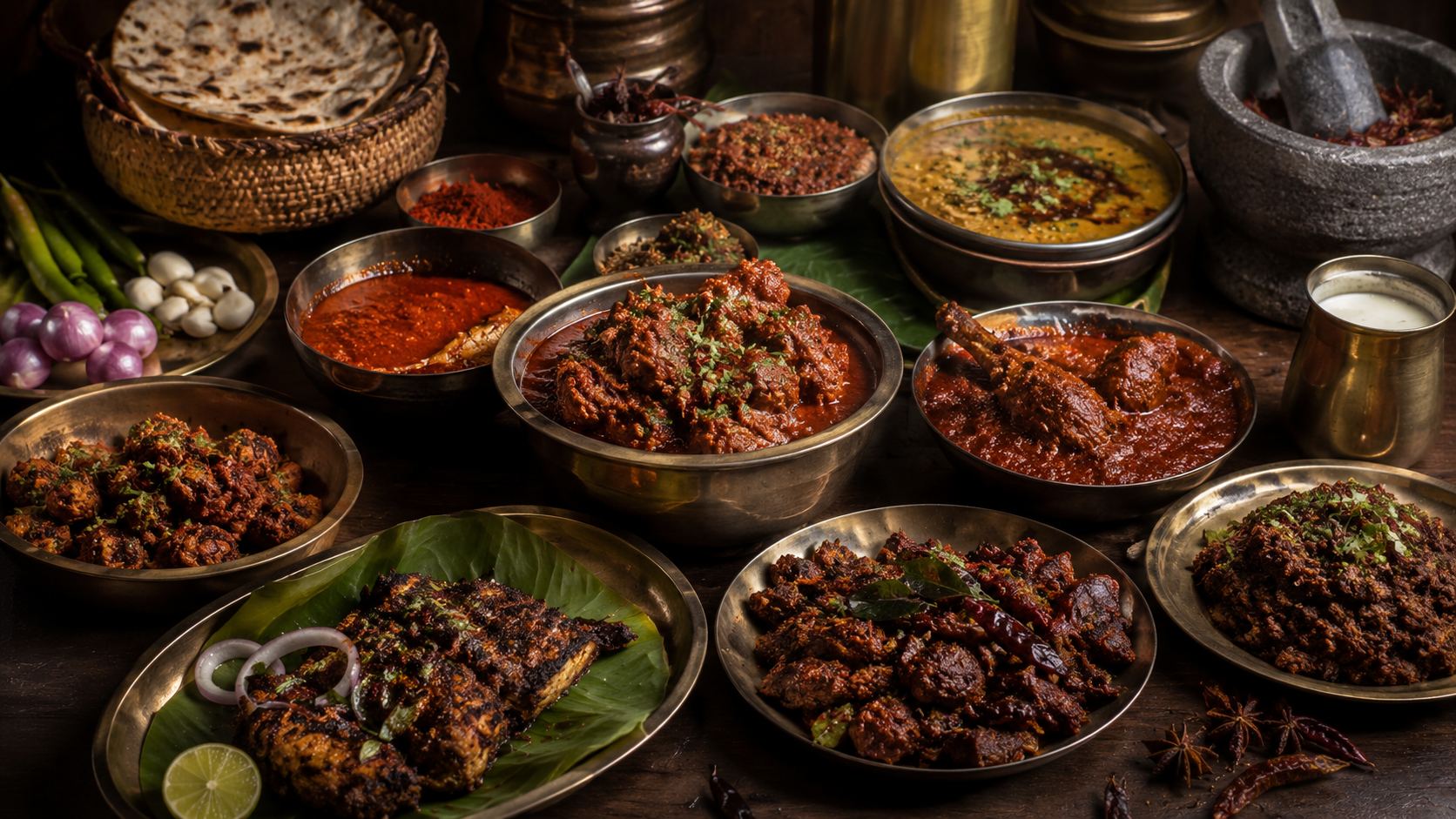
The defining preparations of Kolhapuri Cuisine.
⚙️
Unique Techniques
What this cuisine does that others do not
The kala masala technique is the defining Kolhapuri culinary process. The extreme roasting — taken to a darkness that most Maharashtra cooking deliberately avoids — requires precise attention. The dried coconut is added first, stirred continuously over medium-high heat until it reaches a very dark brown. Then sesame is added. Then the dried Kolhapuri chilli. Then coriander and cumin. Each ingredient has a different roasting time and burns at a different temperature — the cook must manage multiple roasting stages simultaneously without allowing any ingredient to cross from dark to scorched.
The combination of tambda and pandhra rassa — served simultaneously, representing the full red-white spectrum of Kolhapuri meat cooking — is the most theatrically presented Kolhapuri meal format. The two curries in adjacent bowls represent the cuisine's range: aggressive heat and bold spicing (tambda) alongside gentle coconut richness (pandhra). Eating them together, alternating between the two, is the correct way to experience Kolhapuri meat cooking.
The jowar bhakri pairing technique is also specific to this cuisine. The thick sorghum flatbread is broken by hand and used to scoop the rassa curry — the density of the bhakri matching the richness of the kala masala curry. Refined wheat roti would become soggy under the bold kala masala gravy; the jowar bhakri's sturdier texture holds up and provides the carbohydrate ballast suited to the meal's caloric ambition.
Is Kolhapuri the Hottest Food in Maharashtra?
By most measures, yes — Kolhapuri is consistently the most intensely spiced cooking in Maharashtra, and among the hotter regional cuisines in all of India. The specific Kolhapuri chilli variety, the kala masala's high chilli proportion, and the warrior-tradition philosophy of bold unapologetic flavouring combine to produce genuine, sustained heat. However, Kolhapuri cooks would dispute the framing of their cuisine as primarily about heat. The kala masala's smoke, depth, and complexity are the primary achievement — the heat is the consequence of ingredient quality and proportion, not the goal. The goal is depth. The heat is the byproduct.
🔗
Relationship to Parent Cuisine
How Kolhapuri Cuisine differs from Maharashtra
Element
Maharashtra
Kolhapuri Cuisine
Spice intensity
Goda masala — sweet, aromatic, moderate in heat
Kala masala — dark, smoky, intensely spiced, genuinely hot
Coconut use
Fresh coconut milk (coastal) or moderate dried coconut
Dark-roasted dried coconut — the extreme roasting transforms the ingredient
Bread
Wheat roti and bhakri (variable)
Jowar bhakri — the semi-arid plateau bread, suited to bold curries
Cultural identity
Mumbai cosmopolitan, Pune historically Brahmin-influenced
Chhatrapati Shivaji Maharaj's military campaigns spread from the Kolhapur region. The warrior community's food philosophy — bold, sustaining, high-calorie — is embedded in regional identity.
18th–19th century
Kala masala tradition codifies
Kolhapuri cooking develops its specific dark-roasted masala tradition distinct from coastal Maharashtra and Pune. The kala masala becomes the defining regional marker.
20th century
Wrestling culture and akhada food tradition
Kolhapur becomes Maharashtra's most celebrated wrestling centre. The akhada food tradition — tambda rassa as the wrestler's daily meal — embeds the cuisine in physical culture.
Present
National recognition
Kolhapuri restaurants appear in Mumbai and across Maharashtra. Tambda-pandhra rassa achieves recognition as Maharashtra's boldest culinary expression.
Kala masala is Kolhapur's signature spice blend — dried coconut roasted until very dark brown, sesame seeds toasted deep gold, Kolhapuri dried red chilli, and standard masala spices ground together. The extreme roasting produces a smoky, deep, complex spice blend that is the defining element of Kolhapuri cooking.
What is tambda and pandhra rassa?
Tambda rassa is Kolhapuri mutton in red kala masala curry — the bold, hot version. Pandhra rassa is white mutton curry in coconut milk without the dark masala — the gentle version. Served together as a pair, they represent Kolhapuri cooking's full flavour range. The pairing is the standard Kolhapuri restaurant presentation.