The semi-arid cotton belt of eastern Maharashtra — Nagpur, Amravati, Wardha — with a food tradition that is drier, less coconut-dependent, and more influenced by its Andhra Pradesh and Madhya Pradesh neighbours than by coastal Maharashtra.
⏱ 12 min read🗓 Updated June 2026★ Sub-Regional Guide
Sub-regional identity
Vidarbha — Maharashtra's Forgotten Interior
The semi-arid cotton belt of eastern Maharashtra — Nagpur, Amravati, Wardha — with a food tradition that is drier, less coconut-dependent, and more influenced by its Andhra Pradesh and Madhya Pradesh neighbours than by coastal Maharashtra.
Semi-arid cotton belt of the Deccan plateau — dry, hot summers, limited coastal influence
Neighbours
Andhra Pradesh to the south, Madhya Pradesh and Chhattisgarh to the north and east
Distance from coast
600km+ from the Arabian Sea — the furthest from the coast of any Maharashtra region
Defining ingredient
Peanuts — the dry-land crop that substitutes for coastal coconut
Character
Dry preparations over coconut-milk gravies; chilli-forward; more Andhra than coastal Maharashtra in spice philosophy
Nagpur identity
Oranges (the national symbol of Nagpur) and Nagpur Saoji cuisine — its own sub-tradition
What makes it unique
Maharashtra without the coast — proving how much of coastal Maharashtra's identity comes from coconut and Arabian Sea fish
🗺
Geography
The place that made this food inevitable
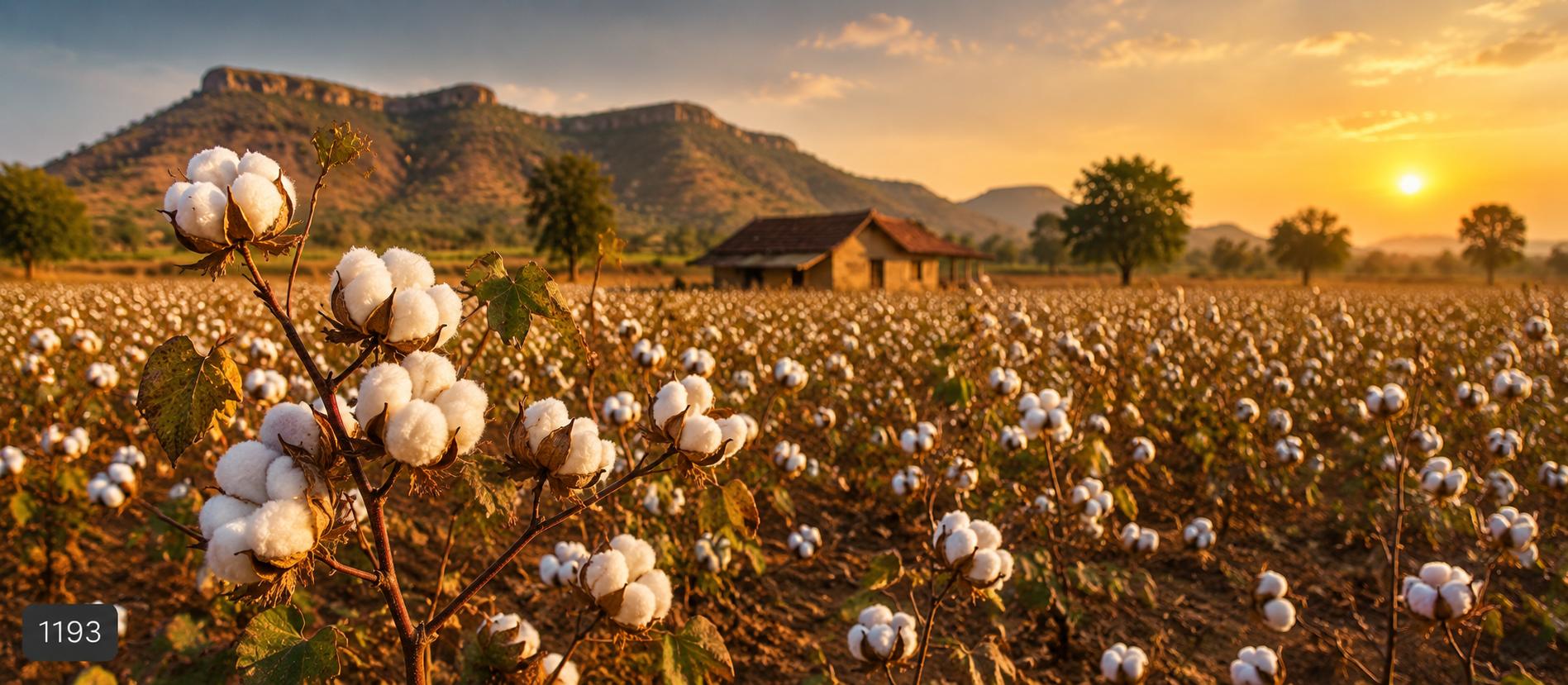
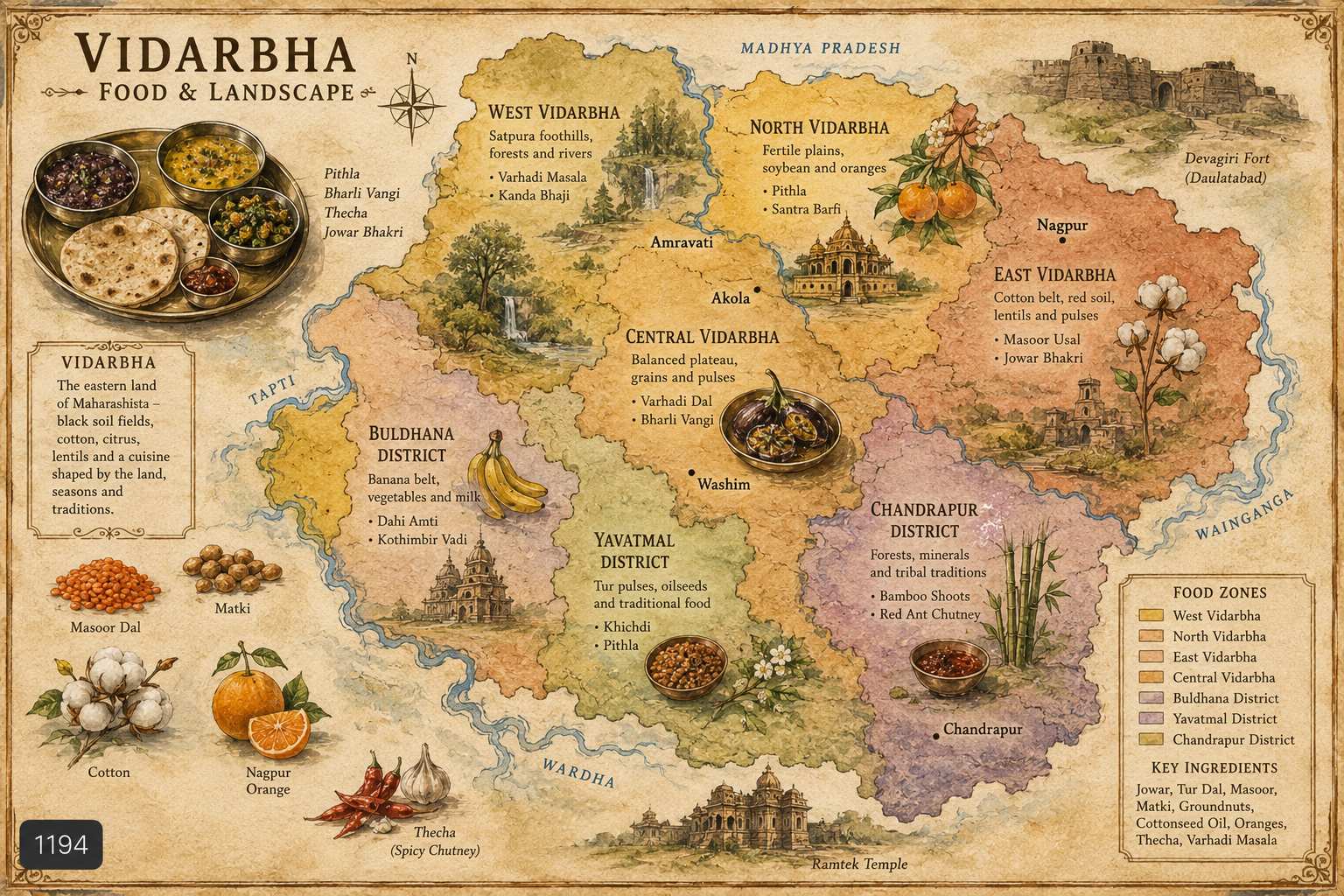
Vidarbha is eastern Maharashtra — the Nagpur-Amravati-Wardha cotton belt, geographically and culturally distinct from the coastal Konkan and the Pune-centric western Deccan. The region sits on the Deccan plateau at 300–500 metres, in a semi-arid climate dominated by cotton cultivation, where the Arabian Sea's monsoon arrives late and weakened. The distance from the coast is not just physical but culinary: Vidarbha is Maharashtra without coconut milk gravies, without fresh coconut, without Arabian Sea fish as daily protein. What remains is a distinctly interior food culture.
The Vidarbha landscape shares borders with Andhra Pradesh to the south, Madhya Pradesh to the north, and Chhattisgarh to the east — and the food tradition reflects these borders more than it reflects the coastal Maharashtra identity that dominates the state's culinary reputation. The chilli heat of Andhra cuisine crosses the border in both the spice philosophy and in the specific chilli varieties grown in Vidarbha's southern districts. The wheat-dominant grain tradition of MP and Chhattisgarh influences the bread tradition. The result is a food that sits at the intersection of multiple regional identities while claiming its own.
Nagpur is Vidarbha's cultural and commercial capital — known nationally for its navel oranges, for its position at the geographic centre of India (the zero mile marker of the Indian road network is here), and for the Saoji community's specific meat-cooking tradition that is the most intensely spiced food in Maharashtra outside Kolhapur. Nagpur Saoji cooking is Vidarbha's most celebrated culinary export — the rest of Vidarbha's food culture is less nationally known, which is the meaning of the region's unofficial designation as "Maharashtra's forgotten interior."
Location and regional context of Vidarbha within its parent state.
📜
Historical Origins
How this cuisine became distinct from its parent
Vidarbha's food identity is shaped primarily by three absences: no Arabian Sea fish as a daily protein source; no fresh coconut in abundance; and no coastal monsoon that produces the lush green produce of the Konkan. In place of these coastal elements, Vidarbha cooking uses peanuts (groundnuts) as the primary enriching agent — the dry-land crop that grows where coconut does not. Peanuts appear ground into gravies, whole in tempering, in the chutney tradition, and as the fat base for cooking in the poorest preparations (peanut oil as the default where ghee or coconut oil is too expensive).
The Nagpur Saoji community developed the most intensely spiced cooking tradition in Maharashtra — a masala of specific composition (black pepper, cloves, cinnamon, star anise, and multiple other whole spices) applied to mutton and chicken at proportions that produce genuine heat. The Saoji tradition was documented and celebrated locally but largely unknown outside Nagpur until the late 20th century. It now has a national restaurant presence through Mumbai Saoji establishments that serve the Vidarbha diaspora.
The peanut-chilli-sesame cooking vocabulary of Vidarbha reflects the agricultural reality of the cotton belt: these three crops grow in semi-arid conditions where rice and coconut require irrigation that is not available. The cuisine built itself from what the land reliably provided — cotton for cash, peanut for protein fat, jowar and bajra for staple grain, and chilli for flavour. The result is a food tradition with its own logic rather than a lesser version of coastal Maharashtra.
Nagpur Saoji — The Spice Level Nobody Prepared For
Nagpur Saoji cuisine uses a masala with more than 20 spices in proportions that produce a heat level unusual in Maharashtra. The Saoji community — traditionally butchers and meat traders — developed their masala as a commercial identity marker: restaurants claiming authentic Saoji cooking differentiated themselves through spice intensity. The Saoji masala's combination of black pepper, cloves, and high-proportion dried red chilli produces a heat that sits differently from the Kolhapuri kala masala — more aromatic-hot, less smoky. Nagpur Saoji mutton is now considered one of Maharashtra's boldest meat preparations alongside Kolhapuri tambda rassa.
🧬
Food DNA
The flavour architecture
The Dry Land Proteins
Mutton — the prestige meat in Vidarbha — goat from the semi-arid scrubland
Chicken — the everyday meat preparation
Freshwater fish — from the Wardha, Wainganga rivers — not the Arabian Sea fish of coastal Maharashtra
The Dry Land Crops
Peanuts (groundnuts) — the coastal coconut substitute — in gravies, tempering, chutneys
Jowar (sorghum) — the primary dry-land grain — bhakri as the staple bread
Sesame seeds — in chutneys and as a cooking enrichment
Nagpur Specifics
Oranges — the Nagpur identity crop — both fresh and in cooking contexts
Saoji masala — the intensely spiced meat tradition specific to Nagpur community
Tarri poha — the Nagpur version of beaten rice with spiced chickpea curry
Pulses (tur dal, chana) — the Andhra-MP border lentil tradition
Sesame chutneys — more common in Vidarbha than in western Maharashtra
🌿
Signature Ingredients
The ingredients that define this cuisine
Ingredient
What It Is
Flavour Character
Availability
Peanuts (groundnuts)
Arachis hypogaea — the dry-land crop and coastal coconut substitute
Rich, nutty, oil-bearing — provides the enrichment and fat in gravies where coconut is unavailable
Grown in Vidarbha and throughout Maharashtra; the interior's default enriching agent
Saoji masala
Nagpur community spice blend — 20+ spices including black pepper, cloves, star anise, chilli
Aromatic-hot, complex — more aromatic than Kolhapuri kala masala, similarly intense in heat
Available from Nagpur Saoji vendors; the home-made version differs significantly from commercial
Jowar (sorghum) bhakri
Thick sorghum flatbread — the staple semi-arid bread of both Vidarbha and Kolhapur
Nutty, dense, sustaining — more nutritious than refined wheat; pairs with the bold dry-land preparations
Grown throughout the semi-arid interior; the bhakri is the default bread over rice in Vidarbha
Nagpur orange (Santra)
Citrus reticulata — the navel orange variety for which Nagpur is the national brand
Sweet-tart, slightly thin peel, easy to separate segments — the orange of Indian commercial produce
Grown specifically in Nagpur's agricultural belt; the national market leader in the orange category
🍽
Signature Dishes
The dishes that cannot exist elsewhere
Dish
What It Is
Why It Matters
Nagpur Saoji Mutton
Mutton in Saoji masala — Maharashtra's second-boldest meat preparation after Kolhapuri
The Saoji masala's combination of aromatic spices and chilli produces a preparation that is simultaneously complex and hot — different in character from Kolhapuri which is smoky-hot, but equally intense.
Tarri Poha
Beaten rice with spiced chickpea curry (tarri) — the Nagpur breakfast preparation
The Nagpur tarri poha is distinct from the Pune and Mumbai versions: it includes a specifically spiced chickpea curry alongside the poha, creating a more complete breakfast preparation than the standard Maharashtra poha-alone.
Wherever coastal Maharashtra uses fresh coconut chutney, Vidarbha uses peanut. The dry-roasted peanut ground with dried chilli, garlic, and tamarind produces a chutney with entirely different but equally functional character.
Saoji Chicken
Chicken in the Saoji masala variant — the poultry application of the intensely spiced tradition
Less famous than Saoji mutton but equally spiced. The chicken version achieves faster penetration of the bold masala and is the everyday Nagpur Saoji preparation.
Jowar Bhakri with Dal-Bhat
Sorghum flatbread with dal and rice — the Vidarbha daily meal
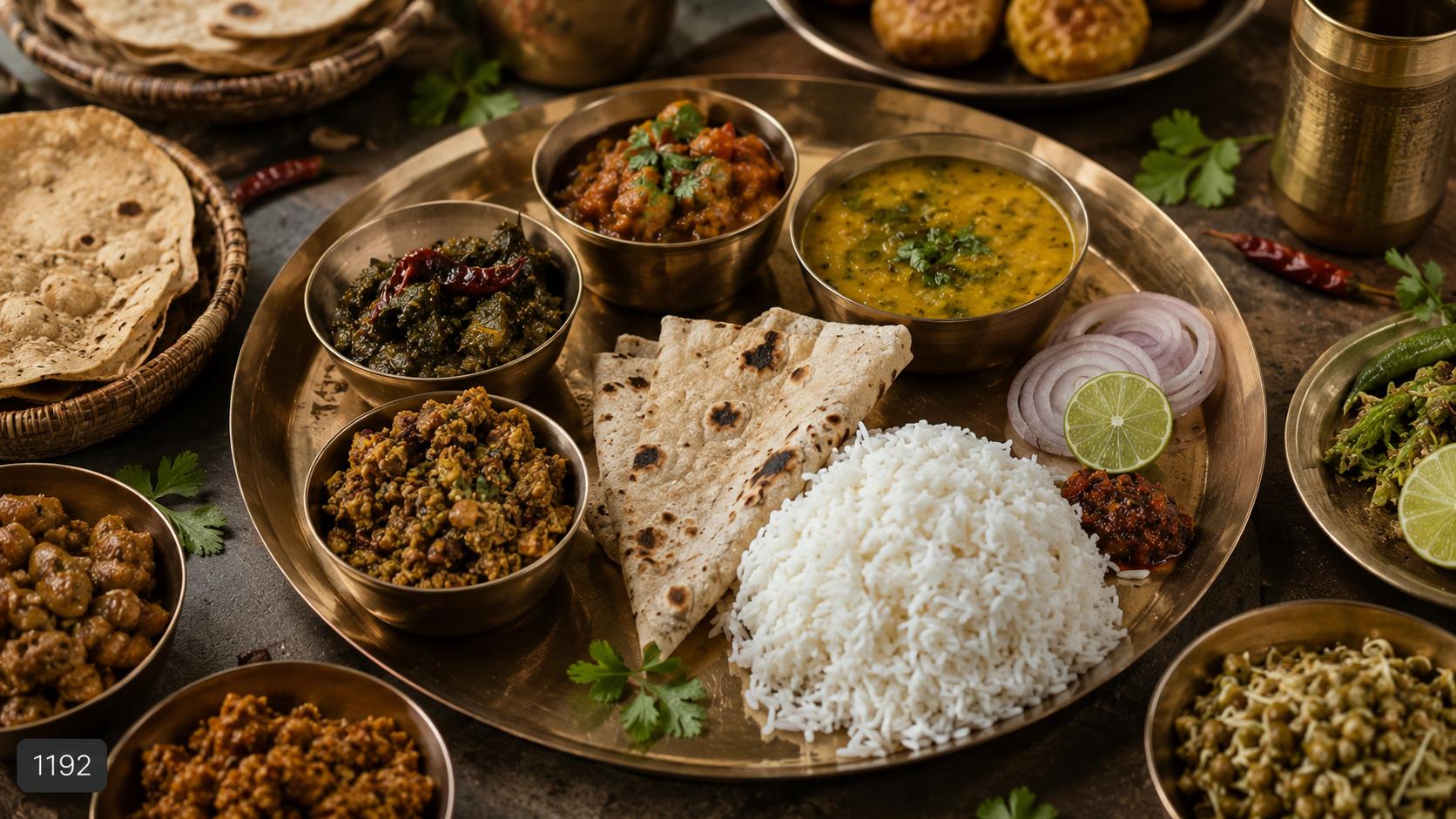
The basic Vidarbha meal is not rice-centric like coastal Maharashtra but grain-diverse: jowar bhakri alongside rice, with dal as the central protein. The bhakri provides complex carbohydrate; the dal provides protein; rice is present but not dominant.
The defining preparations of Vidarbha.
⚙️
Unique Techniques
What this cuisine does that others do not
The Saoji masala preparation differs from Kolhapuri kala masala in one fundamental way: the roasting is not taken to the same extreme darkness. Saoji masala roasts its spices to a medium-dark rather than very dark — which produces a more aromatic, less smoky result. The proportion of whole aromatic spices (cloves, cardamom, star anise, cinnamon) is higher in Saoji masala than in kala masala, giving the finished preparation a complexity that sits differently from Kolhapuri's smoke-and-heat profile. The heat levels are comparable; the flavour architecture is different.
The peanut enrichment technique is Vidarbha's most distinctive cooking process. Where coastal Maharashtra adds coconut milk to gravies for richness, Vidarbha cooking adds a ground peanut paste — dry-roasted peanuts ground to a smooth paste with minimal water. This paste is added to curries after the main spice-building stage and before the final liquid addition. The peanut dissolves into the gravy, providing fat and thickness without the coconut flavour. The result is a richer, nutty gravy of different character from coconut-enriched preparations — useful where coconut is unavailable, valuable in its own right where it is available.
The jowar bhakri technique in Vidarbha follows the same principle as in Kolhapur but with a slightly different grain character — different jowar varieties grown in different soil conditions produce bhakri with slightly different flavour profiles. The bhakri is pressed by hand directly onto a hot tawa — no rolling pin, since jowar flour lacks the gluten that allows rolling without tearing. The hand-pressing technique requires working quickly before the dough cools, using wet hands to press outward from the centre in a circular motion until the bhakri is the right thickness.
The Zero Mile Stone and Vidarbha's Geographic Centrality
Nagpur contains the Zero Mile Stone — the point from which all road distances in India were historically measured, making it the geographic centre of India. This central position is also a culinary position: Nagpur sits at the intersection of South Indian (Andhra), North Indian (MP), and Maharashtrian influences, and its food reflects all three without fully belonging to any. The Saoji masala's complexity may be partly attributable to this intersection — a spice tradition that absorbed influences from three directions and forged them into something that is unmistakably Nagpuri rather than a derivative of any of its neighbours.
🔗
Relationship to Parent Cuisine
How Vidarbha differs from Maharashtra
Element
Maharashtra
Vidarbha
Coastal dependence
Coconut milk, fresh coconut, Arabian Sea fish — coastal Maharashtra identity
None — peanuts substitute for coconut; freshwater river fish replace marine fish; no coast
Spice philosophy
Coastal masalas — goda masala for western Maharashtra
More chilli-forward and Andhra-influenced in the south; Saoji masala in Nagpur
Coastal Maharashtra (Mumbai, Goa) internationally known
Vidarbha largely unknown nationally — despite Nagpur Saoji being one of Maharashtra's boldest food traditions
📅
Timeline
How this cuisine evolved
Ancient period
Interior Deccan plateau food culture
Jowar, peanut, and sesame-based food culture of the semi-arid interior — without coastal influence.
Medieval period
Nagpur becomes Nagpur kingdom capital
The Nagpur sultanate and then Bhonsale Maratha kingdom establish the city. The Saoji community develops their distinctive meat-cooking tradition as professional butchers and traders.
19th century
Cotton economy transforms Vidarbha
The British establish Vidarbha as a cotton-producing zone. The commercial economy produces the middle-class city food culture — Nagpur poha, orange cultivation, and Saoji restaurants.
Present
Slow national recognition
Nagpur Saoji restaurants in Mumbai begin building national awareness. Tarri poha achieves recognition as one of India's distinctive regional breakfast preparations.
What makes Vidarbha food different from coastal Maharashtra?
Vidarbha has no coastal influence — no Arabian Sea fish, no fresh coconut, no coconut milk in gravies. Instead, peanuts substitute for coconut as the enriching agent; freshwater river fish replace marine fish; jowar bhakri competes with rice as the staple grain. The border with Andhra Pradesh also introduces a more chilli-forward philosophy than western Maharashtra.
What is Nagpur Saoji cuisine?
Nagpur Saoji cuisine is the intensely spiced meat cooking tradition of the Saoji community — historically butchers and meat traders in Nagpur. The Saoji masala contains 20+ spices including black pepper, cloves, star anise, and high-proportion dried red chilli. Nagpur Saoji mutton is one of Maharashtra's boldest meat preparations, comparable in intensity to Kolhapuri tambda rassa but with a more aromatic spice character.