The Western Himalayas — altitude from 350 to 6,975 metres producing the most extreme food geography in India. Dham (the ceremonial feast of Himachal), locally foraged ingredients, and the specific preparations of a culture adapted to mountain winters.
⏱ 12 min read🗓 Updated June 2026★ State Food Guide
State Food Guide
Himachal Pradesh — The Mountain Kitchen
Himachal Pradesh rises from the Shivalik foothills at 350m to the high Himalayan peaks at nearly 7,000m — one of the most extreme altitude ranges of any Indian state. This altitude gradient produces entirely different food cultures at different elevations: apple orchards and wheat cultivation in the mid-hills; rice and subtropical produce in the foothills; the ancient grain traditions of barley and buckwheat at high altitude.
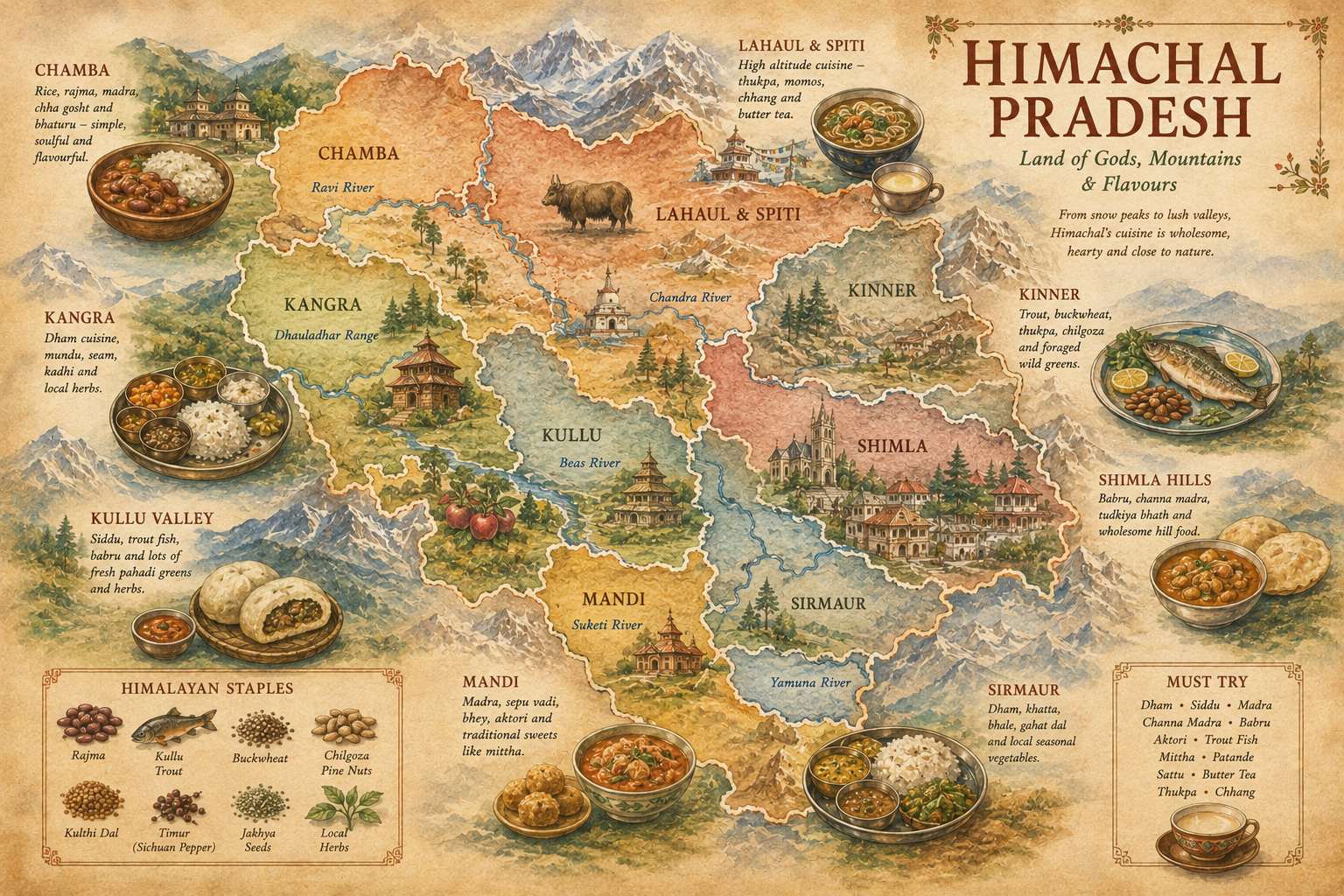
The geographic regions and food zones of Himachal Pradesh Food Guide.
🗺
Geography & Climate
The land that made this food inevitable
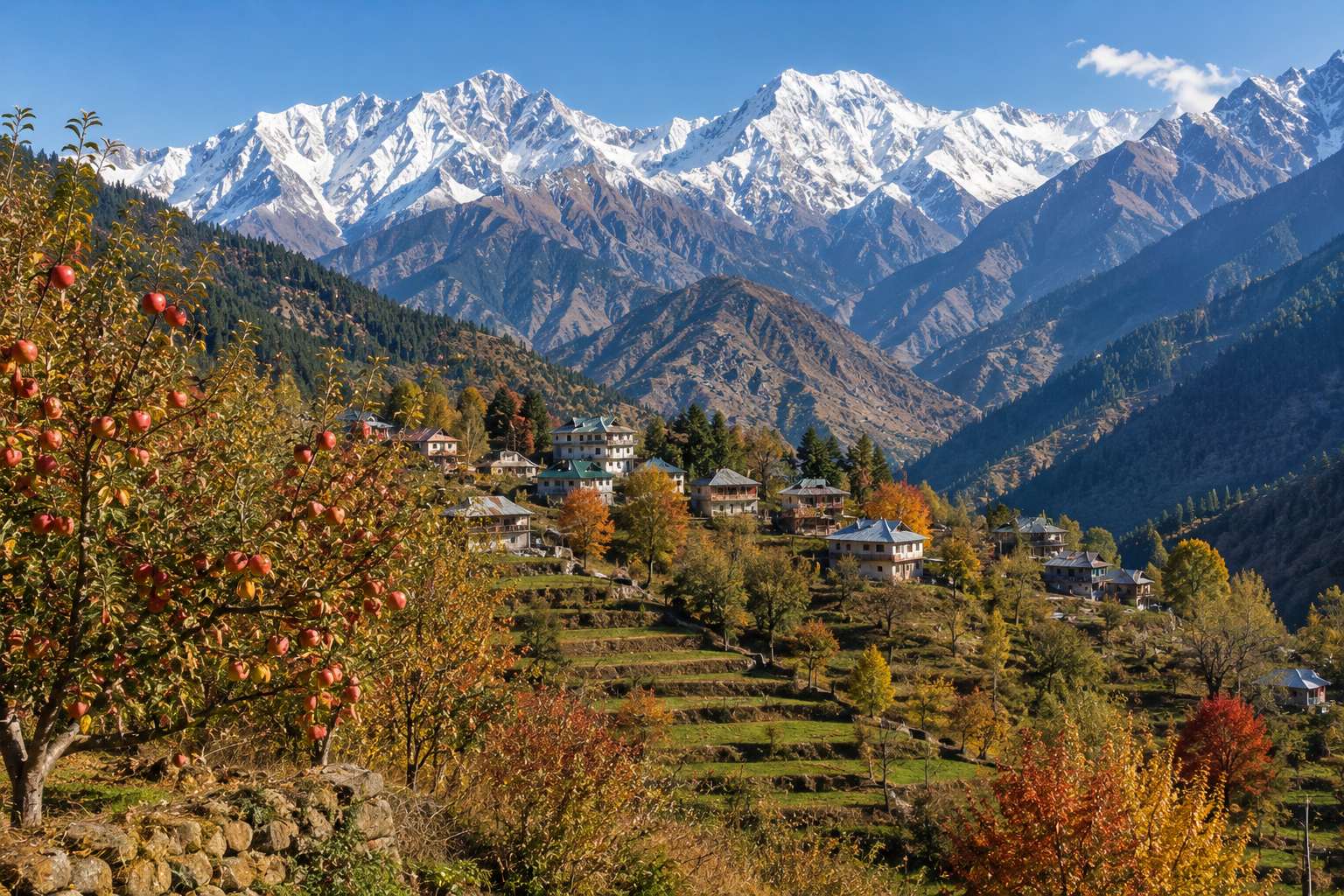
The mountain ecology of Himachal Pradesh determines its food with a directness that few other Indian states experience. At high altitude (above 2,500m), wheat does not grow; rice does not grow; the growing season is compressed to 4-5 months. What grows is barley, buckwheat, and specific cold-tolerant vegetables. The food cultures of Spiti, Kinnaur, and Lahul-Spiti are essentially mountain peasant cuisines built from what the altitude permits.
The Dham is Himachal Pradesh's defining food occasion — a ceremonial feast prepared by Brahmin cooks (Botis) for community occasions including weddings, festivals, and religious events. The Dham is cooked in large brass vessels (tambis) and served on leaf plates. The menu is fixed: madra (yoghurt-braised chickpeas or kidney beans), khatta (sour preparation with tamarind and jaggery), and rice. The Boti cooks who prepare Dham are hereditary specialists whose craft is passed from father to son — the most specific culinary profession in the mountain region.
Lingri — the fiddlehead fern that grows wild in the forests of Himachal Pradesh in spring — is the most specifically Himachal ingredient. Foraged from the forest floor as the spring thaw begins, lingri is made into a sabzi (vegetable preparation) that is the most iconic Himachal foraged food. It has no cultivation; it is only available for a few weeks in spring; and it cannot be found outside the specific forest ecology of the mid-Himalayan zone.
Dham — The Feast That Cannot Be Rushed
The Himachal Dham is prepared exclusively by Botis — a hereditary community of Brahmin feast cooks whose craft is the preparation of the Dham menu. The cooking begins the night before the feast, the preparations slow-cooked in brass tambis over wood fires. The specific Dham menu (madra, khatta, rice) cannot be varied — substituting ingredients or preparations breaks the Dham tradition. The Dham is not just a meal; it is a community ritual in which the specific food, the specific cooks, and the specific sequence are all essential elements. A wedding Dham prepared by non-Botis or with a modified menu would be considered a social failure by the community.
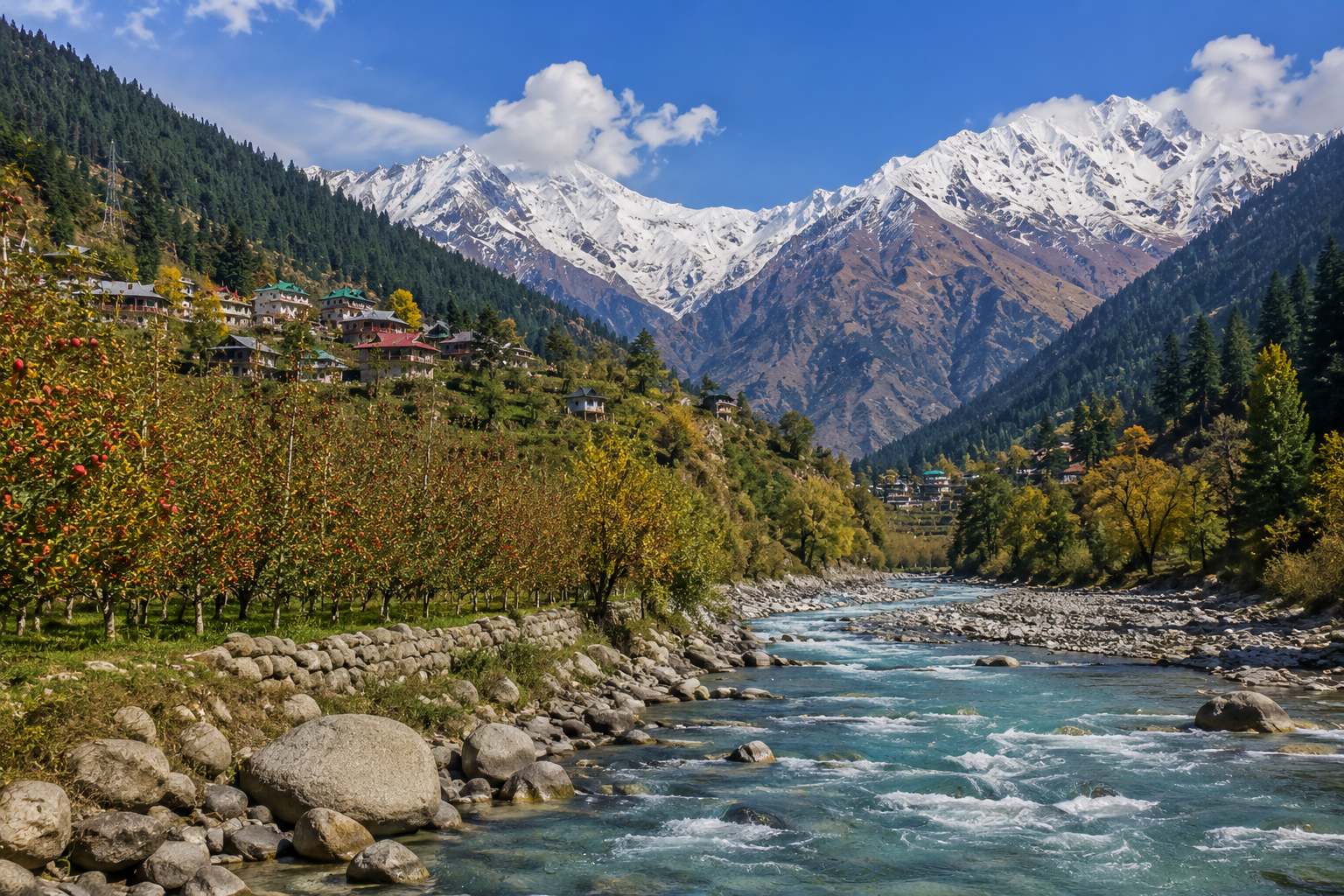
The terrain and agricultural landscape that produces the defining ingredients.
🧬
Food DNA
The flavour architecture
Grains
Rice (lower altitudes) — the prestige grain of the valley regions
Barley (high altitude) — the cold-tolerant grain of Spiti, Kinnaur, Lahul
Buckwheat — in high Himalayan zones — phulka (pancake) and specific preparations
Legumes
Rajma (kidney beans) — the most important Himachal protein — in madra and independent preparations
Chana dal (chickpea) — in madra — the Dham preparation
Black sesame — in specific Himachal preparations
Foraged and Seasonal
Lingri (fiddlehead fern) — spring-foraged wild fern — the most Himachal-specific ingredient
Wild mushrooms — from the pine and cedar forests
Rhododendron flowers — in chutney and juice — the high-altitude flower
Dairy
Ghee (from local cattle) — the primary fat — mountain cattle produce specific ghee character
Lassi — the daily drink — churned from the local dairy
Chhach (buttermilk) — the summer cooling drink of the mountain valleys
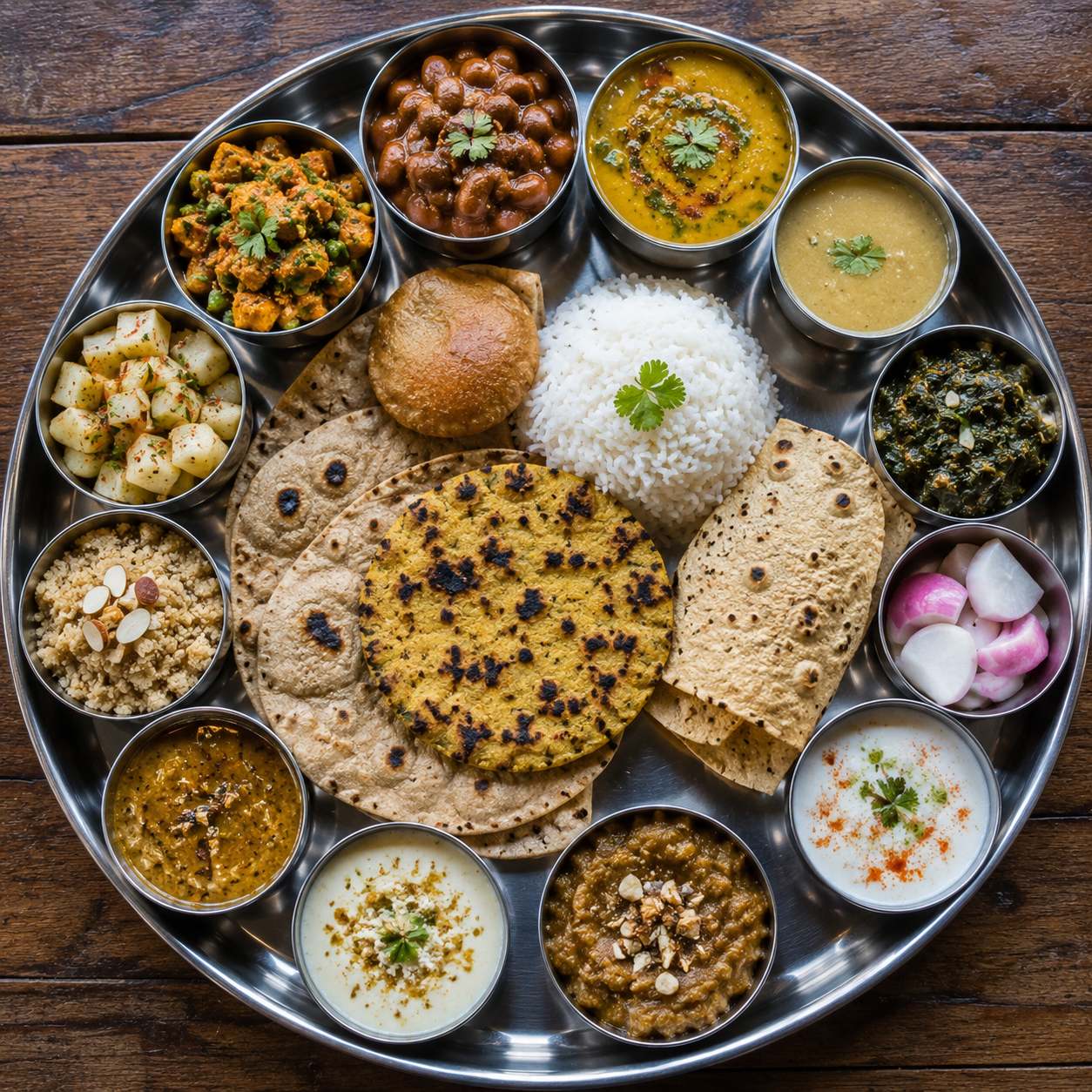
A complete thali representing the full flavour range.
🎉
Festival Foods
When the calendar drives the kitchen
Diwali (Deepavali)
Siddu (stuffed bread steamed over water) and Mittha (sweet rice) — Himachal's Diwali food tradition distinct from North Indian standard.
Minjar
The Chamba festival — specific Himachal food traditions of the Chamba valley.
Shivratri (Mandi)
The Kullu-Mandi Shivratri fair — one of the largest in India, with specific festival food traditions.
Kullu Dussehra
The Kullu Dussehra festival food — mountain festival preparations specific to the Kullu valley.
Lohri
Punjabi-influenced Lohri in the lower elevations — revdi, gajak, and specific Himachal additions.
🌍
Diaspora & Reach
How this cuisine spread beyond its borders
Himachal Pradesh's apple industry — one of India's most productive, centred on Shimla, Kullu, and Kinnaur — has made HP apples a nationally distributed product. The apple industry has also attracted domestic tourism that is beginning to generate food tourism interest in the Dham tradition and local cuisine.
The high-altitude food traditions of Spiti and Kinnaur are increasingly attracting gourmet and food-anthropology interest as extreme ecology food cultures globally. The lingri sabzi and the Dham preparation have begun appearing in discussions of hyperlocal Indian food.
Dham is the ceremonial feast of Himachal Pradesh — prepared exclusively by Boti cooks (hereditary Brahmin feast specialists) in brass tambis over wood fires. The menu is fixed: madra (yoghurt-braised chickpeas or kidney beans), khatta (sour preparation), and rice. Prepared for weddings and community occasions. The specific food, the specific cooks, and the specific sequence are all essential to the Dham tradition.
What is lingri?
Lingri is the fiddlehead fern (Diplazium esculentum) that grows wild in Himachal Pradesh's forests in spring. Foraged from the forest floor as the snow recedes, it is made into a sabzi that is the most specifically Himachal foraged food preparation. Available for only a few weeks in spring; impossible to cultivate or find outside the specific forest ecology.