The world's wealthiest individual (the 7th Nizam) ran the most elaborate court kitchen in India. When the court dispersed in 1948, the cooks opened restaurants. The biryani, the haleem, the Irani cafe — the Nizam's table is still serving.
⏱ 13 min read🗓 Updated June 2026★ City Food Guide
City Food Guide
Hyderabad — The Nizam's Table, Still Open
Hyderabad's food culture is a direct inheritance from the Nizam's court — the 36-course banquet tradition of the most elaborate court kitchen in India, dispersed into the restaurant culture when the state was integrated into India in 1948. The specific Hyderabadi biryani, the haleem that became a Ramadan institution, and the Irani cafes brought by Persian migrants to the Nizam's employment are all still operating in recognisable form.
Most commercially successful biryani internationally
Haleem
Ramadan's defining preparation
Irani cafes
A century-old Persian-Hyderabadi tradition
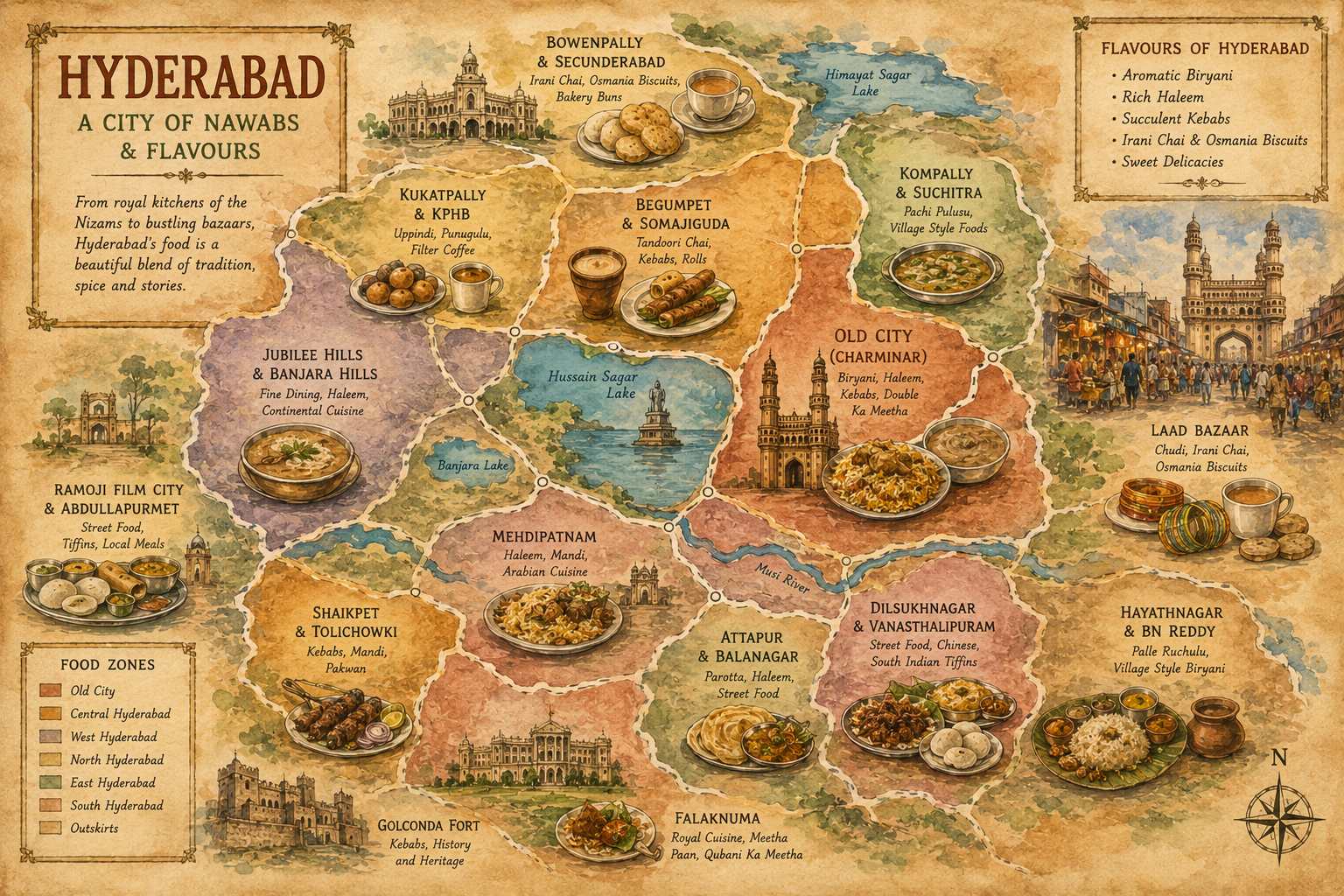
The food neighbourhoods and defining streets.
🏙
City Food Identity
What this city defines itself by
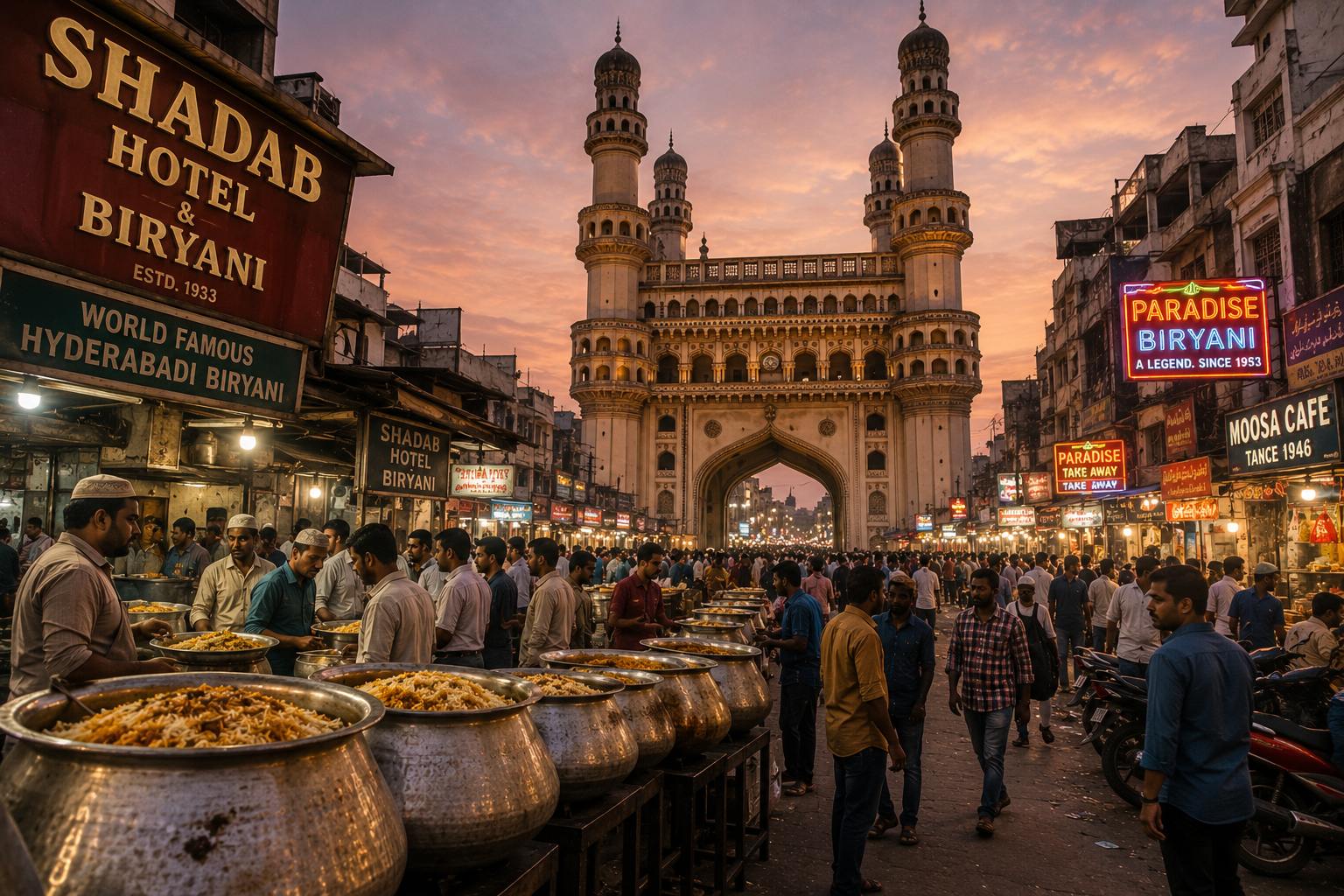
The Hyderabadi biryani is now arguably the most commercially successful biryani format internationally — the kachchi method (raw marinated meat cooked simultaneously with rice under dum), the specific Hyderabadi masala (which includes kalpasi, stone flower, and other specific ingredients), and the Basmati rice combination are widely recognised globally. The specific colour (from saffron and fried onions) and the specific proportion of meat to rice (more meat than most biryanis) are the visual and gustative signatures of the Hyderabadi format.
Paradise Restaurant and the Commercialisation of Court Food
Paradise Restaurant in Secunderabad, established in 1953 by Mohammad Maqdoom (a former royal court cook), was among the first restaurants to commercialise the court biryani tradition. The format — kachchi dum biryani, served in specific quantities, with mirchi ka salan and raita — became the template for Hyderabadi biryani restaurants nationally and internationally. Paradise did not invent Hyderabadi biryani — the Nizam's court did. But Paradise systematised it for commercial service and established the format that 10,000 restaurants now replicate.
The defining street food culture.
🥘
Street Food
The preparations you eat standing up
Hyderabadi Biryani (kachchi)
Raw marinated mutton cooked simultaneously with rice under dum. The most internationally recognised biryani format.
Haleem
Wheat, lentil, and meat slow-cooked 6-8 hours until broken down smooth. The Ramadan preparation that draws queues.
Irani Chai
Strong tea in small glasses at century-old Irani cafes — served with Osmania biscuit.
Lukhmi
Flat square meat-filled pastry — the Hyderabadi non-triangular samosa variant with its own name.
Mirchi ka Salan
Green chilli curry in peanut-sesame-coconut sauce — the traditional biryani accompaniment.
Qubani ka Meetha
Apricot dessert from the court kitchen — dried apricots in sugar syrup with cream.
🍽
Restaurant Culture
How this city eats out
Hyderabad's restaurant culture is divided between the old Irani cafes and biryani restaurants of the old city and the new technology-economy restaurants of HITEC City. The old city (Charminar area) contains the most historically continuous restaurant food in Hyderabad; the HITEC City area reflects the city's transformation into India's second technology hub.
🌍
Diaspora
How this city's food travelled
The Hyderabadi diaspora in the Gulf (particularly in Dubai and Riyadh), the US (particularly in New Jersey and Houston), and the UK has taken the Hyderabadi biryani format internationally. The biryani is now the most commercially available Indian rice preparation internationally.
Hyderabadi biryani uses the kachchi method — raw marinated meat (not pre-cooked) layered with partially cooked rice and sealed under dum. The meat's raw juices permeate the rice during cooking. The specific Hyderabadi masala (including kalpasi, stone flower) and the saffron and fried onion finishing produce the specific colour and flavour profile that distinguishes it from all other biryani formats.
What is haleem?
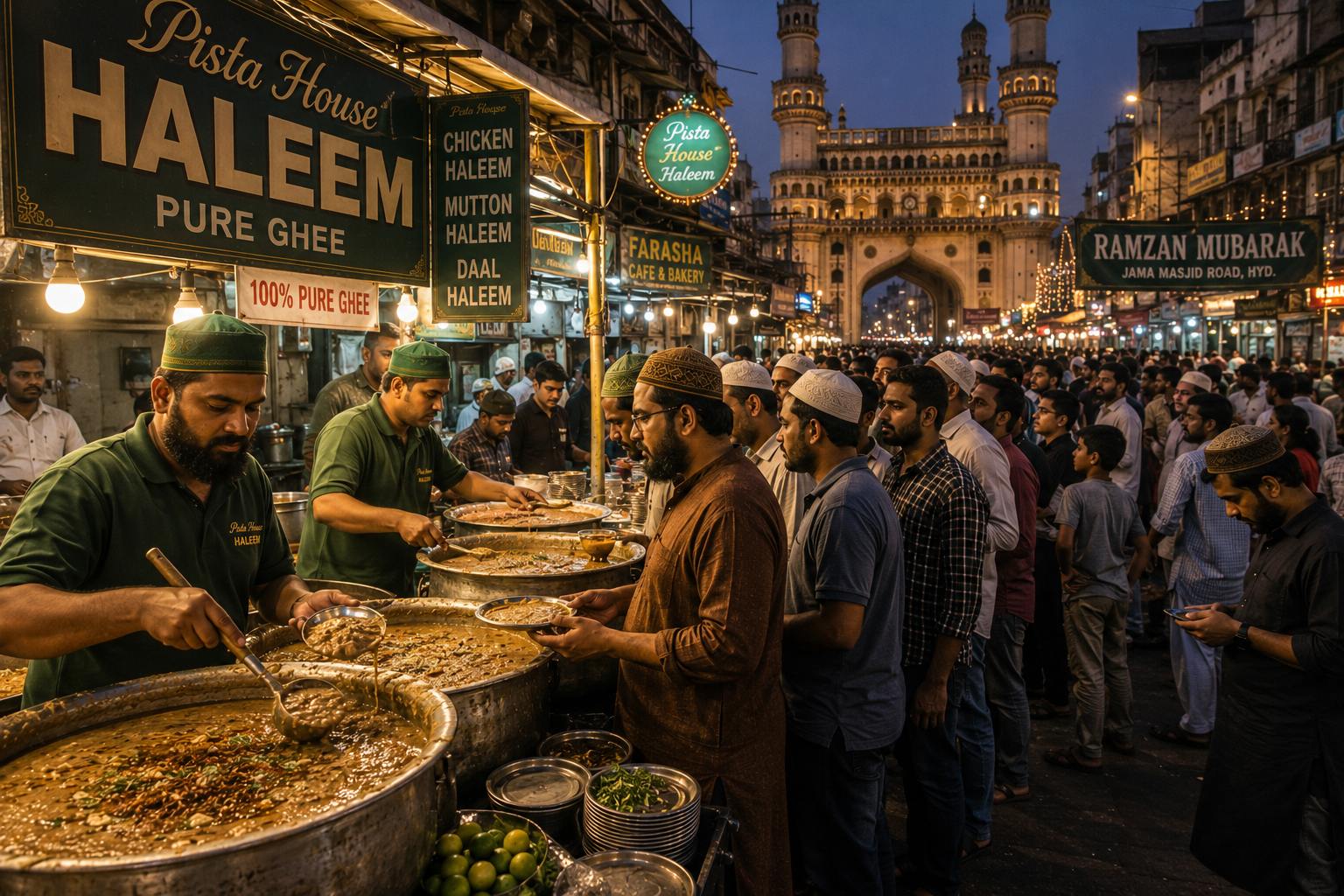
Haleem is wheat, lentils, and meat (usually mutton or beef) slow-cooked together for 6-8 hours until broken down into a smooth, porridge-like consistency. It originated in Arab military tradition (brought to Hyderabad by the Nizam's Arab soldiers) and was adapted to Hyderabadi spicing. It is the defining Ramadan food in Hyderabad — specific establishments serve haleem throughout Ramadan with queues forming from before opening.