Filter coffee at dawn in a steel tumbler. Idli with sambar at 7am. Chettinad lunch at a specific restaurant on Anna Salai. Chennai is the city most committed to its own food culture — resistant to national trends in ways that are specifically Tamil.
⏱ 12 min read🗓 Updated June 2026★ City Food Guide
City Food Guide
Chennai — The Filter Coffee Capital
Chennai (formerly Madras) was the capital of the Madras Presidency under British rule — a cosmopolitan port city that developed a specific food culture combining the deep Tamil Brahmin vegetarian tradition, the Chettinad non-vegetarian tradition, and the specific Andhra influence from the large Telugu-speaking community. The filter coffee culture — so specific to South India that no other preparation adequately substitutes — defines the city's daily rhythm.
The ancient neighbourhood that is also a food destination
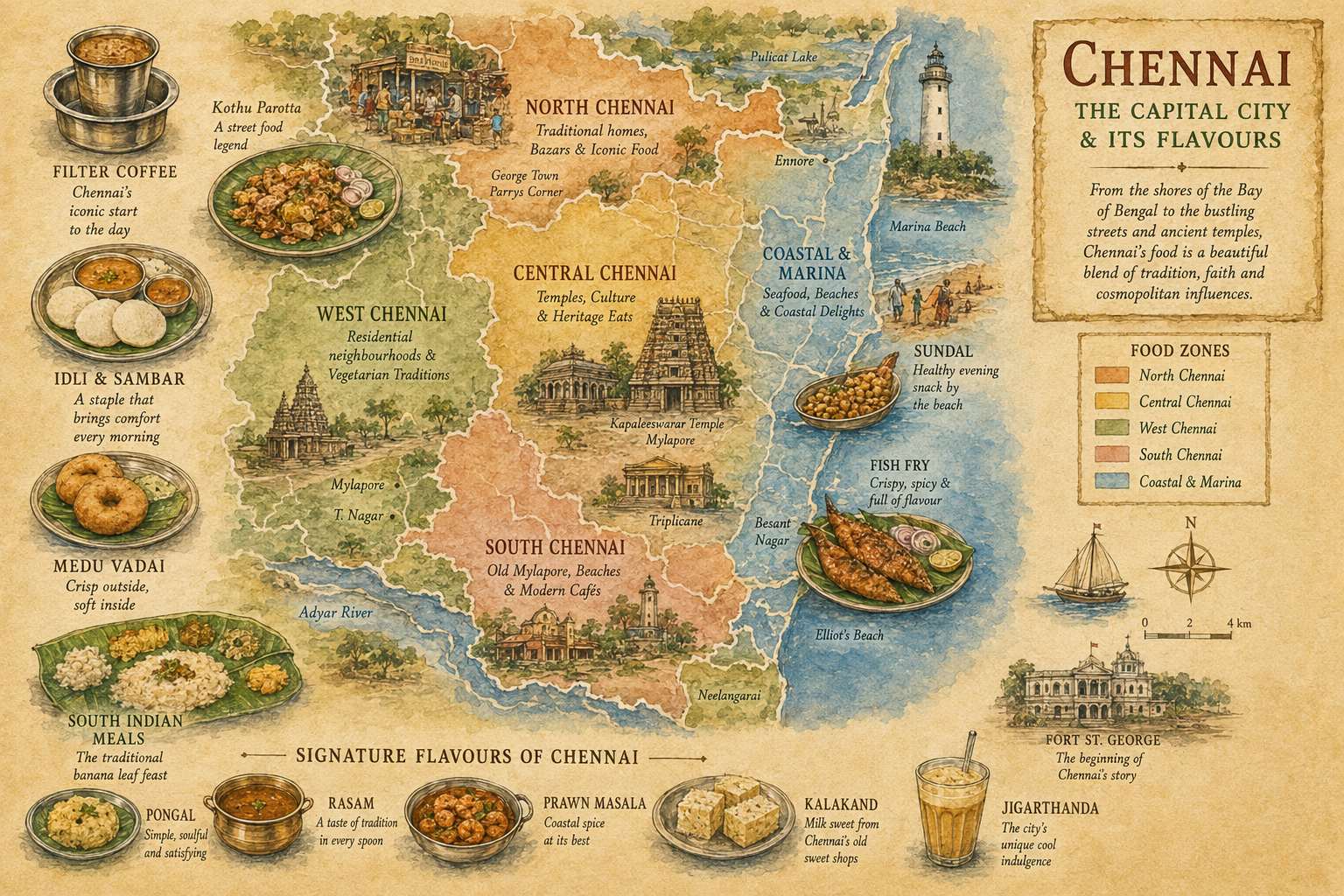
The food neighbourhoods and defining streets.
🏙
City Food Identity
What this city defines itself by
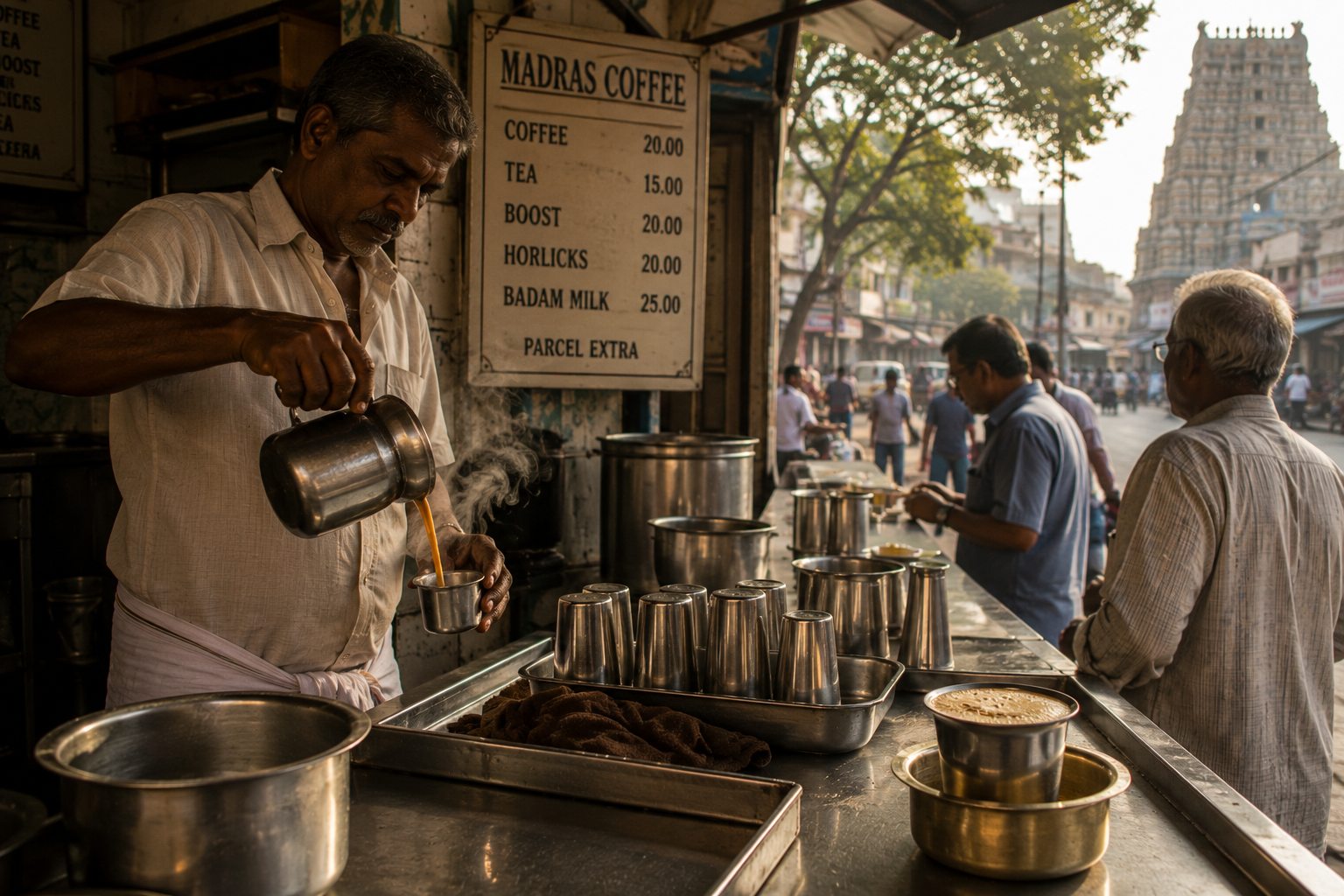
The South Indian filter coffee is not a method of brewing coffee — it is a specific tradition. A stainless steel filter with finely ground coffee (and chicory, in the South Indian tradition) produces a concentrated decoction over 15-20 minutes. This decoction is mixed with hot milk in a specific ratio in a davara (deep tumbler) and tumbler (shallower), then cooled by pouring between the two vessels from a height. The aeration that results from this pouring — which the Tamils call 'pulling' the coffee — produces the froth that is the South Indian coffee's visual and textural signature.
Why Chennai Resisted the Cafe Culture
While Bengaluru became the Indian city most associated with the global coffee shop format (Starbucks, Blue Tokai, and hundreds of independent cafes), Chennai largely maintained its filter coffee culture. The filter coffee from Saravana Bhavan or Murugan Idli Shop — in a steel tumbler, with chicory, for ₹20 — is considered by Chennai's food public to be superior to anything a cafe can produce. This resistance is not nostalgia — it is a genuine quality judgement. The specific character of filter coffee with chicory is not replicable from espresso or pour-over. Chennai's food culture knows what it has and does not need to be persuaded to want something different.
The defining street food culture.
🥘
Street Food
The preparations you eat standing up
Filter Coffee
Decoction with chicory, mixed hot milk, poured between tumblers to create froth. The non-negotiable Chennai morning.
Idli-Sambar
The benchmark — Chennai's idli is softer, whiter, more precisely fermented than most other versions.
Masala Dosa
The Chennai version differs from Bengaluru's — a more refined, less oily preparation.
Sundal on Marina Beach
Boiled chickpeas or black-eyed peas with coconut and chilli — the specific beach snack of India's longest beach.
Kothu Parotta
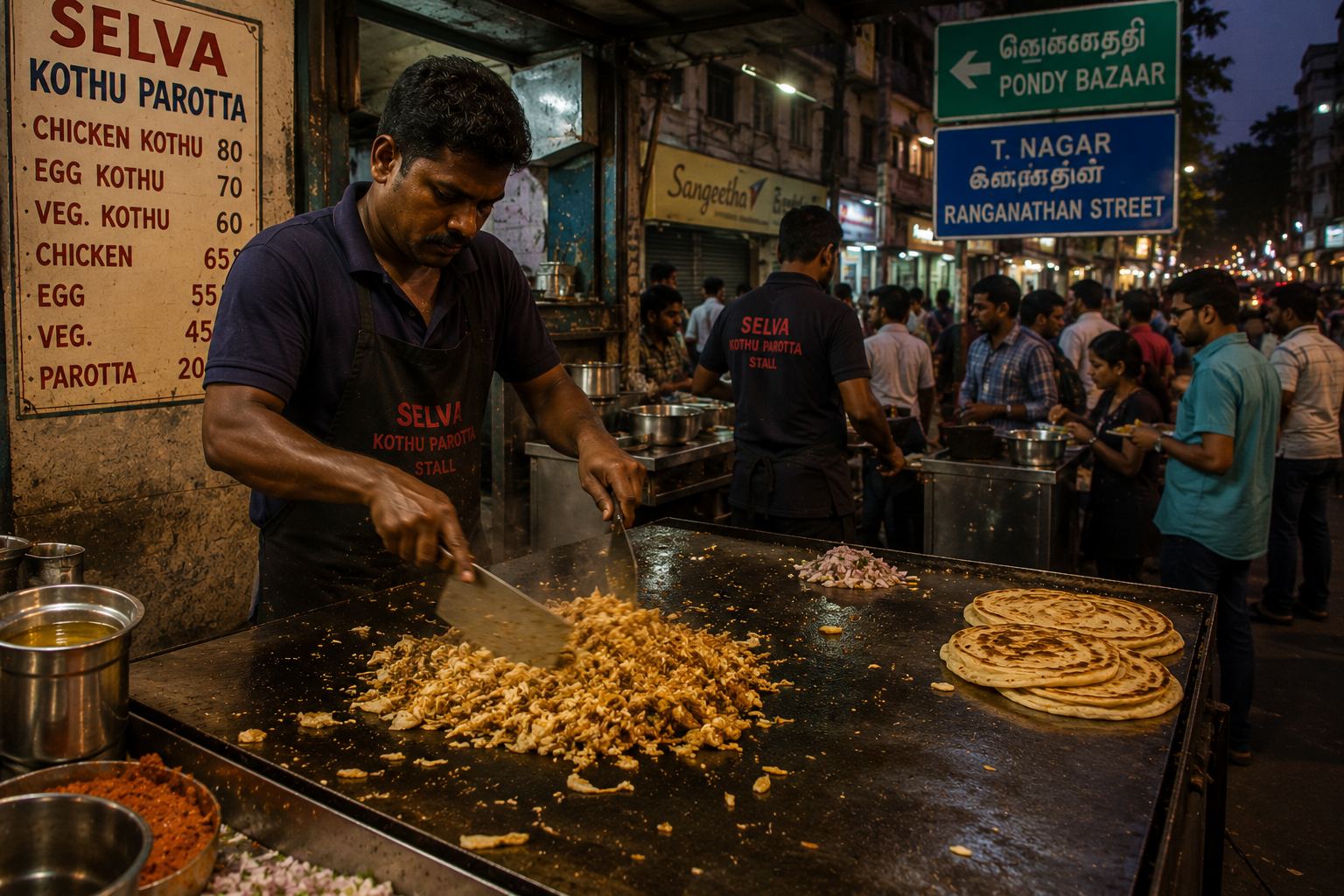
Shredded parotta stir-fried with egg, vegetable or meat — the non-Brahmin street food that defines Tamil street food at night.
Kuzhi Paniyaram
Rice and lentil dumplings in a specific paniyaram pan — the specific Tamil Nadu preparation for leftover dosa batter.
🍽
Restaurant Culture
How this city eats out
Chennai's restaurant culture is built around the brahmin mess (traditional vegetarian restaurant) and the non-Brahmin hotel tradition (which includes non-vegetarian preparations, particularly fish and egg). The Chettinad restaurant format — increasingly available in Chennai after originating in the Chettinad district — brings the most complex spice tradition in South India to the city.
🌍
Diaspora
How this city's food travelled
The Tamil diaspora — in Malaysia, Singapore, Sri Lanka, South Africa, and now North America — has maintained its food culture with unusual tenacity. The banana leaf rice restaurants of Kuala Lumpur and Singapore are direct descendants of the Chennai tradition and have maintained their food identity through 150+ years of diaspora.
What is filter coffee and why is it specific to Chennai?
South Indian filter coffee uses a stainless steel filter to produce a concentrated coffee decoction with chicory added to the ground coffee (for body and specific bitterness). The decoction is mixed with hot milk and aerated by pouring between a davara and tumbler from a height. The chicory, the steel vessels, and the pouring method all contribute to a specific character that no other coffee preparation replicates.
What is kothu parotta?
Kothu parotta is shredded parotta (layered flatbread) stir-fried on a hot griddle with egg, onion, tomato, and either vegetables or meat — using metal implements that create a distinctive chopping sound. It is the defining Tamil non-Brahmin street food eaten at night. The preparation's sound (the rhythmic clang of metal on griddle) is its announcement as much as its smell.